Careful What You Wish for Lyrics by Artist
Match careful what you wish for lyrics to the right artist, year, credits and meaning before you trust a single line.

Careful What You Wish For lyrics aren't one text. At least eight separate recordings carry that title or a close variant, and they sit far apart in every way that identifies a song: release year, album context, running time and the people who wrote them.
Gregg, Texas, Eminem, Jonatha Brooke, Bad Omens, Carly Gibert and Luke Combs each released a different song under that phrase, and Young Guns adds another. None is a cover of another. A search box still treats them as a single query, which is exactly why the search box is the worst place to start.
This page works the way a reference desk works. You identify the recording first, then you read its words. A country album cut, a pop rock single and a metalcore track can share four words on a title line and nothing else. The sections below sort the title into artists, dates, credits and lengths, so the line you eventually quote belongs to the song you heard.
Table of Contents
- Match the Recording Before You Read
- Writers and Producers on the Credited Cuts
- Era and Genre Shelves for the Title
- What the Best Known Versions Mean
- Lengths and Stream Counts That Confirm a Cut
- Related Pages and Titles That Are Not Covers
- Quick Checks Before You Quote a Line
- Open the Artist Approved Lyric Page
Match the Recording Before You Read
The title is the least specific fact in this whole catalog. Careful What You Wish For lyrics were released between 2001 and 2022 by different writers and different copyright owners across country, pop rock, hip hop, metalcore and singer-songwriter catalogs, so any page that files them under the phrase alone merges unrelated texts into one block. A title search works like a shelf sorted by cover color: everything with the same words lands together regardless of who wrote it.
The Jonatha Brooke lyric listing on Genius shows how much identity sits behind a single title. Brooke's version is listed as a 2007 release, with songwriting credited to Brooke, Eric Bazilian and J.C. Chasez and production credited to Brooke, Bob Clearmountain and Eric Bazilian. None of that transfers to a Texas single from 2003 or to a metalcore track from 2021.
Match the row before you read the words. Here is the working index.
| Artist | Year | Genre lane | Release context | What pins the row |
|---|---|---|---|---|
| Ricky Lynn Gregg | 2001 | Country | 17 April 2001, 10-track album | Album runs about 35 minutes |
| Texas | 2003 | Pop rock | Released 20 October 2003 | Single release, dated to the day |
| Eminem | 2006 | Hip hop | 2006 material, later tied to Relapse:Refill | Version label is the pin |
| Jonatha Brooke | 2007 | Singer-songwriter | 2007 release with shared writing and production credits | Full credit set is the pin |
| Young Guns | 2006 to 2022 span | Rock | Separate song, not a cover of the earlier titles | Band name is the pin |
| Bad Omens | 2021 | Metalcore | Released 23 July 2021 | 4:32 and more than 49 million plays |
| Carly Gibert | 2022 | Alternative | BE CAREFUL WHAT U WISH FOR, track 2 on the TABULA RASA EP, 11 November 2022 | Track position is the pin |
| Luke Combs | 2006 to 2022 span | Country | Indexed as Be Careful What You Wish For | Variant title spelling |
Read the last column as the fastest separator, not as a fixed measurement. Each row is pinned by whichever fact divides it from the rest: a runtime, an exact day, a credit set, a track number. Gregg's album shape and Bad Omens' 4:32 do the same job as the Texas single's day-level date or the track position on Carly Gibert's EP.
Spelling shifts do not rescue you. Carly Gibert's stylized BE CAREFUL WHAT U WISH FOR and Luke Combs' Be Careful What You Wish For still collide with the plain phrasing in a search index, because the index ranks the phrase before it ranks the artist name. Casing and punctuation are the first things a search engine ignores and the last things a reader double-checks.
For a lyrics library, the artist name, release year, album association and recording identity are the fields that prevent attribution and version errors. Drop any one of them and you end up with a caption carrying the right chorus and the wrong songwriter.
The matching rule: a title plus one artist plus one release year identifies a song. A title alone identifies a search query.
This section names the work and prints none of the words, because the words belong to whichever row you just chose. The same discipline pays off on any heavily reused phrase, and the provenance notes for And I Wonder apply the habit of picking a release before reading a line.
Writers and Producers on the Credited Cuts
Start with the one recording whose full credit set is documented. Jonatha Brooke's 2007 cut lists three songwriters, Brooke, Eric Bazilian and J.C. Chasez, and three production credits, Brooke, Bob Clearmountain and Eric Bazilian. That's a specific writing room, and it's a testable one.
Why does a producer credit matter when all you want is the lyric? Because Bob Clearmountain's side of the job is the mix, and a mix credit tells you which version of a performance you're reading about. When a song has a single edit, an album version and a later reissue, the production line is often the only thing on the page that separates them. Sites that strip credits down to the performer throw all of that away, then wonder why two versions of a lyric don't line up.
A lyric block that names Brooke alone, or that credits Eminem's camp to a Brooke title, cannot be Brooke's recording no matter how familiar the chorus looks. That's the whole point of listing writers on a song page rather than a performer tag.
Songs that are pinned by date instead
Most of the family here is identified by release facts rather than a writer list, which is normal for catalog data. Texas carries 20 October 2003. Ricky Lynn Gregg carries 17 April 2001 plus an album shape: 10 tracks, roughly 35 minutes. Eminem's entry is an era label, material dated 2006 that was later connected to his Relapse:Refill period. Bad Omens carries 23 July 2021 and a 4:32 running time. Carly Gibert carries sequence rather than streams, track 2 of TABULA RASA, out 11 November 2022.
| Recording | Identity if credits are missing |
|---|---|
| Jonatha Brooke, 2007 | Full credit set is the matcher |
| Texas | Release date 20 October 2003 |
| Ricky Lynn Gregg | 17 April 2001 on a 10-track album of about 35 minutes |
| Eminem | 2006 material later tied to Relapse Refill |
| Bad Omens | 23 July 2021 and a 4:32 track |
| Carly Gibert | Track 2 of TABULA RASA, 11 November 2022 |
Leave a credit cell blank rather than copying a name from a different row. A guessed writer feels helpful and reads as verified, which makes it worse than a gap a reader can see.
Keeping those fields apart is the entire job of metadata management in a lyrics library, and it's what stops a Brooke writing credit from landing on a Bad Omens page.
If the writer list doesn't match the artist row, stop and switch pages. Don't finish the paragraph.
Era and Genre Shelves for the Title
A title reused across two decades needs shelves. Genre tells a fan which audience a recording was pitched at. Year tells them which generation of writing, production and copyright they're looking at. Neither one implies a cover chain, and neither one ranks the songs by quality.
The sketch below lays out the timeline those shelves produce.
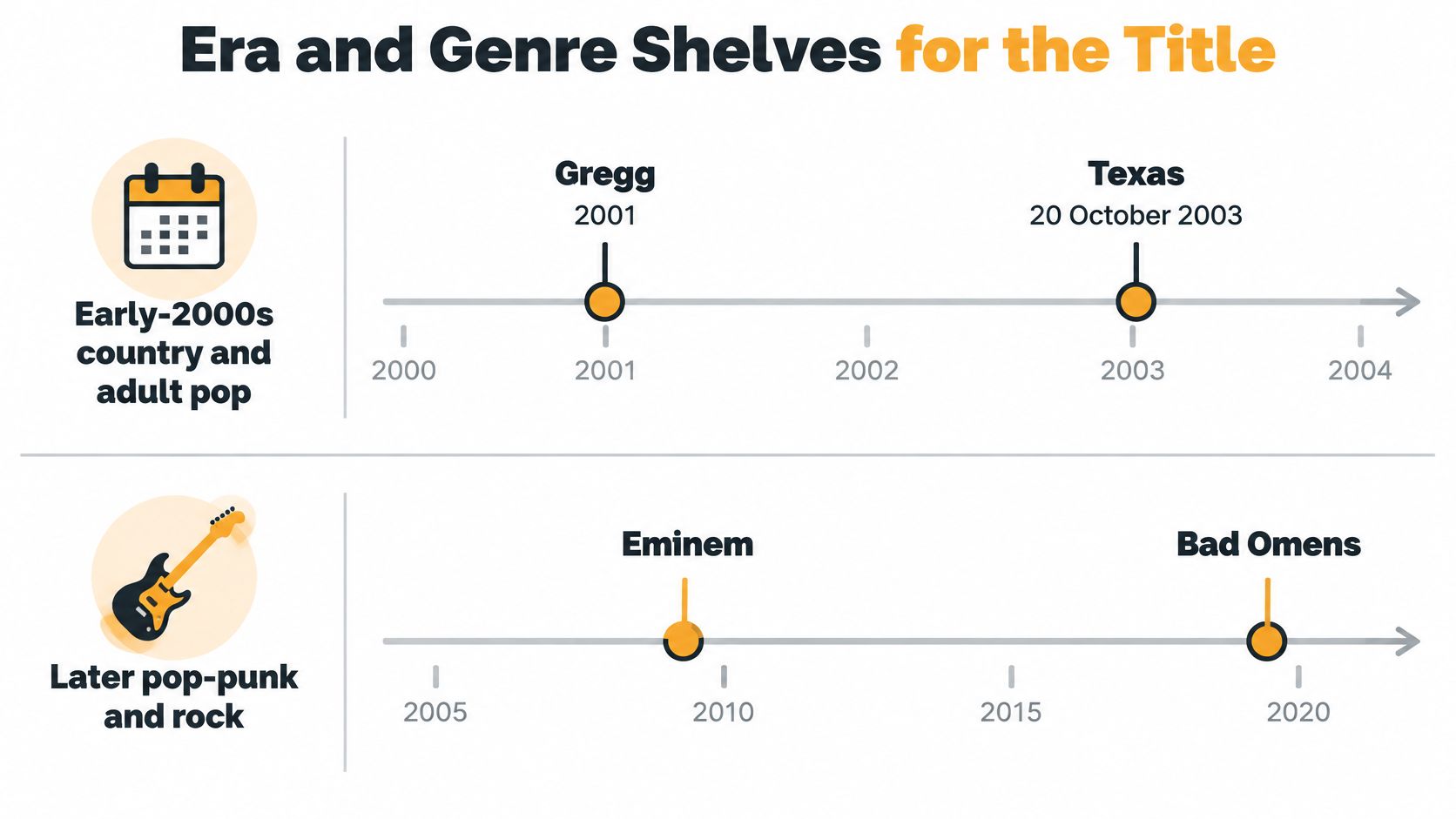
Country, pop and hip hop fill the first half
Ricky Lynn Gregg's 2001 country release opens the run, and Texas followed on 20 October 2003 in a pop rock lane, two years later and aimed at a different audience.
Crowding starts on the mid-2000s shelf. The Genius entry for Eminem's 2006 recording documents material dated 2006, built around the pressure and confinement that come with fame, with a later tie to the Relapse:Refill era. Brooke's 2007 singer-songwriter cut sits on the same shelf by year, which is a trap: same approximate moment, entirely different writing room.
The phrase keeps surfacing in later releases across country, rock, hip hop and 2020s pop. That spread is the clearest evidence of one saying being reused, never one composition being reissued.
Rock and 2020s pop fill the second half
Young Guns recorded a separate song under the same title, a rock entry with no cover relationship to anything before it. Bad Omens follows on 23 July 2021, a 4:32 track whose streaming footprint makes it the entry searchers are most likely to quote.
Then the 2020s reuse. Carly Gibert's TABULA RASA track arrived 11 November 2022, and Luke Combs' closely titled country song, Be Careful What You Wish For, adds a word and still lands in the same search results. Each is its own composition, and together they explain why a title-only lyric page keeps conflating works that share nothing but a proverb.
Two unrelated results also rank on this phrase: an album review that borrows a be-careful headline, and a songwriter's blog post that uses the saying in passing. Neither carries lyric text, so treat both as search noise rather than candidates for the shelf.
Browse one lane at a time. Country, then hip hop, then singer-songwriter, then metal and 2020s alternative. Each click stays inside a single catalog instead of a mixed feed.
The safeguards that keep those lanes separate are plain ones: a song page claimed by the rights holder, a release date on the entry, and an explicit version label. Pick your shelf and the shared title stops being a problem.
What the Best Known Versions Mean
The question most lyric pages skip is whether these songs even say the same thing. They do not, and none of them is a cover of another. Treat any short meaning note here as a map to the right recording; the words themselves belong on a licensed lyric page with attribution.
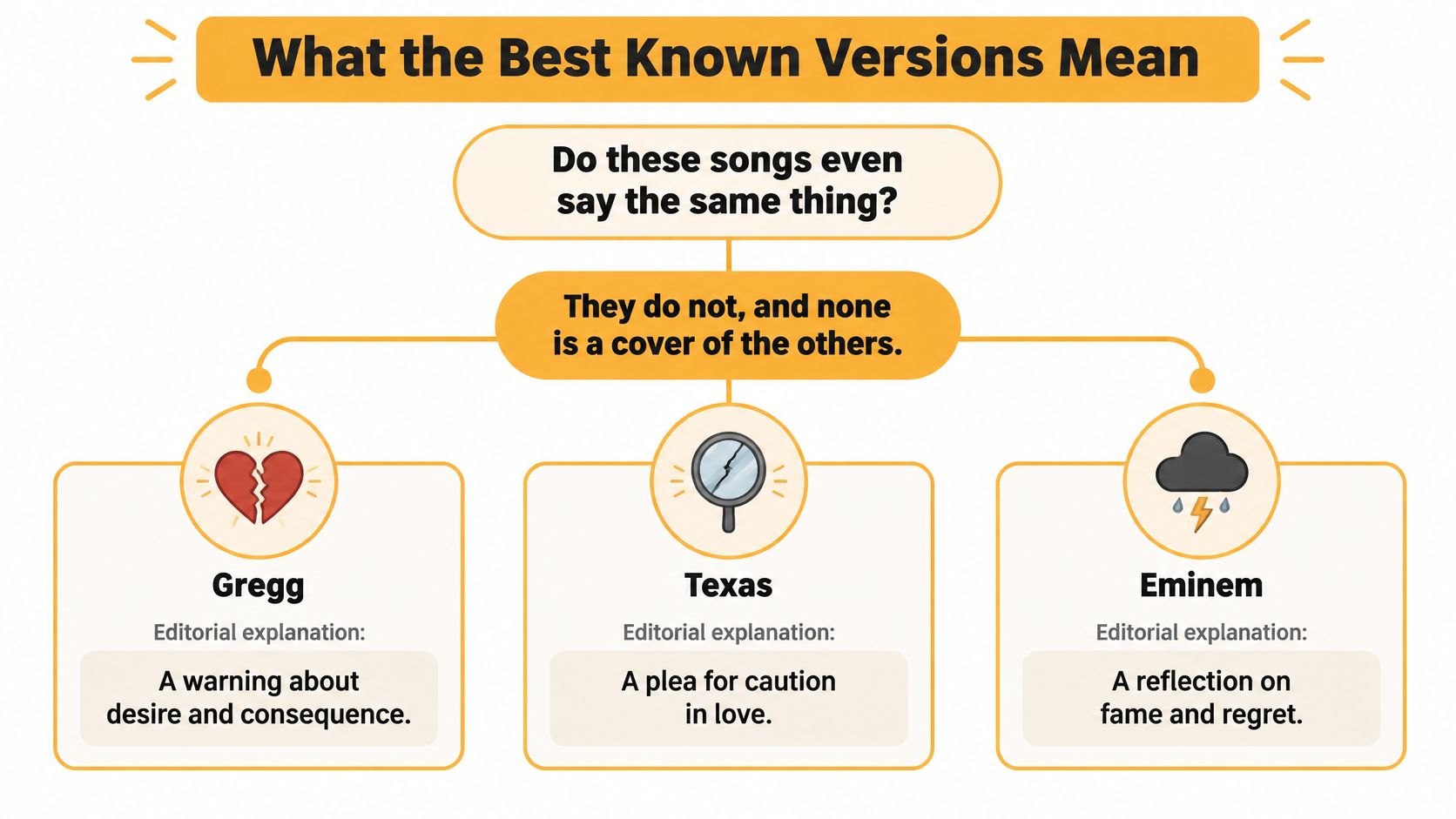
Three different stories behind one phrase
Eminem, 2006. Success treated as a wish that turns into confinement and personal cost. Fame is the subject, and the pressure is the point. If you caught a snippet expecting a love song, that mismatch explains the rest of it.
Luke Combs, Be Careful What You Wish For. Keep this one as a near-match title, not a theme to quote. The extra word changes the search result, and it should also change how carefully you check the artist, release and writer line before assigning a meaning.
Bad Omens, 23 July 2021. File it by markers first: band, date and the separate metal recording. Until an approved lyric page is open, do not infer the song's message from the proverb it shares with Texas, Brooke or Eminem.
The singer-songwriter reading is a different room
Brooke's 2007 song is an adult pop collaboration with Eric Bazilian and J.C. Chasez. Read its narrative as that writing room's song, with its own credits and release trail, even though the years overlap.
A chorus hook shared in conversation proves nothing about authorship. Two writers can land on the same proverb in the same decade and never hear each other's record.
How to use a synopsis without copying a line
A synopsis earns its place by helping you recognize a live clip, a setlist note or a quote in an interview. Once it narrows the recording, confirm the exact release, then copy words only from a licensed page that carries attribution. Skipping the middle step is how a caption ends up crediting the wrong artist.
Read the synopsis first, then the lyric. The synopsis narrows the recording. The licensed page confirms the words.
Transparent provenance separates an artist-approved text from an editor's summary of fame, heartbreak or collapse. Both are useful, and only one is quotable. For a title that also travels across many recorded versions, the All My Tears lyric notes follow the same split.
The FAQ worth answering in one line is this: what does this specific song mean, and which recording do these lyrics belong to?
Lengths and Stream Counts That Confirm a Cut
Bad Omens' Careful What You Wish For runs 4 minutes 32 seconds and, in Kworb's Spotify streaming totals for the artist, reached 49,501,466 Spotify streams in 2026. That pair, a single-track length plus a 2026 stream total, is a fingerprint for the metal recording.
Don't paste it onto Texas, Brooke or Combs. A page that pairs their release dates with a 49-million play figure has merged two songs and will merge their lyrics next.
The numbers separate a song page from an album page or a lookalike title, which is what the chart below is for.
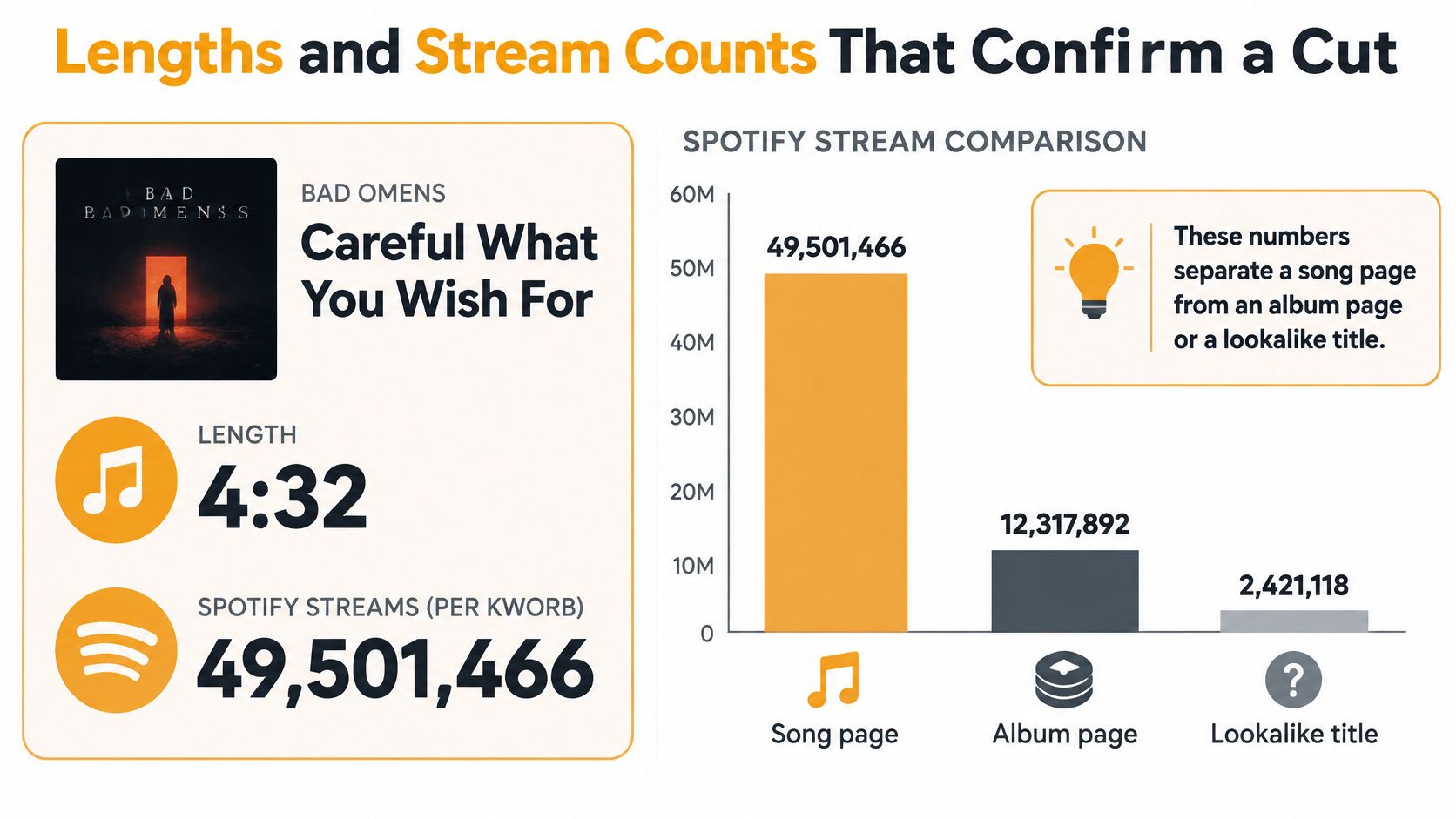
The album-length trap
Gregg's 35 minutes is an album runtime for a 10-track record released 17 April 2001. It is not a song length. A lyric page that lists 35 minutes as the track duration has confused the container with the thing inside it, and that confusion usually travels with the words too.
Gibert's marker is sequence, not streams: track 2 on TABULA RASA, released 11 November 2022, under the stylized title BE CAREFUL WHAT U WISH FOR. Eminem's marker is a version label, the 2006 dating versus the later Relapse:Refill connection, which tells you a demo and a later issue are separate texts worth checking.
Three figures to check before you trust a lyric page. A track length near 4:32 for Bad Omens only. An album length near 35 minutes for Gregg's album only. A stream milestone in the high forty-millions for the 2021 Bad Omens cut as of that 2026 count.
If a page swaps any of those, the text above them is sitting on the wrong entity, and no amount of tidy formatting fixes that. Correct metadata is the cheaper repair.
The same test works on any crowded title. Length and plays aren't trivia. They're the fastest way to tell whether you've opened the single you meant.
Related Pages and Titles That Are Not Covers
A reference page owes you navigation, not a pile of links. For each real song the useful hops are three, and they stay separate entries so Brooke's 2007 credits never land on Bad Omens' 2021 video.
- Artist page: everything released under one name, with the catalog in order.
- Album or EP page: the container, including track position, which is how Gibert's entry is pinned.
- Song page: one recording, its credits, its release date, its embed.
The cross-reference rule
A shared saying earns a cover, sample or medley link only when a credit says so. That single rule kills most of the false connections on this title.
Themes can still sit side by side as a labeled see-also. Eminem's fame-as-confinement reading and Combs' relationship reading are two parallel uses of one proverb, and a short non-lyric synopsis with its credit trail proves they share nothing but the words of the title. Two drafts of one song would share writers. These do not.
False friends that rank beside the lyrics
Some results that rank for this phrase are album reviews or blog posts that borrow the saying as a headline and contain no lyrics at all. Skip them when you are looking for words, because opening them wastes a click.
The embed belongs on the song page of the artist who released that recording, never on a hub page for the title, because a hub will always end up hosting the wrong clip for somebody.
Structure is what makes the hops safe. House of Lyrics keeps artist, album and song apart and currently indexes 1,533 songs; submitted lyrics are reviewed by the song owner or House of Lyrics editors before they appear on a page, and the library only hosts lyrics submitted by the artist or rights holder. A title that eight performers share needs exactly that kind of fence.
If you like a phrase enough to hang it on a wall, shop indie song lyric posters at Striped Circle, where prints are organized by artist rather than by title, the same discipline this page asks of you. Titles that travel across performers are common enough that the Cats and Dogs lyric notes use the identical approach.
Go back to the row you picked. That's the door. The generic title search is the corridor everyone gets lost in.
Quick Checks Before You Quote a Line
You're about to paste a verse into a caption, a setlist or a video description. Run this list first. Each check is pass or fail, and one failure means you don't quote.
- Say the artist name aloud and match it to a row. Gregg, Texas, Eminem, Brooke, Young Guns, Bad Omens, Gibert or Combs. If you can't name which one, you don't have a recording yet.
- Match the year window. 2001, 2003, 2006, 2007, 2021 or 2022. A page whose date falls outside your artist's window is a different song.
- If the page says Brooke, require the writers. Brooke, Bazilian and Chasez, or it isn't that cut.
- If the page says Bad Omens, require 23 July 2021 and a single-track length. No album runtime, no borrowed play count.
- If the page says Gibert, require the stylized title and track 2 of TABULA RASA.
- If the page says Eminem, require a version label, 2006 or the later Relapse:Refill connection, before you treat a demo and a later issue as one text.
- Confirm the words are marked artist-approved or rights-holder text. An editor's summary of fame, heartbreak or collapse is not a lyric.
- Confirm the video embed belongs to the same artist. The right clip next to the wrong text is still the wrong page.
The checklist version is easier to keep open on a second screen.
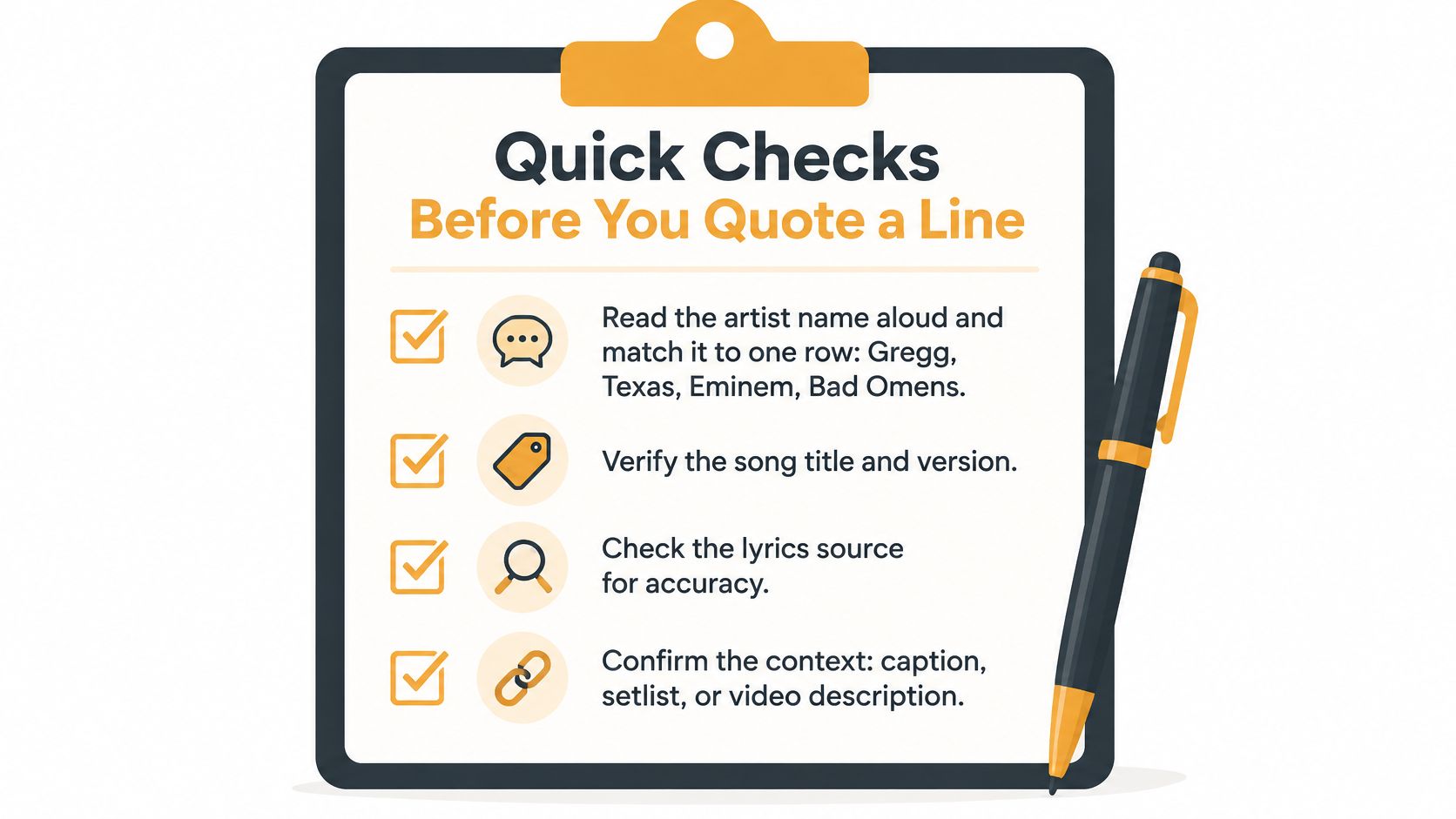
One more reason to slow down: 595 artist pages on House of Lyrics are still waiting to be claimed. An unclaimed page is a reason to be extra careful about what you copy, never a reason to invent a line and attribute it to somebody. If you want a longer version of this routine, these steps for finding trustworthy song lyrics walk through source checking from the start.
Pass every check, then open the single song page and quote from there. Nothing before that point is worth copying.
Open the Artist Approved Lyric Page
If all you wanted was to identify the song in your head, you already have what you need: an artist and a year. The next click is that song's own page, not a roundup for the phrase and not an album review that borrowed the saying for a headline.
On a properly built song page you should see three things, and only three, for that recording alone: the approved lyric, the credit line, and the official video embed. Anything else is a bonus.
Artists, managers and rights holders have a shorter path. Claiming a song page on House of Lyrics is free, and a claimed page lets the owner manage lyrics, chords, embeds and their public profile. A claimed artist can manage albums, songs and official video embeds, publish their own lyrics, and work in a full editor before anything goes live.
Each song holds its own page, so a Bad Omens claim can't overwrite a Brooke entry or a Combs one. A claim on the 2021 metalcore track touches that track, its embed and its credits, and nothing else in the catalog. That separation is the whole reason a title like this one can be hosted cleanly.
Nothing publishes on its own. Lyrics, chords and media go through review by the song owner or House of Lyrics editors before they appear, which is how conflicting web transcriptions get replaced by one attributed text instead of piling up beside it.
Fans, pick your row and open the matching song. Rights holders, claim the page, add the canonical video, and publish the lyric you wrote. That's the practical end of a careful what you wish for lyrics search: one recording, one page, one approved text.
Eight recordings share this title, and each one deserves a page that names its artist, its release date and its writers instead of a generic dump of someone's words. House of Lyrics is an artist-run library that pairs approved lyrics with official video embeds, organized by artist, album and song rather than by phrase. Open House of Lyrics, find the recording you heard, and read the text its rights holder stands behind.