Lately Lyrics Jodeci: Official Words, Video and Story
Explore the lately lyrics jodeci with the official video, credits and the story behind the 1993 Stevie Wonder cover. Discover what the song means.

You're singing along to Jodeci's Lately, but the lyric page ends while the recording keeps going. Before you correct the words or share a timestamp, check whether you're hearing the live performance, the main recording, or an edit.
Table of Contents
- Verified Lately Lyrics by Jodeci
- Which Lately Version Has Which Lyrics
- Lately Credits and Release Details
- How Jodeci Reshaped Stevie Wonder's Original
- Lately's Billboard Run From 1993 Onward
- What Lately's Lyrics Say About Suspicion
- Artist, Album and Song Pages to Follow Next
- Attribution Checklist Before You Quote Lately
Verified Lately Lyrics by Jodeci
A verified lyric panel should tell you exactly which recording you're reading. It should identify the version, attribute the submitted text, and distinguish the main song from any repeated passages or outro. Without those details, even familiar words can be attached to the wrong performance.
The complete, artist-approved text isn't available for reproduction here, and there's no documented approval record establishing a verified panel for this particular recording. Rather than present an unofficial transcription as authoritative, this guide helps you identify the audio, understand the credits, and read the song's emotional story.
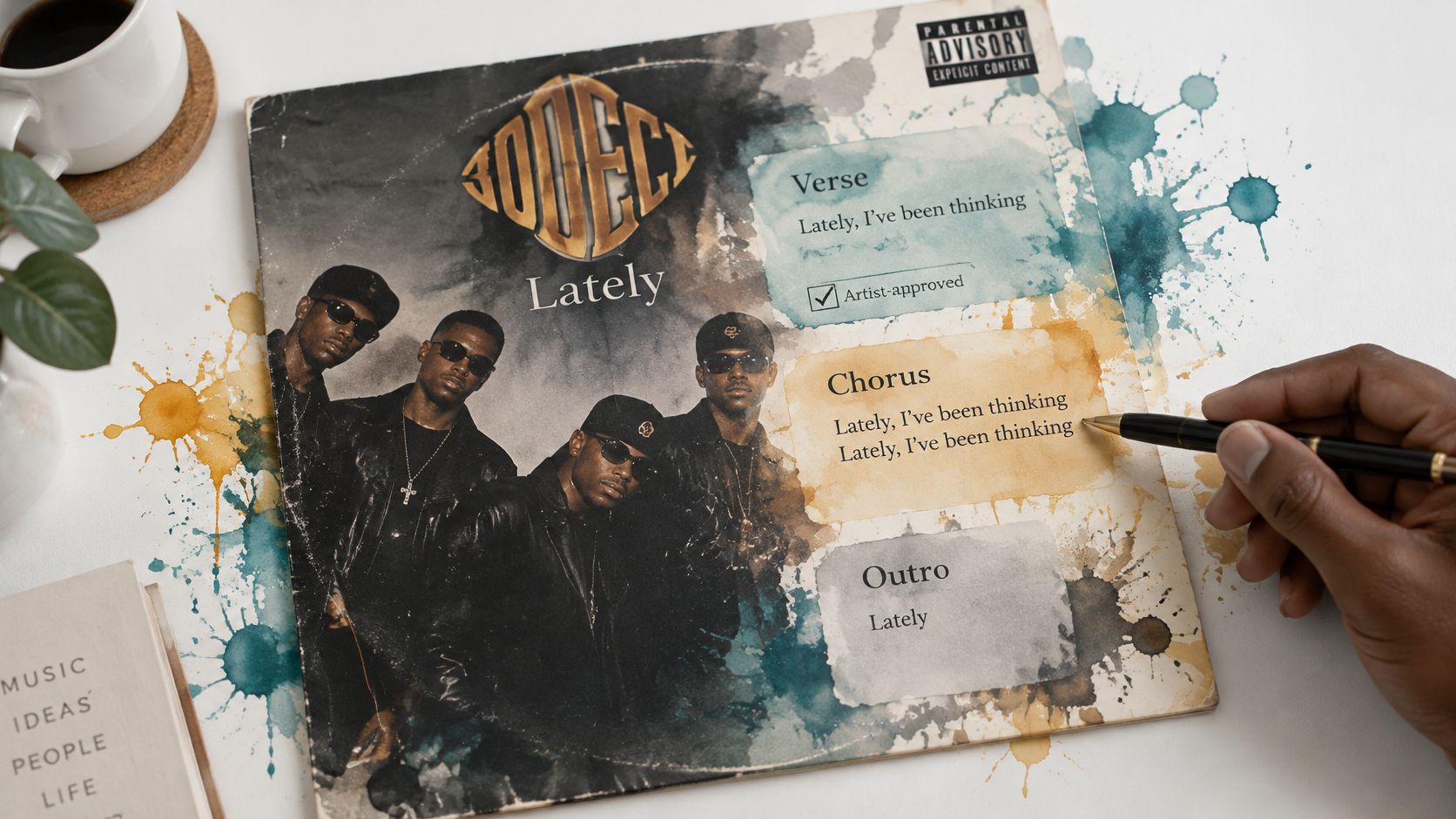
What an Approved Panel Should Establish
Say you're checking a passage near the end of the song. Your recording includes an extended vocal moment, but the text on your screen stops at the preceding refrain. That mismatch doesn't automatically mean someone omitted a lyric. You may have opened a transcription of another arrangement.
A useful panel needs these distinctions:
- Verse text: The narrative passages, separated clearly rather than run together.
- Refrain or chorus: The returning material, labelled according to the submitted text rather than a guessed structure.
- Repeated passages: Words repeated in that take, not repetitions borrowed from another recording.
- Outro, where present: A separate ending label so readers don't mistake an extension for part of every version.
An image containing lyrical snippets isn't a substitute for that attributed text. Neither is a familiar transcription copied across several music websites.
What Verification Means
At House of Lyrics, we only host lyrics submitted by the artist or rights holder. Submitted lyrics are reviewed by the song owner or our editors before they appear on a page. Our explanation of what an editorial review involves describes the review process, but the existence of that process doesn't establish that a particular song has already been approved.
Jodeci's recording is a cover of Stevie Wonder's composition. Keep the written song and the performed arrangement separate when reading: a singer can stretch, repeat, or emphasize a passage without changing who wrote it.
Before quoting or sharing a line, compare the panel's version label with the recording you're playing. If the approval attribution or recording identity is missing, don't describe the text as verified.
Which Lately Version Has Which Lyrics
Say you queue up Jodeci's Lately and pull the lyrics up beside it. Which take are you hearing? The title alone won't tell you. The Spotify recording listing, considered alongside the release distinctions associated with this catalog, provides a reference point for recordings documented at approximately 6:13 for the commonly surfaced live take, 6:20 for the main version, and 4:20 for the radio version.
Lately versions by length and credit
| Version | Approx. Length | Credit Note | Lyric Note |
|---|---|---|---|
| Live, Uptown MTV Unplugged | 6:13 | Stevie Wonder wrote the song; DeVante Swing produced the recording | Extended unplugged arrangement |
| Studio, Lately (Main) | 6:20 | Stevie Wonder wrote the song; DeVante Swing produced the recording | Additional outro documented |
| Radio edit | 4:20 | No separate personnel credited for the edit itself | Shortened running time; don't assume identical timestamps |
| Longer live edit | Runs past the 6:13 take | Stevie Wonder wrote the song; DeVante Swing produced the recording | Requires its own transcription check; word-level differences aren't established |
Those are recording distinctions, and running time can mislead. A longer duration can come from an introduction, a musical passage, a fade, or repeated singing. None of those prove the underlying words changed.
Use the following illustration as a navigation aid for matching a transcription to the right take.
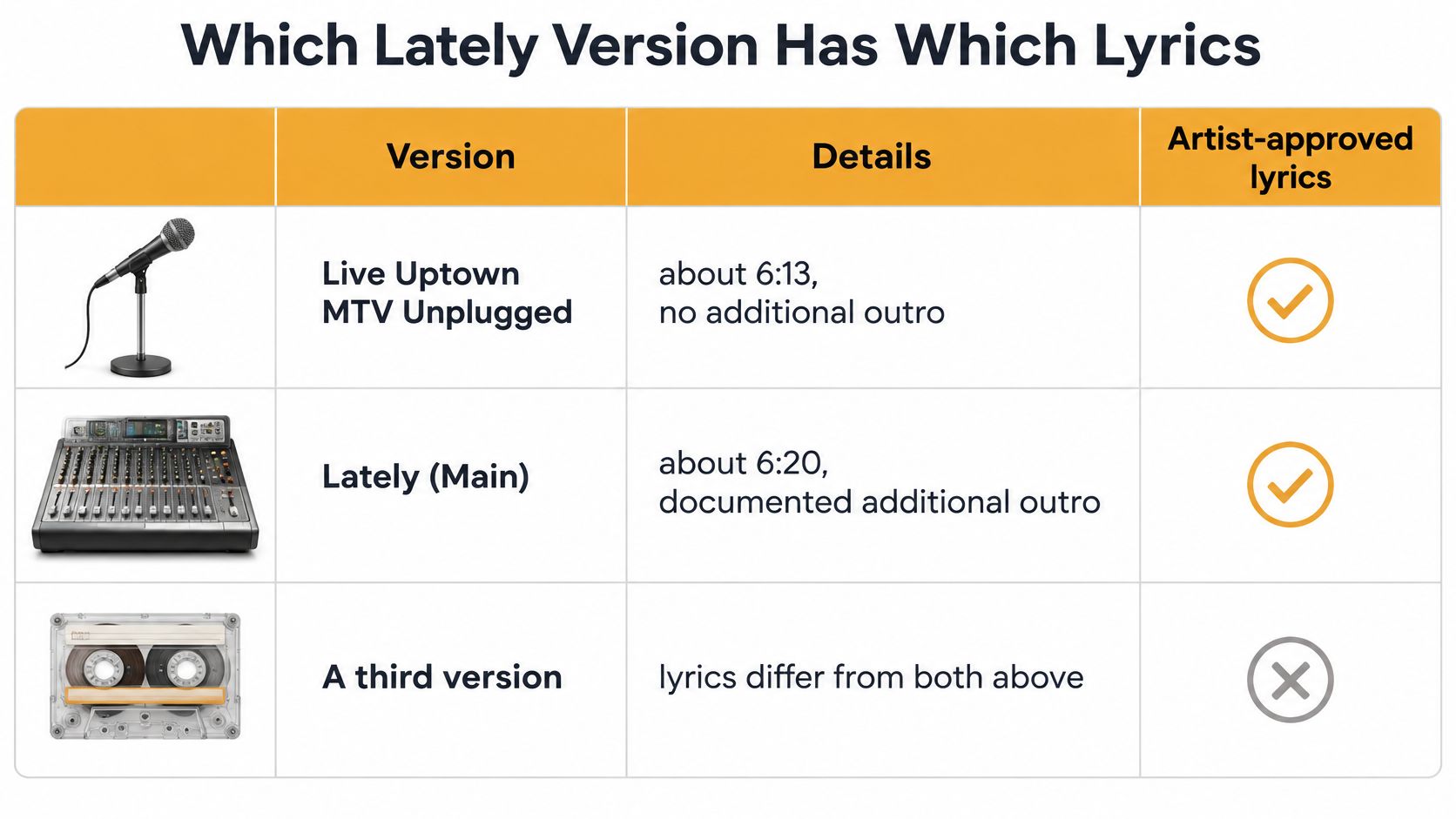
Match the Ending, Not Just the Opening
Say two recordings begin with the same narrative passage. You follow the words comfortably until one recording continues into an ending that the other doesn't contain. The opening match wasn't enough to establish that both transcriptions were interchangeable.
Check the release title, displayed duration, introduction, and ending. A version-specific panel should also place timestamps against the selected audio and identify where an outro begins.
No version-matched official video is established for each alternative here, so an unrelated upload shouldn't be labelled official. The same recording-first habit is useful when exploring another interpretation-focused page, such as the guide to All My Tears lyrics.
Practical rule: Confirm the recording's length and ending before you publish a lyric timestamp.
Lately Credits and Release Details
The release history for Lately) identifies Wonder's original album release in 1980, Jodeci's cover in 1993, the single release on May 25, 1993, the vinyl release on June 22, 1993, and an unplugged running time of approximately 6:13.
Lately credits and release facts
| Credit or Release | Name or Detail | Note |
|---|---|---|
| Original composer and performer | Stevie Wonder | Released on Hotter Than July (1980) |
| Recording artist | Jodeci | 1993 cover performed for Uptown MTV Unplugged |
| Producer | DeVante Swing | Jodeci member who produced the recording |
| Single release | May 25, 1993 | Issued as a single |
| Vinyl release | June 22, 1993 | Followed the single release |
| Running time | About 6:13 | Unplugged version |
Read the Roles Separately
Songwriter, performer, and producer aren't interchangeable credits. Stevie Wonder wrote the composition. Jodeci performed the cover. DeVante Swing produced the recording.
That distinction matters when you're writing something as ordinary as a playlist description. Calling the song a Jodeci performance is appropriate; calling Jodeci its songwriter would erase the composition's authorship. Likewise, identifying Wonder as the writer doesn't mean he performs on Jodeci's recording.
A useful attribution sentence names the work and then assigns each role plainly. You don't need to squeeze every contributor into the artist field or treat a producer credit as a writing credit.
Separate the Release Event From the Recording
A single release date answers when that commercial issue appeared. A vinyl date identifies a different release event. Neither should automatically become the date attached to every later compilation, streaming entry, or edit carrying the same title.
Say you're adding the song to a fan-made catalog. Keep separate fields for composition credit, recording artist, producer, release title, and format. Our explanation of music metadata helps clarify why those fields belong together without being collapsed into one label.
The performance's journey from a televised acoustic setting to a commercial release is part of its appeal. Listeners encountered a familiar composition through Jodeci's own vocal identity, rather than a replacement name on Wonder's original.
Credits belong to the version you're hearing, so confirm that version before assigning it a release date.
How Jodeci Reshaped Stevie Wonder's Original
The pleasure of a great cover isn't just recognizing the melody. It's hearing another performer find a different emotional temperature inside the same song. With Lately, Jodeci's group delivery invites you to hear private anxiety as something that can fill a room.
Keep the composition and the interpretation side by side:
- Wonder's original: The writer performs his own account of relationship uncertainty. Explore the Stevie Wonder artist page with that authorship in mind.
- Jodeci's unplugged performance: The acoustic performance setting brings vocal phrasing and interaction to the foreground.
- The extended arrangement: Sustained passages give the singers room to dwell on an emotion rather than move immediately to the next thought.
- The main recording's ending: The documented additional outro needs to be identified with that release, not casually assigned to every live take.
- The group's gospel-infused delivery: Responses, emphatic phrasing, and collective vocal presence can make an inward-facing narrative feel communal.
Hear Expression Without Inventing New Dialogue
A change of voice doesn't necessarily introduce another character. A supporting singer can reinforce the narrator's fear rather than speak as the partner. Similarly, an emphatic repetition can deepen the emotional weight of a thought without adding another event to the story.
That's where lyric pages can become misleading. Text alone can make a repeated line look redundant, while the performance makes it sound increasingly urgent. Conversely, an improvised sound or extended vowel shouldn't automatically become a newly invented word in a transcription.
Try listening without reading first. Notice where a singer pauses, where the group answers, and where a phrase feels unresolved. Then read the corresponding passage and ask whether the layout helps you hear those distinctions.
A cover can preserve a song's central story while changing how close the listener feels to the narrator.
For a concrete listening test, play the first chorus of Wonder's recording, then the corresponding chorus in Jodeci's live take. Compare the entrance, the held notes, and the emotional emphasis, not just whether the words look familiar.
Lately's Billboard Run From 1993 Onward
Say a fan writes "Lately topped the charts in summer '93" in a forum post. It sounds right, and it nearly is. The Billboard chart history for Jodeci records Lately reaching No. 4 on August 28, 1993, spending 24 weeks on the Hot 100, including 9 weeks in the Top 10, and reaching No. 1 on Hot R&B/Hip-Hop Songs.
Lately Billboard Hot 100 run, 1993
| Chart Date | Position | Note |
|---|---|---|
| June 12, 1993 | No. 44 | Debut on the Hot 100 |
| June 26, 1993 | No. 22 | Climbing |
| July 10, 1993 | No. 11 | Just outside the Top 10 |
| July 31, 1993 | No. 7 | Inside the Top 10 |
| August 28, 1993 | No. 4 | Peak position |
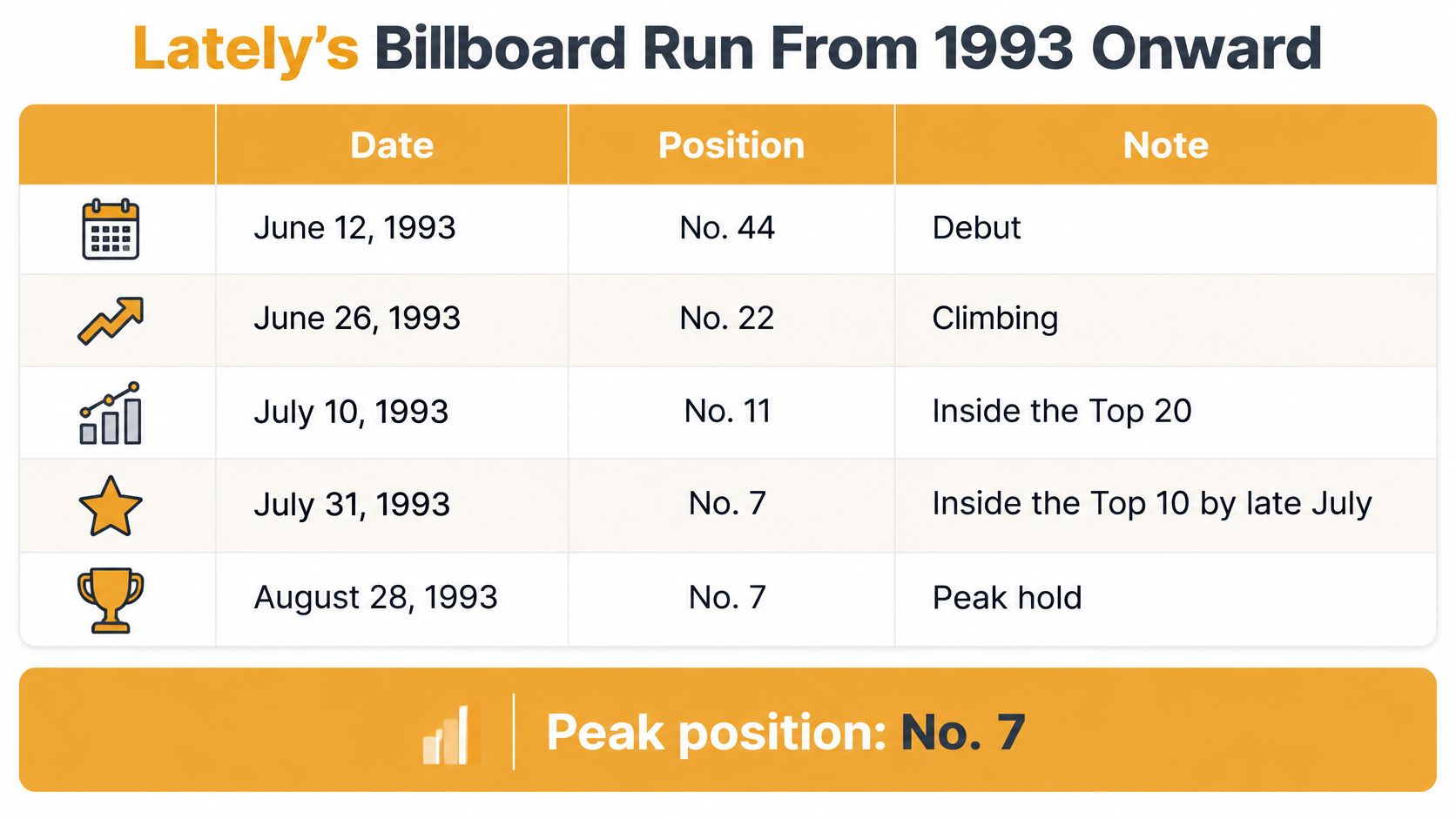
What the Climb Actually Shows
Eleven weeks separate that debut from the peak. The dated positions trace a recording building momentum step by step, rising from a mid-chart entry to a Top 5 finish by late summer.
The distinction between charts matters, too. The Hot 100 result describes crossover success, while the R&B chart result reflects strength in the audience most directly associated with Jodeci's musical identity. Merging the two into a claim that the song topped every chart flattens a more interesting story.
Chart success also can't explain every listener's attachment. It establishes commercial reach, not the reason people connected with the performance.
For listening alongside the chart story, the video below offers an audiovisual reference. Its exact version and official-upload status aren't confirmed, so treat it as a way to revisit the mood of the performance rather than as the authority for version-specific lyric timings.
Write a Precise Playlist Note
Before publishing a chart claim, check the chart name and issue date. A weekly position isn't the same thing as a career peak, and a release date isn't a chart date.
For a fan post, describe the gradual climb and identify the relevant chart. Avoid calling the recording a universal chart-topper or guessing at positions the chart history doesn't list.
What Lately's Lyrics Say About Suspicion
The familiar reading is straightforward: the narrator thinks a partner is involved with someone else. But suspicion isn't confirmation, and that difference is central to the song's emotional pull.
The text presented on the Genius lyric page for Jodeci's Lately supports a reading grounded in the narrator's feelings and interpretation of troubling signs, rather than an independently confirmed account of infidelity. We hear someone trying to understand a relationship, not an impartial witness delivering a settled verdict.
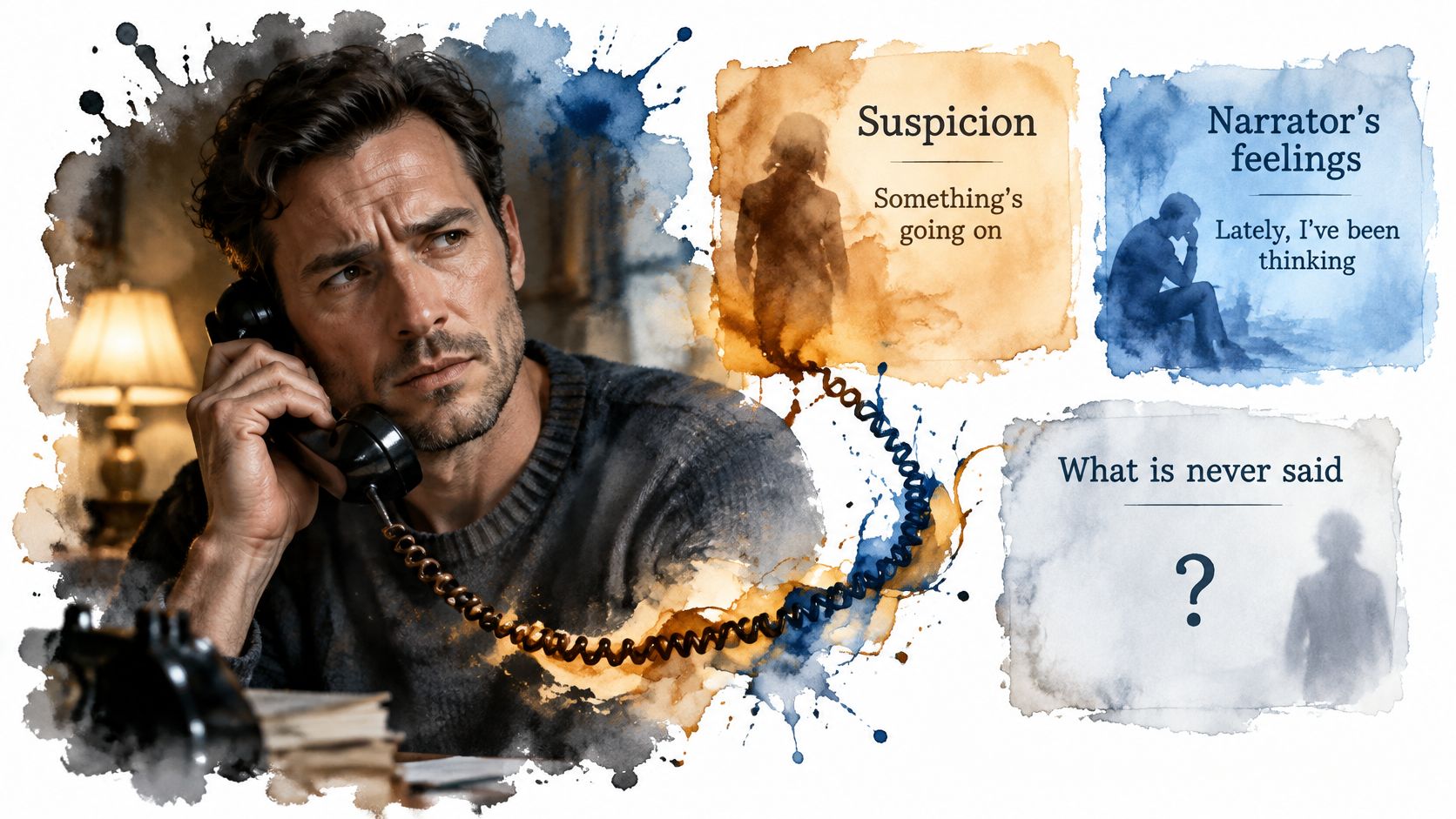
Separate Observation From Conclusion
Say a partner seems distracted during a conversation. The distraction is observable; the explanation isn't. The listener might interpret it as secrecy, exhaustion, emotional withdrawal, or something unrelated to the relationship.
That distinction offers a fair way into Lately:
- Suspicion: The narrator interprets changes as possible signs of another relationship.
- Feeling: Anxiety and emotional distress shape how those signs are understood.
- Uncertainty: The narrative doesn't establish the partner's actions as an independently verified fact.
- Alternative readings: Jealousy, insecurity, distance, and changing communication can all inform how a listener understands the song.
These readings don't require pretending the fear is trivial. A person can experience intense pain before knowing whether the feared explanation is correct.
Questions Worth Asking While You Listen
Is the narrator certain the partner is involved with someone else?
The more careful reading is that the narrator fears it. Singing with conviction doesn't turn that fear into proof.
Who sings each emotional perspective?
The available credits don't establish a line-by-line vocal allocation, so assigning every passage to a named member would go beyond what's confirmed. Beyond that, different singers don't automatically represent different people in the relationship.
How does Jodeci make the song more communal and dramatic?
The gospel-infused delivery lets the group reinforce an individual emotional account. Vocal intensity can make the narrator's distress feel shared without supplying an answer from the absent partner.
The most rewarding interpretation leaves room for that uncertainty. Listen for the distance between what the narrator notices, what the narrator fears, and what the song never resolves. That distance is where much of the heartbreak lives.
Artist, Album and Song Pages to Follow Next
Say a DJ wants to quote the long slow burn of Jodeci's Lately during a set, but the search results show several uploads with different lengths and endings. Start with the song, follow the performing artist, inspect the release context, and return to the recording credits. That route answers different questions without treating every page bearing Lately as the same reference.
On House of Lyrics, each song has its own page, separate from other songs by the same artist. Artist, album, and song pages are connected for catalog navigation. The library only hosts lyrics submitted by the artist or rights holder, and a claimed song page lets its owner manage lyrics, chords, embeds, and the public profile before reviewed changes appear.
Choose the Page That Answers Your Question
| Your Question | Page to Look For | What to Check |
|---|---|---|
| What else does the group perform? | Jodeci artist page | The group's catalog, rather than similarly titled recordings by other artists |
| Which release contains this take? | Album or release page | Track label and release context |
| Which text belongs to this audio? | Lately song page | Attribution, recording identity, and any approved lyric panel |
| Who wrote the underlying composition? | Stevie Wonder's catalog | The original work and its authorship |
A specific Jodeci artist-page address, album-page address, and Lately song-page address aren't established here. Use the site's catalog navigation rather than relying on a guessed destination, and don't assume that every indexed song already contains approved text or a version-matched video.
Keep Discovery Separate From Attribution
Once you've settled the recording question, there's room to keep exploring R&B. If the listening session widens beyond Jodeci, you can stream Aaliyah tracks commission-free as a separate music stop. Treat that as discovery, not as evidence for who wrote, produced, or approved Lately.
Give each destination one job. Artist pages help you explore performers, release pages establish context, and song pages should identify the exact work you're reading. Enjoy the catalog connections, then return to the selected recording before making a precise attribution.
Attribution Checklist Before You Quote Lately
A good fan caption can be warm and precise at the same time. You don't need to turn a favorite performance into a catalog entry, but you should know which recording you're quoting and which credits belong to it.
Check the Evidence Before the Caption
Look for approval and attribution. Check whether the lyric panel identifies an artist or rights-holder submission and carries a recording label. A page title or search-result snippet doesn't establish approval.
Match the text to the audio you intend to discuss. Use the version name, displayed duration, and ending together, especially if you're quoting a passage after the main refrain.
Assign the roles correctly. Credit Stevie Wonder as writer, Jodeci as the performing group, and DeVante Swing as producer of the recording. Don't convert a performance credit into a songwriting credit.
Keep any quotation brief and necessary to your commentary. When a verified song page is available, direct readers there for the complete text rather than reproducing the song in a caption or blog post.
Confirm timestamps against the actual player. Start the selected recording from its beginning and locate the passage again before publishing. An introduction, fade, or extended ending can make a timestamp from another upload inaccurate.
If there's no verified lyric panel for the take you're hearing, don't present your transcription as approved. You can discuss the performance without quoting it, or explicitly identify a verified alternative without suggesting that it documents the unverified take.
Approval Doesn't Replace Permission
An attribution tells readers who created and performed the work. It doesn't, by itself, grant permission to reproduce the lyrics in another publication. Our guide to music rights management provides context for keeping authorship, ownership, and permitted use distinct.
Before you share: Be as precise about the recording as you are about the words.
Say you're posting about the ending because it's the part that moves you most. Identify the take first, then describe what the singer does there: the held phrase, the response, the hesitation, or the release of tension. That can communicate your enthusiasm more faithfully than an uncertain transcription.
Your next action is simple: check the version label of the lyrics you're about to share.
House of Lyrics brings artist-approved lyric submissions, recording credits, and official video embeds together through an artist-led review process. Visit House of Lyrics to explore the catalog, and check the attribution and version details before sharing your next favorite passage from Lately.