How to Find Song Lyrics: A Practical Guide for 2026
Learn how to find song lyrics accurately in 2026, from search tricks and verified artist pages to AI transcription pitfalls and accessibility tools.

You're halfway through a song, feeling certain you know the chorus, when someone corrects you. The line you've been singing for years isn't just slightly off. It belongs to another verse, a cover, or a version with different wording. A quick search often makes the problem worse by serving up text without showing which recording it describes.
Reliable lyric discovery is a verification workflow, not a single search trick. You need a useful fragment, a page that identifies the song properly, a way to handle audio when words aren't available, and a method for comparing versions when results disagree. Even something as simple as collecting lyrics for a music lyric prints guide benefits from checking the exact recording rather than copying the first text that appears.
The difference between a plausible lyric and the right lyric matters. The House of Lyrics editorial review process reflects that distinction by treating submitted text as material to check before it becomes public. The steps below apply the same standard to everyday searches.
Table of Contents
- The Moment You Realise You Got the Words Wrong
- Search Tricks That Actually Get You Somewhere
- Verified Artist Pages Beat the Aggregators
- When You Only Have Audio, Not Words
- Picking the Right Version When Results Conflict
- Why Lyrics Without Context Can Mislead You
- Hum-to-Search, Multilingual Lyrics, and Accessibility
The Moment You Realise You Got the Words Wrong
You're standing at a bar, phone tilted toward the light, confidently singing a chorus everyone knows. Then the track reaches the line you've been waiting for and the recording says something else. A friend opens a search result, points to the screen, and suddenly your favourite lyric has become a small public embarrassment.
The problem usually isn't memory alone. Lyrics travel through covers, live performances, radio edits, translations, user submissions, and recordings with similar titles. A page can contain words that sound right while pointing to the wrong album or performer. Search engines are good at finding text, but they don't automatically prove that the text belongs to the version in your headphones.
Practical rule: Treat every lyric result as a lead until the artist, recording, and version line up.
Listeners search lyrics for several reasons. A peer-reviewed Japanese study combined an online survey of 206 participants with analysis of more than 23 million lyric-request logs from a smartphone music-streaming service. More than 75% of surveyed participants said they often viewed lyrics to confirm what an artist was singing or understand its meaning more fully, while over 50% said they often used lyrics to sing along or identify structures such as verses and choruses. The study's findings show why a merely similar text isn't enough.
A dependable search therefore has four moving parts:
- A smarter query that starts with the words you remember.
- A credible source with attribution and recording details.
- Audio handling for songs you can identify by sound but not by words.
- Version checking when album, live, clean, translated, or remixed lyrics differ.
The rest is practical judgment. You're not trying to find any lyric page. You're trying to establish which words were recorded, by whom, and in which release.
Search Tricks That Actually Get You Somewhere
Start with the line, not the title. If you remember a distinctive five-to-eight-word fragment, put it in quotation marks and add lyrics. This works because unusual word combinations narrow the search more effectively than a broad title or a guessed artist name. The Japanese study cited above found that people use lyrics to identify and confirm songs, not only to read familiar words, so a remembered fragment can be a stronger starting point than uncertain metadata.
Use this sequence:
- Search
"distinctive lyric fragment" lyrics. - If the result identifies an artist, add the artist name.
- Once the recording looks right, add the album or release title.
- Compare the result with the official video or audio.
- If the wording leads to a cover or remix, search a second distinctive line.
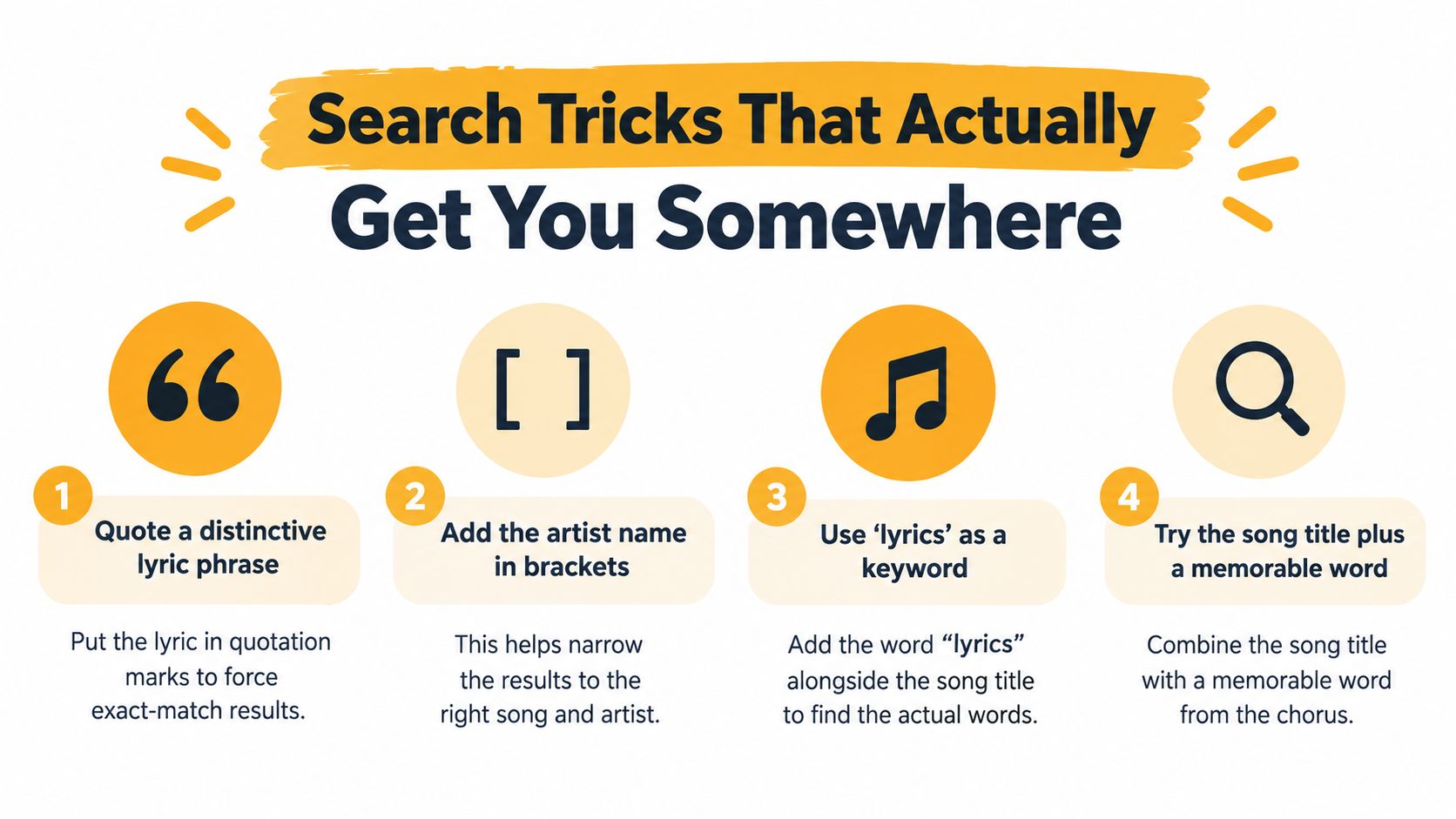
Quotation marks are useful, but don't treat them as proof. A misheard word can block an exact-match search, and a copied error may appear across several pages. Try spelling variations, remove one uncertain word, or search a phonetic approximation without quotation marks. Adding the artist, genre, or album can separate similarly named songs.
Use a query that reflects your uncertainty
If you know the song title but not the words, try:
"song title" artist lyrics"song title" "official lyrics""remembered fragment" artist"remembered fragment" lyrics chorus
If you know only a phrase, don't add a random artist just because the voice sounds familiar. That assumption can steer the search toward the wrong catalogue. Confirm the performer from the recording first, then refine the query.
Google's direct lyrics display changed the search environment when it began showing lyrics in United States results on December 19, 2014, initially for only some songs. A contemporaneous analysis found that three major lyrics sites together received more than 30 million monthly visits from Google's organic results and had approximately 6 million indexed lyric pages. It also reported that roughly 40% to 50% of their Google organic traffic came from mobile devices. The analysis of lyrics in search results explains why mobile readability, clear attribution, and canonical song identification still matter.
Search results may answer the query without sending you to a full page. When they do, open the source anyway if the version matters. The useful question isn't “Did Google show words?” It's “Can I connect these words to the exact recording?”
For a worked example of how a song page can be organized around the track rather than a loose text snippet, see the Cats and Dogs lyrics page.
Verified Artist Pages Beat the Aggregators
A lyric aggregator can be convenient, but convenience and authority aren't the same thing. Open submissions may be copied from another page, corrected by a listener who heard a different version, or displayed without any indication of who supplied the text. Several pages repeating identical wording don't create independent confirmation.
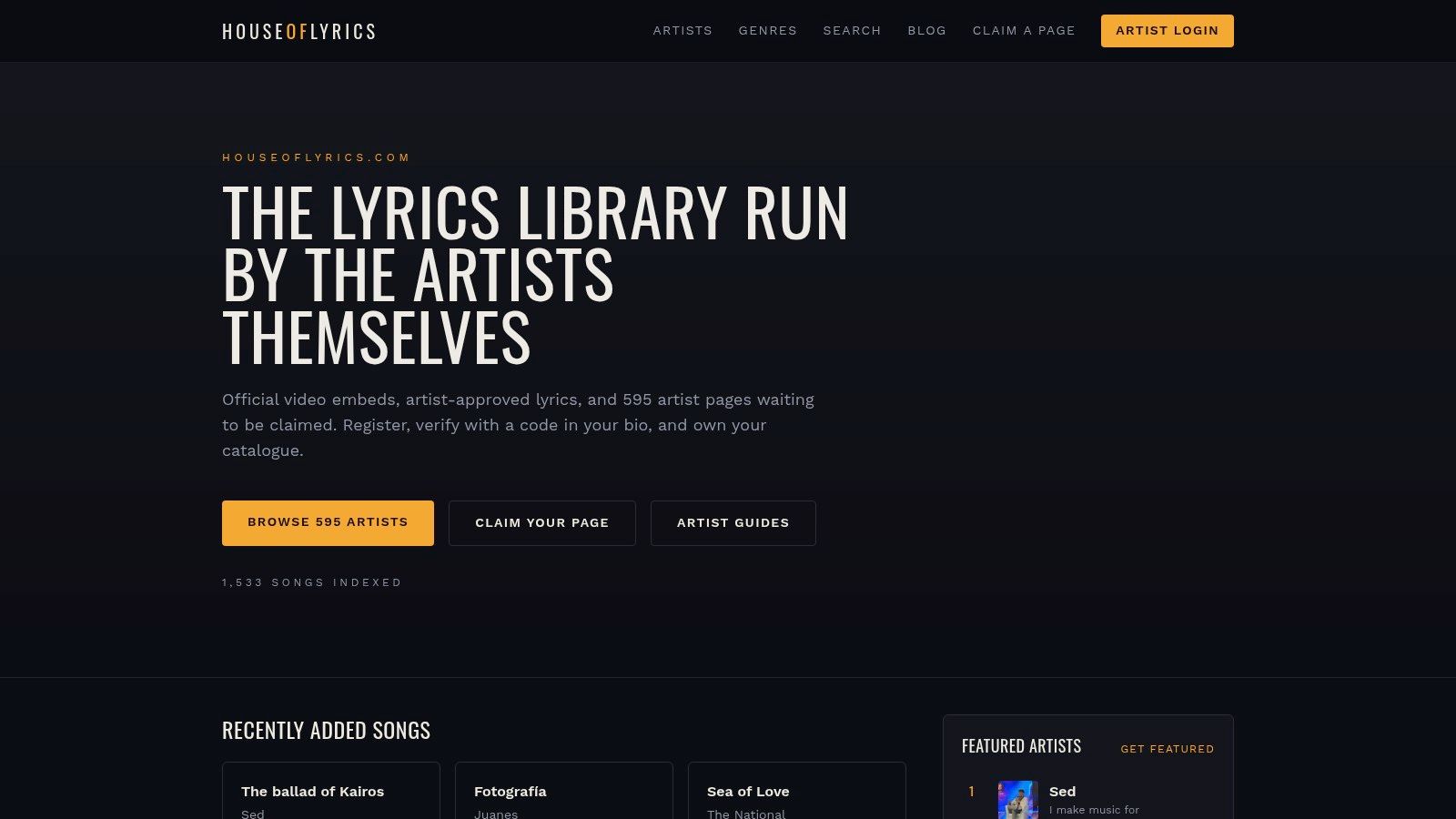
A rights-holder-managed page starts from a stronger chain of evidence. It can connect the lyric to the artist, album, song entity, credits, and official audiovisual source. House of Lyrics is one example of this model. Its pages can be claimed by artists or verified rights holders, with ownership confirmed through a code placed in an X or SoundCloud bio. Lyric and metadata changes then move through an editorial review process before publication, while official video embeds sit alongside the song information.
That doesn't mean every non-artist page is wrong. It means you should inspect the evidence visible on the page.
Signals that deserve attention
Look for:
- Visible attribution: Does the page identify an artist, rights holder, publisher, or contributor?
- Version labeling: Does it say album version, live version, clean edit, remix, translation, or demo?
- Catalog relationships: Can you move from the song to the correct artist and album?
- Audio comparison: Is an official video or recognized release available beside the words?
- Editorial status: Does the site explain whether text is submitted, reviewed, or artist-approved?
The strongest result usually makes its provenance easy to see. A page that hides the source leaves you doing the editorial work yourself.
Finding a verified page directly
Search the artist name, song title, and terms such as official lyrics, then inspect whether the result belongs to the artist, label, publisher, or a platform with a clear verification process. You can also search an artist's own site and social profiles for a linked lyrics page. If the page is indexed under separate artist, album, and song entities, navigation can help expose mismatches that a standalone text page conceals.
The same check applies when a song has multiple similar results. The All This Time lyrics resource is useful as an example of a song-specific destination, but the broader principle is portable: a lyric should remain attached to the recording it describes.
When You Only Have Audio, Not Words
The difficult search starts with a clip. You have a voice, a melody, perhaps a chorus buried under guitars, but no reliable phrase to type. Audio-to-lyrics tools can produce useful candidates, yet they shouldn't be treated as automatic authorities.
Research on sung-input retrieval found that using a full song produced 86% top-one identification accuracy, rising to 91% when the top ten candidates were considered. Short sung lines averaged only 37% top-one accuracy, while expanding the candidate list to the top 100 raised that result to 67%. The sung-input retrieval research supports a simple operational choice: give the system more clean audio and keep several possible matches.
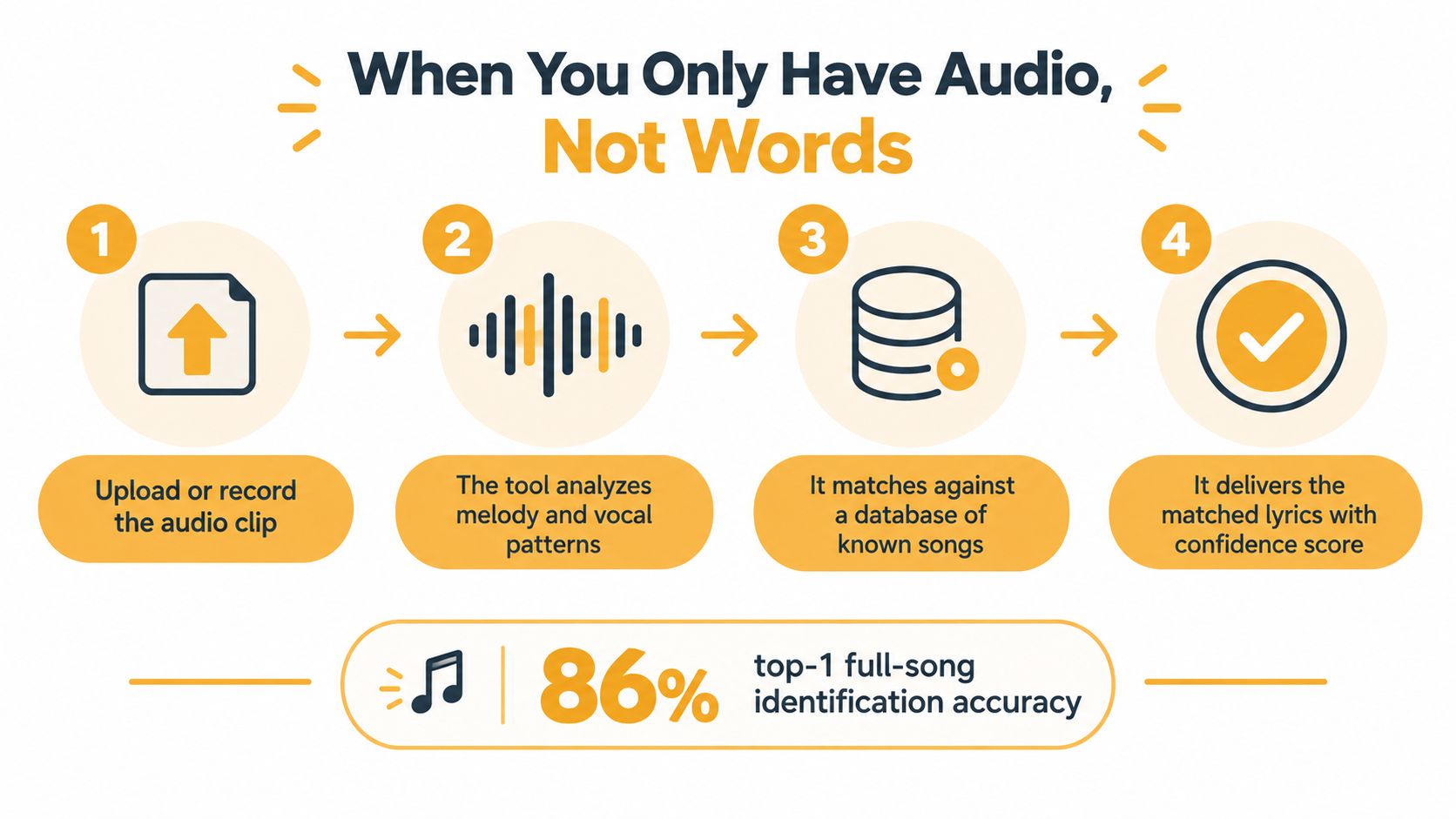
A practical audio workflow
- Capture a longer section. A clear chorus is usually more useful than a clipped syllable or resting opening.
- Isolate the vocal where possible. Background music and backing vocals can confuse transcription.
- Generate multiple candidates. Run more than one segment or transcription pass rather than accepting the first output.
- Normalize the text. Try lower-case comparison, alternate punctuation, spelling variants, and phonetic substitutions.
- Search distinctive multiword fragments. Match the candidates against a catalogue or web index.
- Verify the recording. Check artist, title, album, version, and audio before treating the words as final.
A transcription tool such as AIDictation's transcribe tools can help turn an audio fragment into searchable text, but the output remains a draft. The technical reason is fundamental: singing contains sustained vowels, melisma, pitch changes, vocal effects, pronunciation shifts, instruments, and overlapping voices. Speech-trained systems don't automatically understand those conditions.
One benchmark reported a 62% word-error rate for lyrics transcription on the Jamendo dataset. The benchmark research demonstrates why a fluent-looking transcript can still be wrong in more than half of its word positions. The same research described a singing-voice recognition system that improved word accuracy from 85.71% to 93.18%, equivalent to a 52.3% reduction in word-error rate, after adapting the acoustic model to sung audio.
Use audio tools to narrow the field. Use attributed lyrics and the recording itself to decide what belongs on the page.
Picking the Right Version When Results Conflict
Conflicting lyric pages are normal, especially for songs with clean edits, live recordings, remixes, translations, or alternate album releases. The first result isn't necessarily the authoritative one, and the most polished page may still describe a different take.
Check the evidence in this order:
- Title and artist: Confirm that both match the recording you're listening to.
- Album or release: Identify whether the page names the same album, single, soundtrack, or compilation.
- Version label: Look for terms such as live, acoustic, radio edit, clean, explicit, remix, demo, or translated.
- Audio comparison: Play the disputed line in the exact release and compare delivery, omitted words, ad-libs, and repeated sections.
- Attribution: Prefer text connected to the artist, publisher, label, or a clearly identified rights holder.
A clean edit and a radio edit aren't always interchangeable. A translated lyric isn't the original text, and a live performance may contain improvisation that never appears on the studio release. Treating all pages as one universal lyric creates errors even when each page is internally consistent.
| Check | What to Look For | Why It Matters |
|---|---|---|
| Title and artist | Exact song and performer | Similar titles can point to different recordings |
| Album or release | Album, single, soundtrack, or compilation | The same song may appear in several catalog contexts |
| Version label | Live, remix, clean, explicit, acoustic, or demo | Wording and structure can change between releases |
| Audio | The disputed line in the recording | The audio is the direct test of what was performed |
| Attribution | Artist, publisher, label, or verified contributor | Provenance helps distinguish a checked text from a copy |
Version matching also improves machine-assisted recognition. The singing-voice research linked above found better results after adapting the acoustic model to the relationship between lyrics and sung audio. That result doesn't turn software into an editor. It reinforces why metadata and recording identity have to accompany the words.
When the pages still disagree, mark the uncertainty rather than smoothing it away. For another song-specific example of lyrics presented in a catalog context, consult the Go Crazy lyrics page, then apply the same release and audio checks to any competing result.
Why Lyrics Without Context Can Mislead You
A listener searches a fast rap verse, finds a confident-looking transcript, and quotes a line that belongs to a different recording. Rap and other densely worded genres create this problem often. An independent analysis of Google Trends data from 2020 through February 2025 found that rap produced the strongest lyric-search interest among the genres examined. Rapid delivery, wordplay, cultural references, and double meanings may help explain why. The lyric-search trend analysis also points to the practical issue: the words are often hardest to separate when listeners need them most.
A transcript captures words, not the full performance. Delivery, timing, emphasis, backing vocals, production, repetition, and surrounding choices can change how a line is understood. It may also leave out the recording identity, making a correct transcription look like the right answer for the wrong version.
That is why finding lyrics is not only text retrieval. The recording and its context are evidence. Read the words while listening, then check the artist, release, and version before treating a disputed line as settled.
A useful lyric page reconnects text with sound. Official video, release metadata, performer attribution, and version labels help readers avoid quoting another performance or interpreting a fragment without the musical frame that gives it force.
Hum-to-Search, Multilingual Lyrics, and Accessibility
Not everyone begins with an exact English phrase. You may remember only the melody, approximate sounds, a translated idea, or the shape of a chorus. A useful lyric workflow has to accommodate those starting points without pretending that every output has the same authority.
Google's 2025 trend reporting highlighted substantial interest in hum-to-search alongside lyric searches, with viral soundtrack and international releases prominent in the results. That makes melody-based discovery a sensible first step when the words are unavailable. Hum the most distinctive section you can, record a clean clip, and test more than one attempt if the result seems generic. A melody match identifies a candidate song. It doesn't establish the lyric version.
Working across languages
A translated phrase can lead to the right song, but it may also lead to a translated lyric page rather than the original text. Search with several forms:
- The approximate phrase in the language you heard.
- A transliteration if the original uses a different script.
- The artist and title in their original spelling.
- Terms such as
original lyrics,translation, ortransliteration. - A remembered chorus sound alongside the suspected artist.
Keep the categories separate. Original lyrics, translations, transliterations, clean edits, and timed captions serve different purposes. A translation helps with meaning but shouldn't be presented as what the performer sang. A transliteration helps pronunciation and discovery, but it isn't the original script. A clean edit may intentionally omit or replace words from the standard release.
Making pages usable for more listeners
Lyrics also work as listening and comprehension support. A recent EFL learner study reported that students used song lyrics outside class as visual support for following audio, recognizing vocabulary, and understanding meaning more closely. The study of lyrics in EFL learning reinforces the value of readable, accurate text rather than a decorative transcript.
Research on Deaf and hard-of-hearing music experiences identifies lyric captioning as a common accessibility approach and discusses richer formats such as synchronized captions and ASL accompaniment. A static block of words may help, but it doesn't tell a reader whether timing is accurate, whether backing vocals are included, or whether the text was copied from an unverified source.
Look for:
- Synchronization labels: Does the page identify timed captions rather than plain text?
- Speaker or vocal cues: Are backing vocals, ad-libs, and separate performers distinguished?
- Language labels: Can you tell original text, translation, and transliteration apart?
- Readable presentation: Does the page work on a phone and preserve line breaks?
- Provenance: Is the lyric connected to an artist, rights holder, publisher, or reviewed submission?
An artist-approved page with structured artist, album, song, and video metadata can bring these signals together. The official lyrics video resource illustrates why audiovisual context belongs close to the text, particularly when listeners need to follow both sound and words.
A repeatable decision flow
Keep this five-move version beside you while searching:
- Start from the strongest clue. Use a distinctive fragment, melody, approximate sound, or translated phrase.
- Confirm the artist and version. Match the title, release, performer, and recording.
- Prefer an attributed page. Look for artist approval, rights-holder information, version labels, and linked metadata.
- Treat audio-derived text as a draft. Generate candidates, compare repeated lines, and expect singing to confuse transcription.
- Resolve conflicts against the audio and provenance. Don't choose a wording merely because it appears most often.
For a live version, search the song title with live, the venue or event, and the performance date if known. For an unreleased demo, label the result as a demo and avoid treating later official lyrics as proof of what the early recording says. For a translated song, open both the original and translated pages and confirm which one you're reading before quoting it.
The words matter, but so do the performer, recording, version, and source that keep those words attached to the music.
House of Lyrics pairs artist-approved lyrics with official video embeds and organized artist, album, and song pages, with verified rights holders able to manage submissions through review. Visit House of Lyrics when you want to find lyrics while keeping the exact recording and its attribution visible.