And I Wonder Lyrics: Find the Right Song Version
Find the correct And I Wonder song by artist, year and length, then read canonical lyrics, credits and official video links on one verified page.
A search for And I Wonder doesn't identify one song. Catalog records attach that exact title to different artists, albums and singles across generations, so the first job isn't interpretation. It's identification. Pin down the recording, and the lyrics, credits and video fall into place. Skip that step, and you can read a thoughtful analysis of entirely the wrong track.
Table of Contents
- Find Which And I Wonder Recording You Mean
- How to Match a Half-Remembered Song to the Right Version
- Similar Titles That Are Not the Same Song
- Where to Read Canonical Lyrics You Can Trust
- Credits and Release Details to Verify
- What the Song Means in Each Version
- Official Videos and Embeds for Each Recording
- Confirm the Right Version Before You Quote or Share
Find Which And I Wonder Recording You Mean
Six cataloged releases answer to this exact title, and the records cited row by row below place their release dates between 2007 and April 2024. The underlying material reaches further back than the release dates suggest. The oldest entry is a Siren track carried on a compilation whose own title dates the sessions to 1969 through 1972, so the title has been reused across parts of at least five decades. That range is why artist, album, release year and duration do the identifying work here, not the title itself.
The Cataloged Recordings at a Glance
| Artist | Title and release | Year | Duration | Notes |
|---|---|---|---|---|
| Kevin Coyne & Siren | And I Wonder on The Dandelion Years 1969-1972 (Deluxe Edition) | 1969 material, compilation 2007 | 2:46 | Often framed as lost love and separation |
| Alex Nicol | And I Wonder on All for Nada | 2020 | 4:14 | English-language; performer and composer credit |
| Lowrider | And I Wonder on Black Stones | 2022 | 4:17 | Same title, different act |
| Yunger | And I Wonder on Of Hopes & Dreams | September 23, 2022 | Not listed | Album release; no duration in indexed record |
| The Slackers | And I Wonder? on The Question | 2008 | 3:49 | Question-mark variant, Hellcat Records |
| Ami Leigh | And I Wonder, single via Ami Leigh Music | April 12, 2024 | Not listed | Amelia Leigh Boorman credited as songwriter |
Start with the oldest row. The Amazon Music catalog record for the Siren track lists a 2-minute-46-second recording on The Dandelion Years 1969-1972 (Deluxe Edition), a 2007 compilation presenting earlier Kevin Coyne & Siren material. Read the date carefully. The 1969 figure comes from the compilation's title describing its source sessions, so the documented release year is 2007 even though the performances are older. A title-only search folds this track together with Alex Nicol's English-language song on All for Nada, dated 2020, despite the two being entirely separate works.
Lowrider's version on Black Stones, dated to 2022, runs within a few seconds of Nicol's listed length, which is why duration alone cannot close the case. You need the album name too. Yunger adds a second 2022 entry, on Of Hopes & Dreams dated September 23, 2022 in the Apple Music record for Yunger's And I Wonder.
The Slackers complicate things with punctuation. Their And I Wonder? lasts 3 minutes and 49 seconds, comes from The Question on Hellcat Records, and is dated to 2008 in its catalog record. That question mark is part of the title, and it separates their work from every plain-form entry in the table.
The newest row belongs to Ami Leigh. The Shazam record for Ami Leigh's And I Wonder single dates it to April 12, 2024, released through Ami Leigh Music with Amelia Leigh Boorman credited as songwriter. If none of these six rows matches what you remember, resist the urge to force a fit. Crowded titles reward the same patience you would bring to sorting out Happy Day lyrics by version.
How to Match a Half-Remembered Song to the Right Version
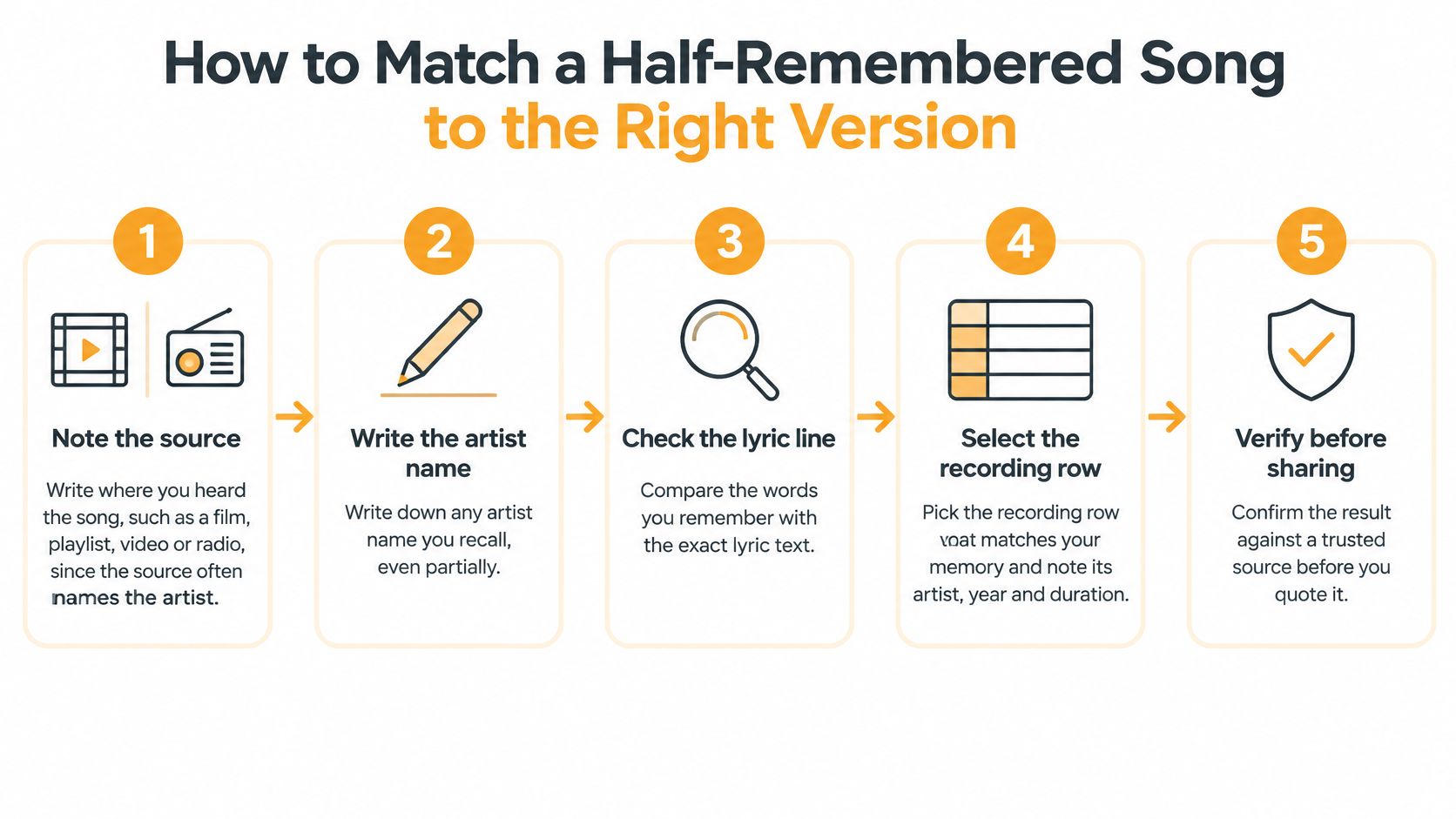
Half-remembered songs usually leave clues beyond the title. Use them in order, and six candidates shrink to one without guessing. Lyrics, meaning and video only help once the exact recording is pinned down, which is the step title-only searches skip.
A Seven Step Matching Routine
- Note where you heard it. A film credit, playlist, video description or radio announcement often names the artist, and that context beats a hummed chorus.
- Write down any artist name you recall. Even a partial name helps, because it can eliminate most rows instantly.
- Check the punctuation. And I Wonder? with a question mark points to The Slackers. The plain form matches the others.
- Compare year or album. A single dated April 12, 2024 points toward Ami Leigh. A deluxe compilation dated 2007, the Dandelion Years material, points back toward Siren.
- Check duration in your streaming app. This is your fastest pass or fail test, and the exact lengths are worth memorising for this title.
- Confirm the language. The Alex Nicol record is listed as English-language, so language metadata can support or weaken a match.
- Verify credits before trusting lyrics. Open the candidate page and check that the credited songwriter and album match your memory.
Practical rule: Treat punctuation as metadata, not as a typo. A question-mark title and a plain title are different recordings.
Duration deserves special care because two candidates sit close together. Alex Nicol at 4:14 and Lowrider at 4:17 differ by only seconds, so pair the timing with the album title, All for Nada versus Black Stones. Siren at 2:46 and The Slackers at 3:49 separate at a glance.
That gap is the difference between a hint and a check.
If you're building a broader habit for lyric searches, a systematic method for finding song lyrics uses the same logic. Record the source, capture fragments exactly, then verify against a structured record before you quote anything.
Similar Titles That Are Not the Same Song
A single character can separate two different recordings. Drop the "and", drop the question mark, or shorten the phrase, and a search engine will hand you a different artist's work without flagging the substitution. Resolving those neighbours is part of pinning down the exact recording, because none of them can tell you anything about the And I Wonder you heard until you rule them out.
Three Confusions Worth Clearing Up
- Da-iCE and I Wonder: Da-iCE's I Wonder) is a separate single by a different act, sharing only part of the title. It never enters the And I Wonder catalog.
- The Slackers and the question mark: And I Wonder? differs from the plain title by one character, yet it is a separate cataloged recording from The Question.
- Kanye West and I Wonder: a shorter title under a different artist. It tends to surface when a listener types a sung phrase into a search box rather than the cataloged title, which makes it a lyric-fragment match rather than an exact-title one.
The distinction matters. An exact-title search names a work as it is cataloged. A lyric-fragment search depends on words sung inside a song, and that song may carry a completely different title. Mixing the two is how a reader ends up analysing Kanye West when they meant Siren, a pattern also visible with playful phrase titles like disambiguating Cats and Dogs lyrics.
A simple test catches most of these cases. If your search term is missing a word or punctuation mark, check the artist before assuming a result is the right song, then compare its duration with the matching row from the catalog table. When artist, album and length fail to align, you are looking at a neighbour rather than the recording itself.
Near matches earn a mention here for one reason only: each one is a documented separate work, and treating them as variants of And I Wonder would corrupt the catalog you are trying to search.
Where to Read Canonical Lyrics You Can Trust
A lyric becomes canonical only after it is tied to a specific recording: artist, release, date and duration fixed before the words are trusted. A page can look polished and still attach the right title to the wrong performance.
The setting below shows how lyrics often live alongside albums and keepsakes, which is lovely for fans but no substitute for attribution.
Comparing Lyric Source Types
| Source | What it gives you | Reliability for canonical text |
|---|---|---|
| House of Lyrics song page | Lyrics shown with visible attribution, credits and an official video embed | Strong when those details match the confirmed recording |
| Artist or label official website | Text supplied by the rights holder, often with release details | Strong when the release year and label line up |
| Streaming service lyric panel | Synced lyrics tied to the licensed recording | Useful after the version matches your duration |
| General lyric websites | User-transcribed text, sometimes with comments | Uneven, because different versions can be blended |
| Social media clips and fan videos | Lyrics read aloud or captioned | Weak for citation, handy as a memory cue |
The safest pages behave like catalog records. They name who performs the song, where the text came from, and which release the words belong to. If Alex Nicol's 4:14 track from All for Nada in 2020 is the recording under discussion, a trustworthy lyric page should not drift toward Ami Leigh's 2024 single or The Slackers' And I Wonder? era.
Official artist and label pages can be excellent because the rights holder is close to the text. Streaming panels are convenient because the words move with the audio. User transcription needs more caution, since the same title can collect verses from adjacent recordings, a hazard also discussed around checking All This Time lyrics against the right release.
Treat every video as evidence, not decoration. If an embed does not identify artist, title and release year clearly enough to sit beside one catalog row, pause before using its captions or description as lyric authority.
Compare any lyric you find against the recording row already confirmed, then check that the attribution names the same artist. If a source hides credits or provenance, keep its text provisional.
Credits and Release Details to Verify
Credits turn a familiar title into an identifiable work. A canonical song page should hold normalized artist identity, release title, release date, label, duration, songwriter credits, language and source provenance, each tied to one recording.
What Each Field Proves
- Artist identity: Alex Nicol's record credits him as both performer and composer for his 4:14 track from All for Nada in 2020, in the JioSaavn record for Alex Nicol's And I Wonder. When one person holds both roles, the credit line is easy to verify.
- Songwriter credit: Ami Leigh's single shows why artist and songwriter shouldn't be assumed identical as names. Amelia Leigh Boorman is credited as songwriter, while the release artist is Ami Leigh.
- Label and date together: A 2008 album track on Hellcat Records and a 2024 single through Ami Leigh Music can't plausibly be the same release, even with the same title.
- Duration and language: These fields catch close calls, especially where two recordings differ by only a few seconds.
- Source provenance: A page should show where its information came from, so you can retrace the claim.
A sound production workflow captures those fields, then routes edits through rights-holder verification and editorial review before publication. That's the same discipline behind good music metadata management. If a credit looks wrong, it should be flagged and reviewed rather than changed without notice by anyone who notices.
A credit you can't trace to a source is a lead, not a fact. Treat it that way until it's verified.
A Quick Checklist for Any Page
Run these five checks before you trust a page. Does the artist match your row? Is a songwriter named? Is a release date present? Does duration match your streaming app? Is a source cited? If two or more answers are no, keep looking.
What the Song Means in Each Version
Take the lost-love reading attached to Siren's recording and apply it to Ami Leigh's 2024 single. The result sounds plausible and cites nothing. That is what a wrong entity match does to interpretation: it smuggles a reading across recordings that share only a title, and the error stays invisible until someone checks which row the analysis was written for.
Among the cataloged And I Wonder recordings, Siren's is the one with an attributed reading. The LyricsMeanings page on Siren's And I Wonder reads the song as uncertainty after lost love and separation. Treat that as one commentary's interpretation and label it as such, rather than presenting it as the settled meaning of every song with this title.
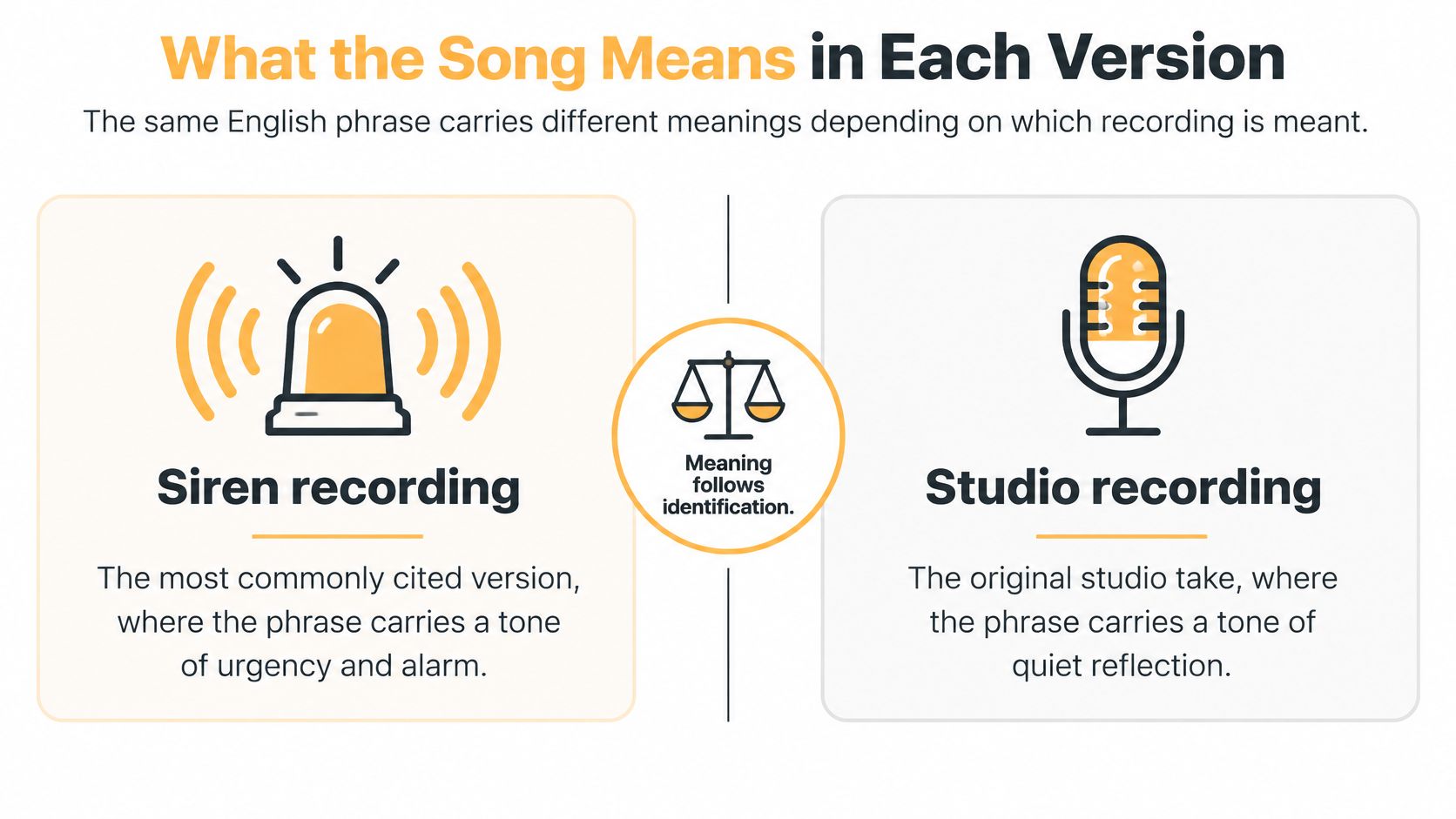
For the rest, the honest answer is shorter. The Slackers' 2008 track on Hellcat Records, Ami Leigh's 2024 single on Ami Leigh Music, and the entries under Alex Nicol, Lowrider and Yunger each carry documented release facts, verifiable through the credits checks described above. None of them, in the sources cited across this guide, has published commentary from artist or label explaining what the song is about. Reading them through Siren's lens, or through the emotional register of Kanye West's differently titled I Wonder (a separate, non-matching work that belongs to the near-titles discussion), would assign meaning to recordings that never earned it. Where no attributed interpretation exists, a page should say so plainly.
The gap is useful information in itself. It marks the line between documented fact, like the Hellcat release year or Amelia Leigh Boorman's songwriter credit, and listener inference, like what a fan personally hears in a chorus. Both belong on a song page. Each just needs its own label.
Pin down the recording first. The reading you can defend depends entirely on which row you matched.
Official Videos and Embeds for Each Recording
An official video must match the recording row, not just the title. Otherwise a video for one And I Wonder can sit beside lyrics for another, and the page looks coherent while being wrong.
A Five Point Video Checklist
- Confirm the channel. It should belong to the artist, label or verified rights holder, not an unrelated uploader.
- Match artist and title. The video's listed artist and title should match your confirmed row exactly, including punctuation.
- Compare audio length. If the video length differs greatly from the listed duration, suspect a different version or an edit.
- Prefer official over fan-made. An official video is the canonical audiovisual reference. Lyric videos and fan uploads can help memory but shouldn't replace it.
- Admit gaps plainly. If no official video exists for a recording, say so rather than substituting a similar one.
Older compilation tracks may have no video at all, and that's useful information in itself. A missing video tells you something about the release context, while a substituted video tells you something false.
When a song page embeds a verified official video alongside attributed lyrics and credits, you can check all three against each other in one place. Words, sound and image either corroborate the same recording or expose a mismatch quickly. That triangulation is the practical payoff of entity resolution.
Confirm the Right Version Before You Quote or Share
You can finish the whole verification in one sitting. It takes minutes, and it saves you from passing ambiguity on to everyone who reads your quote.
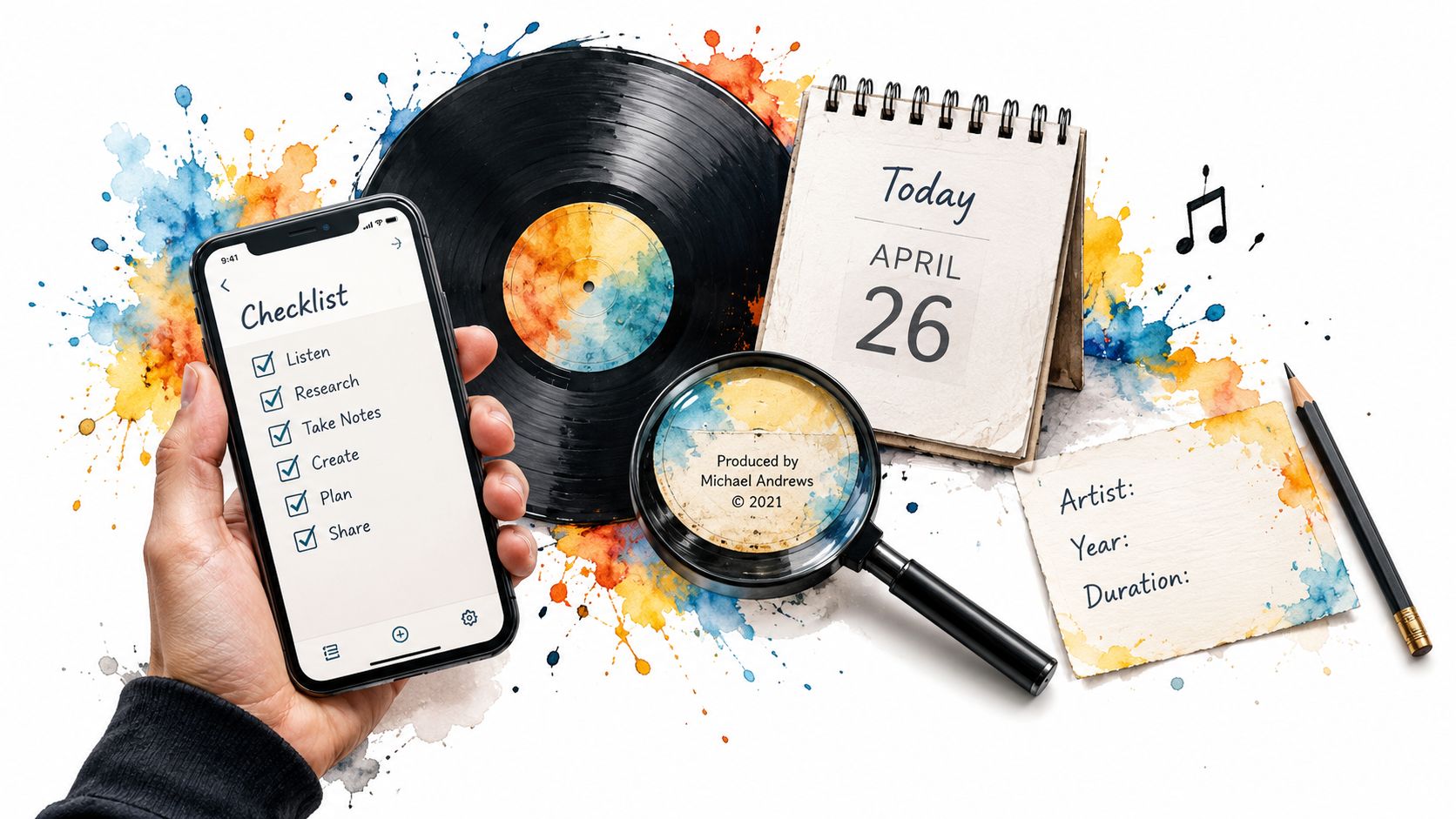
The true test comes after the checking, at the moment you cite the song. A title in quotation marks tells a reader almost nothing, because the same title can point at several different recordings. The same title followed by an artist name and a release year points them to the exact version you heard. That attribution is the deliverable entity resolution produces.
A structured song page does the corroborating for you. One page tied to one recording, with attributed lyrics, credits and the official video side by side, and edits reviewed before they appear. If any element disagrees with the others, you catch the mismatch before your readers do.
Sharing with context costs one extra clause. Write the artist and year alongside the title, and whoever encounters your quote inherits the identification work you already did instead of repeating the ambiguity.
When you're ready to verify a recording rather than guess at one, House of Lyrics lets you browse indexed song pages to confirm which And I Wonder you mean.