All My Tears Lyrics: Official Text, Version and Credits
Read official All My Tears Lyrics with clear credits, a version guide for Julie Miller, Emmylou Harris and more, and the right attribution.

Julie Miller wrote “All My Tears,” and Emmylou Harris's 1995 Wrecking Ball version is a recording of Miller's song, not an original Harris composition.
But if a lyric page gets every word right and attaches those words to the wrong artist, is it really accurate? Searching for “All My Tears” lyrics can lead you to several performances of Miller's composition, as well as unrelated songs with the same title. The useful starting point is identity accuracy: knowing which recording you're hearing before trusting its words, credits, or video.
Table of Contents
- Which All My Tears Version You Are Hearing
- Official Lyric Text Laid Out by Verse and Chorus
- Who Wrote, Recorded and Owns the Song
- Watching the Official Video With the Lyrics
- How Listeners Hear the Song's Message
- Mix-Ups With Other Songs Titled All My Tears
- Confirm Your Version Before You Quote or Share
Which All My Tears Version You Are Hearing
Which “All My Tears” recording is playing? Start by separating the composition from the recording. The composition is the underlying song, while each recording is a particular performance. Julie Miller's authorship belongs to her song even when another artist changes its sound or delivery.
SecondHandSongs lists Miller's first release as “All My Tears (Be Washed Away)” in May 1993. Emmylou Harris's version followed on September 26, 1995, and Jimmy Scott's on September 24, 1996.
Known recordings of All My Tears by version
| Recording | Release date | Album or context | Credited writer | How to identify it |
|---|---|---|---|---|
| Julie Miller (original) | May 1993 | Released as “All My Tears (Be Washed Away)” | Julie Miller | Earliest listed release; alternate title |
| Julie Miller and Emmylou Harris | 1993 | Orphans & Angels, duet | Julie Miller | Harris performing alongside Miller |
| Emmylou Harris | September 26, 1995 | Wrecking Ball | Julie Miller | Daniel Lanois production; Harris's solo album recording |
| Jimmy Scott | September 24, 1996 | Heaven | Julie Miller | Scott's distinct vocal interpretation |
| Crowder and Buddy Miller | May 31, 2024 | The EXILE | Julie Miller composition | Joint artist billing |
The recording history published by Melody identifies the duet on Miller's 1993 album and places Harris's later studio performance at track 3 on Wrecking Ball, with an approximate running time of 3 minutes 42 seconds. The Apple Music listing for Crowder and Buddy Miller dates their The EXILE recording to May 31, 2024.
Other versions are easier to identify by their catalog listings than by comparing them with the dated releases above. Ane Brun's catalog includes a piano version of “All My Tears,” and its Apple Music catalog entry credits Julie Miller as songwriter. Jars of Clay also recorded the song in a rock style. In both cases, the performer and arrangement distinguish the recording, while Miller remains the songwriter.
Match the recording, not just the title
Before choosing a lyric page, compare a few details:
- Title: Include the alternate subtitle if the release uses it.
- Writer: Look for Julie Miller when identifying this composition.
- Performer: Match the artist shown in your music player.
- Release: Check the album and year, particularly when an artist has more than one version.
A familiar voice identifies the singer, not necessarily the songwriter. Once the artist and release match the recording you hear, you can compare its lyrics without mixing it up with another performance.
Official Lyric Text Laid Out by Verse and Chorus
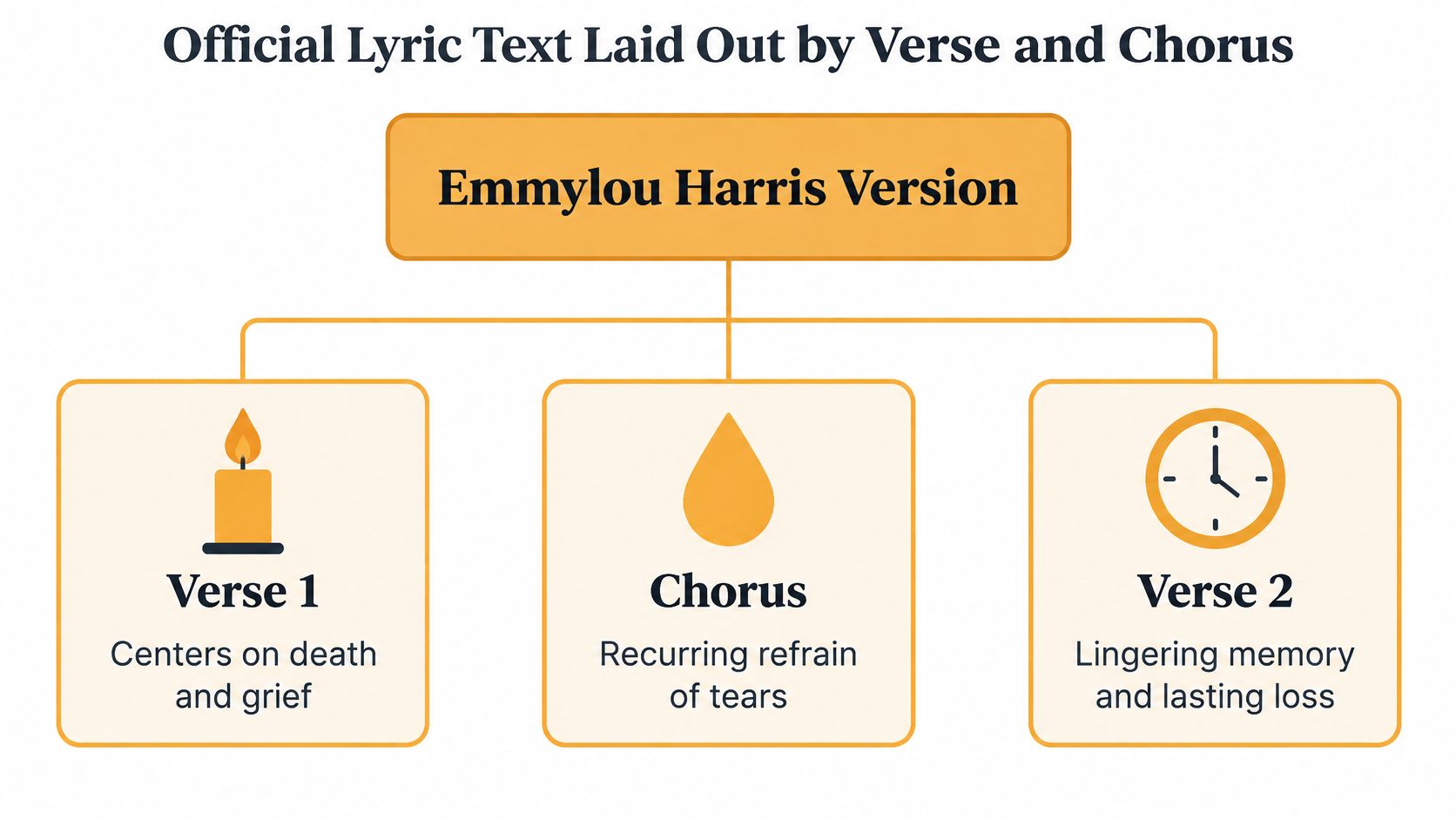
Which “All My Tears” lyric page matches the recording you're hearing? Start by checking the performer. The Genius lyric page for Emmylou Harris's recording lays out the song in two verses with a recurring chorus. Its imagery brings together death, spiritual comfort, freedom, worldly possessions, and resurrection.
The lyric blocks offer a useful map without reproducing the complete copyrighted text. Read them as a guide to the song's progression, then compare the wording with the performance itself. A lyric page can help identify the structure, while the recording reveals how a particular singer phrases and repeats each passage.
Follow the lyric blocks
Verse 1 introduces death from a consoling perspective. The speaker acknowledges death, while the song's spiritual outlook points beyond it.
Chorus returns to release and freedom. Its burial imagery supports a larger promise of comfort, rather than focusing only on grief at a graveside.
Verse 2 contrasts worldly wealth with what the speaker expects beyond death. The reference to resurrection gives the song a forward-looking direction.
Final chorus brings back the central reassurance. Like a refrain in a conversation, its return makes the song's main comfort easier to recognize and remember.
The diagram offers a visual guide to the main blocks. Its shorthand about memory and loss is only a starting point; the lyric's religious themes give that structure more specific meaning.
Lyric blocks and what to compare
| Block | Thematic role | What to compare with the recording |
|---|---|---|
| Verse 1 | Death and spiritual consolation | Check where the verse begins and ends, and note any sung variation |
| Chorus | Freedom and tears removed after burial | Compare repeated choruses for consistent wording |
| Verse 2 | Release from worldly wealth and anticipated resurrection | Follow how the verse develops the contrast with the chorus |
| Chorus (final repeat) | Closing refrain | Check whether the final return matches earlier chorus wording |
When comparing a lyric page with the recording, check that each chorus repeat uses the same wording. If the performer changes a word or phrase, treat it as a difference in that performance rather than assuming every version is identical. Spelling, punctuation, and line breaks can also vary between lyric pages, so use the song's verse-and-chorus structure to keep your place.
A familiar structure does not prove that two songs share the same lyrics. Confirm the performer and recording first; another song with the same title may have entirely different words.
Who Wrote, Recorded and Owns the Song
Julie Miller's writing credit and Emmylou Harris's performance credit describe different contributions. Apple Music's credits for the Miller and Harris recording identify Miller as songwriter and list Julie Miller, Dan Posthuma, Buddy Miller, and J.R. McNeely as producers.
That distinction prevents a common catalog error: presenting a singer's recording as though the singer also created the composition. It also keeps production and performance credits from being mistaken for ownership information.
The image below separates the creative activities involved in bringing a song to listeners.

Credits a trustworthy page should display
- Songwriter: Name Julie Miller. Use a formal words-and-music credit only when the authoritative credit supports that wording.
- Title: Preserve “All My Tears (Be Washed Away)” as an alternate title where applicable.
- Performers: Distinguish the principal artist from duet partners and featured artists.
- Release information: Identify the album, release date, and track position when verified.
- Production and musicians: Attribute the recording's actual contributors rather than copying credits from another version.
- Text provenance: Name the approved lyric source and the party who authorized publication.
Authorship isn't a complete ownership record
A songwriter credit doesn't, by itself, identify the current publisher, licensing administrator, or owner of a particular master recording. Those questions require separate rights documentation.
For anyone managing a catalog, this guide to music rights management provides useful context for keeping composition rights and recording rights distinct.
Cataloging rule: Keep the composition connected to its recordings, but don't merge the recordings' credits.
Separate pages or clearly labeled recording variants make that possible. A listener can then move between performances without losing the underlying songwriter attribution.
Watching the Official Video With the Lyrics
Which “All My Tears” are you hearing? Start by matching the video's artist, release context, and title to the recording you selected. A shared title alone cannot establish a match, and a live performance may differ from the studio recording.
A song-page layout can place lyrics and audiovisual references together, as shown below.

Check the upload before treating it as authoritative
- Uploader: Look for the artist's or label's recognized channel, then check the description.
- Recording: Identify whether the audio is the album performance, a concert recording, or another arrangement.
- Format: Separate an official music video from official audio and a lyric video.
Harris's recording is an album track, but that alone does not confirm a dedicated promotional video. No matching official video has been confirmed for this recording, so check the uploader and the recording before pressing play on any upload. An official audio upload may be a better reference than a performance clip whose connection to the recording is unclear.
Lyric videos need one more check: who supplied and approved the words on screen? The guide to official lyrics videos explains why a video's format does not, by itself, establish that its lyric text is authoritative. Treat the audio and displayed words as separate details to confirm. A player's presence alone does not verify the recording, lyrics, or credits.
How Listeners Hear the Song's Message
Lyric facts and listener interpretation aren't the same thing. The Ane Brun lyric text on SongLyrics includes explicitly Christian imagery involving Jesus, resurrection, death, and freedom beyond earthly life.
A Christian reading therefore comes from the words themselves, not merely from the song's atmosphere. Still, listeners can respond to its reassurance without sharing every belief expressed by its speaker.
Faith, farewell, and release
As a faith testimony, the song voices confidence that death won't have the final word. The consolation depends on an expectation of continued life, not on denying that death hurts.
As a farewell to survivors, it can sound like someone asking loved ones to remember them without imagining them trapped in suffering. That perspective can be moving during anticipatory grief, when a family is facing loss but hasn't yet experienced the final separation.
As a meditation on release, the song shifts attention from bodily burial and possessions toward a freedom the speaker considers more important. A listener may connect with that emotional movement while understanding its theological claims differently.
Comfort doesn't require every listener to hear the song in exactly the same way.
For a funeral or memorial, consider the beliefs of the person being remembered and the people attending. Calling the song merely soothing can conceal religious language that matters to both believers and nonbelievers.
Choose an arrangement by listening to its emotional weight
Harris's acoustic-leaning performance can feel intimate while retaining the spacious atmosphere of its production. Ane Brun's piano arrangement offers a different frame: the voice and keyboard can draw attention to pauses, exposed phrases, and the weight of individual words.
Jars of Clay's rock-album context may suit listeners who want momentum rather than stillness. These are listening judgments, not fixed properties that every audience will experience identically.
- Quiet remembrance: Try the piano recording and listen for whether its sparseness feels comforting.
- Hymn-like reassurance: Compare how each singer delivers the recurring promise.
- More movement: Hear the rock arrangement before deciding whether its energy suits the occasion.
For another example of religious language carrying both sorrow and reassurance, the discussion of “Trading My Sorrows” lyrics offers a useful comparison. The practical question is whether the words and the performance fit your situation together.
Mix-Ups With Other Songs Titled All My Tears
Which “All My Tears” are you hearing? A shared title can point to separate compositions, so identify the songwriter and recording before comparing lyrics or credits.
The Frightnrs' “All My Tears” is a distinct song with its own writing and production credits. Check its release listing rather than carrying over credits from Miller's composition. Similar references to grief and tears do not make two songs versions of each other.
Apple Music lists sevenyBeats' “All My Tears” as a single released on February 3, 2024. That release has its own identity, too. A matching title alone does not connect its credits to Miller's song.
Compare the identities side by side
| Search result | What to establish | What not to assume |
|---|---|---|
| A performance of Miller's composition | Miller's writer credit and the selected performer | Every arrangement uses identical phrasing |
| The Frightnrs' song | Its own writing and production credits, checked against its release listing | Similar grief imagery means the same composition |
| sevenyBeats' single | Its release-specific credits | A matching title establishes authorship |
Use a simple decision test
- Writer match: Does the page name the songwriter for the composition you meant?
- Performer match: Does the artist shown match the recording you are playing?
- Release match: Does the album or single information belong to that performance?
A mismatch can mean the page is valid but refers to another song. The same care helps with other ambiguous titles, including “Cats and Dogs” lyrics.
For archives, store a composite identity: title, songwriter, performer, and release. Keep alternate titles with the right composition. The title alone is too broad to serve as a reliable key when importing text.
Confirm Your Version Before You Quote or Share
A short verification pass can prevent a well-intentioned quotation from spreading the wrong attribution. Keep the recording open while you check the page, rather than relying on a remembered voice or a search-result snippet.
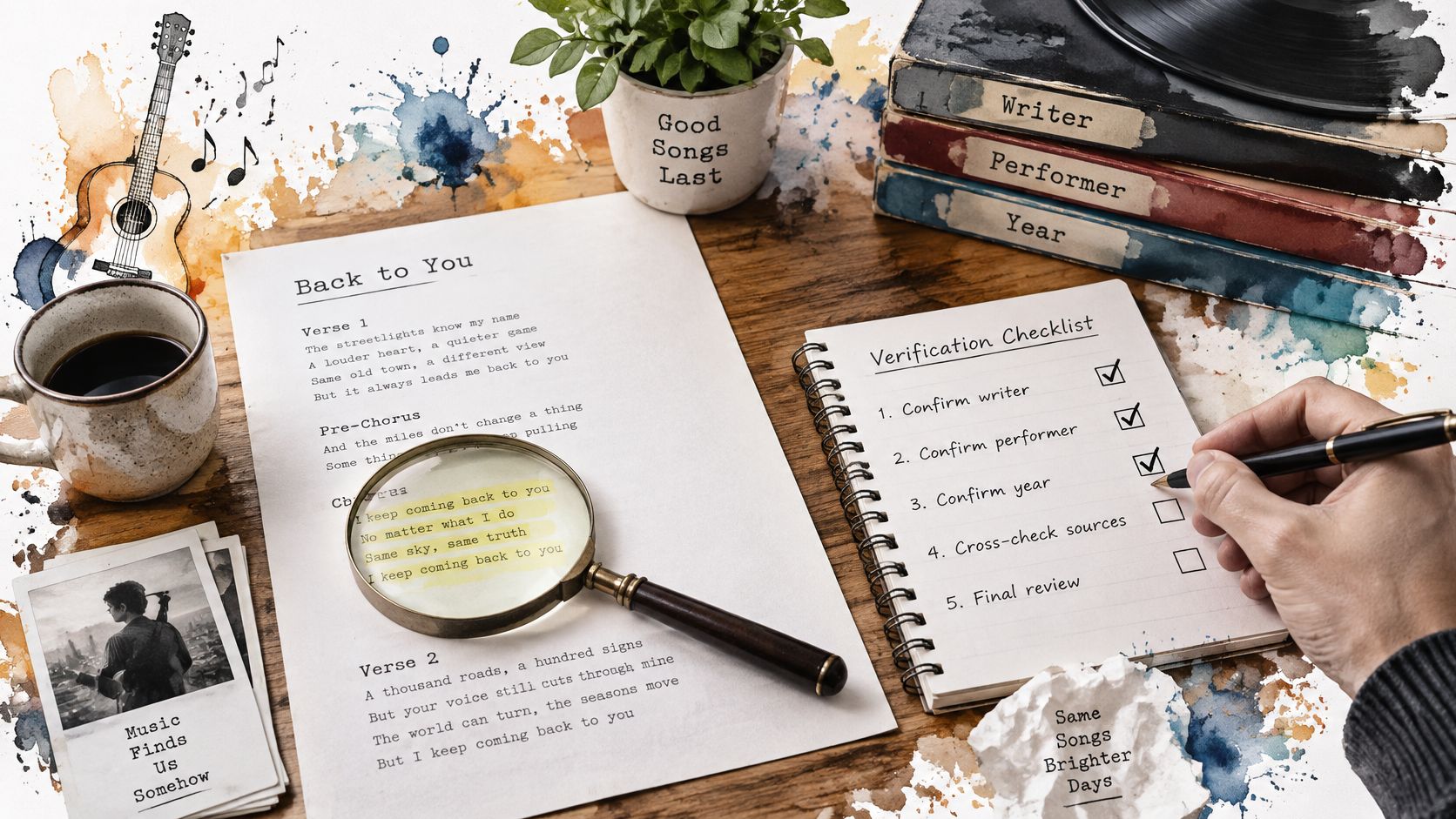
Use the workspace illustration as a reminder to check both words and credits.
A practical verification sequence
- Identify the recording. Match the performer and release to the composition you intended.
- Compare the text carefully. Use an approved source to check section boundaries, chorus repetitions, and final lines.
- Read the attribution. Confirm the songwriter and look for an identifiable source of approval.
- Inspect the audiovisual reference. Make sure a linked upload contains the same performance.
- Flag missing information. Report an absent credit or unconfirmed video instead of filling the gap from an unofficial page.
If you're working from an authorized audiovisual source, Typist's guide to transcribe YouTube videos with AI can help with a preliminary listening transcript. Treat that output as a draft: automated transcription can mishear sung words, and it neither grants permission nor establishes approved spelling.
A route for artists and rights holders
Alongside artist websites and label catalogs, House of Lyrics offers verified owners claimable artist, album, and song pages. Its process uses a one-time code in an X or SoundCloud bio, with lyric and credit edits held for review before publication.
For listeners still trying to locate a reliable text, this guide to finding song lyrics offers a practical starting point. Check the version, consult approved words where available, and share with the correct credit.
House of Lyrics pairs artist-approved lyrics with official video embeds and connected artist, album, and song pages. Visit House of Lyrics to browse its catalog and check whether your “All My Tears” recording is represented with the credits and text you need.