La Bamba Lyrics: Versions, Credits and Where to Verify
Compare every major La Bamba lyrics version, see who performed it and when, and check credits and official video before you sing or cite it.

The usual advice for finding La Bamba lyrics, search the title and copy the first complete text, skips the most important question: which version are you singing? A regional performance, a Ritchie Valens recording, and a Los Lobos recording shouldn't automatically share the same lyric sheet. Start with a labeled version, then check its words, credits, and recording together. You'll understand the music better, and you'll avoid teaching or performing a mixture nobody intended.
Table of Contents
- Why La Bamba Has No Single Lyric Sheet
- Every Major Version at a Glance
- Key Lines and What They Actually Mean
- Approved Lyric Text and Attribution
- Performance Context and Use Cases
- Song Credits and Official Video
- How to Verify Attribution, Credits and Video
- Choose the Right La Bamba Version Before You Sing or Cite
Why La Bamba Has No Single Lyric Sheet
La Bamba has no single authoritative lyric sheet that covers every performance. It belongs to a living musical tradition, not just to a familiar recording. A useful lyric page identifies a particular rendition rather than presenting its text as the final answer for everyone.
The song is a traditional, variable-text son jarocho from Veracruz's southern Gulf-coast region, where Spanish, Indigenous, and African musical elements meet. The scholarly document hosted by the University of California places its circulation as a popular son in the early nineteenth century and describes a performance tradition in which recurring refrains coexist with changing or improvised verses. That distinction explains why a recognizable song can have different words without either performer making a mistake.
A tradition isn't the same as a recording
In a traditional performance, singers can select verses from a shared repertoire or adapt their delivery to the occasion. The song's identity doesn't require every rendition to preserve an identical sequence. A refrain can remain recognizable while the surrounding verses change.
A commercial recording creates a different kind of reference. Once a performer records a particular sequence, listeners can check a transcription against that performance. The recording fixes that rendition, not the whole tradition.
Rock adaptations by Ritchie Valens and Los Lobos therefore need their own labels. Their arrangements and selected verses are useful references for listeners who want those recordings, but neither should replace the wider son jarocho repertoire.
Practical rule: A lyric can be accurate for one recording and wrong for the recording you're using.
What a useful version label includes
Before reading the opening line, look for these details:
- Category: Traditional son jarocho, rock adaptation, or another clearly described arrangement.
- Performer: The singer or ensemble heard in the reference recording.
- Recording date: A documented date, with uncertainty stated rather than concealed.
- Material status: Traditional material, an adaptation, or a combination identified in the credits.
Keep recording dates and release dates separate when the documentation distinguishes them. Don't fill an empty field by guessing from an upload date.
Our guide to how to find song lyrics offers a broader starting point for identifying the right text. For this song, the essential habit is especially simple: choose the performance before choosing the words.
Every Major Version at a Glance
| Version | Performer | Release | What to check |
|---|---|---|---|
| Traditional son jarocho | Anonymous regional performers | Oral tradition, no single release | Identify the actual ensemble or recording; regional and improvised stanzas can differ |
| Early commercial recording | Álvaro Hernández Ortiz, performing as El Jarocho | Around 1938 or 1939, on Victor, according to the Library of Congress history, which also identifies Valens's 1958 rock reinterpretation | Compare the label and, where available, matrix identifier with the audio and verse order |
| Rock adaptation | Ritchie Valens | The rock recording identified in the Library of Congress chronology above | Check the selected verses, repetitions, and Spanish-language delivery of that recording |
| Film soundtrack version | Los Lobos | The recording released with the film soundtrack of the same name | Identify the soundtrack recording rather than assuming a live take or later upload matches it |
Each row points to a different kind of reference. The traditional row describes a musical tradition, not an anonymous master recording. To check a transcription, identify a particular performer or recording, just as you would choose a specific edition before comparing passages in a book.
The Library of Congress account connects the song's deeper history with Afro-Mexican cultural exchange and movement between Spain and the port of Veracruz. It also describes uncertainty about the precise origin, including an account that treats it as an eighteenth-century folk work. An origin estimate is not a release date, and an early commercial recording does not prove when the song was first sung.
Read the table as a selection tool
An older recording does not automatically preserve the most authentic or complete text. Age alone cannot show which regional verses a performer chose, whether a singer improvised, or how an arranger shaped the performance. Listen to the recording and check its documentation.
For a familiar rock singalong, choose the artist whose arrangement your accompaniment follows. For cultural study, choose a documented son jarocho performance and retain its regional context. For an early-recording comparison, use the label information and audio together rather than relying on a modern title alone.
- Choose the sound first: Identify the recording you intend to use.
- Match the transcription: Compare the opening, verse sequence, repeated phrases, and ending.
- Record the reference: Save the performer and release information with your working lyric sheet.
The same version-first approach can help when exploring El Cuarto de Tula lyrics. A familiar title does not mean every performance uses the same words.
For karaoke, teaching, or an event program, use the matching setting in Performance Context and Use Cases to narrow your choice.
Key Lines and What They Actually Mean
A single English translation can't settle every question about La Bamba lyrics. Translators make choices, and readers need to know whether a sentence explains the words themselves or interprets their cultural meaning.
The familiar declaration “I'm not a sailor, I'm a captain” makes that distinction clear. The NPR discussion of La Bamba connects the stanza with Veracruz's nautical setting and notes that even the title's meaning remains disputed. Reading the declaration only as a romantic boast leaves out that coastal context.
The maritime imagery is a useful starting point, not proof of a single hidden message.

Read meaning in separate layers
A careful translation distinguishes these approaches:
| Translation layer | What it does | What it shouldn't do |
|---|---|---|
| Literal | Preserves the basic meaning of the words and grammatical relationships | Add a message that isn't stated |
| Idiomatic | Makes the meaning sound natural in English | Pretend every wording choice is inevitable |
| Interpretive | Explains possible associations, performance context, or symbolism | Present a possible reading as the only meaning |
For the sailor-and-captain declaration, the literal contrast concerns roles or rank. An idiomatic English rendering can keep that contrast without sounding stiff. An interpretive note might discuss confidence or self-presentation, but it should identify that explanation as a reading, not an extra line of the song.
The same care applies to language about grace. In English, grace can suggest elegant movement, charm, or a quality associated with a person's manner. In a dance-centered explanation, an educator can discuss coordination and expression without claiming that the lyric explicitly lists those qualities.
Partnership needs similar restraint. A reference to another person may sound intimate, but performance context matters. Don't automatically turn every shared action or address into a love story.
A translation should let readers distinguish what the singer says from what the translator thinks it suggests.
Keep the title and verse history honest
Leave La Bamba as the title unless you're explaining a documented interpretation. Don't replace uncertainty with a confident word-origin story or claim that it has one settled English equivalent.
For line-by-line study, use a consistent layout:
- Source line: Copy the exact wording from the identified, authorized text.
- Literal gloss: Explain its direct meaning beneath it.
- Interpretive note: Label cultural associations or possible implications separately.
Verse provenance also deserves a label. A line may belong to the traditional repertoire and also be familiar because listeners heard it in a Valens or Los Lobos recording. Those are different claims: traditional origin doesn't mean selected for every recording.
If an alternate regional verse appears, identify the performance that documents it. Don't insert it into a rock transcription merely because it belongs somewhere in the song's wider history. When documentation doesn't establish a verse's origin, say that its provenance hasn't been confirmed.
Approved Lyric Text and Attribution
A lyric block should identify the performance it represents before presenting the words. That label helps readers tell one version from another, much as a name tag distinguishes similar-looking files.
The example below shows the layout a lyric block should follow, so readers can see which details belong beside the words.
A clear lyric-block layout
| Field | What readers should see |
|---|---|
| Version label | Performer, recording date, and whether the version is traditional or adapted |
| Source text | Submitted words, preserving spelling, contractions, repetitions, and verse order |
| Attribution | The named artist, rights holder, or reviewing party |
| Approval status | Whether the text has been approved, is pending review, or remains unverified |
| Reference recording | The performance used to check the transcription |
Approval status should describe the review accurately. House of Lyrics hosts lyrics submitted by the artist or rights holder, and submitted lyrics are reviewed by the song owner or House of Lyrics editors before appearing on a page. A correction by an editor alone does not mean the artist approved the text.
“Traditional” describes a version's provenance, not the accuracy of a particular transcription. A traditional verse can still be misheard, placed in the wrong order, or associated with the wrong recording.
Separate text from explanation
Keep translations outside the source lyric block. Place each source line first, its literal gloss beneath it, and any interpretation under a clear label. Give alternate traditional verses separate blocks with their own performance references, rather than blending them into a different version.
- Preserve the performance: Keep repetitions that appear in the identified recording.
- Expose uncertainty: Mark unclear wording for review instead of guessing.
- Keep attribution visible: Identify who submitted or reviewed the text beside the lyric block.
The surrounding identifying details are metadata. A guide to what metadata means can help distinguish those details from the lyric itself. For La Bamba, they tell readers which performance the text represents, without presenting one version as definitive for the entire tradition.
Performance Context and Use Cases
At a fandango, musicians and dancers participate in a shared event. Consider a rehearsal in which the dancers begin their footwork, the singers listen, and the ensemble adjusts its delivery to the people taking part. The words aren't functioning like a poem read from a sheet.
An account of La Bamba's fandango and wedding context from KPBS describes zapateado on a wooden platform and wedding choreography in which a couple ties a ribbon into a bow with their feet, symbolizing union. That setting gives an educator a concrete way to explain why movement, grace, and partnership matter beyond a dictionary translation.
Match the text to the activity
| Use case | Starting version | Check before use |
|---|---|---|
| Karaoke | Rock adaptation matching the backing track | Confirm that the track's verse sequence, repeats, and ending match the lyric sheet |
| Classroom study | Traditional son jarocho with a labeled translation | Separate literal meaning from interpretation and identify the reference performance |
| Dance practice | Traditional son jarocho recording | Note zapateado timing, vocal entrances, and verse changes |
| Wedding or cultural program | Traditional version with approved lyrics | Credit the performer and confirm the relevant permissions |
| Published citation | Artist- or rights-holder-approved version | Cite performer, date, approval status, and the source consulted |
For karaoke, rehearse with the actual backing track. Mark the lead vocal entrance, any backing responses, and non-vocal passages on a practice copy. A lyric sheet can contain the right words yet still leave a singer stranded if the accompaniment repeats a section differently.
In a classroom, assign roles explicitly. Ask one reader to follow the source text and another to read the labeled translation, then compare what each can explain. If students create new verses as an exercise, label them as classroom adaptations rather than traditional lyrics.
Dance practice needs cues that translation can't supply. Mark where the singer begins, where the dancers need an uninterrupted phrase, and where a verse change occurs. If live performers intend to improvise, agree on a cue so the dancers aren't relying on the printed page to predict every transition.
Give performers usable context
For a wedding or cultural program, the program note should explain the chosen performance without prescribing a supposedly universal singing pattern. Identify who will sing the lead, whether others will respond, and whether any verses are prepared specifically for the occasion. Discuss permissions separately from cultural provenance; an approval label isn't a blanket answer to every use.
For guitarists comparing related regional approaches, TrueFire's five free Cuban guitar lessons offer a separate practice resource. Use them for broader exploration, not as instructions for son jarocho or evidence that Cuban and Veracruz traditions are interchangeable.
For event teams: Pair the working lyric sheet with a short performance note naming the arrangement, vocal roles, dance cues, and planned improvisation.
A mixed arrangement also needs an honest description. If a group combines traditional verses with a rock refrain, say so in the program and identify the sources used. Don't label the result as a transcription of a recording it no longer follows.
Before rehearsal, have the singer and musical director compare the version label with the accompaniment. That small check can prevent an avoidable mismatch before dancers, students, or guests have learned the wrong sequence.
Song Credits and Official Video
A trustworthy credit line separates the people and roles involved. Performer, writer, and arranger aren't interchangeable, and a famous recording artist shouldn't automatically receive every credit on a lyric page.
Use the credits attached to the chosen release. Where documentation identifies traditional material, preserve that designation rather than inventing an individual author.
Read each role separately
- Performer: Name the artist or ensemble heard in the selected recording.
- Writer: Reproduce the documented credit, including traditional or unknown where appropriate.
- Arranger: Name the credited arranger when the release identifies one; don't infer the role from performance alone.
- Material description: Identify traditional son jarocho from Veracruz when that description applies, while keeping recording-specific credits distinct.
An unavailable credit and a traditional credit mean different things. Unknown signals a gap in identification. Traditional describes provenance. Neither is a reason to assign authorship to the person whose recording happens to be most familiar.
Check the video as a separate source
A video should help readers verify the lyric, not merely decorate the page. Check the uploader's identity, the description, and the recording itself before treating an upload as official.
A live performance, a promotional edit, and a soundtrack recording can share an artist and title without sharing every vocal passage. Listen to the opening, transitions, repetitions, and ending. If the video differs, label the difference or select a matching reference instead.
Our video embed service guide explains the role of embedded media alongside song information. For verification, keep the credits and video near the lyric block so readers can compare them without losing their place.
A credit without an identifiable version is difficult to check. An official video of a different take still isn't evidence for the text on the page.
How to Verify Attribution, Credits and Video
Verification works best as a repeatable routine. Keep a working note beside the page and record the evidence for each decision rather than relying on a polished layout or a familiar artist photograph.
The visual checklist summarizes the relationship between version, attribution, video, and use.
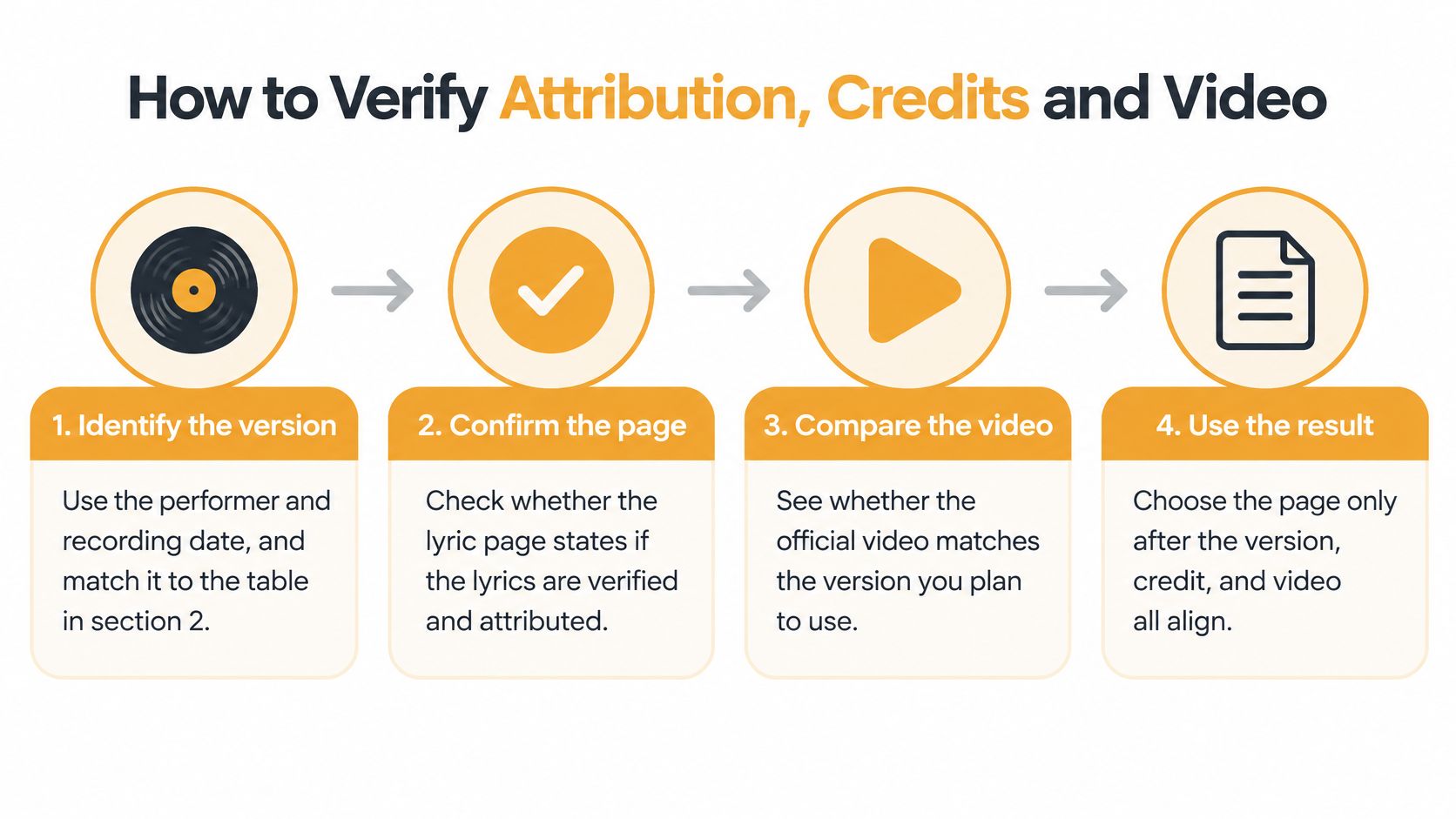
Run the checks in order
Identify the version by performer and date. Match it to the appropriate category in the version table. Distinguish a recording date from a release date or video upload date so you aren't comparing unrelated references.
Confirm the material's status. The page should tell you whether you're reading traditional material, an adaptation, or a documented combination. If it doesn't, avoid supplying that classification from memory.
Check who submitted the text. At House of Lyrics, we only host lyrics submitted by the artist or rights holder. Submitted lyrics are reviewed by the song owner or our editors before they appear on a page, so submission and review are distinct parts of the process.
Look for visible attribution. Identify the approving party and read the status attached to the text. Our explanation of what an editorial review is helps clarify the purpose of review, but a general policy doesn't replace page-specific evidence.
Inspect the recording credits. Check performer, writer, and arranger separately, preserving traditional or unknown designations where documented. If a role isn't supported, leave it unresolved rather than filling it with the best-known name.
Confirm the embedded video's provenance. Establish whether it comes from the artist, rights holder, or another documented official source. Then check whether it contains the same recording, since official status alone doesn't establish a lyric match.
Compare the text with the audio you will use. Follow the words while listening and log omitted verses, added repetitions, alternate wording, and changes in order. Don't correct the page to match another performance.
Keep a record of unresolved differences
A simple note can distinguish wording mismatch, different take, missing credit, and approval not established. Those descriptions help an editor or rights holder address the actual problem without treating every discrepancy as a transcription error.
A fully checkable page puts its identifying information within easy reach: version label, performer, date, attribution, approval status, credits, and the matching official video. If an element can't be established, the page should make that uncertainty visible.
Choose the Right La Bamba Version Before You Sing or Cite
Choose a single reference version for each project. Fans, teachers, and event organizers can then use the same labeled source on handouts, rehearsal notes, slides, and programs rather than unknowingly combining incompatible texts.
Keep the version details visible while comparing a page with its recording.
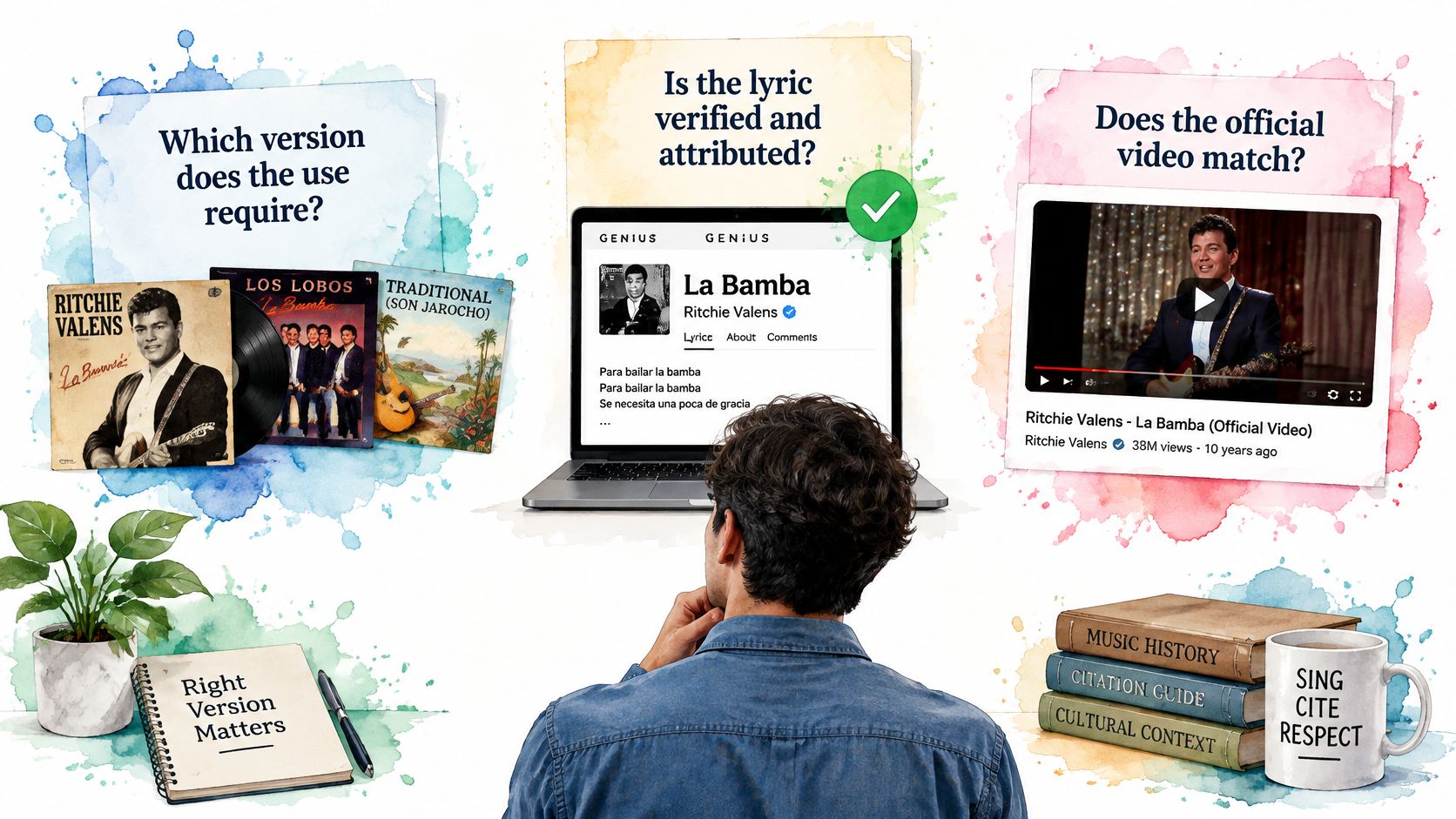
Make the final decision from evidence
Ask whether the selected version suits the activity, whether the text is attributed and reviewed, and whether the reference video matches it. Treat a page without a version label, attribution, or approval status as unverified for your purpose, and check the status displayed on the song's House of Lyrics page before relying on it.
We have 1,533 songs indexed, but catalog size isn't evidence that a particular La Bamba rendition is available or approved. A claimed song page lets its owner manage lyrics, chords, embeds, and their public profile, which provides a route for maintaining recording-specific information without making every rendition interchangeable.
Use the embedded video as a comparison candidate, checking its identity and track against your selected text rather than assuming the match.
The next step is concrete: choose a rendition from Every Major Version at a Glance, run the routine in How to Verify Attribution, Credits and Video, and resolve any mismatch before you sing, teach, or cite the words. If your arrangement intentionally combines sources, give it its own accurate label.
Visit House of Lyrics to explore artist-submitted lyrics, visible attribution, and official video embeds. For La Bamba, start by checking the available version information and approval status, then compare the text with the recording you plan to use.