Blessed Assurance Lyrics: Full Text, Credits and Videos
Find the full Blessed Assurance Lyrics with credits for Fanny Crosby and Phoebe Knapp, version notes and official video options.
You pull up Blessed Assurance lyrics ten minutes before rehearsal, and the second stanza on the screen isn't the one your hymnal prints. The melody is familiar, yet the credit names only one person. That mismatch is easy to fix once you match the words to a printing and keep the text writer separate from the tune writer.
Table of Contents
- Blessed Assurance Lyrics in Full, Stanza by Stanza
- Stanza Versions and How to Check a Lyrics Page
- Who Created the Hymn and How It Began
- Cite the Lyricist, Composer and Tune Correctly
- 1873 Publications and the Revival Spread
- Blessed Assurance Today in Hymnals and Recordings
- Official Videos and Where to Hear the Hymn
- Choose the Right Version to Sing or Share
Blessed Assurance Lyrics in Full, Stanza by Stanza
Copy the 1873 text below when you need the original wording. It has three stanzas and a refrain. Line breaks differ from book to book, so check the words, not the way a page is spaced.
Stanza 1
Blessed assurance, Jesus is mine!
O what a foretaste of glory divine!
Heir of salvation, purchase of God,
Born of His Spirit, washed in His blood.
Refrain
This is my story, this is my song,
Praising my Savior all the day long.
Stanza 2
Perfect submission, all is at rest,
I in my Savior am happy and blest,
Watching and waiting, looking above,
Filled with His goodness, lost in His love.
Stanza 3
Perfect submission, perfect delight,
Visions of rapture now burst on my sight;
Angels descending bring from above
Echoes of mercy, whispers of love.
Why the refrain comes back three times
The refrain follows every stanza, so a congregation sings "This is my story, this is my song" three times in a full rendering. That repeat is the chorus, not a fourth stanza. If a slide deck prints the refrain only once at the bottom, the singing pattern is still stanza, refrain, stanza, refrain, stanza, refrain.
Practical rule: Match the wording, not the layout. A book may join two short lines or shift a comma, and the text is still the 1873 form if the phrases above are intact.
| Part | Opening line | Role in the hymn |
|---|---|---|
| Stanza 1 | Blessed assurance, Jesus is mine! | Introduces the assurance and the believer's union with Christ |
| Refrain | This is my story, this is my song | Repeats after each stanza as the chorus |
| Stanza 2 | Perfect submission, all is at rest | Describes peace and trust in the Savior |
| Stanza 3 | Perfect submission, perfect delight | Closes with visions of rapture and divine love |
Stanza 1 plants the claim: Jesus is mine, and the singer is an heir, purchased, born of the Spirit, and washed. Stanza 2 turns that claim into rest, watching, and love. Stanza 3 keeps the submission theme and lifts it toward rapture, mercy, and love. If your copy swaps stanza 2, you are no longer holding this 1873 sequence, even when stanza 1 and the refrain look right.
Stanza Versions and How to Check a Lyrics Page
A projection slide can keep Crosby's first line and still carry someone else's second stanza. Hymnals alter or replace stanzas for theological, editorial, or congregational reasons, so two honest books can disagree. Hymnary's record of later printings documents a 1985 alternative second stanza by Marie J. Post in one hymnal and a Psalter Hymnal edition that marks its replacement stanza as a 1987 copyrighted "Reformed theological corrective" to Crosby's original stanza. The practical question is which printing the page copied.
| Version | Stanza change | Where you may meet it |
|---|---|---|
| Original 1873 text | Three stanzas with refrain, Crosby's original second stanza | Canonical reference for attribution |
| Marie J. Post alternative, 1985 | Alternative second stanza in one hymnal | Hymnals using that alternative stanza |
| Psalter Hymnal replacement, 1987 | Replacement stanza marked as a Reformed theological corrective | Congregations using that Psalter Hymnal edition |
Keep the roles straight while you compare: Fanny Crosby wrote the words, Phoebe Palmer Knapp wrote the tune, and later editors such as Post or the Psalter Hymnal committee changed only the stanza their edition names. A page that prints Post's second stanza under Crosby's first line is mixing versions, even if the refrain looks familiar.
Label the page before you share it
- Name the edition or recording you are reading, not a generic "hymn lyrics" header.
- Compare stanza two first, because that is where these changes sit while stanza 1 and the refrain often stay put.
- Separate the canonical 1873 text from the edition name and its date on the page.
- Keep Crosby credited for her original stanza even when a later editor supplies a substitute.
A church that sings the 1987 corrective is using a denominational revision, and the page should say so. The same is true of Post's 1985 alternative. "Lyrics" can mean the original public-domain text or a later revision, and those are different works for citation.
A six-point check
- Three stanzas and a refrain: The page shows the full stanza-refrain pattern, not a chorus-only clip.
- Two creators: Lyricist and tune composer are credited separately.
- Version and date: 1873, 1985, or 1987 is named, not implied.
- First line: It matches "Blessed assurance, Jesus is mine."
- Editor or rights holder: Named when the site itself names one.
- Source publication: A book or edition is cited, not only a website title.
A page that fails two or more of those items should be checked against a hymnal before you project it or print it. House of Lyrics only hosts lyrics submitted by the artist or rights holder, and submitted lyrics, chords, or media are reviewed by the song owner or House of Lyrics editors before they appear. Across 1,533 songs indexed, that review step gives each song page one accountable source instead of a blend of printings. If you are still hunting a trustworthy transcription, the guide on how to find song lyrics walks through source-checking without treating one web copy as final.
Who Created the Hymn and How It Began
The words and the tune did not come from one pen. In 1873, lyricist Fanny Crosby (1820–1915) and composer Phoebe Palmer Knapp (1839–1908) made the hymn together, as the Hymnology Archive account records.
Picture a New York City meeting. Knapp has a new melody and sits at the keyboard. She plays it and asks Crosby what the music suggests. Crosby answers with "Blessed assurance, Jesus is mine!" and then builds the lyric around that musical idea. The opening line is a reply to a tune, not a poem that later went looking for notes.
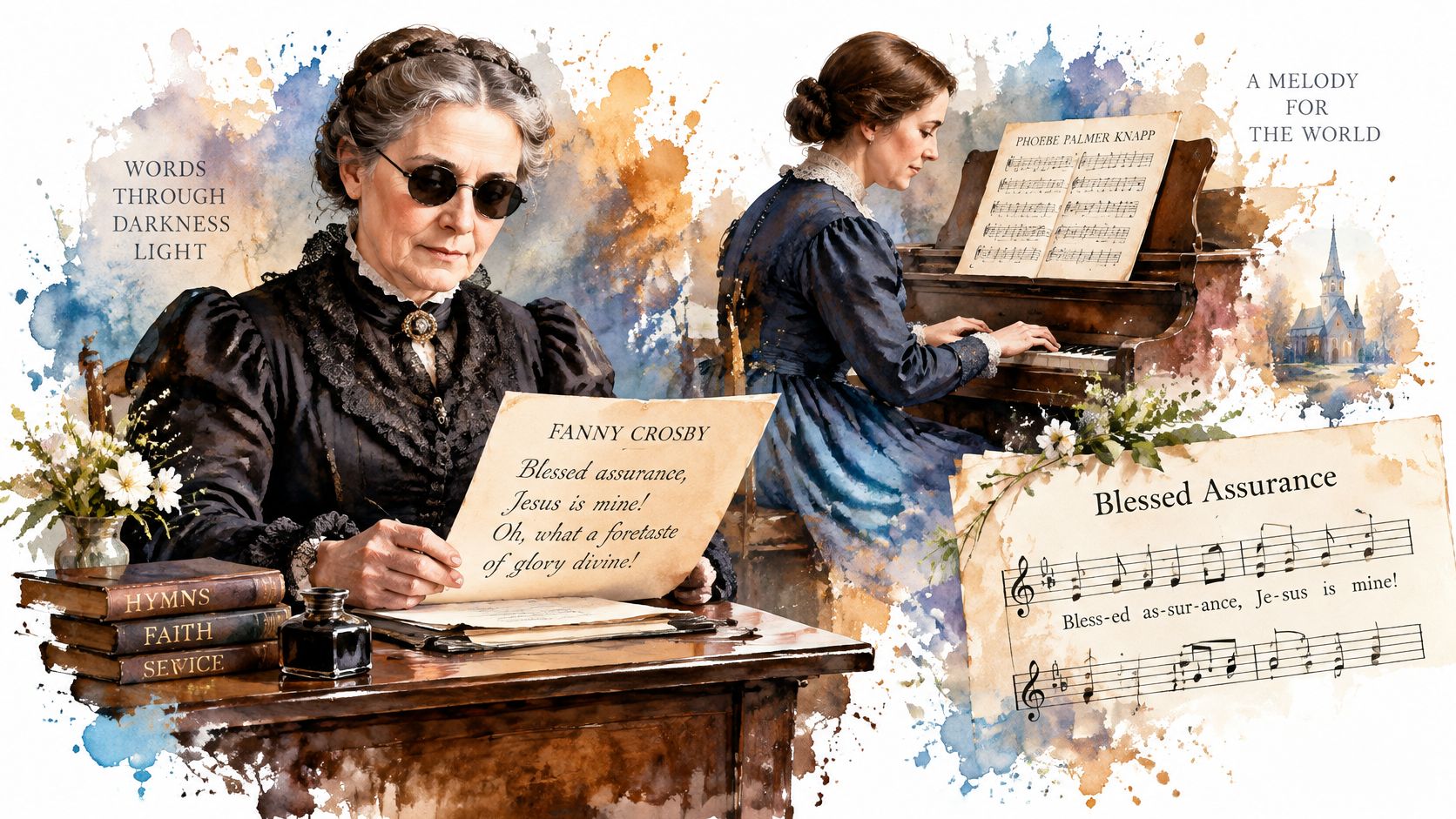
Crosby was blind and one of the most prolific hymn writers of her era. Knapp was a composer connected to the Methodist revival tradition. Their partnership matters because each role is distinct: Crosby supplied the text, Knapp supplied the melody. Collapsing them into "written by Fanny Crosby" drops the person who prompted the first line.
The work is three stanzas plus a recurring refrain, a verse-and-chorus shape that suited congregational singing. People could learn the chorus quickly and still have new lines in each stanza. The hymn also went to press three times during that first year, so the collaboration was not left as a private sketch.
When you hear these words on Knapp's melody, you are hearing the hymn in its original shape, because the title line grew out of that tune.
Cite the Lyricist, Composer and Tune Correctly
Catalogs keep the text author and the tune composer apart, and your citation should do the same. Merging them into one creator record is a common cataloging mistake. Hymnary's catalog entry treats this as a text-tune pair from 1873: Fanny J. Crosby wrote the words, and Phoebe Palmer Knapp composed the melody commonly identified as the tune "Assurance." It was not an anonymous folk lyric. The canonical first line is "Blessed assurance, Jesus is mine," and the publication history links Crosby's text and Knapp's tune to John R. Sweney's Gems of Praise in Philadelphia in 1873.
Write the credit in this order
- Name the text author first, then the tune composer. Crosby does not get the melody credit, and Knapp does not get the lyric credit.
- Add the first line as the identifier, so a printed copy with a shortened title can still be matched.
- Give the original year, 1873, and the source publication.
- If you are citing a later adaptation, name that editor or hymnal on its own line. Post's stanza and the Psalter Hymnal corrective are not Crosby's stanza.
- For a recording, list the performing artist as performer. The singer did not write the 1873 text.
A complete credit line names the author, the composer, the first line, the year, and the publication. Use the fields below as the minimum record.
| Credit field | Blessed Assurance value | Why it matters |
|---|---|---|
| Work title | Blessed Assurance | Canonical title for the catalog record |
| Text author | Fanny J. Crosby, 1873 | Credits the words, not the tune |
| Tune composer | Phoebe Palmer Knapp, 1873 | Credits the melody commonly called Assurance |
| First line | Blessed assurance, Jesus is mine | Identifier for matching printed versions |
| Original publication | Gems of Praise, John R. Sweney, Philadelphia, 1873 | Source publication for the first printing |
Contemporaneous publication in Guide to Holiness, Gems of Praise, and Bible School Songs corroborates that 1873 pair of credits across more than one edition. If your bulletin has room for one line, write: Fanny J. Crosby, 1873; tune Assurance by Phoebe Palmer Knapp; first line "Blessed assurance, Jesus is mine"; Gems of Praise, Philadelphia.
1873 Publications and the Revival Spread
The words did not stay in one American songbook. Within the first year they sat in a general hymnbook, a periodical, and a Sunday-school collection almost at once.
| Year | Milestone | Where it appeared |
|---|---|---|
| 1873 | First publication | John R. Sweney's Gems of Praise, No. 1 |
| 1873 | Periodical printing | July 1873 issue of Guide to Holiness |
| 1873 | Sunday-school printing | Bible School Songs, edited by Knapp and J. H. Vincent |
| 1887 | Revival circulation | Ira D. Sankey's Gospel Songs, No. 5, then Moody and Sankey meetings |
What 1887 changed
A wider reach came through revival-era hymnbooks. In 1887, the hymn appeared in Ira D. Sankey's Gospel Songs, No. 5, and it was then sung extensively during Moody and Sankey revival meetings in both the United States and Great Britain, according to United Methodist historical materials. That is a transatlantic evangelical network, not a single hometown printing.
Those same materials show later durability: the hymn is number 369 in The United Methodist Hymnal, one of that denomination's ten most popular hymns, and one of eight Crosby hymns in that book. Its 150th anniversary was observed in 2023, exactly 150 years after the 1873 creation and first publications. The path runs from a private collaboration, through three 1873 printings, into 1887 revival use, and then into a modern denominational book.
If you are tracing a text backward, start with the 1873 and 1887 sources in the table, then note which modern book your church owns. Other public-domain carols raise the same "which printing?" question, including the wording history behind Joy to the World lyrics.
Blessed Assurance Today in Hymnals and Recordings
The hymn is still a working congregational text, not a museum piece. Hymnary.org records Blessed Assurance in 1,302 hymnals, on a page updated in 2026. That count measures presence in hymnals. It is not a sales figure, a stream count, or a rank of which recording is most played.
Read a modern entry without mixing dates
A hymnal number tells you which edition a congregation uses. It does not reset the origin year. When a book includes an anniversary note, treat that observance as commemoration. Cite 1873 when you mean the creation and first printings. A commemorative year is not a new publication date, and it should not replace 1873 in a footnote, a slide credit, or a program.
What to do with the book in your pew
Open the hymnal your church owns and read stanza 2 before you copy anything onto a screen. If it matches Crosby's "Perfect submission, all is at rest," you are in the original sequence. If it does not, you are in a later edition, and the bulletin should name that edition. Projection software often stores one "default" text and will not warn you that the pew book differs.
A current book answers "what do we sing here?" The 1873 text answers "what did Crosby write?" Those are both fair questions, and they are not the same question.
The same care helps with other hope-filled congregational songs people look up in a hurry, such as God Never Fails lyrics. Match the book in the room, then credit the creators of the text you sing.
Official Videos and Where to Hear the Hymn
Start with who posted the recording. An official version lives on the recording artist's official channel or in the label's catalog, so treat a random upload as unconfirmed until the credits in its description match the performer and the rights holder.
A current recorded example is the 2025 Apple Music release by Hymns of Grace: the album Little Hymns of Grace includes "Blessed Assurance" among its 24 songs, as the Apple Music album page shows. That credit belongs to the performers. Crosby wrote the words and Knapp wrote the tune, and a modern recording, however polished, does not move those two names.
Check a video before you share it
- Confirm the artist's official channel or a verified page rather than a lyric video with no named owner.
- Read the label or publisher credit in the description. If it is missing, do not call the clip official.
- Match the sung words to the canonical 1873 text before you send the link to a choir or a class. A well produced video can still carry a revised stanza.
- Note the release year. A 2025 recording is a performance date, not the hymn's origin.
Keep the performer credit separate from Crosby and Knapp wherever the hymn appears, and expect the same split on other hymn pages, such as I'll Meet You in the Morning lyrics. On House of Lyrics, a rights holder who claims a song page can add artist-approved lyrics, chords or tabs, and media embeds, and submitted material is reviewed before it appears. Claiming the page is free. That is the clean way to set an authoritative recording next to a labeled text.
Choose the Right Version to Sing or Share
Pick the version by the job in front of you, not by whichever page ranks first.
Worship leaders should sing the hymnal the congregation owns. Credit Crosby for the text and Knapp for the tune in the bulletin. If one service uses the 1873 second stanza and another uses the hymnal's substitute, label each sheet with the edition and the date. People in the pew should not have to guess which words are authentic.
Students and writers should quote the 1873 text when they mean Crosby's words, cite an 1873 publication, and label any adaptation as an adaptation. A paper that mixes Post's stanza into a Crosby quotation without saying so misattributes the theology as well as the poetry.
Recording and video makers should confirm the performer, the label, and the rights holder before publishing. Check the sung lyric against the canonical text first, then say which text you used. A polished video with the wrong stanza still teaches the wrong stanza.
Anyone managing a catalog of hymn texts should keep author, composer, and version as separate fields, so a later editor can audit the page. Claiming a song page on House of Lyrics is free, and that claim is what lets the owner correct those fields in public. For a model of how a traditional text gets a clear lyric page, look at Wayfaring Stranger lyrics.
Your last step is the same whatever your role. Copy the canonical text, credit the two creators, label the version, and only then choose an official video. Then sing "This is my story, this is my song" with those credits already in place.
House of Lyrics pairs artist-approved lyrics with official video embeds, so a hymn page can show the right words beside a verified recording. If you are a rights holder, you can claim the page, set the credits, and keep Fanny Crosby's text distinct from Phoebe Palmer Knapp's tune. Visit House of Lyrics to browse the index or claim the song you are responsible for.