Metadata Management for Musicians: A Complete Workflow Guide
Master metadata management for music releases. Learn essential fields, verification workflows, and review processes to keep your catalog accurate

A fan searches for your latest song and finds three pages with different lyrics, release dates, and songwriter credits. One page calls it a single, another places it on an album, and none of them clearly identifies the official video. The fan may leave before pressing play.
Behind the scenes, the same inconsistency creates harder problems. A distributor has one title, a rights database has another, and your lyric page shows an outdated credit. Metadata management is the discipline that keeps those details aligned, so your catalog remains discoverable, defensible, and useful long after release day.
Table of Contents
- The Real Cost of Messy Music Metadata
- Essential Metadata Fields Every Release Needs
- Building a Consistent Cataloging Workflow
- Verification and Editorial Review in Action
- Connecting the Dots Into a Unified Workflow
- Your Next Steps for Cleaner Metadata
The Real Cost of Messy Music Metadata
Messy metadata rarely arrives as one dramatic failure. It appears as small contradictions that people learn to ignore. A songwriter's name is spelled differently across platforms. A release date shifts between a distributor and a press kit. A lyric page omits the publisher, while a collaborator assumes the credit was already recorded somewhere else.
Those inconsistencies affect real decisions. A playlist curator may hesitate when the ISRC attached to a pitch doesn't match the streaming record. A licensing contact may need extra time to confirm who owns a hook. A fan who sees conflicting lyric pages may assume none of them are authoritative.

A catalog is more than a spreadsheet
Artists often treat metadata as release paperwork. That mindset works until the catalog expands across distributors, streaming services, collection societies, lyric sites, publisher systems, social profiles, and press archives. Each destination may copy, transform, or partially ignore the information you supplied.
The hard part isn't entering a title once. The hard part is knowing which version is authoritative, who can approve a change, and how to notice when an old record no longer reflects the current release. Static cataloging captures a moment. Effective management maintains the relationship between the recording, the composition, the people behind it, and the public pages where listeners encounter it.
Practical rule: Treat every public metadata record as part of your release infrastructure, not as decoration around the audio.
This matters especially for independent artists who handle their own administration. You may be managing a crowdfunding campaign, coordinating collaborators, and preparing marketing assets at the same time. Practical background on how music crowdfunding supports release activity is available in PledgeBox music crowdfunding insights, but the campaign itself won't resolve conflicting credits or stale song information.
The silent loss is the dangerous one
A broken link is visible. A missing publisher field is less obvious. An incorrect lyric credit may sit unnoticed until a sync request, royalty question, takedown dispute, or press feature forces someone to verify the record.
That's why metadata management belongs alongside music marketing services, not in a forgotten folder after distribution. Marketing brings people to the catalog. Accurate metadata helps them understand what they found and gives partners enough confidence to use it.
The goal isn't impossible perfection across every platform. The goal is to prevent avoidable uncertainty. A clean catalog gives fans a consistent path from artist to album to song, while giving managers and rights holders a documented basis for correcting errors when they appear.
Essential Metadata Fields Every Release Needs
A release can contain dozens of descriptive fields, but not every field deserves the same review effort. Start with the information that identifies the recording, establishes ownership, controls timing, and determines how the work appears in a catalog.
Identify the recording precisely
The ISRC identifies a specific sound recording. Keep it attached to the correct version, including the distinction between an original master, radio edit, acoustic version, remix, or re-recording. If a distributor assigns an ISRC and a separate spreadsheet associates that code with another version, later matching becomes unnecessarily difficult.
A practical release record should connect the ISRC to the exact track title, primary artist, featured artists, version label, duration where relevant to your process, and distributor submission. Don't rely on memory when a catalog has alternate versions. Use one controlled record and preserve the submission history.
Record the people who own and shaped the work
Songwriter and publisher information carries a different function from recording identification. It helps describe the composition and supports royalty administration. Capture every songwriter, the agreed split, publisher or publishing status, and any relevant society or rights administrator reference used by your team.
Missing publisher information creates ambiguity even when the lyric text and recording are correct. A collaborator may know they wrote the hook but lack a visible, approved record connecting that contribution to the song. Before release, confirm the spelling of names, the legal or professional identity used for registration, and the split approval from every relevant party.
Control timing and catalog structure
The release date affects scheduling, campaign assets, licensing conversations, and how people interpret the catalog. Keep the date consistent across your distributor submission, website, electronic press kit, and song or album pages. If a release has an original date and a reissue date, label the distinction rather than overwriting the history.
Album and single status also deserves deliberate treatment. A song may exist as a standalone single and later appear on an album. Those are related catalog entities, not necessarily the same public object. Track the relationship so the song page can point to the correct album without erasing its single history.
| Field | Review question | Typical failure |
|---|---|---|
| ISRC | Does the code identify this exact recording version? | A remix inherits the wrong recording reference |
| Songwriters | Have all contributors approved names and splits? | A hook contributor disappears from the public record |
| Publisher | Is the publishing information complete or clearly pending? | Rights administration cannot connect the work to the correct party |
| Release date | Does the date match the approved release plan? | Campaign pages and catalog pages contradict one another |
| Catalog relationship | Is the song correctly connected to its single, album, or EP? | Fans and partners encounter duplicate or incomplete entries |
Use this guide to releasing music as a release-planning reference, then add a metadata sign-off before delivery. Fields such as mood tags, lyrics formatting, credits for production roles, and official video links still matter, but they can be prioritized after identity and rights fields are stable.
Building a Consistent Cataloging Workflow
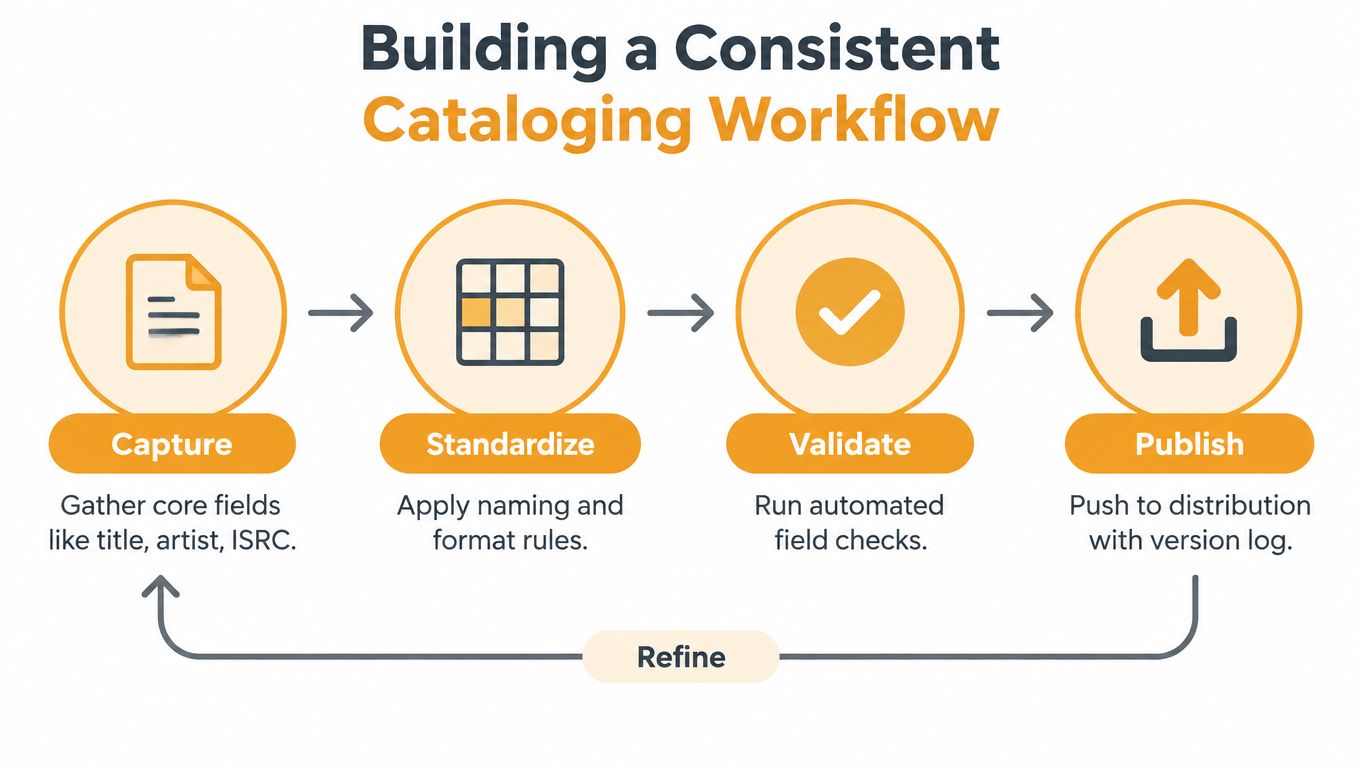
A catalog usually breaks in the handoffs: one person captures a credit, another reformats it, and a third publishes it without checking the source. Separate capture, standardization, validation, and publication so data entry does not become the final quality decision.
Start with a house standard
Write the rules before adding records. Define how featured artists appear, how remix titles are formatted, whether explicit status has its own field, how songwriter names are entered, and which date represents an original release or a reissue. If those decisions remain informal, different people will make reasonable but conflicting choices.
Keep the standard usable. A shared spreadsheet, Airtable base, Notion database, or version-controlled CSV can support a small team when field definitions and change history are clear. Larger catalogs may need dedicated software, but no tool can resolve ambiguous editorial rules. If your cataloging rules also need to support promotion, use this guide to building a music marketing strategy.
Separate required fields from optional ones. Missing or contradictory required values should block publication. Optional details can wait when a delivery deadline is close.
Harvest information once, then validate it
Collect each value from the source best positioned to confirm it. Use distributor or label delivery records for technical identifiers, approved split documentation for composition details, and the artist or manager for public descriptions. Do not treat every platform as an authority. Platform data shows what was published, while the master record should reflect what has been approved.
Automation can handle repetitive checks. A spreadsheet can flag blank required cells, inconsistent capitalization, duplicate ISRCs, and dates that conflict with the approved release record. A catalog platform can import connected records, but a person still needs to resolve uncertain matches and disputed credits.
Make quality gates visible
Run three distinct checks before publication:
- Freshness: Does the record contain the latest approved title, credit, lyric version, link, and release status?
- Completeness: Are the required identity, rights, and relationship fields present?
- Conformance: Does each value follow the agreed naming and formatting rules?
The open-data process described in the EU Open Data Maturity 2024 report separates harvesting, freshness monitoring, and compliance validation. Music teams can apply that sequence without enterprise software. Capture the update, check how current it is, test it against the house standard, and publish only after review.
Measure whether the gates catch mistakes
A polished spreadsheet proves little. Sample published records and test whether the checks would have caught the errors that matter to your catalog. Log unresolved conflicts, stale pages, missing credits, and rejected edits so recurring failures become visible.
The Digital Library Federation's benchmark framework in its metadata quality benchmark supports three practical quality levels: minimum, better-than-minimal, and ideal. For an artist catalog, minimum could mean a correct title and recording identifier. Ideal could add verified credits, approved lyrics, linked entities, current media, and documented change history.
A workflow earns its place when it catches inaccurate information before fans, partners, or rights administrators rely on it.
Verification and Editorial Review in Action
Public music catalogs face a basic trust problem. An open edit model makes contribution easy, but it may also allow someone to alter a lyric, credit, or artist relationship without proving authority. A closed model limits errors, yet can leave legitimate artists unable to correct information.
A stronger approach uses two distinct decisions. First, confirm who controls the page. Second, review what that person wants to change.
Compare the two models
In an unverified crowdsourced catalog, a contributor may submit a plausible correction with no direct connection to the artist or rights holder. Other users may accept it because it looks professional. Over time, an incorrect version can become the version that gets copied elsewhere.
Claim-based management changes the starting point. The person requesting control must demonstrate a relationship with the artist identity or rights record. That doesn't make every proposed edit correct, so editorial review remains necessary.
House of Lyrics provides a practical example. Its ownership process uses a one-time code placed in an X or SoundCloud bio, allowing the requester to demonstrate control of the associated artist presence. After verification, the owner can manage artist, album, and song pages, while submitted changes are held for review before publication.

Verification is not editorial judgment
Ownership answers, “Who is allowed to propose this change?” Editorial review answers, “Does the proposed change meet the catalog standard?” Confusing those questions creates weak controls. A verified artist can still paste an outdated lyric, select the wrong album relationship, or submit a credit that needs clarification.
A useful review queue checks:
- Identity: Does the page belong to the intended artist, song, or release?
- Authority: Does the claimant have a reasonable basis to manage the record?
- Evidence: Can the proposed credit, lyric, link, or release detail be supported?
- Consistency: Does the update agree with related pages and approved release information?
- Presentation: Is the public text clear, complete, and free from accidental formatting errors?
Teams designing their own process can use this explanation of editorial review to distinguish approval from simple user editing. The essential lesson is operational: let the right person submit changes, but don't let authority bypass quality control.
Keep a human in the loop
Automated checks can detect missing fields, duplicate identifiers, and formatting conflicts. They can't reliably decide whether two similarly named collaborators are the same person or whether a lyric variation reflects an intentional official edit. Those cases need an editor, manager, or rights holder with context.
Review also creates an audit trail. Record who proposed the update, what changed, when it was approved, and what evidence supported the decision. That history makes future corrections faster because the team doesn't have to reconstruct the original discussion from scattered messages.
Connecting the Dots Into a Unified Workflow
Metadata management becomes sustainable when the catalog follows a rhythm rather than a one-time checklist. The rhythm starts with agreed standards, moves through controlled data entry and distribution, and returns to verification when the public record changes.
One record, several responsibilities
The master record should hold the approved version of the release information. Distribution sends that information outward. Public pages make it discoverable. Verification and editorial review protect the catalog when someone proposes a correction or when an external platform changes the presentation.
Those responsibilities shouldn't all sit with one person by default. An artist may approve lyrics, a manager may maintain release details, a label may own delivery identifiers, and an editor may check public presentation. Smaller teams can combine these roles, but they should still perform the decisions separately.
A practical operating rhythm looks like this:
- Define standards: Agree on field names, naming rules, entity relationships, and required evidence.
- Enter metadata: Capture approved release, recording, composition, and presentation details in one controlled record.
- Distribute: Send the record to relevant platforms and retain the submitted version.
- Verify: Confirm ownership, review public changes, and compare important pages against the master record.
- Refine: Correct errors, document decisions, and update the standard when a recurring problem appears.
The linked lyrics page for “All This Time” illustrates why a song should be treated as a structured entity, not merely a text block. A useful page connects the song to its artist, release context, lyrics, and official media, so each element can be checked without losing the larger catalog relationship.
Decide what to automate
Automate tasks with clear rules. Required-field checks, duplicate detection, date comparisons, link checks, and formatting normalization are good candidates. They reduce repetitive work and make obvious problems visible before publication.
Keep judgment-heavy decisions with people. Ownership disputes, ambiguous songwriter identities, conflicting lyric versions, and major catalog restructures need editorial review. The best workflow doesn't chase complete automation. It automates predictable work and protects human attention for questions where context changes the answer.
Freshness deserves its own recurring review. A page can be complete and still be wrong because the artist changed a credit, replaced an official video, issued a new version, or updated the release relationship. Quality monitoring closes the loop between what your team approved and what listeners see.
Your Next Steps for Cleaner Metadata
You don't need to rebuild an entire discography before improving it. Start with the releases that receive the most attention, contain the most collaborators, or have the greatest rights uncertainty. Then apply the same process to older work as time allows.
Audit three fields first
Begin with the recording identifier, songwriter and publisher information, and release date. Confirm that each field matches the approved source record and that alternate versions are clearly distinguished. If any value is uncertain, mark it as unresolved instead of guessing without verification.
Then check the catalog relationship. Make sure a song points to the correct single, EP, or album and that a reissue hasn't overwritten the original context. This small structural check often reveals duplicate pages and inconsistent titles.
Plug two workflow gaps
Most small teams need two immediate controls:
- A master record: Choose one maintained file or database as the reference for titles, identifiers, credits, dates, versions, links, and approval status.
- A publication gate: Require someone other than the data-entry person to review required fields and public presentation before release or update.
If you're working alone, create a deliberate pause between entry and approval. Leave the record overnight, compare it against the source documents, and read it as a fan would. A second pass catches errors that feel invisible while you're focused on delivery deadlines.
Adopt one verification habit this week
Whenever a collaborator, manager, or platform reports a correction, ask for the authority and evidence behind it. Confirm who is requesting the change, identify the affected recording or composition, compare it with the master record, and document the decision.
Don't assume a streaming platform is automatically authoritative for every field. Don't treat lyric pages as secondary just because they don't contain the audio. Fans, journalists, collaborators, and rights holders use public lyric and catalog pages to interpret your work, so those pages need the same care as release assets.
Choose tools by workload
An independent artist may manage a clean catalog with a structured spreadsheet, cloud storage for source documents, and calendar reminders for freshness checks. A small label may benefit from Airtable, Notion, or a dedicated catalog system with permissions, history, and review states. Larger operations should look for ingestion, lineage, approval workflows, duplicate detection, and integrations that reduce manual copying.
The trade-off is straightforward. Automation saves time on repeatable checks, but setup and maintenance take effort. Manual review is slower, yet it remains the safer choice for contested rights, ambiguous credits, and meaningful editorial changes.
The fastest catalog is not the one with the fewest review steps. It's the one that avoids sending the same correction through five disconnected systems.
Make one release the test case. Build its master record, verify its credits, check its public relationships, review the lyrics and official media, and record every correction. Once that process feels repeatable, apply it to the rest of the catalog.
House of Lyrics gives artists and rights holders claimable artist, album, and song pages, a verification process, editable lyrics and metadata, official video embeds, and an approval step before changes appear publicly. Visit House of Lyrics to give your music catalog a clearer, more controlled home.