Cats and Dogs Lyrics: Find the Song You Actually Mean
Looking for Cats and Dogs lyrics? Discover how to identify the exact song, find verified lyrics, official videos, and rights context across multiple tracks.

Most advice about “cats and dogs lyrics” starts by guessing the song. That's backwards. The phrase points to several unrelated recordings, so the first job isn't displaying lyrics. It's identifying the track.
Search results can place R&B beside indie rock, folk, novelty music, and children's songs. A familiar line about rain may send you toward the wrong title, while an artist name or a remembered chorus can settle the question quickly. Treat the search as a catalog problem, not a lyric-memory contest.
The phrase itself has a long history outside modern music. Historical discussions citing the Oxford English Dictionary evidence and early uses of “raining cats and dogs” trace the expression through English usage from at least the late 1500s, with Jonathan Swift using it as an explicit weather phrase in 1738. That history explains why songwriters keep returning to the wording, but it doesn't make every “Cats and Dogs” recording the same song.
Table of Contents
- Why There Is No Single Cats and Dogs Song
- Quick Triage to Identify the Right Track
- The Most Searched Cats and Dogs Songs at a Glance
- City High and the Early 2000s R&B Reading
- Best Coast and the Indie Rock Reading
- The Head and the Heart and the Folk Reading
- Why the Raining Cats and Dogs Idiom Keeps Showing Up
- What a Verified Song Page Contains
- How Artists Claim and Update Their Pages
- Lyrics Rights Versus Video Rights Explained
- Related Tracks and Similar Titles Worth Knowing
Why There Is No Single Cats and Dogs Song
Treat “Cats and Dogs” as a catalog label, not a song identification. The title appears across unrelated recordings, so displaying lyrics before confirming the track risks presenting the wrong words, credits, album context, rights information, or video.
Use a concrete identifier before opening any lyric page. City High points to an early-2000s R&B vocal group, Best Coast to a later surf-pop setting, and The Head and the Heart to folk. Gorilla Biscuits, Camille, and Mackenzy Mackay create further matches. These recordings have different writers and recording identifiers, so shared wording does not establish a shared composition.
Titles are weak identifiers
Music librarians verify a recording through the artist, version, release context, and recording identifiers. Title alone cannot separate a studio track from a live performance, alternate take, radio edit, or cover. Those versions may change the arrangement and the lyric text.
Genius lyric listings show pages for The Head and the Heart, Best Coast, and City High. See the table in The Most Searched Cats and Dogs Songs at a Glance for the catalog comparison. Treat those listings as leads, then confirm the artist and release details against the exact recording you remember.
Librarian's rule: A shared title requires two checks. The artist and the opening line must agree before you trust the lyric page.
Disambiguation protects the entire reference. It keeps the displayed lyrics attached to the correct writers, recording, album, and visual material. Confirm the track first, then read or share its lyrics.
Quick Triage to Identify the Right Track
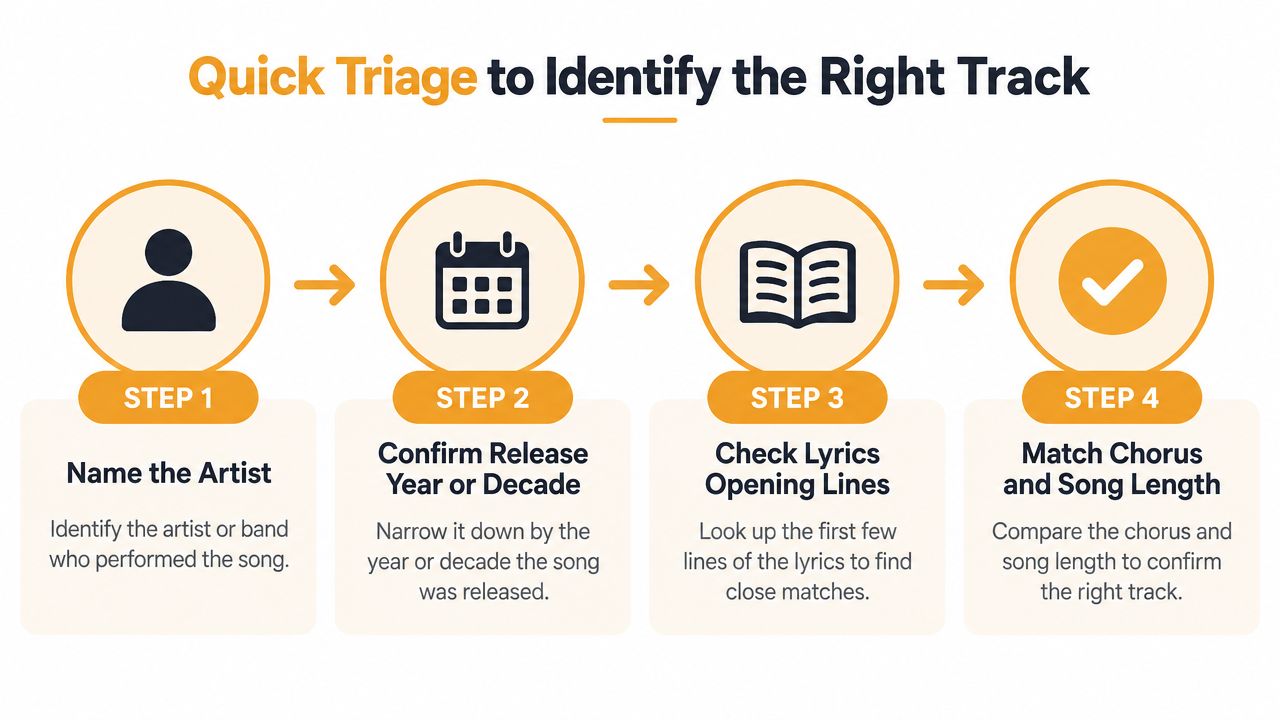
Use this order when you search. It turns a vague query into a practical identification exercise.
- Name the artist first. City High, Best Coast, and The Head and the Heart lead to entirely different catalogs. Artist is the strongest filter because it removes most false matches immediately.
- Confirm the release year or decade. An early-2000s R&B memory points in a different direction from a 2010s indie or folk recollection. Era also helps separate remakes, covers, and later uploads.
- Check the genre. R&B, surf-pop, folk, hardcore, novelty, and children's music carry different expectations. Genre won't prove the answer, but it removes obvious mismatches.
- Use a lyric fragment as the tiebreaker. Even two or three remembered words can confirm the chorus or opening. Don't rely on a broad phrase such as “raining cats and dogs” when a more distinctive fragment is available.
Match the sound, not just the spelling
Listen to the opening and chorus before you copy anything. The right track should match the remembered vocal style, arrangement, and lyrical mood, not merely the words in the title.
If you plan to turn the confirmed song into a sing-along or visual lyric project, use a practical Veo3 AI sing-along video guide after the identification step. Creating a polished video for the wrong composition only makes the catalog error harder to spot.
The Most Searched Cats and Dogs Songs at a Glance
Treat “cats and dogs lyrics” as an identification problem first. The title alone points to unrelated recordings, so compare the artist, era, genre, album, and one distinctive lyric fingerprint before reading or sharing any lyric text. The table is a recognition aid, not a substitute for an authorized lyric source. A blank entry means the available material does not verify that detail.
| Song Title | Artist | Year | Genre | Album | Signature Lyric |
|---|---|---|---|---|---|
| “Cats And Dogs” | City High | May 22, 2001 release listing | R&B | City High | Check the opening line against a verified City High lyric page |
| “Cats & Dogs” | Best Coast | June 12, 2018 release listing | Indie rock | , | Match the chorus and surf-pop vocal style |
| “Cats and Dogs” | The Head and the Heart | , | Folk-leaning | , | Match the folk arrangement and remembered chorus fragment |
| “Cats and Dogs” | Gorilla Biscuits | , | Hardcore punk | , | Check the short, forceful punk delivery |
| “Cats and Dogs” | Camille | , | , | , | Match the artist and vocal setting before using the title |
| “Cats and Dogs” | Mackenzy Mackay | , | , | , | Check the artist name against the catalog entry |
The release listings for Best Coast and City High are collected in the Genius catalog reference. They demonstrate why the exact title cannot identify a recording by itself. Gorilla Biscuits, Camille, and Mackenzy Mackay remain additional catalog possibilities, as shown in the SongMeanings catalog context.
Make the fingerprint distinctive
A title is weak evidence. An artist paired with a chorus fragment is much stronger. If the artist is missing from your memory, combine the fragment with the decade and genre, then listen to the opening and chorus before choosing a result.
Use the recording context as a final check. Vocal style, arrangement, lyrical mood, and section order should fit the memory, not just the matching words. Do not publish or share a lyric block because its first line looks familiar. Confirm the correct composition first, then consult a verified lyric page for the text.
City High and the Early 2000s R&B Reading
City High's “Cats And Dogs” is the clearest example of why an artist-first search matters. Its Genius listing carries a May 22, 2001 release date, placing the recording in early-2000s R&B rather than among later indie or folk uses of the title. If your memory involves a vocal-group arrangement, contemporary R&B production, or that period's radio sound, City High is the first candidate to test.

A reliable page for this recording should lead with the canonical artist and title, then show the release context before the lyrics. It should distinguish the song from every other “Cats and Dogs” result and preserve line breaks, punctuation, and section labels so readers can compare the displayed text with the recording.
The same page should also carry songwriter, producer, label, and publishing information where those details have been verified. Don't treat a lyric transcription as a complete music record. Recording-level and composition-level identifiers belong beside the text, not inside it, because they help services match the correct work and allocate rights.
For a focused browse through comparable vocal styles, use the R&B genre catalog. The genre filter is useful only after the artist and recording have been identified, but it can reduce the chance of drifting into a similarly titled indie or folk page.
The official video belongs below the reference material, not as a replacement for it. An embed lets the reader hear and watch the authoritative audiovisual source while the lyric body remains a separate, reviewable text layer.
If the vocal style and period don't match your memory, stop there. City High may be a prominent result, but prominence isn't proof.
Best Coast and the Indie Rock Reading
Best Coast's “Cats & Dogs” demonstrates how sharply the same title can change character. The available Genius listing gives the release date as June 12, 2018, and places the song in an indie-rock context rather than the early-2000s R&B setting associated with City High.
The useful distinction is sonic. Best Coast's version belongs to a quieter, surf-pop world, where the title can feel like atmosphere, texture, or a compact image rather than the center of a large vocal narrative. If you remember hazy guitars, an understated delivery, and a mood that matters as much as the literal words, this is a stronger candidate than City High.
Credits matter even for understated songs
A restrained performance still needs a complete catalog record. The page should identify the principal songwriter, producer, label, album, and verified lyric text, then connect those details to the correct recording. Without that frame, a short lyric fragment can look interchangeable with any other result.
Browse the indie genre catalog only after checking the artist. Genre navigation helps readers find neighboring material, but it can't resolve a shared title by itself.
The official video slot should follow the same logic used for an R&B page. Keep the lyric text clean, retain the recording and composition metadata separately, and attach an official audiovisual source when permissions and ownership are clear. A mood-driven track doesn't need less metadata. It needs metadata that prevents the mood from being assigned to the wrong artist.
The Head and the Heart and the Folk Reading
The folk reading deserves verification before you read a single lyric line. The Head and the Heart's “Cats and Dogs” is best identified through the group, its folk-leaning arrangement, and the recording's catalog context. A page updated in 2025 is not automatically evidence of a 2025 release, so check the album credit and release details on a verified song page.
Use the first 15 seconds as a practical test. Group harmonies and a folk arrangement point toward The Head and the Heart, while the song's narrative emotional shape provides a second check. This approach separates the track from City High's R&B performance and Best Coast's indie-rock atmosphere without treating the shared title as proof of any lyrical or creative connection.
| Artist | Album | Genre | Signature Lyric |
|---|---|---|---|
| City High | Verify against the official catalog | R&B | Confirm the recorded chorus |
| Best Coast | Verify against the official catalog | Indie rock | Confirm the opening and mood |
| The Head and the Heart | Verify against the official catalog | Folk-leaning | Confirm the narrative lyric fragment |
Read the page as a catalog record
A reliable entry should give the artist's canonical spelling, exact title, album relationship, writers, producer, and lyric-text status. Check those fields against the recording you heard. A page that merely matches the words “cats” and “dogs” can still assign the lyric to the wrong song.
The Genius lyric page for The Head and the Heart is useful for discovering that this title recurs across artists, as noted in the table above. Use it for discovery, then verify the recording through the artist, album credit, and lyric attribution before quoting or reproducing any text. Rights provenance matters as much as accurate identification.
Why the Raining Cats and Dogs Idiom Keeps Showing Up
“Raining cats and dogs” is older than modern songwriting, but its history matters here for a practical reason: the phrase carries meaning before any artist uses it. Historical discussions trace the expression through English usage from at least the late 1500s, with Jonathan Swift using it as an explicit weather phrase in 1738. The documented history of the idiom provides useful background.
Songwriters reuse the idiom because it compresses a full storm into four familiar words. It can signal loud weather, disorder, emotional conflict, or a relationship breaking down without spelling out every feeling. That shared metaphor explains recurring titles and lyric fragments across unrelated genres.
Shared metaphor does not mean shared song
Several writers may choose the same expression because listeners already understand its force. Treat each result as a separate composition until the artist, recording, era, and lyric fragment match. A familiar phrase alone cannot establish borrowing or prove that two tracks are versions of one work.
Search confusion starts with memory. A listener recalls “raining cats and dogs,” enters it into a lyric search, and finds a page whose artist, genre, or narrative conflicts with the recording remembered. Use the phrase as a search lead, then confirm the track through the performer and surrounding words before reading or quoting lyrics.
For a related weather image, the walk in the rain lyrics guide offers a useful comparison. Keep that comparison thematic. Shared weather language does not identify the correct recording.
What a Verified Song Page Contains
Treat “cats and dogs lyrics” as an identification problem before a reading problem. A verified page should establish the exact artist, recording, and release context before displaying any lyric text. Canonical title spelling, artist name, album relationship, and release year help separate similarly named tracks.
The lyric body should preserve line breaks, standard punctuation, and readable section separation. Store it as structured content, not one undifferentiated paragraph, and place songwriter and composition details beside it. Music metadata guidance from Orphiq distinguishes ISRC, which identifies a recording, from ISWC, which identifies the underlying composition.

The page anatomy should be predictable
A reliable record includes:
- Canonical identity: Song title, artist spelling, release year, and album relationship.
- Lyric presentation: Verified text with clearly separated verses and choruses, without unnecessary timestamps.
- Credits block: Writers, producers, mix engineers, featured performers, label, publisher, and relevant identifiers.
- Media placement: An official video embed after the lyrics, kept separate from the lyric license.
- Metadata footer: Genre, duration, language, explicit-content status, and latest verification state when available.
Each field has a distinct purpose. Lyrics support reading or singing, credits establish authorship, and identifiers connect the page to the correct recording and composition.
An editorial record should state what changed, why it changed, and who approved it. The guide explaining what an editorial review is supports checking corrections before publication, particularly when several versions share a title.
How Artists Claim and Update Their Pages
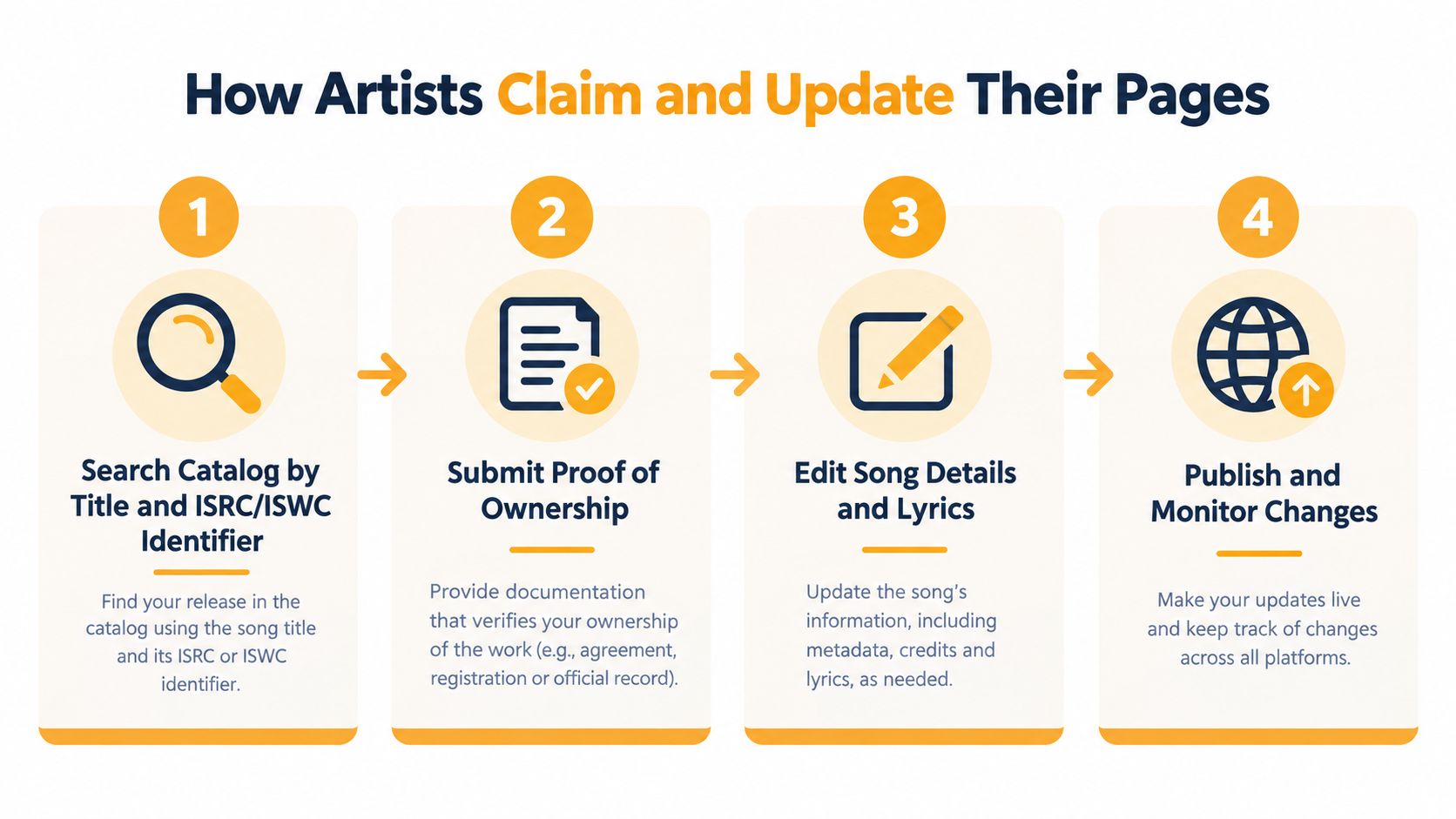
Rights holders need a controlled process, not an open comment box. Start by searching the catalog with the title plus the relevant ISRC or ISWC identifier, then confirm that the record matches the artist, recording, and composition.
Next, submit proof of ownership. A serious review may require an identity match, a signed split-sheet excerpt, and a registered publisher or label reference. Those documents connect the claimant to the work instead of merely proving access to an email account.
Editing should preserve the catalog history
After verification, the owner receives a claim code and gains edit access to the specific title and registered alternates. The editor can correct lyrics, add an alternate version, or replace an official video embed, but sensitive historical credits and ownership transfers should require another verification cycle.
Every correction then goes through human review before it becomes public. That matters for a title like “Cats and Dogs,” where a careless edit can attach one artist's lyrics to another artist's page.
Artists and rights holders should use the House of Lyrics claim process to establish control over the correct catalog record. Claiming the wrong duplicate is not a harmless administrative mistake. It can propagate incorrect credits and media across the page network.
Lyrics Rights Versus Video Rights Explained
Lyrics and recordings occupy different rights layers. Publishing rights cover the composition and lyrics, while master rights cover the specific sound recording. A video can add another layer because audiovisual use may require permission connected to both the composition and the recording.
The Universal Music Publishing licensing guide explains the practical distinction between publishing and master rights and notes that lyric transcription into sheet music can involve print rights. The lesson is simple: a lyric permission doesn't automatically authorize a master recording, a video, or every format in which the words might appear.
Three permissions, three questions
- Publishing: Who controls the composition and lyrics?
- Master: Who controls the particular recording being played?
- Audiovisual use: Does the video or synchronization use have the required clearance?
That separation affects everyday searches. An official video embed doesn't prove that the surrounding lyric text is authorized, and a licensed lyric doesn't prove that an uploaded audio rip or unofficial video is permitted.
Covers and remixes create further complications because the composition may remain the same while the master changes. A page should therefore keep writer, publisher, label, recording, and video ownership information distinct wherever the data is available.
Rights check: Pair verified lyric text with an official audiovisual source. Never assume that one permission covers both.
Related Tracks and Similar Titles Worth Knowing
Once you've identified the correct “Cats and Dogs” recording, nearby titles can help you explore the same animal or weather vocabulary without confusing the original search. Keep these as a listening map, not as substitute lyric pages.
| Theme | Song Title | Artist |
|---|---|---|
| Animal conflict | “The Dogs of War” | Pink Floyd |
| Animal imagery | “Dog Days Are Over” | Florence + The Machine |
| Stray-animal character | “Stray Cat Strut” | Stray Cats |
| Family and pet metaphor | “Cat's in the Cradle” | Harry Chapin |
| Rain imagery | “Raindrops Keep Fallin' on My Head” | B. J. Thomas |
| Weather phrase | “It's Raining Men” | The Weather Girls |
| Dramatic weather | “Purple Rain” | Prince |
| Folk pet narrative | “Old Shep” | Verify the artist before quoting |
| Indie pet narrative | “I Love My Dog” | Verify the artist before quoting |
These titles share themes, not necessarily musical structure or rights ownership. Search each by artist and exact title, just as you did with “Cats and Dogs,” and keep lyric reproduction separate from casual song discovery.
House of Lyrics pairs artist-approved lyrics with official video embeds, structured artist, album, and song pages, and reviewable updates from verified rights holders. Use this catalog approach to identify the right “Cats and Dogs” track, then visit House of Lyrics to browse authoritative lyrics and claim or manage your own music pages.