Music Rights Management Explained for Independent Artists
Learn how music rights management works, from publishing and master rights to royalties, metadata, and verification tools that protect your catalog.

You spot the problem while checking a song page: the lyrics aren't yours, a collaborator's name is missing, or the credits don't match the split sheet you remember signing. Maybe a track is already streaming, but you can't tell whether a payment is late, misattributed, or tied to the wrong recording. These aren't just paperwork headaches. They're signs that the information connecting your music to its owners and permissions needs attention.
Music rights management is the work of identifying what you own, documenting who shares it, and keeping that information consistent wherever your music is used. In a streaming business, the details have to travel with the song. A trustworthy catalog isn't a collection of files or memories. It's a record you can check, update, and support with evidence.
Table of Contents
- Why Music Rights Management Matters Right Now
- Publishing Rights and Master Rights Demystified
- How Royalties Actually Flow From One Stream
- Metadata and Standard Identifiers Explained Simply
- A Practical Workflow for Artists and Managers
- Disputes, Mismatches, and How Verified Catalogs Help
- AI, Lyric Use, and the New Provenance Question
- Your Music Rights Audit This Week
Why Music Rights Management Matters Right Now
A lyric page carries your artist name, but you didn't write the words. A collaborator asks why their credit is missing. A payment statement arrives, yet you can't work out which release it covers. When something like this happens, it's tempting to treat it as a one-off mistake. In practice, these problems often point to a more basic issue: the information about your music doesn't agree across the places where people and platforms rely on it.
The market has changed, too. Global recorded-music revenue was approximately US$14 billion in 2014 and had more than doubled to US$29.6 billion by 2024, following years of decline linked to piracy, shrinking physical sales, and the disruption of download-based distribution, as IFPI's 2024 market report describes. The shift to licensed digital services is a central milestone in modern music rights management.
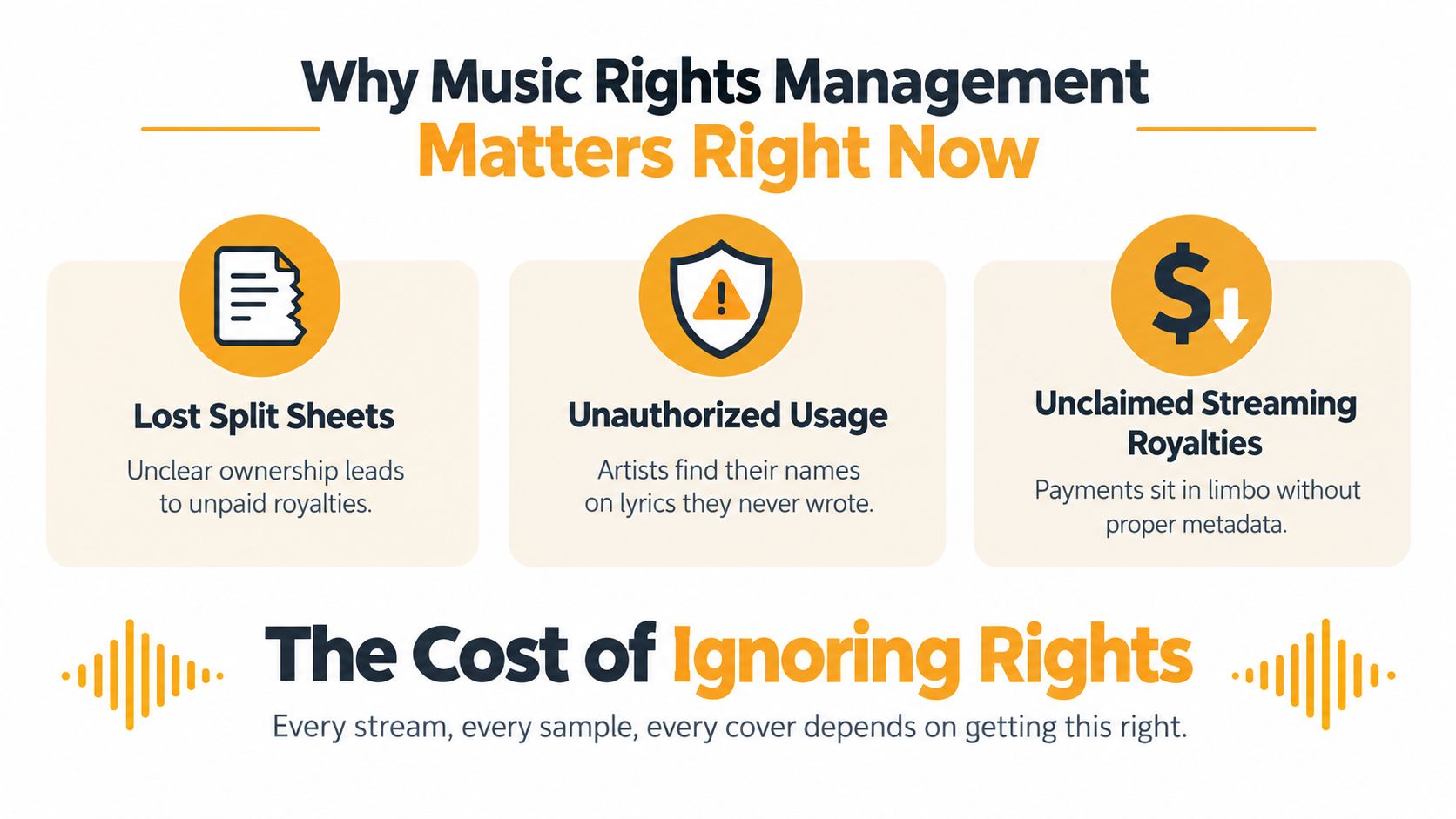
Streaming makes the stakes easier to understand. A service needs to identify what was played, connect the use to the relevant rights, report it, and allocate royalties to the right beneficiaries. The same track may involve songwriters, publishers, a recording owner, a distributor, and different territorial arrangements. If a name, identifier, or ownership claim is wrong, that information can interfere with matching and attribution.
Treat your catalog as a record, not a recollection
A clear catalog helps other people distinguish your song from another work with a similar title, understand who contributed, and find the right contacts for permissions. That public record should reflect what you can verify, not what someone assumes. Keep source documents, such as split sheets and registrations, alongside the details you publish.
The practical habit is simple: when a release, ownership arrangement, or credit changes, review the connected records as well. Rights management isn't only about preventing unauthorized use. It's also about making the correct use legible to the people and services that need to identify your work.
Publishing Rights and Master Rights Demystified
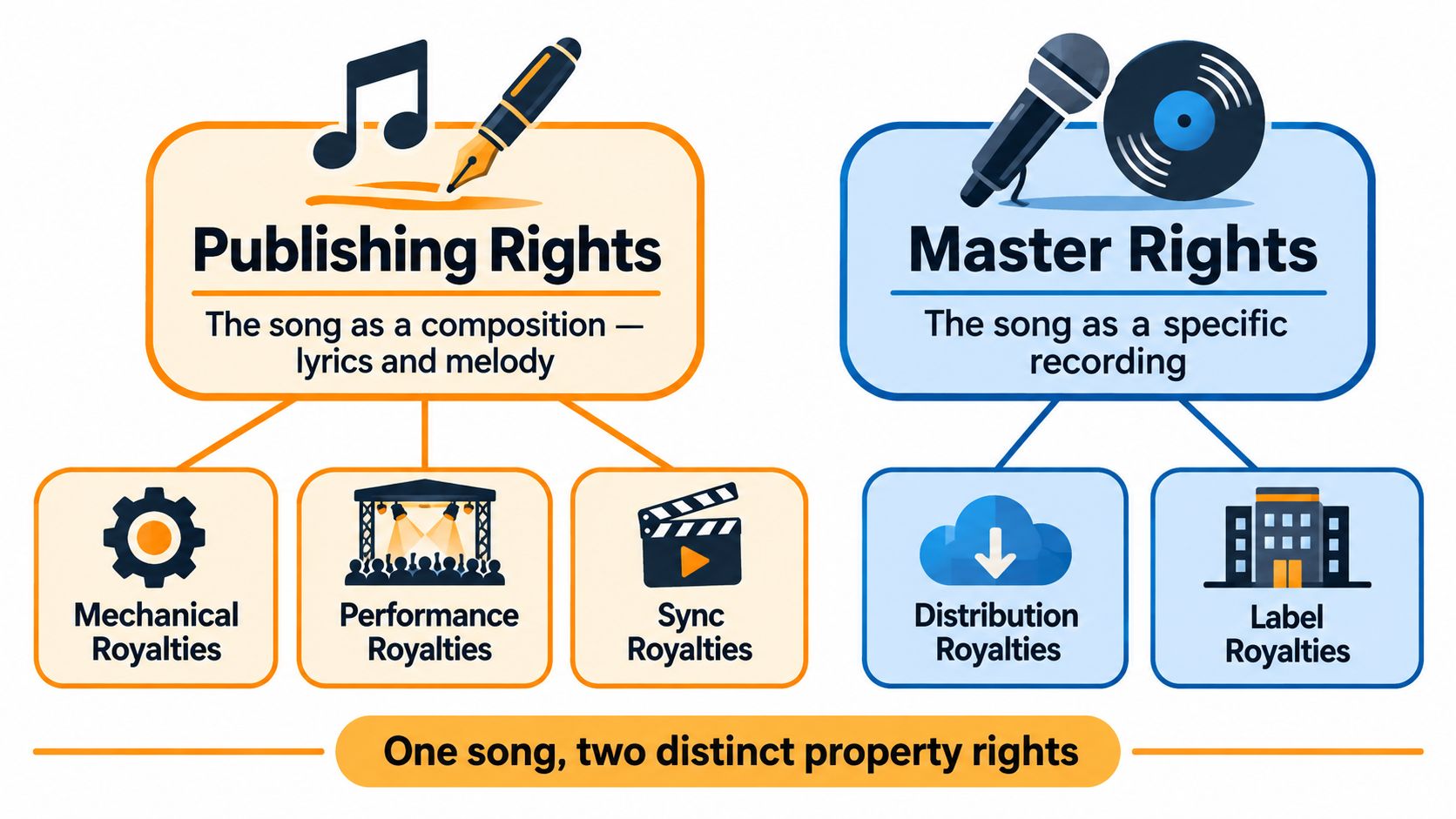
Think of a song as a building project. Publishing rights relate to the blueprint: the composition, including its lyrics and melody. Master rights relate to a particular completed building: a specific recorded performance of that composition.
That distinction answers a common question: “Is my master my song?” Your master is the recording you own or control. The composition is a separate work. If you wrote the song and recorded it yourself, you may control both. If you wrote it with collaborators, the composition may be shared. If a label funded or released the recording under an agreement, the label may control the master while you retain some or all of your composition rights. The actual ownership depends on the agreements and contributions involved.
Two rights, different questions
When a songwriter writes a melody and lyrics, that composition can be recorded by different artists. A cover, remix, or translation may create another recording or version, but it doesn't automatically turn the underlying composition into an entirely unrelated work. The composition and the recording need separate records because they answer different questions: who created or controls the song itself, and who controls this particular recorded version?
The distinction matters when someone wants to use your music. A request to license the composition for a film or advertisement concerns publishing rights. A request to use your released recording may also require permission from the master owner. If the two rights have different owners, both sides may need to approve the use.
Splits belong to the composition side. Co-writers should agree on their shares and document them clearly, rather than relying on a conversation that may be remembered differently later. Recording agreements and release arrangements, meanwhile, should make clear who owns or controls the master and how income is handled.
Practical rule: Before approving a use, ask whether the request concerns the composition, the recording, or both. That question helps you find the right owner and the right agreement.
For artists comparing publishing services and administration options, this overview of music publishing platforms can help frame what to look for. If your publishing company or partners need formal agreements, digital signing for publication houses from Closer Innovation Labs Corp. is a resource for handling signatures digitally.
How Royalties Actually Flow From One Stream
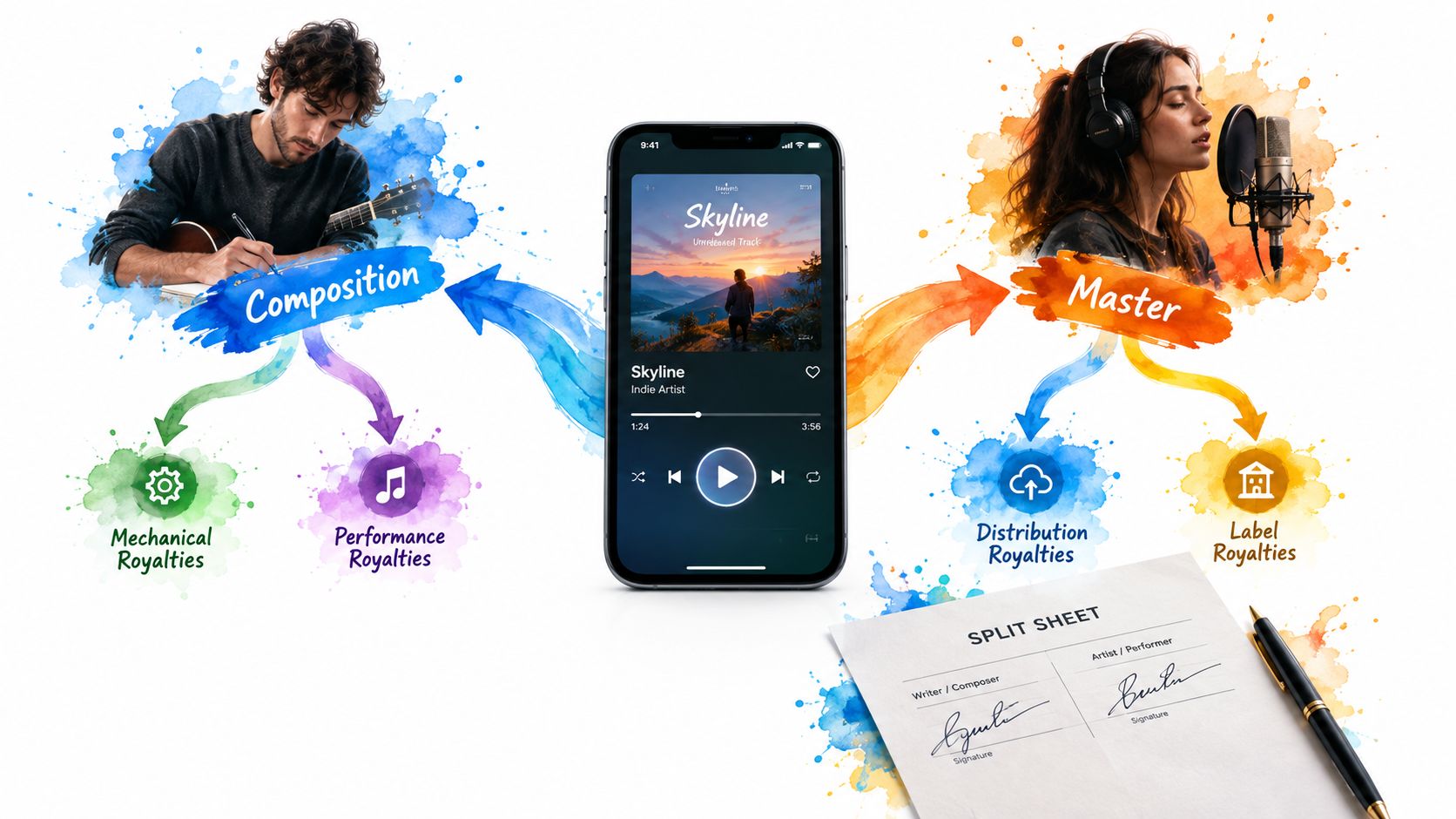
A listener taps play on your new track. That single action doesn't create one simple payment that lands in one account. It creates usage information that must be matched to the recording and the underlying composition, then handled under the relevant agreements and reporting arrangements.
In 2024, global streaming revenue reached US$20.4 billion, a 7.3% increase, and exceeded US$20 billion for the first time. Streaming represented 69.0% of recorded-music revenue worldwide, according to IFPI's Global Music Report. That scale helps explain why accurate matching is not a minor administrative detail.
Follow the information, not just the money
For a hypothetical indie release, the distributor delivers the recording to streaming services and reports activity under the master-rights arrangement. The composition has its own writer and publisher information, which services and rights organizations may use to identify and administer the related publishing rights. Those are distinct paths. A payment associated with the recording doesn't automatically settle what's owed to the songwriters.
Mechanical and performance royalties are also different kinds of publishing income. Their administration and collection depend on the relevant service, territory, and rights arrangements. A sync fee is different again: it relates to permission to pair music with visual media, such as a film or advertisement. An ordinary stream doesn't, by itself, mean the song has been synchronized to video or generated a sync fee.
When an artist says, “I earned a fraction of a cent from one stream,” they're often compressing a complicated chain into a shorthand statement. The exact amount and timing depend on the service, territory, agreements, and rights being administered. For a plain-language discussion of how Spotify royalty reporting is commonly approached, see Premierely on Spotify royalties.
The leak to watch for is a mismatch between the work's actual writers and the songwriter or publisher details attached to its records. Keep your split documentation and registration information consistent, and check that your master and composition records aren't being treated as if they were interchangeable. The next step is to make sure the identifiers and descriptive details can connect those records reliably.
Metadata and Standard Identifiers Explained Simply
A title is a useful label for people, but it's not a reliable unique identifier. Two different songs can share a title, and one composition can exist as multiple recordings. If a platform treats the title alone as proof that two records describe the same thing, it can attach the wrong credits or merge unrelated works.
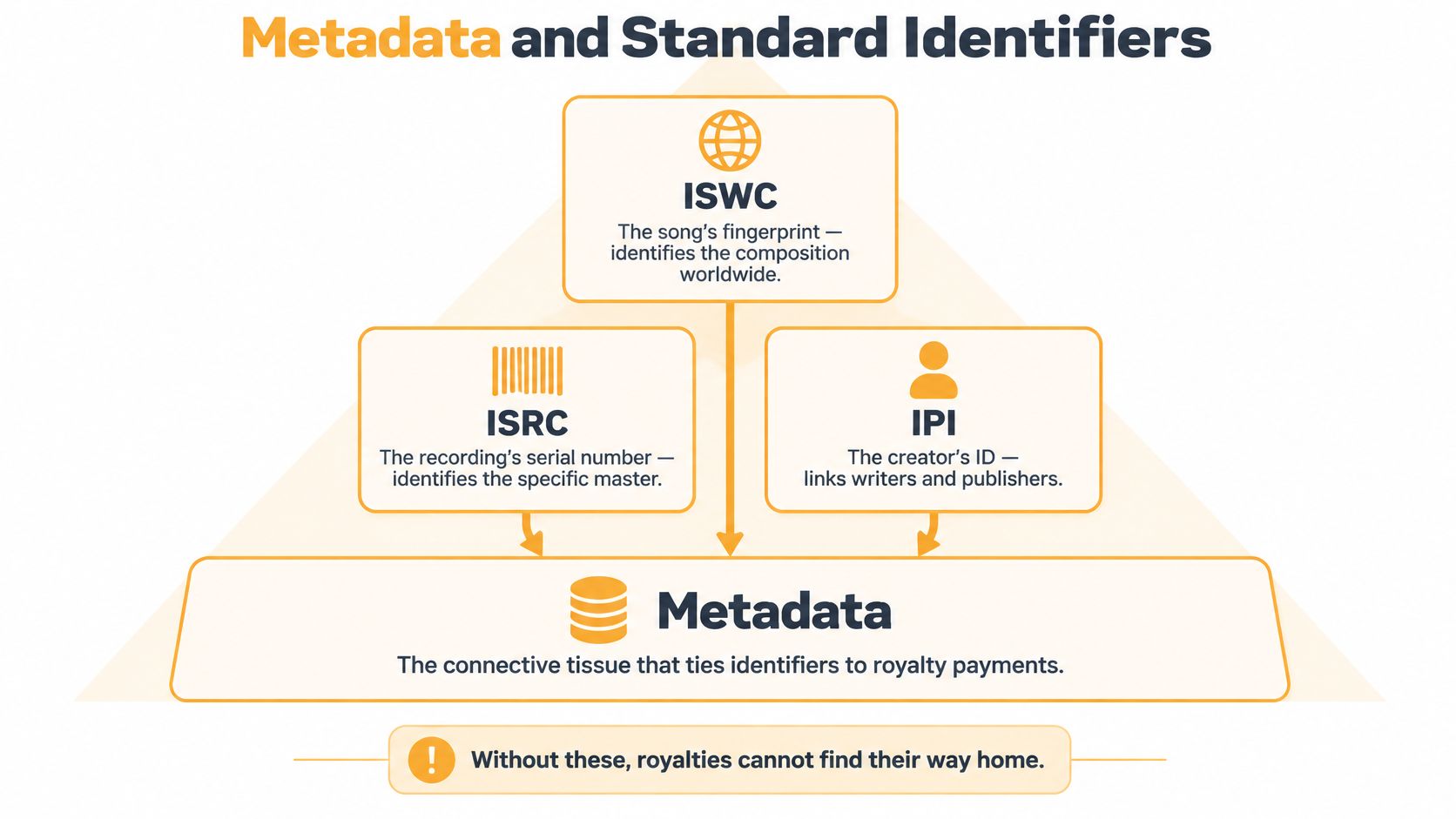
Standard identifiers help separate these identities. Think of them as different kinds of passports: each one identifies a particular thing, not every related thing at once. The International Standard Musical Work Code (ISWC) identifies the underlying composition. The International Standard Recording Code (ISRC) identifies a sound recording. ISAN identifies an audiovisual work, such as a music video. CISAC explains that the ISWC is defined by ISO 15707 and is distinct from the ISRC and ISAN in the international identifiers overview.
Connect the right identity to the right asset
Suppose your composition has an original recording, a remix, a live performance, and an official video. They're connected, but they aren't the same asset. The composition has its composition-level identity. Each distinct sound recording needs its own recording reference. The video is an audiovisual work, so it should be documented separately from both the composition and recording.
A useful catalog also carries descriptive details alongside identifiers. For a composition, that can include the original title, all creators and their roles, alternate titles, and whether the work is adapted or derived from another work. If a work is derived, preserve source-work information and identifiers when available. These details help a rights administrator distinguish related works without falsely combining them.
IPI is another identifier that can help connect a creator or publisher to their works. Don't confuse it with an ISWC or ISRC: one points to a party, while the others identify works or recordings. Your distributor dashboard may show different identifiers for different assets, so check what each field represents before copying an ID across records.
A correct identifier attached to the wrong asset is still a bad record. Verify the relationship as well as the code.
For hands-on guidance on keeping credits and identifiers organized, use this guide to metadata management. The goal is not to collect codes for their own sake. It's to preserve clear relationships among the composition, its recordings, its audiovisual references, and the people who contributed.
A Practical Workflow for Artists and Managers
A reliable rights record needs a process, not a heroic memory. For an independent artist, that process can start with one release and then become part of the routine for every new song, re-release, or ownership change.
Claim, verify, edit, publish
Claim the relevant pages. Keep the artist, album, and song records connected, so listeners and collaborators can move between them without guessing which version is authoritative.
Verify control. A verification method should show that the person claiming a page controls the artist identity or has authority from the rights holder. House of Lyrics, for example, uses a one-time code placed in an X or SoundCloud bio to verify control before a page can be managed.
Edit from source documents. Add lyrics, credits, and metadata using the information you can support. Check spelling, contributor roles, alternate titles, and the relationship between the composition and the recording. If a split is disputed, don't publish a percentage as settled fact.
Submit for review. An editorial check before publication gives the owner a chance to catch a wrong lyric, inconsistent credit, or unsupported edit before it becomes public. The workflow should leave a clear record of what was submitted and what was approved.
| Stage | Owner Action | Public Result |
|---|---|---|
| Claim | Request control of the artist, album, or song page | The right person can manage the catalog record |
| Verify | Confirm control using an authorized method | The page has a checked owner |
| Edit | Submit lyrics, credits, and metadata against available evidence | Proposed details are organized in one record |
| Publish | Review and approve the update | Confirmed information appears publicly |
The same rhythm can work for a solo artist handling a small catalog or a manager coordinating several clients. Keep each artist's source documents and submission history organized separately. When a release is approaching, this guide to releasing music can sit alongside your rights checklist, so delivery details and ownership records are reviewed together.
Disputes, Mismatches, and How Verified Catalogs Help
An artist uploads a track with the right credits, but a service displays a different songwriter name. The distributor's record may be correct while a publishing registration uses an older spelling, or an earlier version may omit a collaborator. The dispute takes time because each party is looking at a different record and no one can tell which one reflects the signed agreement.
In another situation, a lyric page attributes a song to the wrong artist. Listeners repeat the error, a media contact copies the credit, and the actual songwriter has to request corrections across separate sites. A verified public page won't settle a legal ownership dispute on its own, but it gives the artist a clear place to publish supported lyrics and credits, with an identifiable owner and a review process for updates.
Make uncertainty visible
The underlying ecosystem is not one universal database. Industry analysis describes music-rights data as fragmented across hundreds of national collecting societies, with proprietary workflows and incomplete or conflicting historical records that can complicate accurate attribution, as outlined in this analysis of music rights data platforms. That's why a conflicting entry shouldn't be “fixed” by guessing or copying another service's metadata.
If you find a mismatch, preserve the evidence before submitting corrections. Gather signed split sheets, registration confirmations, distribution records, relevant agreements, and official release or video references. Note which version of the information appears in each system, then contact the responsible organization with a specific correction request.
For listeners and researchers, a well-maintained reference page can also help separate a track from another work with a similar title, such as “All This Time” lyrics. For your own catalog, prioritize clarity over volume: publish what you can verify, identify unresolved claims as unresolved, and keep a single dependable public reference up to date.
AI, Lyric Use, and the New Provenance Question
Making lyrics available for readers doesn't automatically give every third party permission to use them for any purpose. An artist-approved lyric page, for example, isn't by itself approval for AI training, scraping, reproducing the text elsewhere, generating derivatives, or commercial reuse. Those uses raise different permission questions, so a public page should not blur them together.
The same care applies to recordings and videos. Permission to embed an official video for reference isn't the same as permission to reuse the recording in an advertisement or train a model on it. Artists without legal teams can still make their position easier to understand by recording what has and hasn't been authorized.
Record permission and provenance separately
A plain-language rights matrix can answer practical questions: What use is allowed? Who approved it? Which territory and duration apply? What attribution is required? How can permission be withdrawn or a use challenged? If you don't know the answer, mark the status as unknown rather than implying that a use is approved.
Useful provenance fields might include artist-approved text, rights-holder verification status, official video source, AI-use policy, and last-reviewed date. These fields don't replace contracts or legal advice. They help distinguish verified information from assumptions and make the boundary between public reference access and commercial reuse easier to see.
A 2025 market report on AI rights clearance notes the launch of a platform offering more than five million pre-cleared tracks. The development illustrates why structured permission and provenance information matter to licensing workflows. For artists, the practical lesson is not to grant broad consent accidentally. Keep your rights record specific, and link an official video reference only when you can identify it as the intended source, as in this guide to official lyrics videos.
Your Music Rights Audit This Week
Set aside a focused session to make your catalog easier to verify. Start with one release, complete the checks, and save the evidence with the record so you can repeat the process when details change.
- List contributors: Write each songwriter and producer's legal name and role. Save the list with the release documents.
- Confirm splits: Check the agreed ownership shares against a signed split sheet. If collaborators disagree, record the dispute and avoid presenting a contested share as final.
- Check identifiers: Confirm the ISWC for the composition, the ISRC for each relevant recording, and ISAN where an audiovisual work needs its own identifier. Note any identifier you still need to verify.
- Review affiliations: Check publisher and collecting-society affiliations against your current records. File confirmations or follow up on missing information.
- Update the public record: Claim or revise the appropriate catalog pages, submit supported lyrics and credits for review, and record your AI-use policy or mark it undecided.
For a broader view of documenting royalty checks and supporting records, consult this 2026 royalty audit guide for licensors. Make the audit part of your release routine, and revisit the catalog whenever a credit, ownership arrangement, or recording changes. Your first visible result can be modest: one corrected credit, one filed split sheet, or one verified page with evidence behind it.
House of Lyrics lets verified artists and rights holders claim artist, album, and song pages, manage artist-approved lyrics and credits, and pair song pages with official video embeds through an editorial review process. Start with one release, gather the records that support its credits, and visit House of Lyrics to create or update a clear public reference for your catalog.