Trading My Sorrows Lyrics: Meaning and Song Context
Trading my sorrows lyrics - Explore the full lyrics of Trading My Sorrows, plus the song’s meaning, background, and popular versions. A complete guide for fans

You're preparing a worship set, checking a line before rehearsal, or trying to find the recording you remember from church. You search for Trading My Sorrows lyrics, recognize the refrain, and then notice different artist names attached to the same song. Before you copy anything into a slide deck or recording session, it helps to separate the song itself from the version you're hearing.
Table of Contents
- Navigating the Trading My Sorrows Lyrics and Versions
- Trading My Sorrows Lyrics Verse by Verse
- The Meaning Behind the Lyrics
- The Origin Story Behind the Song
- A Version Map of Notable Recordings
- Credits, Rights, and Licensing Metadata
- How House of Lyrics Presents the Song
- A Practical Playbook for Worship Leaders and Cover Artists
- Quick Reference and Frequently Asked Questions
Navigating the Trading My Sorrows Lyrics and Versions
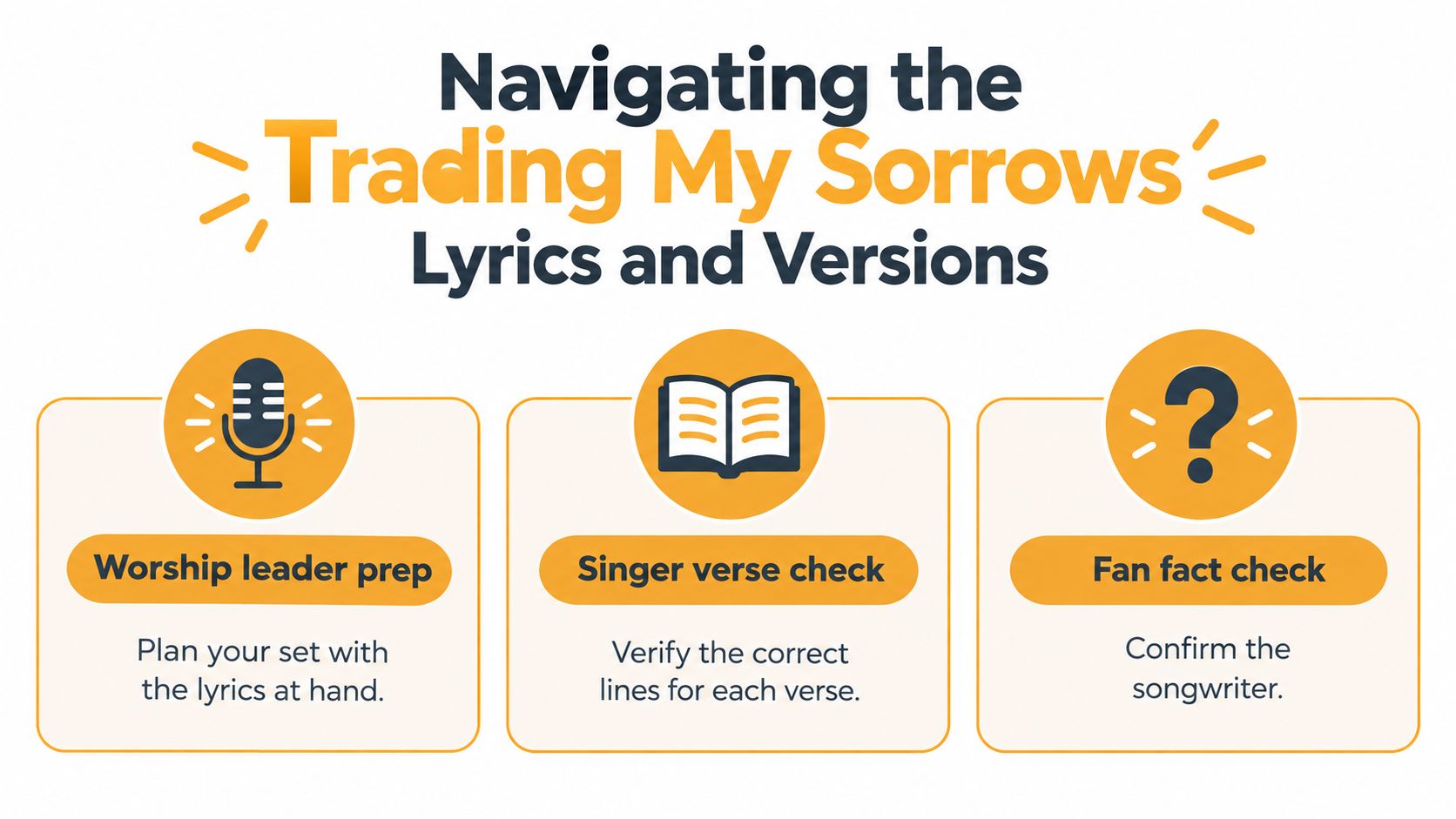
Start with the question that matters to your task: Do you need the composition, a particular recording, or a performance-ready reference? Those aren't interchangeable. A songwriter credit identifies who wrote the work; an artist credit identifies who performed a recording; an arrangement tells your musicians how that performance unfolds.
For a singer, the immediate concern is usually wording and entry points. For a pastor, it may be meaning and suitability for a service. A cover artist needs those answers plus clear attribution and a dependable source recording.
Choose your reference before copying the text
- Preparing worship slides: Use an authorized lyric reference, then check your planned section order against the arrangement your team will perform.
- Learning a vocal part: Follow the intended recording rather than assuming every singer enters, repeats, or finishes a phrase identically.
- Checking authorship: Look for composition credits, not just the artist name at the top of a streaming page.
- Researching a release: Keep the artist, album, and recording title together so your notes don't combine unrelated versions.
Keep a small working record
A useful rehearsal note has separate spaces for lyric source, recording reference, and performance decisions. Put cuts, wordless transitions, and repeat cues in the performance notes, not inside the approved lyric text.
That separation prevents a familiar mistake: treating your band's shortened arrangement as the definitive song. It also lets you change the musical plan without losing track of the words or their attribution.
The aim is practical confidence. You should be able to identify the text you're using, explain its central meaning, and tell another musician exactly which recording inspired your performance.
Trading My Sorrows Lyrics Verse by Verse
The full copyrighted lyrics aren't reproduced here. Instead, this section-by-section reading guide summarizes the core text and uses short excerpts to help you recognize its structure; consult an authorized lyric page for complete wording.
Opening verses
The opening names four burdens: sorrows, shame, sickness, and pain, exchanging them for “the joy of the Lord.” The lyric reference for Israel & New Breed's recording documents that exchange, the recurring affirmation, and the bridge's language of endurance.
Read the opening as a repeating pattern rather than a developing storyline. The singer names a burden, expresses the act of surrender, and returns to joy as the shared destination.
For rehearsal purposes, label this passage Opening exchange. That's more useful than relying on verse numbers that might differ between lyric sheets or arrangements.
Chorus
The chorus centers on “Yes Lord”, turning the opening declaration into a direct response. Its musical function is participation: singers can recognize the response without needing a new narrative or a fresh set of images.
Keep the words separate from the repeat instructions. Your slide operator needs to know the displayed text; your band needs to know how long you intend to stay there. Those are related decisions, but they shouldn't be stored as though they're the same thing.
Bridge
The bridge shifts from surrender to perseverance. It describes pressure without defeat, opposition without abandonment, and suffering without final destruction, then moves toward blessing and renewed joy.
Its ending contrasts nighttime sorrow with morning joy. In a lyric sheet, identify that closing thought clearly so the singer doesn't mistake it for a separate, unrelated verse.
| Section label | What to recognize | What to check in rehearsal |
|---|---|---|
| Opening exchange | Burdens surrendered in favor of joy | Where each phrase begins and ends |
| Chorus | The recurring affirmation | Repeat cues and the final response |
| Bridge | Endurance amid suffering | Entry point and transition back |
| Closing contrast | Sorrow followed by renewed joy | Whether the arrangement repeats it |
Capitalization and punctuation are editorial matters, not reliable recording identifiers. If pages disagree about a comma or capital letter, check the wording and audible phrasing before deciding that they represent different compositions.
The Meaning Behind the Lyrics
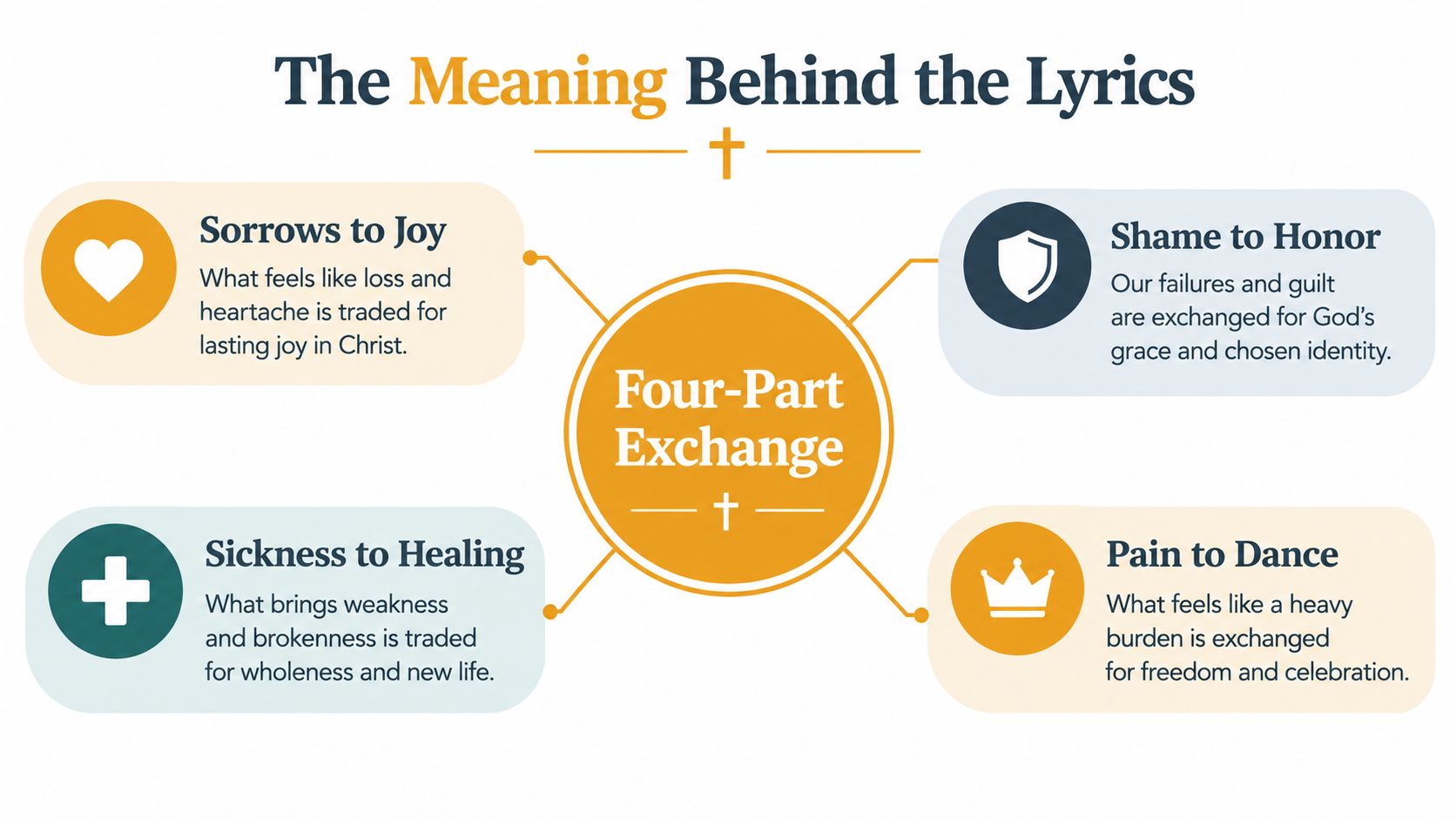
The exchange is the song's central metaphor. The singer doesn't just announce a cheerful mood. The singer names difficult conditions and answers them with a deliberate statement of Christian hope.
That distinction matters when explaining the song to a congregation. An upbeat performance can make the text sound like a demand to feel happy, but the bridge keeps suffering in view. My reading is that the song expresses confidence within hardship rather than pretending hardship has vanished.
Read the exchange carefully
The named burdens differ, but their lyrical destination is shared. The text doesn't assign a separate promise to each condition, such as an individual guarantee of healing or immediate relief from pain.
The concept graphic offers broader devotional associations. Treat those branches as interpretive illustrations, not as a word-for-word account of what the song promises.
Hear affirmation and endurance together
The repeated response gives a congregation something it can say together. Although the opening uses personal language, communal singing turns that declaration into a shared act of assent.
The bridge recalls the suffering-and-endurance language of Second Corinthians, while the closing night-and-morning contrast echoes Psalm Thirty. Read those connections as biblical imagery, not as proof that the song quotes an entire passage or promises a particular timetable for relief.
Reading principle: Let the bridge qualify the celebration. The song acknowledges pressure and sorrow even while expressing hope.
There's no named character, location, or resolved incident in the lyric. That makes its meaning structural rather than narrative: burden, surrender, affirmation, endurance, and renewed joy.
For a useful comparison of how another worship text expresses joy, consider this guide to Joy to the World lyrics. The editorial habit is the same: explain the words present before adding the associations listeners bring to them.
The Origin Story Behind the Song
Darrell Evans was leading a church service when an improvised worship moment became the seed of the song. The Crosswalk account of the song's origin traces that moment to 1997, followed by Evans's recording on Freedom in 1998 and inclusion on The Best of Darrell Evans: Trading My Sorrows in 2002.
That history helps explain the song's directness. It began as something sung in a worship setting, not as a detailed story listeners needed to decode before joining in.
From a church moment to a recorded work
Evans's authorship and his recorded performance belong together historically, but they answer different questions. The improvised beginning concerns the composition's origin; the album concerns a released recording.
Keep that distinction when introducing the song publicly. Saying who wrote it is not the same as naming the artist whose arrangement your team learned.
The image is an illustration of worship music-making, not documentary evidence of Evans's original service. The historical account supports the improvised setting, but it doesn't justify inventing the room's atmosphere, a congregation's reaction, or a conversation afterward.
What the history helps you understand
- The text's accessibility: Its recurring language suits participation without requiring a long explanation.
- The author's role: Later performers interpret a work whose origin belongs to Evans.
- The recording's role: A released arrangement gives listeners a concrete performance to learn, reference, or revisit.
The account describes international church use, but it doesn't provide an authoritative global performance count. Calling the song a recurring worship standard is more defensible than attaching an unsupported popularity ranking.
Listeners interested in another worship song's background can explore Did You Feel the Mountains Tremble lyrics and context, keeping the same distinction between composition history and recording history.
A Version Map of Notable Recordings
A familiar title isn't enough to identify a recording. Artist, release context, and displayed track title should travel together whenever you save a reference or share it with your team.
The Katinas lyric listing provides a distinct artist context within a wider version history that includes Darrell Evans's 1998 recording, Israel & New Breed's 2001 recording, The Katinas' 2002 recording, and Worship Jamz's 2007 release. Other reinterpretations belong in separate entries rather than being folded into an anonymous master recording.
Notable Recordings of Trading My Sorrows
| Artist | Year | Album | Distinctive Feature |
|---|---|---|---|
| Darrell Evans | 1998 | Freedom | The writer's original recorded version |
| Israel & New Breed | 2001 | New Season | Uses the expanded title Trading My Sorrows (Yes Lord) |
| The Katinas | 2002 | Confirm the specific release | A separate artist performance, not a new authorship credit |
| Worship Jamz | 2007 | Confirm the specific release | A later release context that needs its own reference |
| Other performers | Varies by release | Confirm individually | Credits and performance choices require recording-level checks |
The dated entries above follow the linked version history; the original and Israel & New Breed album details follow the earlier historical and lyric references. Where an album isn't established, leave it unconfirmed rather than guessing.
Compare what you can actually hear
Arrangement style, instrumentation, vocal phrasing, and intended use can help you choose a performance. They shouldn't become factual descriptions of a particular release unless you've checked that recording.
- Listen for entrances: Does the singer begin immediately, or does an introduction establish the pulse?
- Mark phrasing: Note held syllables, pauses, and responses that affect your vocal preparation.
- Identify the forces required: Decide whether your available musicians can reproduce the arrangement or need a simpler approach.
- Consider the setting: Choose what serves your congregation or recording project, not merely what feels familiar.
A choir-led service, a small acoustic team, and a studio cover may need different musical choices even when they use the same underlying text. That's a selection decision, not evidence that one artist's words are the universal version.
The same listening discipline applies when comparing performances through the Happy Day lyrics guide: name the recording before treating its performance details as definitive.
Credits, Rights, and Licensing Metadata
Credits identify the work; permissions govern its use. A reliable reference panel should help you establish attribution without implying that a catalog entry grants every permission you might need.
The PraiseCharts composition and chord-chart record identifies Darrell Evans as author, Integrity's Hosanna Music as publisher, English as language, Freedom as album, and CCLI Song No. 2574653 as the composition identifier.
A compact rights panel
| Field | Reference value |
|---|---|
| Composition title | Trading My Sorrows |
| Author | Darrell Evans |
| Publisher | Integrity's Hosanna Music |
| Language | English |
| Original album reference | Freedom |
| Composition identifier | The CCLI song number cited above |
| Arrangement credit | Record separately for the arrangement used |
The CCLI song number identifies the underlying worship composition, not an individual audio recording. A performer's recording can involve different recording-level ownership and release metadata.
Apply the panel to your actual use
For a printed program, verify the required attribution wording under the permissions that apply to your use. For lyric projection, consult your relevant license terms rather than treating the identifier as blanket authorization.
For a streaming release, distinguish your new recording credits from the composition's author and publisher fields. Don't import another performer's label or recording ownership into your own metadata because you used their arrangement as a listening reference.
A correct song credit is necessary, but it isn't a substitute for checking permission.
Keep an approval state alongside the factual fields: confirmed, awaiting review, or unresolved. That simple editorial habit prevents an uncertain album name or arrangement credit from becoming a public assertion.
For broader catalog practice, the metadata management guide is a useful companion to this song-specific panel. The practical goal is consistency between the words you publish, the work you credit, and the recording you use.
How House of Lyrics Presents the Song
For this song, a structured catalog should let a reader move from artist to album to song without losing the recording context. House of Lyrics is an artist-run option that pairs artist-approved texts with official video embeds and allows verified artists and rights holders to manage linked catalog pages.
That model is useful alongside a licensed worship reference and an official artist recording. Each serves a different purpose: approved text, composition information, and audible performance evidence.
A worked catalog example
If the song is indexed, begin with the intended performer's artist page. Open the relevant album, then the song entry associated with that release.
Check whether the lyric contributor's attribution is visible and whether the embedded official video represents the recording you meant to find. An approved text should still be matched to the correct artist and release context.

The screenshot illustrates the library interface; it doesn't establish that every recording discussed here has a published page.
Verification and editorial review
- Claiming a page: An artist or rights holder confirms control through a one-time code placed in an X or SoundCloud bio.
- Editing the record: The page owner can submit lyrics, credits, and metadata through the editor.
- Publishing changes: Updates remain under editorial review before appearing publicly.
This workflow separates permission to contribute from permission to publish immediately. It also gives editors a place to resolve mismatched release information before readers encounter it.
For a title shared across performers, that distinction matters. A lyric correction should improve the appropriate entry, not overwrite every recording with the same words and title.
A Practical Playbook for Worship Leaders and Cover Artists
A service is approaching, and your team has chosen a recording as its reference. The goal is to make the song work for the people in the room, while keeping the arrangement clear enough that every singer knows what happens next. Decide on the musical changes before rehearsal and write them down.
Start with the voices and instruments available. Choose a key that feels comfortable for the congregation, then test the bridge as well as the opening. A melody that sits well at first can still climb beyond a comfortable range later.
Make musical decisions visible
- Transpose deliberately: Use an authorized chart and check the full melody after changing key. Test the bridge, not just the first lines.
- Simplify the texture: Reduce the number of playing parts before changing the harmony. A smaller team may need fewer parts, not a different song.
- Shorten repetition first: Where your permissions allow, cut one chorus repeat before cutting a lyric line. The repeated chorus gives the congregation a familiar place to rejoin after an edit.
- Write transitions down: Mark entrances, breaks between vocal sections, and the ending on the arrangement notes.
If your Atlanta-based team needs a place to try those choices, Encore Film And Music Studio's Atlanta music rehearsal space guide can help with planning. Use rehearsal to settle cues and balance before a service or recording session.
Confirm the public-facing details
Before the performance, compare the working materials so the musicians, slide operator, and audience follow the same version:
- Writer and publisher: Match the attribution to the rights panel.
- Composition identifier: Check that your reference points to the intended work.
- Source recording: Name the performer and release the musicians used to prepare.
- Displayed lyrics: Compare slides or printed text with the authorized reference.
- Performance plan: Ensure the team and slide operator have the same cuts and repeats.
Rehearsal check: Ask someone to follow the displayed lyrics while the team plays. Correct words can still appear at the wrong moment.
For another example of planning around a worship song's lyrics, see the I Love Your Presence lyrics guide. Treat the arrangement and displayed text as separate checks, then confirm both during rehearsal.
Quick Reference and Frequently Asked Questions
Who wrote Trading My Sorrows?
Darrell Evans is the writer. Another artist's name on a lyric page usually identifies that performer's recording, not a replacement composition credit.
The historical account above distinguishes the improvised worship origin from the later album release. Use those as separate milestones rather than assigning the composition's beginning to a cover.
Is Israel & New Breed's version the definitive one?
It's a notable recording with its own title and album context. The available references don't establish a reliable ranking that would justify calling it the most widely recognized cover.
Streaming totals, worldwide sales, and chart positions also aren't authoritatively established here. Recognition in your church or listening history isn't a substitute for those measurements.
How can I identify the right lyric page?
Check the artist and release information, then compare the page with an official recording or audiovisual reference. Don't use punctuation alone to decide which version it represents.
- For complete wording: Choose an authorized or artist-approved text.
- For performance details: Listen to the intended recording and mark your own arrangement decisions separately.
- For attribution: Use composition credits rather than copying only the performer's name.
How should I credit a program or streaming release?
Follow the attribution requirements that apply to your use, using the rights panel as a factual starting point. A streaming release also needs accurate information about your own recording, so don't copy another artist's release metadata wholesale.
The portable takeaway is simple: identify the work, identify the recording, and verify the permission. When those remain distinct, you can learn, teach, and perform the song without confusing its author with its interpreters.
House of Lyrics offers linked artist, album, and song pages with artist-approved lyrics and official video embeds. Visit the library to check whether your intended Trading My Sorrows recording is indexed, then compare its attribution and lyric text with your rehearsal or release materials.