All I Could Do Is Cry Lyrics: Official Text and Credits
All I Could Do Is Cry Lyrics with credits, the 1960 Etta James original, covers and official video guidance for accurate attribution.
“All I Could Do Was Cry” is the official title of the Etta James song recorded in January 1960 and released on Argo in March 1960. If you searched for “All I Could Do Is Cry” lyrics, start with the Etta James entry, then check that the attributed lyric page matches the recording you're hearing.
The title difference is small, but it matters. A search can lead you to the original, a later cover, or a soundtrack performance, and those pages shouldn't share every credit. The rewarding part of this little catalog puzzle is learning to recognize the song while keeping each singer's recording distinct.
Table of Contents
- Official Song Facts at a Glance
- Title Spellings and Search Aliases to Know
- How to Confirm You Have the Right Version
- Every Recording and Cover Compared
- The Lyric Story and the Reported Backstory
- When a Lyric Page Is Missing or Conflicting
- Citing the Exact Version You Quote
- Verified Lyric Pages and Your Next Steps on House of Lyrics
Official Song Facts at a Glance
Etta James is the original performer of “All I Could Do Was Cry.” A performer credit identifies the voice on a recording; songwriting and production credits identify different roles. Checking those fields side by side helps distinguish the original from a cover or another performance.
The Apple Music listing for “All I Could Do Was Cry” provides credits for the song and recording. Use it to check the names, while keeping the performer and release details tied to the version you're identifying.
Core facts for All I Could Do Was Cry
| Field | Detail |
|---|---|
| Official title | All I Could Do Was Cry |
| Original artist | Etta James, recorded January 1960 |
| First release | March 1960 on Argo, a Chess Records subsidiary |
| Songwriters | Berry Gordy, Gwen Gordy Fuqua, Billy Davis |
| Producers | Phil and Leonard Chess |
| Orchestrator | Riley Hampton |
Read the table like a set of catalog labels: the title names the song, the artist names the performer, and the credits describe who wrote and shaped the recording. The duration and video listing are left out here, since neither is needed to identify the recording from these details.
Catalog habit: Copy the title exactly, then check the performer and credits independently. An album cover alone cannot confirm that a lyric page belongs to the same version.
Title Spellings and Search Aliases to Know
Store the official title; search the alternatives. The Apple Music song listing uses “All I Could Do Was Cry” and names Berry Gordy, Gwen Gordy Fuqua, and Billy Davis as writers, Phil and Leonard Chess as producers, and Riley Hampton as orchestrator.
That combination gives you more to compare than spelling alone. When you search for “All I Could Do Is Cry” lyrics, the substituted word can be a search alias rather than evidence of another composition.
Title forms and how to treat them
| Title form | Treatment | Where it appears |
|---|---|---|
| All I Could Do Was Cry | Canonical title; store as the official entry | Etta James original; Apple Music; MusicBrainz |
| All I Could Do Is Cry | Search alias mapped to the canonical entry | Common user query |
| All I Can Do Is Cry | Alias mapped to the canonical entry, labelled with its performer | Tina Turner performance |
The first row supplies your display title. The second helps readers who remember the wording differently. The third needs performer context, because an alternate title can accompany a distinct interpretation rather than a mere typing mistake.
Keep the work and the recording separate
A composition is the underlying song. A sound recording is a particular recorded performance of it. A remaster, soundtrack appearance, and lyric transcription also need their own identifying information, even when they refer to that same composition.
For example, finding a cover through an alias shouldn't cause a catalog editor to replace the original's production credits. Map the spelling to the work, then select the recording.
Search the canonical title in quotation marks, add the performer, and try the aliases before deciding an entry is missing. Our guide to finding song lyrics offers a broader search method when remembered words don't match a catalog title.
How to Confirm You Have the Right Version
A lyric page is useful only if you can connect its text to the performance you're playing. A correct song title doesn't guarantee a correct recording match.
The Amazon Music soundtrack listing identifies Beyoncé's version with the deluxe Cadillac Records soundtrack, released December 2, 2008, and credits Steve Jordan as producer. That's a concrete example of why soundtrack metadata must stay separate from the original's credits.
Use this visual as a compact checking routine.
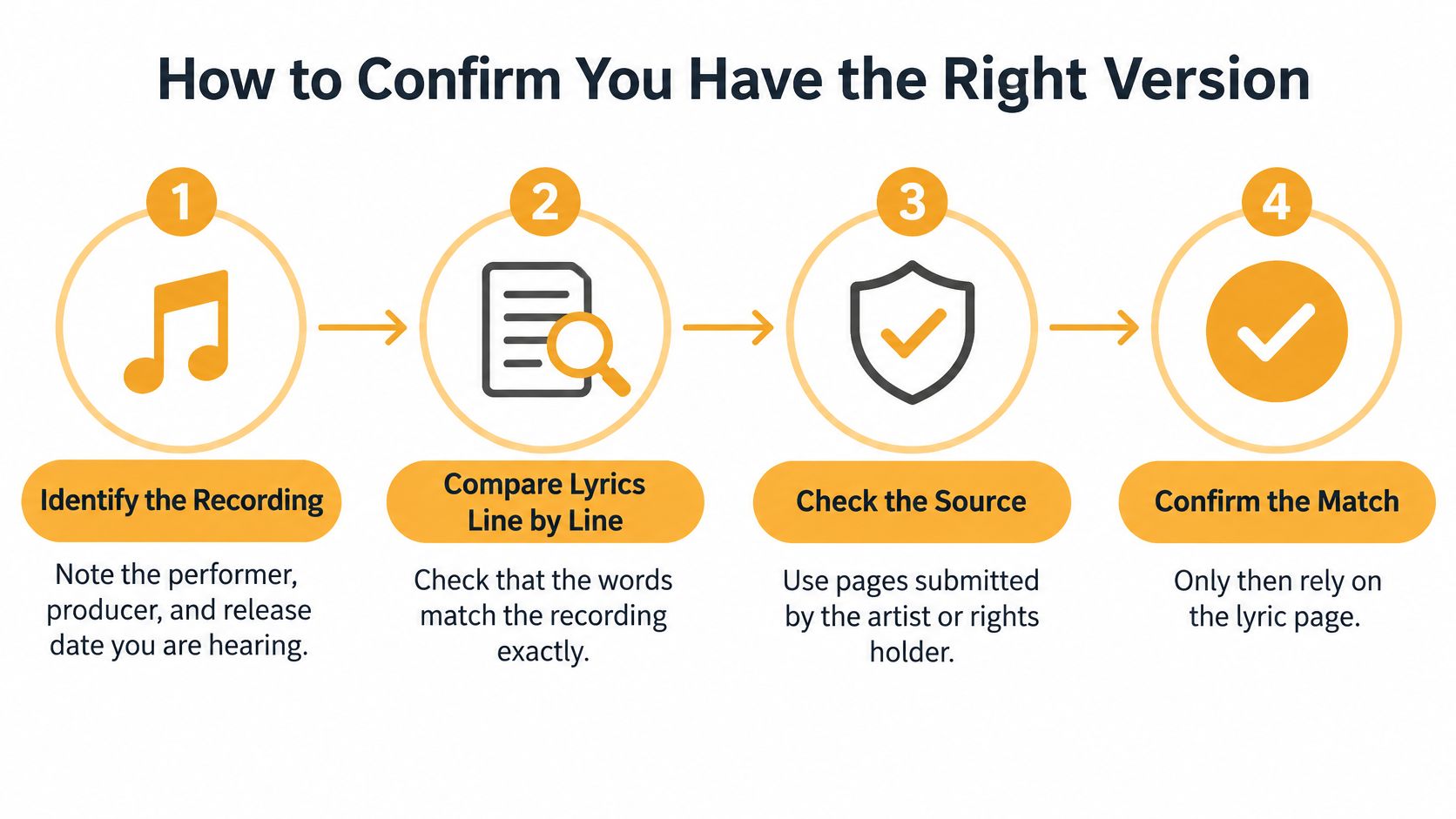
Check the page against the audio
Identify the work and recording. Look for both the composition title and the performing artist. A page that gives only a title leaves the version ambiguous.
Match the release context. Check whether you're hearing an original single, album appearance, soundtrack cover, or reissue. Don't mistake a reissue's publication date for the original recording date.
Compare the credit block. Inspect writers, producers, label, and duration against a catalog listing. A soundtrack producer attached to the original performer is a reason to investigate.
Read the attribution. Look for a named artist, rights holder, or other clearly identified source for the text. Attribution helps you evaluate provenance, although it doesn't by itself grant permission to reproduce lyrics.
Check the review status. Distinguish an approved text from a submission awaiting review. If the page doesn't explain its approval process, don't infer one.
Inspect the audiovisual source. Open the uploader information rather than trusting a video title. An artist or label upload is different from a fan-uploaded recording.
Listen while reading. Compare the words and their order, and use runtime as a secondary clue. Introductions, endings, or differences in phrasing can expose a mismatch that metadata alone misses.
A strong match combines consistent identification, traceable text, complete credits, and authoritative audio or video where available. No single checkbox substitutes for the others.
Every Recording and Cover Compared
The chronology documented in the Etta James biographical entry lines the performances up in order: Joe Tex in August 1960, Tina Turner in 1965, Gladys Knight & the Pips in September 1969, and Beyoncé for Cadillac Records in 2008. Etta James's original is the reference those later recordings are measured against. A lyrics search can surface any of them.
Read the table as a version map. It does not claim that every release, reissue, or live performance appears here. Two rows can share a melody and still need separate lyric pages, the way two catalog cards can sit on one shelf and still carry different call numbers.
Documented recordings of All I Could Do Was Cry
| Version | Performer | Date | Key detail |
|---|---|---|---|
| Original | Etta James | Recorded January 1960, released March 1960 | Argo; first recording and first release |
| Cover | Joe Tex | August 1960 | Earliest cover in this documented comparison |
| Cover | Tina Turner | 1965 | Performed as “All I Can Do Is Cry” |
| Cover | Gladys Knight & the Pips | September 1969 | Documented 1969 cover of the song |
| Soundtrack cover | Beyoncé | December 2, 2008 | Deluxe Cadillac Records soundtrack; writers Berry Gordy, Roquel Davis, Gwen Gordy Fuqua; producer Steve Jordan |
Check title spelling beside the credits. James's composition is “All I Could Do Was Cry.” Turner's cover is listed as “All I Can Do Is Cry.” The words in the title already tell you which page you are on.
Missing production credits should not be filled from memory. A familiar name makes an unsupported guess tempting. Leave the credit blank until a catalog listing supplies it.
Why the original's release context matters
The original sat on Argo, a Chess subsidiary. The song's release and chart history records peaks of No. 2 on Billboard's Hot R&B Sides chart and No. 33 on the Hot 100, with 15 weeks on both charts from May 2 through August 8, 1960. Listeners met the recording outside the R&B market as well as inside it.
That history connects Davis and the Gordys with the Detroit-centered songwriting network and places the single before James's At Last! album, issued in 1960. The recording belongs in a discussion of crossover R&B, not only in a search for remembered words.
For a complementary exercise in keeping a song's identity separate from its interpretations, explore our guide to “All My Tears” lyrics.
A different performer usually means a different version entry, not an error that needs correcting on the original.
The Lyric Story and the Reported Backstory
What the lyrics establish
The Genius lyric page attributed to Etta James presents a woman watching the man she loves marry someone else, with church bells, a choir, vows, and rice locating her heartbreak within a wedding ceremony. Read the text there alongside the corresponding recording rather than assuming the page is an artist-approved transcription.
The scene is public, even though the narrator's pain is intensely personal.
Calling this a breakup song misses that contrast. Other people are celebrating a commitment while the narrator confronts her exclusion from it. The wedding details make the loss concrete without requiring the listener to know anything about the singer's private life.
That leaves room for different readings. A listener might connect the scene with unresolved attachment, an ex-partner's marriage, or the experience of standing outside someone else's happiness. Those are interpretations, not biographical findings.
What historical sources report
A reported inspiration story involves Harvey Fuqua, Billy Davis, and Gwen Gordy. Treat that as reported backstory, not confirmed biography; neither the narrator's situation nor the songwriting credits prove that the lyric describes a particular real-life event.
Keep the documentary layer narrower: James made the original recording for the Chess-associated catalog, and Davis and the Gordys receive the writing credits. A credit establishes authorship, not the truth of an anecdote about inspiration.
Use the embedded player as a listening aid, but check its uploader before describing it as an official source.
Listen for the relationship between the ceremony's outward celebration and the narrator's inward response. You don't need an uncertain romance story to hear why the contrast is powerful.
If you quote the lyric, choose only a brief excerpt, identify the text's source, and keep any inspiration claim outside the factual credit block.
When a Lyric Page Is Missing or Conflicting
A failed search isn't proof that the song is absent. A conflicting page isn't proof that the recording itself has been misidentified, either. Diagnose the mismatch before changing anything.
| What you find | What to do |
|---|---|
| An alias produces no result | Search the canonical title with the performer's name. |
| A page for James carries soundtrack-cover production credits | Flag a version merge; preserve the original's identity. |
| The runtime looks substantially different | Check for a different performance, edit, or release context. |
| Lyrics appear without attribution | Treat the text as unverified until you can establish its provenance. |
| No official video is available | Keep the field unverified rather than substituting a fan upload. |
For a conflicting word, listen to the corresponding passage repeatedly before accepting the most widely copied spelling. Multiple pages can repeat the same transcription mistake, so repetition across websites isn't independent confirmation.
Keep a small conflict log with the page title, performer, release context, disputed field, and the catalog or audio used to check it. That makes a correction understandable to another reader or editor.
Our guide to handling incorrect lyrics can help you distinguish a transcription problem from a page attached to the wrong recording. Submit the specific discrepancy rather than replacing a whole entry on the strength of one mismatch.
Citing the Exact Version You Quote
A good citation tells readers which performance you mean and where your lyric text came from. Those are related references, but they aren't interchangeable: a music catalog can verify production credits without establishing the provenance of a transcription.
Build the recording citation in this order:
- Title and performer
- Recording year, when established
- Release title and label, where established
- Writers
- Producers
- Lyric-page attribution, if you quote words
Citation models without invented fields
For the original, begin with All I Could Do Was Cry, performed by Etta James, then identify the Argo original and add the writers and production credits from the catalog. Attribute the producer information to Apple Music rather than presenting yourself as the source.
For the soundtrack cover, begin with All I Could Do Was Cry, performed by Beyoncé, identify the deluxe Cadillac Records soundtrack, and retain its own writer-credit wording and producer. Don't copy a release date into a recording-year field when the recording session date hasn't been established.
Use not established for an unavailable field in your working notes. It's better to omit an unsupported label or session date from a published citation than to supply a plausible guess.
Our guide to metadata management explains why consistent fields help keep these references usable. For any quoted excerpt, name the transcription source separately and avoid implying that attribution alone establishes permission for reuse.
Verified Lyric Pages and Your Next Steps on House of Lyrics
At House of Lyrics, we only host lyrics submitted by the artist or rights holder. The song owner or our editors reviews submitted text before it appears on a page. That's a different provenance model from accepting unattributed lyric copies.
Our library has 1,533 songs indexed. That library count doesn't establish that this particular song or every cover is available, so search before assuming there's a verified entry.
The site's browsing interface provides a starting point for checking the catalog.
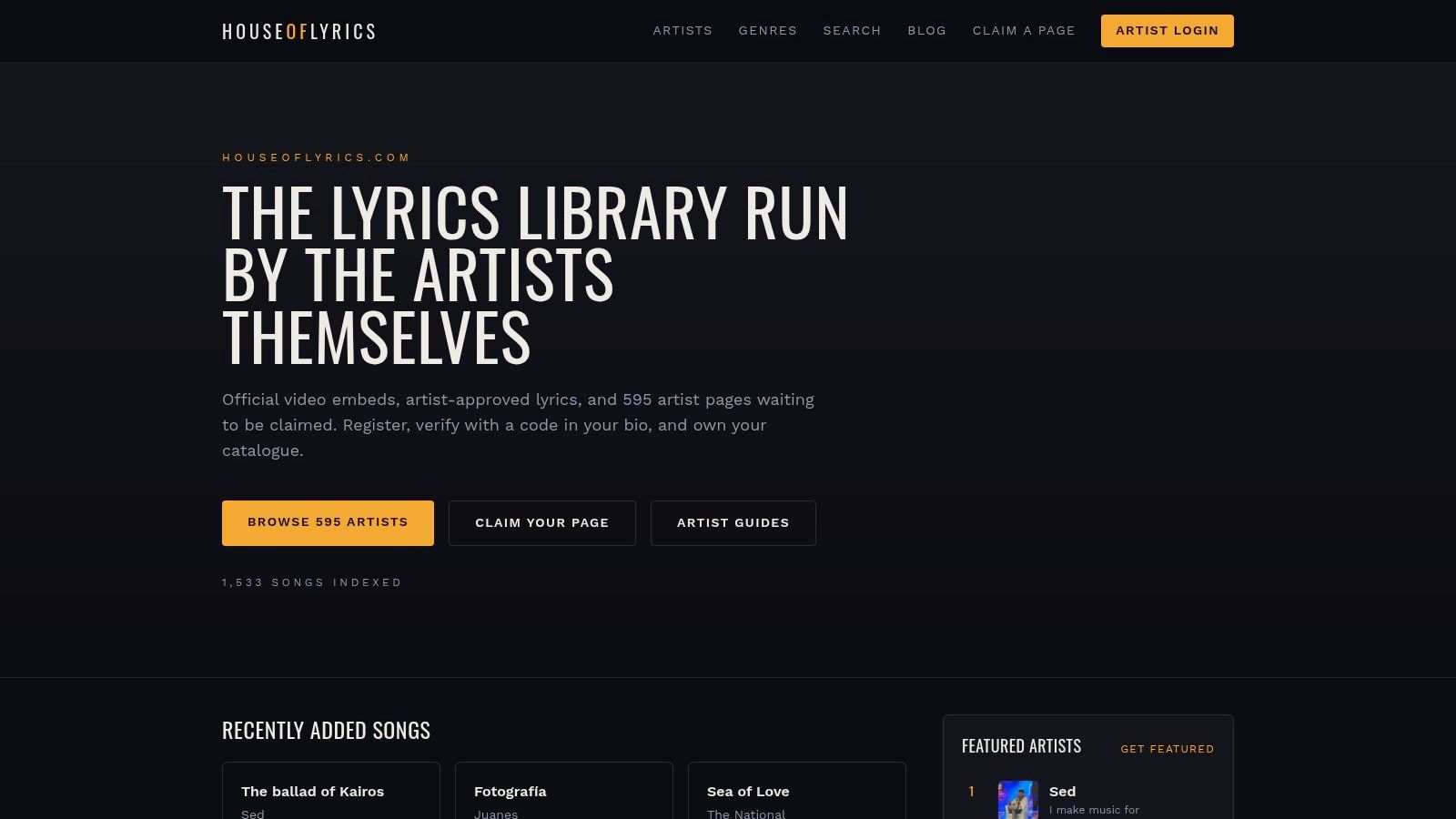
Search, inspect, then share
- Search the official title. Add Etta James if you want the original, or the cover artist if you're listening to another performance.
- Inspect the actual entry. Apply the recording and provenance checks before treating its text as the match you need.
- Handle absence. If no matching page exists, don't describe another website's transcription as verified without checking its source.
Our explanation of what an editorial review involves gives readers context for the approval step. Prefer a named approver and an identifiable official audiovisual source over a page that explains neither, but don't confuse an available video with approval of the accompanying transcription.
For artists and rights holders, claiming a song page is free. Once verified, an owner can manage lyrics, credits, and official media through the editor, with updates reviewed before public display.
Keep the final decision specific: does this page identify the performance, account for its text, and support its credits? If not, save it as a lead rather than sharing it as the authoritative lyric source.
House of Lyrics offers rights-holder-submitted lyrics with review before publication, helping you keep a song's words attached to the right performer and recording. Visit House of Lyrics, search for “All I Could Do Was Cry,” and share a matching page only after you've checked its attribution and version details.