Incorrect Lyrics: How to Find, Report and Fix Them
Found incorrect lyrics on a song page? Learn how to verify the error, claim the page and submit a fix through House of Lyrics' editorial review.

You hit play, the chorus lands, and the words on the streaming lyric panel do not match what the singer just sang. You rewind once. Same clash. Before anyone edits a page, the job is to prove which recording you heard and what that recording says.
Incorrect lyrics stick because a wrong line can sound more natural than the original one. A fix that skips the recording just copies the mistake onto a cleaner page. I would start by naming the release, then writing the disputed line down, and only then deciding whether the page is wrong.
Table of Contents
- Confirm the Error Before You Report It
- Tell Intentional Versions From Real Mistakes
- Claim the Page to Get Edit Access
- Submit the Correction Through Editorial Review
- Prevent Incorrect Lyrics Before They Spread
- Submit Your First Correction This Week
Confirm the Error Before You Report It
The line looks off inside the app. That feeling is common, and it is not proof. A 2025 Butlin's Big Weekenders poll found that 69% of British respondents had been told they were singing the wrong words to their favorite songs. Treat the clash as a lead, then run six checks in order.
- Play the official studio or video version. Lyric videos and fan uploads often paste an unofficial text over the track, so they cannot settle the dispute.
- Listen at normal speed, then at half speed. Write exactly what you hear, including mumbled syllables, so memory does not tidy the line.
- Compare that note with the lyric page and mark the timestamp. A correction request without a time is a guess, and reviewers send guesses back.
- Check the chorus and every repeated line. One bad line is often copied through the whole song on a re-upload.
- Confirm the release. Studio, radio edit, live, remix, or clean version. The text has to belong to the recording in front of you. If you are still hunting an official text, this guide to finding song lyrics shows where artist-approved wording lives.
- Decide mishearing or real version change. If the release matches the approved text and your note differs, you have an error. If the release itself differs, you have a version, not a typo.
| Error type | What it looks like | Evidence to check | Who can correct it |
|---|---|---|---|
| Misheard word | Sounds meaningful but differs from the sung word | Official recording and artist-approved text | Page owner or editors |
| Missing or extra line | A chorus line dropped or added on a re-upload | Full track, checked at every chorus | Page owner or editors |
| Clean or radio edit | Profanity swapped or removed | Release details naming the edit | Page owner, with a version label |
| Live or remix wording | Ad-libs or new verses from a performance | Event date, performer and recording source | Page owner, labelled as a separate version |
| Typo or formatting | Misspelled word, merged words or wrong punctuation | Artist-approved source text | Page owner or editors |
Practical rule: A request I would approve carries a timestamp, a release name, and a written note of what the recording says. Anything thinner gets sent back.
Tell Intentional Versions From Real Mistakes
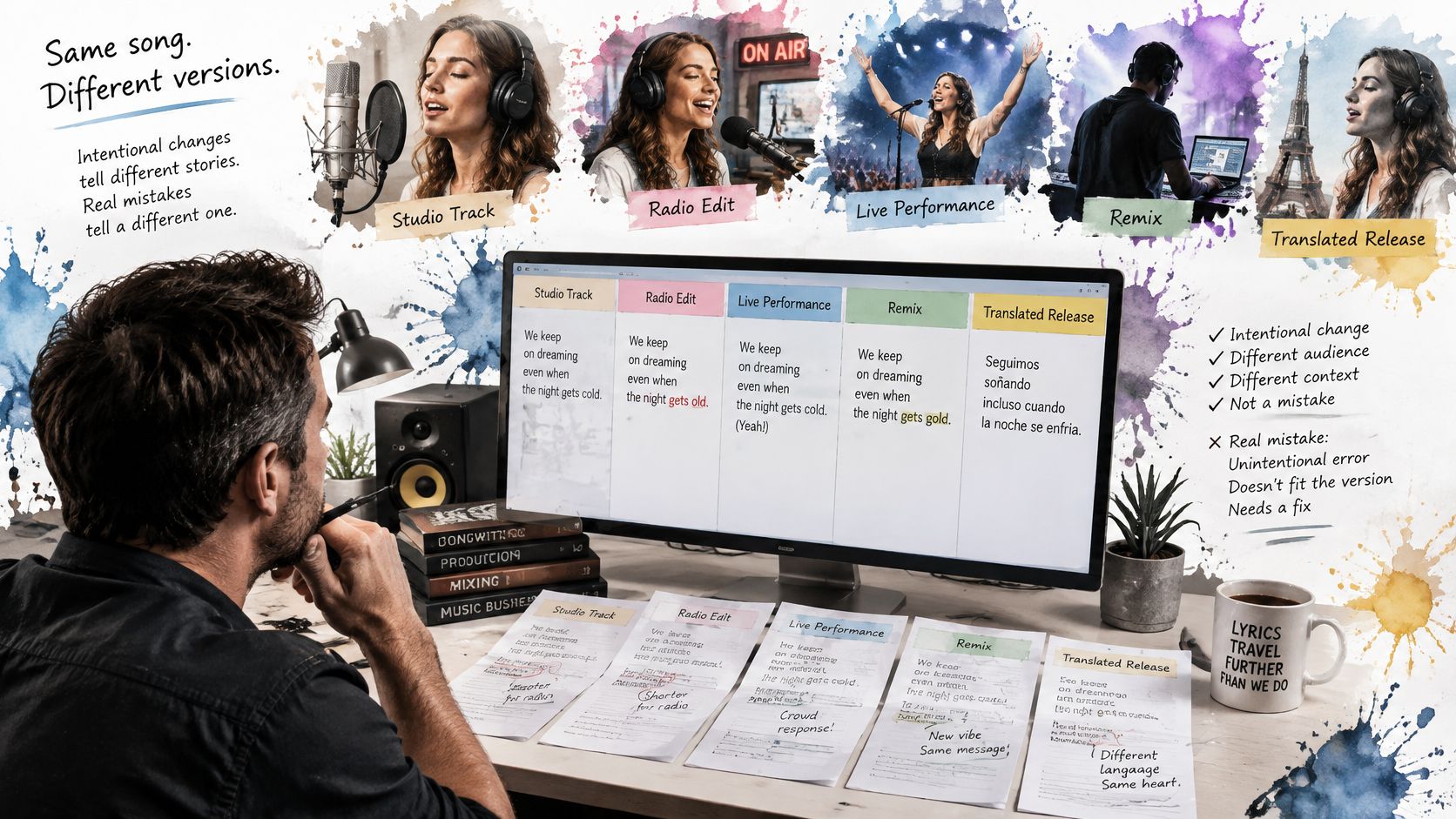
The same song can have several legitimate lyric texts. A studio master, radio edit, live performance, remix, or translated release may differ. Music publishers have argued in court that AI systems can reproduce lyrics in ways that affect the market for original compositions. That dispute makes accurate version labels matter: a single scraped text can flatten distinctions between releases.
Before submitting a correction, decide whether the difference is an error, an approved alternate, or an unapproved version.
A real error to fix is a wrong word in a recording that matches the approved text. A misheard hook on the official studio track belongs here. Correct the word rather than creating a separate version to explain a listening mistake.
An approved alternate to label belongs to a specific release. A clean edit may replace a profane word, and a live performance may include an improvised verse. Include the release name so readers know which recording the text follows. A line-by-line lyric page shows how specific wording can be tied clearly to a song, rather than blended into one ambiguous text.
An unapproved community version stays off the page. A fan transcription or a translation the artist has not supplied may be discussed in release notes, but it cannot replace the approved text. House of Lyrics only hosts lyrics submitted by the artist or rights holder. That keeps unapproved wording from overwriting the text submitted by the rights holder.
Captions are an access tool
For deaf and hard-of-hearing listeners, lyrics and captions can make a song's words accessible. Accessibility research on musical media examines lyric visualization and captioning as ways to support access. Captions should match the released recording and identify ad-libs, overlapping voices, or unclear words. A joke mishearing is not an accurate caption.
If the release matches the approved text, correct the error. If the recording differs, label the alternate version.
Claim the Page to Get Edit Access
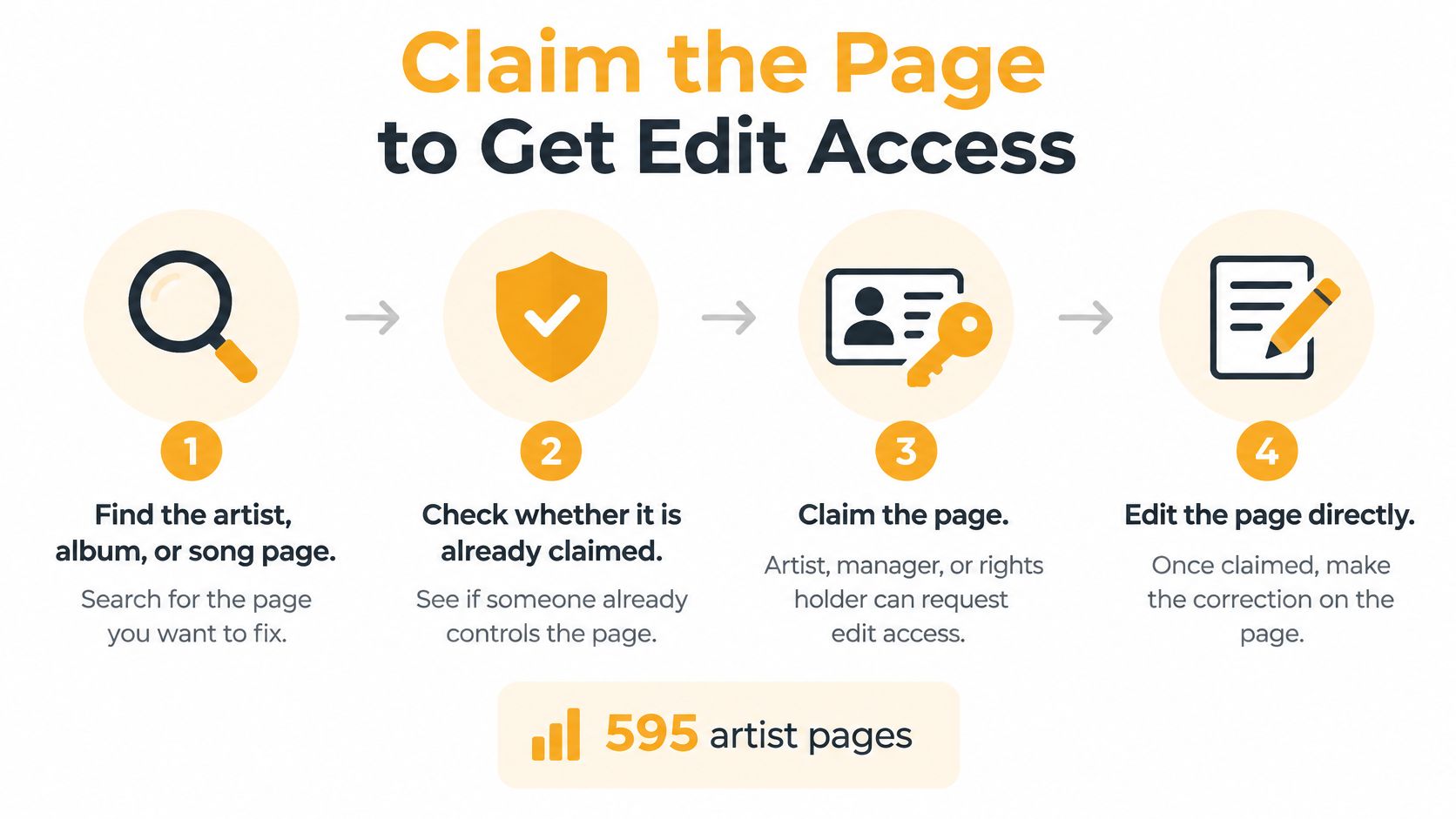
A correction request starts with the recording, but making the change requires access to the right page. The artist or rights holder claims the page and can then manage its content. House of Lyrics has 595 artist pages waiting to be claimed, so check whether the page already has an owner before starting.
Search by artist, album, or song, then check the claim status. If another owner has claimed the page, contact that owner rather than opening a second claim. This keeps the request attached to the catalog entry for the recording you identified.
The code proves the account
- Choose the claim option on the page. Start with the exact artist, album, or song entry you need, not a similarly named page.
- Copy the verification code shown on screen. Use the code for this claim rather than forwarding a screenshot as proof.
- Add the code to the artist's X or SoundCloud bio. The account needs to show your connection to the artist. An email address alone does not establish control of the artist's page.
- Submit the claim and wait for confirmation. The editor becomes available after the page is linked to you. If you know which catalog entry is yours, start through the House of Lyrics claim page.
If the code does not appear or the bio cannot be edited, check that you are signed into the account connected to the artist. A personal account with no visible connection to the act will not establish page ownership.
For shared teams, agree on who manages the page and who submits changes. The artist or rights holder should retain control of the claim, while managers and label contacts coordinate requests with that owner. A guide to managing project users offers a general example of assigning roles across a shared account, but the lyrics page's claim status determines who can edit it.
Each song has its own page, separate from other songs by the same artist. Once the rights holder claims a page, they can manage its lyrics, chords, embeds, and public profile. Keep the correction tied to the specific recording, so the approved text for one song or release does not get confused with another.
Submit the Correction Through Editorial Review
Owning the page does not push the words live. The correction sits in review until someone checks the release you named.

| Situation | Your next action | What happens before it goes live |
|---|---|---|
| Typo on a page you have claimed | Edit the line in the full editor and add the source | Held for review, then published once approved |
| Wrong lyric on an unclaimed page | Claim the page first, then submit the edit | Reviewed by the song owner or House of Lyrics editors |
| Disputed alternate version | Submit with release details and your reasoning | Editors check the release; visible attribution is kept |
| Missing chorus line after a re-upload | Paste the full approved chorus and note the track | Compared against the approved text before publication |
Open the song page, change only the disputed line in the full editor, add a release or source note, and submit. Submitted lyrics are reviewed by the song owner or House of Lyrics editors before they appear on a page. A claimed artist can manage albums, songs, and official video embeds, and publish their own lyrics, with a full editor before anything goes live. The editorial review is the gate, not a formality.
What gets approved
Keep the edit on the disputed line. Rewriting the whole song looks like a new transcription, and reviewers treat it as one. Paste the exact approved wording instead of retyping it, because a fresh typing pass creates a second typo. Put the release name in the note so the reviewer can open the same recording you used.
An unclaimed page cannot be corrected by a fan. The claim comes first. If you are collecting listener notes while you wait, a guide to collecting website feedback is a clean way to sort comments so only evidenced lines reach the editor.
Watch the short walkthrough of a lyric edit before you submit, so the fields you fill match what review expects.
Expect a held submission, then a decision. Reviewers ask three things. Does the release match? Is the wording copied from the approved source? Will attribution stay visible once it publishes? A yes on all three becomes a public lyric with the owner named on it.
Prevent Incorrect Lyrics Before They Spread
Raw machine lyrics are a draft, not a publishable text. In a benchmark of singing transcription, a singing-adapted end-to-end system still produced a 34.8% word error rate on the SSV dataset and 43.4% on the DALI dataset, as reported in this singing-lyrics transcription paper. That is roughly one wrong word in three on the cleaner set, and worse on the harder one. I would not publish that output.
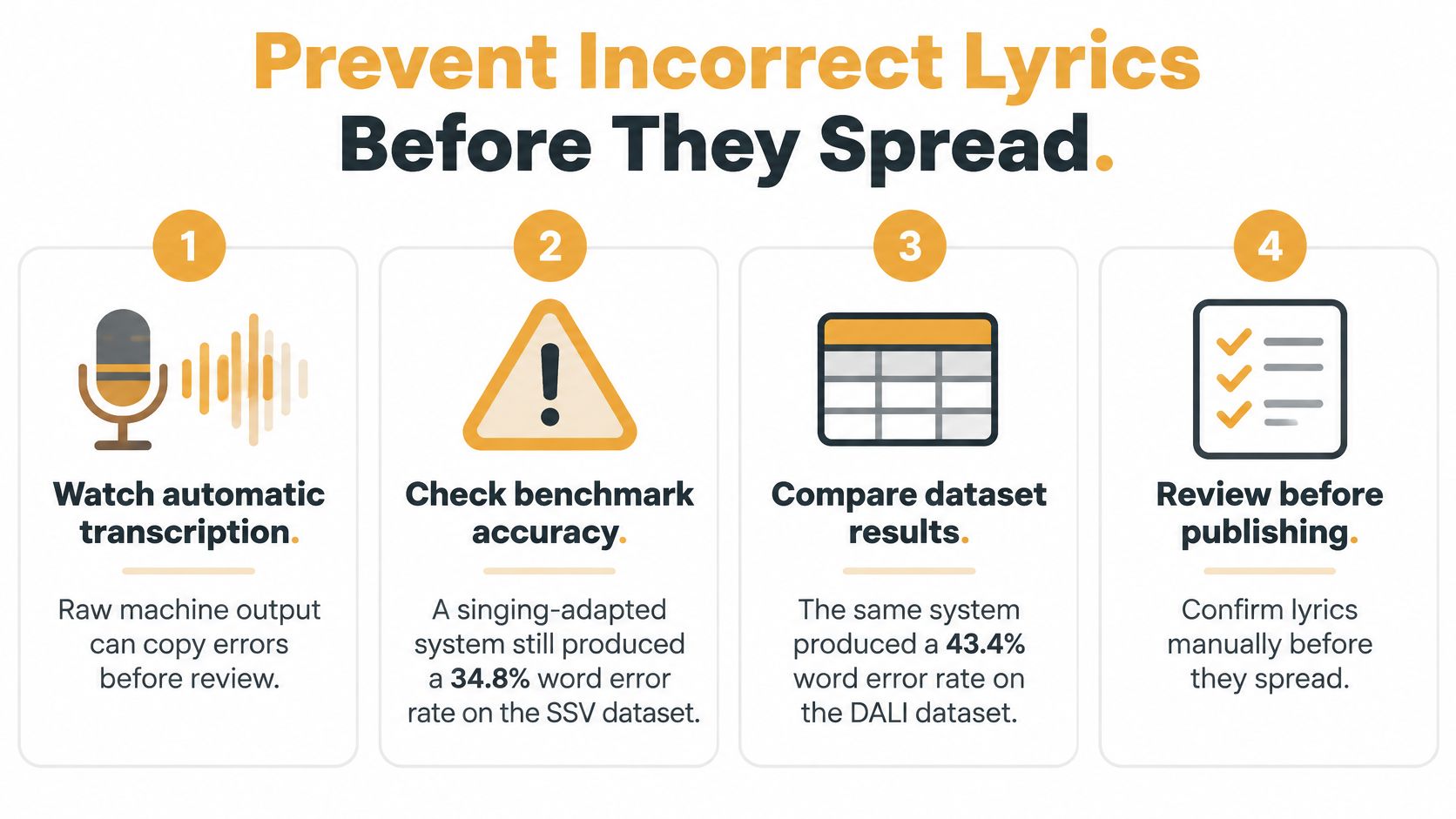
Keep the audio-derived draft as a discovery aid. Verify every uncertain substitution, deletion, and insertion. Proper nouns, repeated choruses, dialect, ad-libs, and deliberately odd spelling fail first. Word error rate counts every wrong word the same, so a calmer overall score can still hide a broken hook. Run a second listening pass on every chorus before you trust the draft.
Timing does not prove the words
Alignment can drop an incorrect lyric on the right beat. A polyphonic alignment study measured an average line-level alignment error of 0.94 seconds, with individual absolute errors from 0 to 9 seconds, in this line-alignment paper. A tight timestamp only shows where a line sits. It does not show that the line is the one the artist approved.
Build the habit into the catalog, the same way you would track credits in metadata management.
- Keep the approved source text on file. Reviewers compare against a document, not against memory.
- Record the release name and date for every version. A later clean edit cannot overwrite the studio text if both are labelled.
- Recheck the page after every new release or re-upload. A fresh audio file is where a dropped chorus sneaks back in.
- Flag uncertain words instead of guessing them. A marked blank is easier to fix than a confident wrong hook.
Each time a new track or edit ships, the owner opens the source file, plays the chorus twice, and confirms the page still names that release. Ten minutes there saves a public correction later.
Submit Your First Correction This Week
Submit now only if the checks confirmed a real error on a release you can name. A hunch, a meme lyric, or a live clip you cannot date should wait.
Gather four things before you open the editor.
- The timestamp from the recording, so the disputed line is easy to find.
- The release name, studio, clean, radio, live, or remix.
- The approved source text, pasted, not retyped.
- The social account that will prove control of the page.
Claiming a song page is free. Claiming an artist page is free and lets the artist manage lyrics, chords, embeds, and their public profile. If the page is still unclaimed, pass the timestamp, the release name, and the source text to the artist or manager. They are the people who can file it.
Open the page today, check its claim status, and either start the claim or send that packet to the owner. The dispute leaves the comment thread and lands with someone who can change the text.
House of Lyrics pairs artist-approved lyrics with official video embeds, so a correction is tied to the release you can hear. Verified artists and rights holders claim their pages and submit lyric fixes that stay in review until they are right. Visit House of Lyrics and claim the page that still shows the wrong line.