What Is an Editorial Review and Why It Matters
Discover what is an editorial review and how artist-run platforms use it to ensure accurate lyrics, verified credits, and official video embeds.

About 30% of scholarly submissions are rejected during initial editorial screening, before external review, and one study recorded 4,181 acceptances from 20,755 submissions processed through the first editorial board stage. An editorial review is a structured quality-control step where platform editors or verified rights holders evaluate accuracy, rights provenance, and formatting before content goes live.
You may know the frustration already. You search for your own song and find lyrics with missing lines, credits attached to the wrong people, or an unofficial video presented as if it were the definitive version. Fans, journalists, and collaborators can't easily tell which page reflects your approved work.
For independent artists, editorial review isn't just an academic publishing tradition or a bureaucratic delay. It's a practical safeguard for your public catalog. The process creates a clear path from a raw submission to a reliable page that respects your lyrics, credits, ownership, and presentation.
Table of Contents
- The Real Cost of Unverified Music Content
- How Editorial Review Evolved From Academic Triage
- The Four-Step Workflow for Artist-Run Platforms
- Crowdsourcing Versus Artist-Approved Accuracy
- Protecting Provenance With Official Media and Metadata
- Taking Control of Your Public Catalog
The Real Cost of Unverified Music Content
A lyric page can look like a small piece of information, but it often becomes part of the public record surrounding a song. Fans use it to follow along, media teams reference it when preparing coverage, and collaborators may rely on visible credits when discussing the release. If those details are wrong, your catalog starts telling a story you didn't approve.
The problem often begins with an innocent-looking edit. Someone hears a line incorrectly and types a replacement. Another person adds a producer without checking the release credits. A third user attaches a video that resembles the official upload. Each change may seem minor, yet together they can create a page that misrepresents the song.
Practical rule: Treat every public lyric, credit, and media field as part of your artist identity, not as disposable website text.
An editorial review provides the missing control layer. Before publication, an editor or verified rights holder checks whether the submission matches an authoritative source, belongs on the relevant page, and follows the platform's formatting standards. That review helps distinguish an artist-approved version from an unverified transcription.
Why accuracy affects trust
Fans don't always know where a lyric page came from. If the wording conflicts with your recording, they may assume the performance was unclear or that your own team made an error. Incorrect songwriter or producer credits create a separate problem because they can blur who contributed to the work.
A reliable platform should make provenance visible. That means showing who supplied the content, preserving the relationship between the artist and the song, and giving official audiovisual material a clear place beside the text. For a useful example of how lyric presentation can shape a song page, explore All This Time lyrics.
The review as a protective shield
A strong review process asks practical questions:
- Accuracy: Does the lyric text match the approved version?
- Ownership: Is the person submitting the change authorized to make it?
- Credits: Are contributors attached to the correct song and role?
- Formatting: Can fans read the page clearly across devices?
- Media: Does the embedded video come from an official source?
The result isn't perfection through guesswork. It's a documented decision about what deserves to appear publicly. That distinction matters because artists shouldn't have to spend their time correcting pages that strangers can alter without accountability.
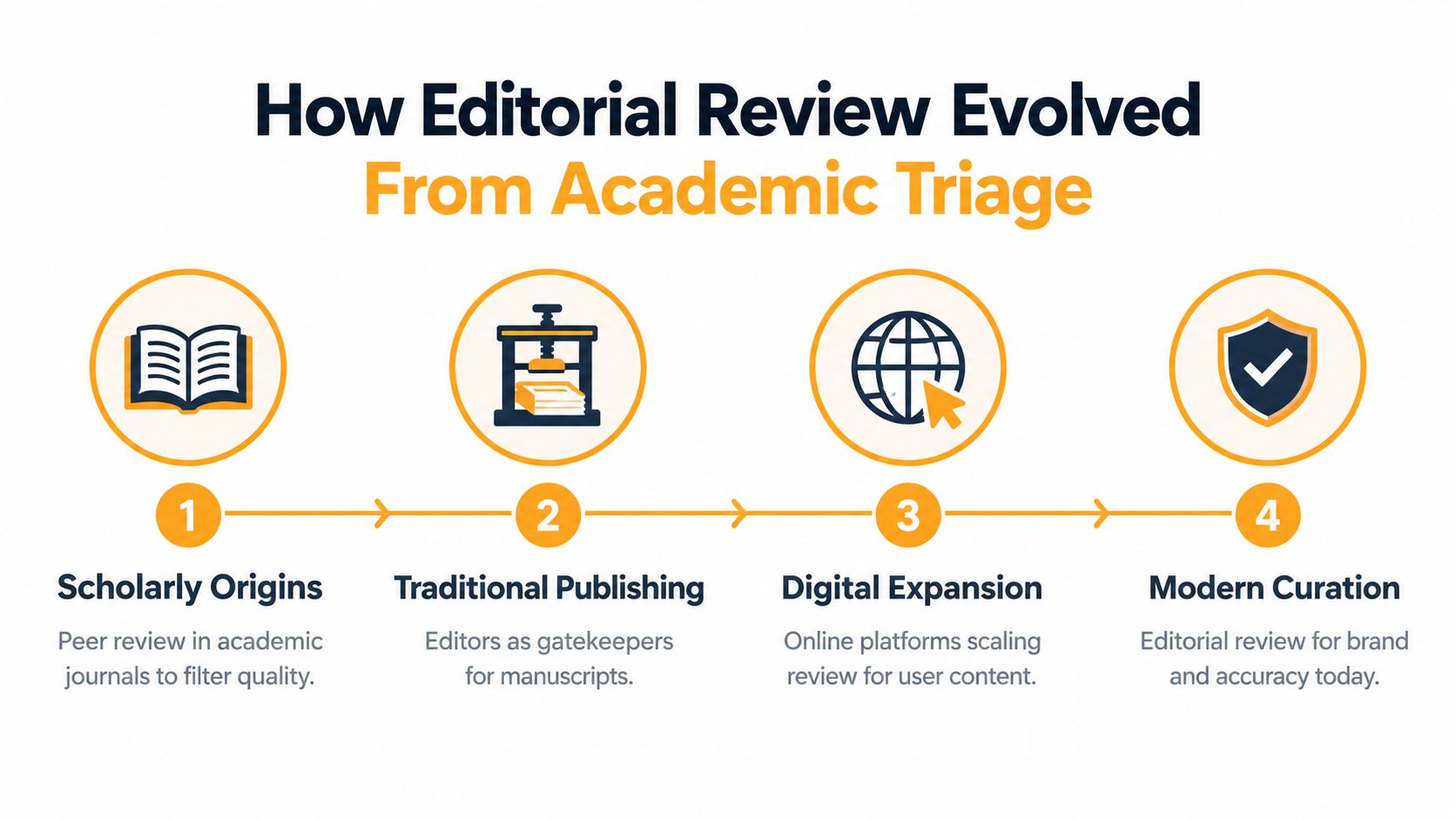
How Editorial Review Evolved From Academic Triage
Traditional editorial review began as an early filter in publishing workflows. In scholarly publishing, an editor or editorial team evaluates a submission internally and decides whether it should advance to publication without sending it to external subject-matter reviewers. The purpose is straightforward: identify submissions that fall outside the publication's scope or fail basic quality and originality requirements before asking more reviewers to spend time on them.
The scale of that gatekeeping role is measurable. One analysis of elite science journals found that about 30% of submissions were rejected at the initial editorial screening stage before external review, while 4,181 papers were accepted from 20,755 submissions processed through the first editorial board stage. Those figures show that editorial review isn't a ceremonial glance. It can remove a substantial share of unsuitable work early in the workflow. The scholarly publishing explanation of editorial review provides the relevant context.
Why speed matters at the first gate
Editorial assessment also functions as triage. A 2025 analysis reported a mean of about 10 days from submission to editorial rejection without peer review, compared with a mean of 34 to 46 days for first decisions after external peer review, depending on the journal group. The same analysis reported median times to final decision ranging from 59 to 65 days, showing how the initial editorial check sits at the front of a longer process. The published journal workflow metrics support that comparison.
Music platforms adapt this logic to a different kind of material. Instead of deciding whether a scientific manuscript belongs in a journal, editors may assess whether a lyric edit matches the official recording, whether a credit update has a credible provenance, or whether a media embed represents the canonical release.
That adaptation also appears in broader creative operations. Teams researching editorial work for brands can see how review standards help keep public-facing content consistent with an organization's identity. The underlying principle is the same: a trusted editor checks the material before an audience treats it as authoritative.
A modern music page may therefore pass through a sequence resembling scholarly publishing:
- A creator or rights holder submits content.
- The platform checks the submission and its provenance.
- An editor evaluates scope, accuracy, originality, and format.
- Approved material moves into its public presentation.
A lyric page for Body Electric lyrics illustrates why the final display needs more than raw text. The page should connect the song to its artist and surrounding catalog, while keeping the public version clear and dependable.
The Four-Step Workflow for Artist-Run Platforms
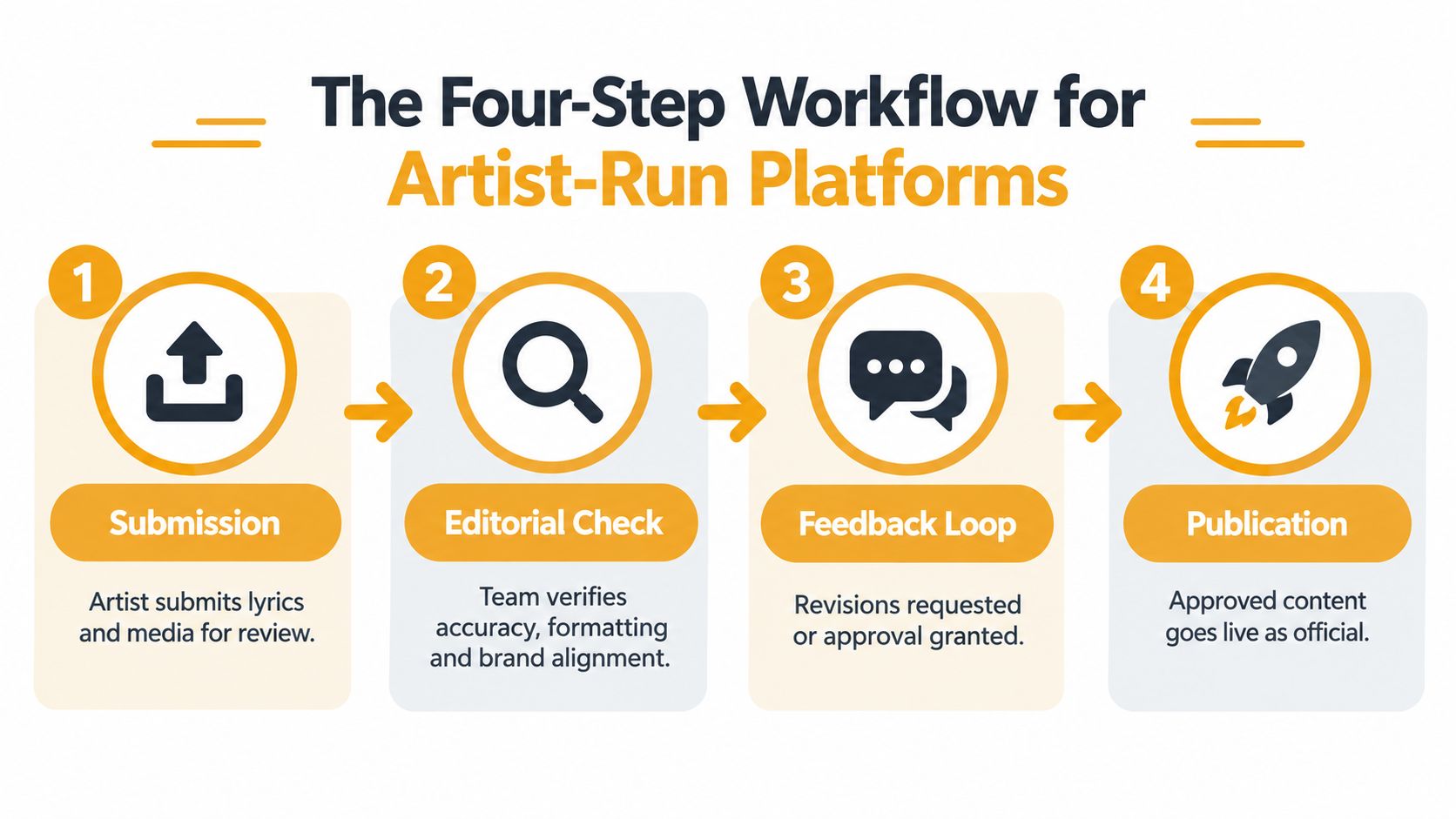
A useful editorial system should be easy for an artist to understand. You shouldn't have to wonder whether an edit disappeared, went live immediately, or reached a reviewer without enough context. The workflow should show who submitted the change, what needs checking, and when the approved version becomes public.
Step one, submission
An artist, manager, label representative, or other verified rights holder starts by submitting an update. That update might correct a lyric, add a songwriting credit, revise album information, or supply an official video. A full-page editor is especially useful because it lets the contributor see the surrounding context instead of changing one isolated field with no view of the finished page.
The submission should preserve the contributor's intent. If a line has a deliberate spelling, repeated phrase, or stylized formatting, the artist can provide the approved version rather than relying on a third party's interpretation.
Step two, verification
Verification confirms that the person requesting control has a legitimate relationship to the page or catalog. A practical method uses a one-time code placed in an X or SoundCloud bio. Once the code appears in a public profile controlled by the artist, the platform has a stronger basis for connecting the request to the rights holder.
Verification and editorial review solve different problems. Verification asks, “Who is submitting this?” Review asks, “Should this content be published?” Keeping those decisions separate makes the workflow easier to defend when a change affects credits, lyrics, or official media.
Step three, editorial check
The review stage is the hard gate. Editors compare the submission with official sources, examine whether the requested change belongs on the selected page, and check formatting and presentation standards. If something is unclear, the team can request a revision rather than publishing a version that may later need to be removed.
A revision request protects the catalog better than a fast approval based on incomplete information.
This step also creates a useful feedback loop. The artist can clarify a credit, correct a transcription, or provide a better source without losing control of the page.
Step four, publication
Only after approval does the update move into the public catalog. Publication should preserve the relationship among artist, album, song, lyrics, credits, and media, so fans can find the corrected information in the right place.
Artists building a release plan can also review how to release music to understand why catalog preparation and public presentation belong in the same operational conversation.
Crowdsourcing Versus Artist-Approved Accuracy
Open crowdsourcing and artist-run editorial review make different tradeoffs. A crowdsourced lyric site may invite many users to submit or edit content, which can create broad participation but leaves the platform sorting through uncertain authorship and conflicting versions. An artist-approved model starts with a narrower pool of contributors and places their submissions behind a formal review gate.
The distinction isn't about dismissing fans. Fans can notice errors and care about a song. The issue is authority. A listener may hear a line accurately, but they may not know whether a lyric includes intentional stylization, whether a credit belongs to the track, or whether a video upload is the official source.
In scholarly publishing, the review stage operates as a hard gate that filters scope and originality failures early, reduces downstream rework, and supports format integrity before public release, as described in the staged journal editorial workflow. Music platforms can apply the same cause-and-effect logic to provenance and catalog management.
| Feature | Legacy Crowdsourcing | Artist-Run Editorial Review |
|---|---|---|
| Who can submit | Broad or loosely controlled user base | Verified artists and rights holders |
| Authority | Based mainly on user contribution | Connected to confirmed page ownership |
| Lyric accuracy | May depend on competing transcriptions | Checked against approved material |
| Credit changes | Can be added without clear provenance | Reviewed before appearing publicly |
| Media selection | May include unofficial uploads | Favors official or canonical embeds |
| Correction process | Often reactive after publication | Designed to check changes before publication |
| Catalog structure | Pages may remain disconnected | Artist, album, and song records are linked |
The cost of reactive correction
When an unverified edit goes live, the artist may need to contact a platform, explain the error, prove ownership, and wait for a correction. If the same information appears across multiple sites, the artist's team has to repeat the work and monitor whether the incorrect version returns.
A controlled workflow reduces that exposure by asking for evidence before publication. It also gives editors a consistent way to handle ambiguous submissions, conflicting information, and requests that require clarification. The strongest system doesn't merely remove bad content. It makes the path to accurate content clear.
Protecting Provenance With Official Media and Metadata
Editorial review should examine the whole song page, not just the lyric text. A polished page tells fans which artist performed the song, which album contains it, who contributed to it, and where to find the official audiovisual release. Those relationships help prevent a correct lyric from appearing in an otherwise misleading context.

Media provenance belongs beside the lyrics
An official music video embed gives the audience a canonical audiovisual reference. That matters because search results can surface multiple uploads, lyric videos, fan edits, and re-uploads that look similar at a glance. A review process can check whether the selected embed comes from the artist's or rights holder's recognized channel before it appears beside the lyrics.
The goal isn't to decorate the page. It's to connect the written work with a source the artist stands behind. That connection can make the page more useful for fans and more dependable for anyone researching the release.
Metadata creates a reliable catalog map
Structured metadata separates the artist, album, and song into clear entities. Editors can then confirm that a credit belongs to the right track, that an album link leads to the correct release, and that a song doesn't become attached to an unrelated artist with a similar name.
This structure also protects context. A page for 16 Shots lyrics should identify the correct song and artist while presenting the approved text and relevant media together. Without those relationships, even accurate information can become difficult to use or easy to misattribute.
The same concern appears in other digital publishing categories. Readers exploring unauthorized celebrity biography trends will recognize the broader provenance problem: public information can spread quickly while the subject has little control over how it's framed. For musicians, editorial review offers a direct way to keep catalog details tied to verified ownership and approved presentation.
Catalog principle: Accuracy means more than getting the words right. It means attaching the right words, credits, media, and identity to the right release.
Taking Control of Your Public Catalog
An editorial review gives independent artists something they rarely get from open web publishing, a defined point of control before information becomes public. You can submit the approved lyric, confirm your ownership, correct the credits, and ensure the page presents official media rather than leaving those decisions to anonymous contributors.
The workflow also helps management teams and labels work consistently. A manager can maintain a clear record of requested changes. A rights holder can review provenance before approving an update. An artist can protect the details that make a song recognizable, including its lyrics, collaborators, album context, and official video.
Start with the pages that matter most to your current catalog. Gather the approved lyric text, confirm the credit information, identify the official media source, and use the platform's verification process before making edits. Then review the public page after approval to ensure the artist, album, song, lyrics, and media connect as intended.
If you're ready to establish that ownership, begin by claiming your artist catalog. A trusted editorial process won't replace your creative judgment. It gives that judgment a secure route into the public record.
House of Lyrics offers claimable artist, album, and song pages, ownership verification, a full-page editor for lyrics and credits, and official video embeds reviewed before publication. Visit House of Lyrics to manage your public catalog and keep your approved work, provenance, and presentation under your control.