Video Embed Service Explained: Official Embeds for Lyrics
Learn what a video embed service is, how official YouTube and Vimeo embeds work, and how to use them responsibly on lyrics pages.
You're reading the words to a new single, you spot the official video right above the second verse, and you press play without ever leaving the page. It feels effortless. Behind that one tap, though, someone chose the video, confirmed it belongs to the rights holder, decided when the player should load, and made sure a reader who can't use a mouse can still start it. That's the work of a video embed service, and it's exactly what makes the difference between a trusted song page and a random paste job. Let's build that understanding step by step, using lyrics pages as our working example.
Table of Contents
- What a Video Embed Service Actually Does
- Embed Methods Compared at a Glance
- How Embedding Works Behind the Scenes
- Pros and Cons of Embedding Official Videos
- Consent and Privacy Before the Video Plays
- Accessibility Gaps in Official Video Embeds
- Real-World Embed Scenarios for Lyrics Pages
- Confirm Each Embed Before You Publish It
What a Video Embed Service Actually Does
A video embed service is the method and provider toolset that puts an official video player inside another website. The video file never moves to your page. It stays on the provider's infrastructure, while your page supplies the context around it.
Think of a museum lending a painting to a partner gallery. The museum keeps ownership and can recall the work. The partner gallery hangs it carefully and adds a proper label. On a lyrics page, that label is the song title, artist name, verification status, and the lyrics themselves. The host displays, the provider delivers, and the rights holder decides what gets shown.
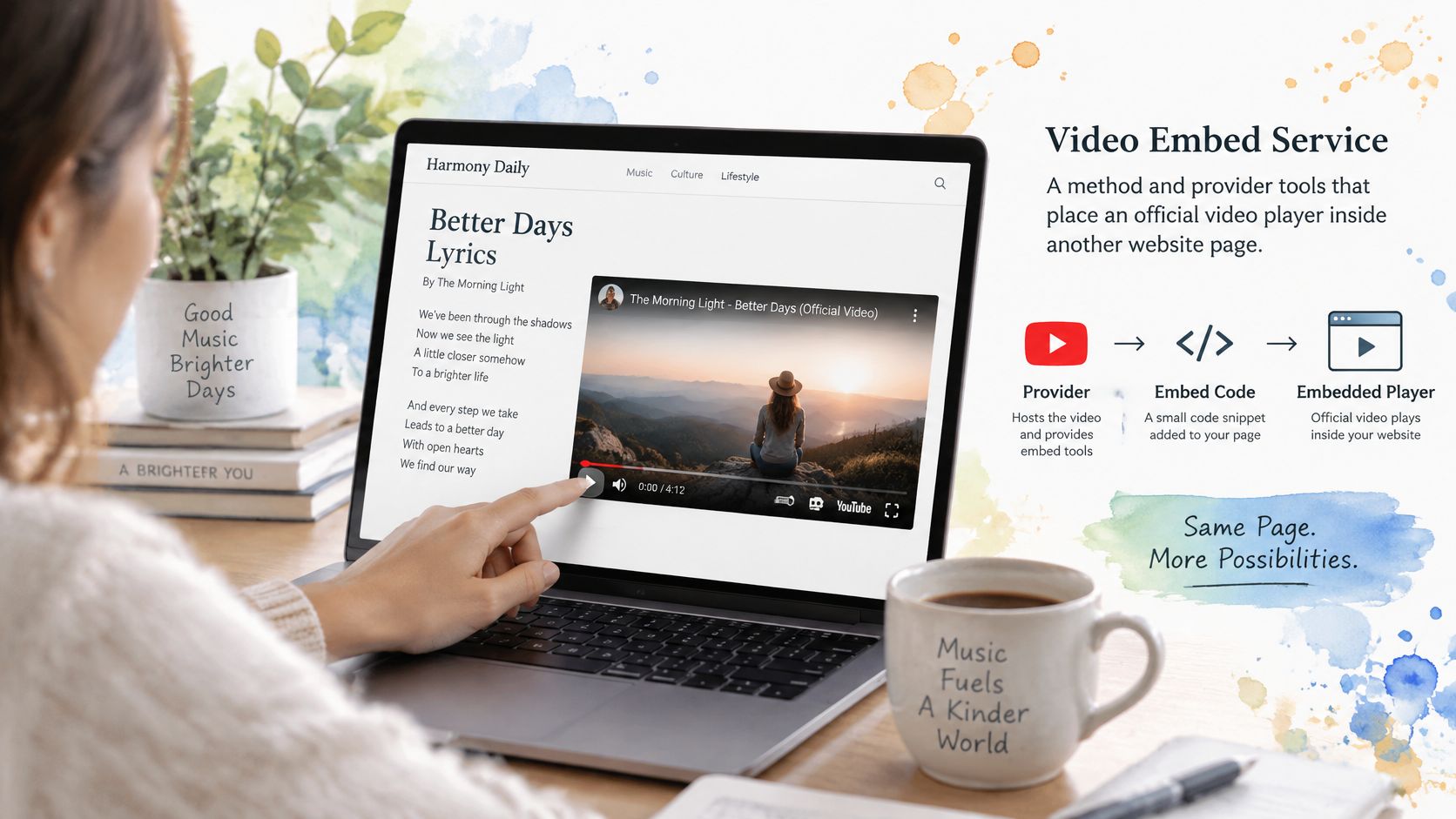
That arrangement solved a demand that appeared early. Video placed directly inside a webpage lets people watch without navigating to a separate destination, a pattern the Pew Research Center survey of the online video audience showed was already spreading across home and work contexts. For music, that means a fan can hear phrasing, watch performance, and follow verified words in one place.
The simple test: If removing your page would not remove the video from the internet, you're embedding. If it would, you've rehosted it.
By the end of this guide, you'll be able to compare embed methods, follow the mechanics behind the player, check privacy and accessibility before publishing, and apply a clear checklist to scenarios artists and managers face every release week.
Embed Methods Compared at a Glance
Five methods cover almost everything you'll see on lyrics pages, and they differ most in who hosts the file and when visitor data starts flowing.
| Method | Who hosts the video | Playback and data flow | Rights risk | Best for |
|---|---|---|---|---|
| Official iframe embed | YouTube or Vimeo | Provider player loads with the page | Low when the video ID is verified | Song pages with verified official videos |
| Click-to-load placeholder | YouTube or Vimeo | Player loads only after the reader clicks play | Low when the video ID is verified | Lyrics pages where most visitors read rather than watch |
| Direct file upload or rehost | Your own platform | Your servers stream the file | High, needs a licence for every copy | Rarely advisable for a lyrics platform |
| Unofficial re-upload embed | Unknown uploader | Unknown player and unknown ads | High, often unlicensed | Avoid entirely |
| Plain link-out | Provider | Reader leaves the page | Low | Fallback when no verified video exists yet |
If you're setting this up in a page editor for the first time, a step-by-step walkthrough of how to embed YouTube and Vimeo shows the basic placement mechanics. Choosing the method is a separate decision from pasting the code, and our explainer on official lyrics video pages covers how that pairing should look for fans.
A decision rule you can apply today
- Official iframe: Use it when the rights holder has verified the video ID and the page is built mainly for watching.
- Click-to-load placeholder: Use it when most visitors arrive to read, so the player waits for intent.
- Plain link-out: Use it when no verified video exists yet, rather than guessing at a similar upload.
- Rehost or unofficial re-upload: Don't use either. You gain no control and you take on the rights problem.
Notice what drives risk. It isn't the embed code. It's whether someone verified that specific video ID against the rights holder's official channel.
For most lyrics pages, make the click-to-load official iframe your default. The lyrics stay first, attribution stays visible, and third-party loading waits until the reader asks for video.
How Embedding Works Behind the Scenes
Embedding looks like one snippet, but a reliable page treats it as a small record plus a rendering step. Your system stores a structured entry for the song, then turns that entry into a player only when the relationship is approved. That separation is what lets you audit, swap, or remove a video without touching the lyric text.
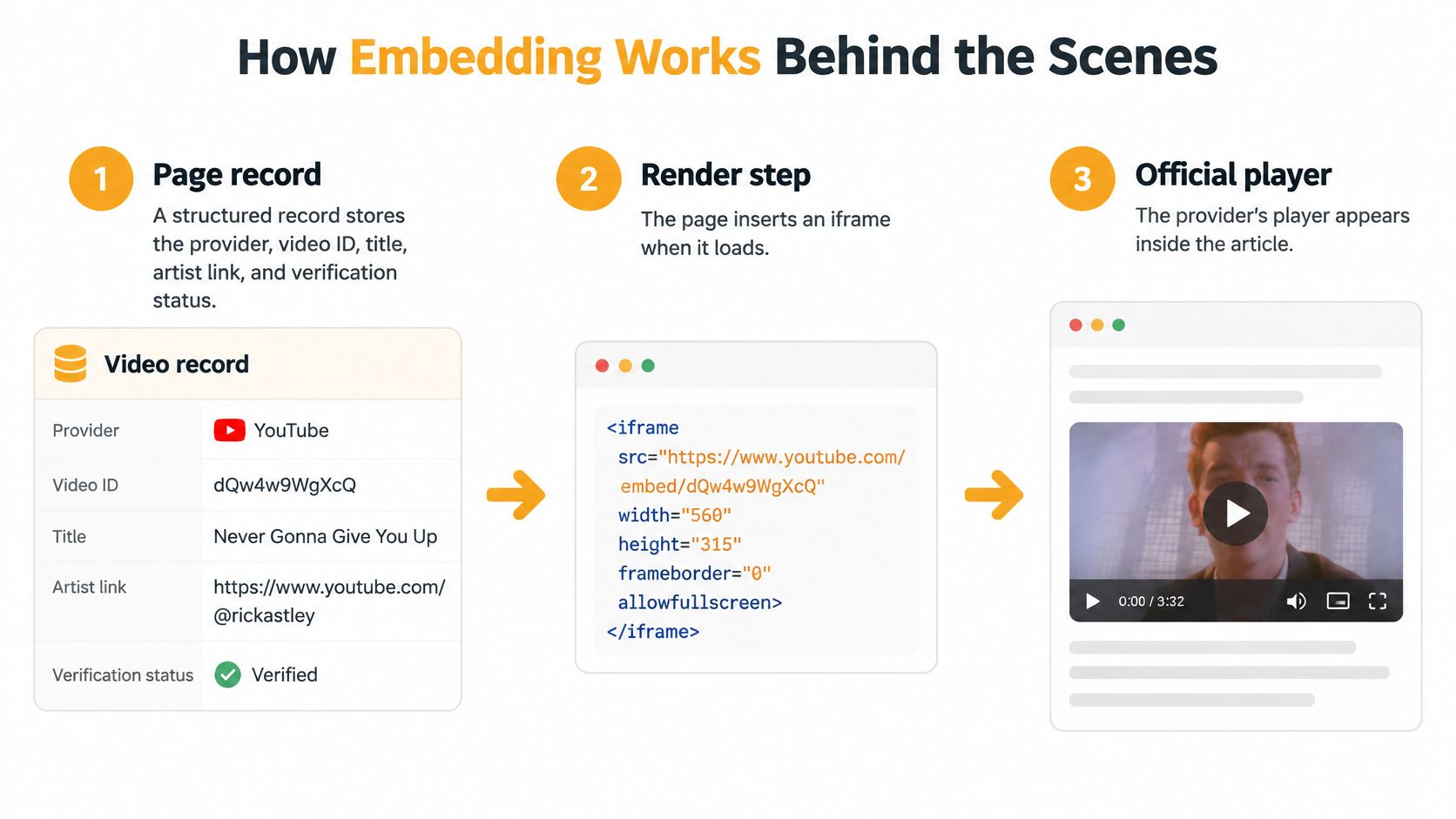
The official route matters here. The YouTube IFrame Player API reference describes a model where the page embeds playback and can control the player through JavaScript, while the provider retains delivery, transcoding, and playback infrastructure. You don't download or rehost the audiovisual file. You point to it.
The five stages in order
- Store the verified video ID alongside the provider, title, artist link, attribution, and verification status.
- Check approval so the song-to-video link is confirmed before anything renders publicly.
- Render the iframe inside a responsive box on the page. Good metadata management for music pages keeps those fields consistent across albums and singles.
- Let the provider stream the right quality version for the reader's device and connection.
- Keep a fallback ready for unavailable, region-restricted, private, or deleted videos.
One confusion trips up many editors. A player that loads successfully doesn't prove the upload is still the rights holder's official video. Channels get renamed, videos get replaced, and ownership claims change. Treat the iframe as presentation and the stored record as your source of truth, and recheck that record on its own schedule.
Pros and Cons of Embedding Official Videos
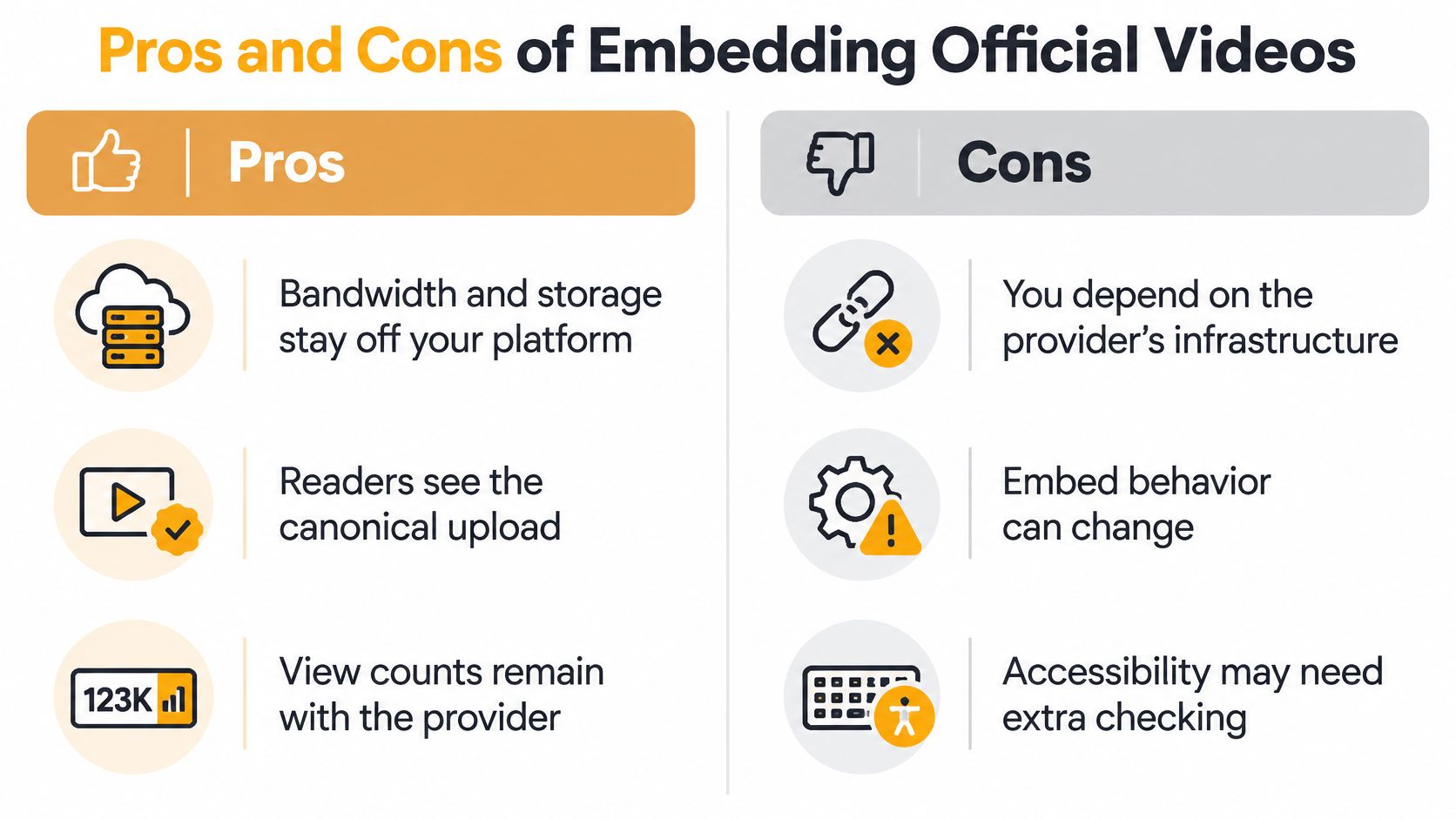
Official embeds earn their place, but they aren't free. Weigh both sides against the job your page is trying to do.
What you gain
- Lower running costs: Bandwidth and storage stay with the provider, not your platform.
- The canonical upload: Readers see the recognised version, with its view counts staying where labels and managers already track them.
- One trusted reference: A verified video beside verified lyrics gives fans, press, and collaborators a single point they can cite, which supports the wider work of music rights management.
What you accept
- Someone else's player: Ads, recommended videos, and tracking arrive with the provider's interface.
- Dependency: The provider or rights holder can restrict or remove the video, leaving a gap you didn't schedule.
- Page weight: Every embed adds requests and can delay the moment the lyrics become readable.
- Lookalike risk: A polished fan upload can appear official until someone checks the channel properly.
These trade-offs shift with the reader's goal. A premiere page built for watching tolerates a heavier, player-led layout because playback is the point. A reference page built for reading, quoting, or learning a song feels every drawback more sharply, because the video is supporting material rather than the main event. Match the method from the comparison to that primary purpose, and most embed arguments resolve themselves quickly.
Consent and Privacy Before the Video Plays
An official video can still contact a third party before anyone presses play. That is the part many embed guides skip, and it is why a lyrics page needs a deliberate loading choice rather than a default paste.
An automatically loaded iframe works like a door left open: the provider is contacted as soon as the page renders. A click-to-load player works more like a doorbell: a placeholder appears first, and the provider is contacted only after the reader chooses to watch. Same official video, very different data flow.
The UK Information Commissioner's Office guidance on storage and access technologies says organisations embedding third-party services such as streaming video should determine whether the feature stores information on the device or accesses information already there, explain that to users, and configure the feature as privacy-preservingly as possible. On a song page, that means asking a practical question before publishing: does this embed set or read identifiers before consent, and if so, what exactly does the reader get told?
Build a consent-aware placeholder
- Show the essentials first: song title, artist name, attribution, and the lyrics.
- Render a thumbnail with a clear, labelled play control and a short note that playback loads the provider's player.
- Load the iframe only after explicit interaction or valid consent.
- Use the privacy-enhanced domain where supported, so views are not used to personalise the viewer's YouTube browsing experience.
Consent is easier to understand when the controls are written in plain language. DOM Studio's privacy control block shows how a settings surface can group permissions by what the reader is deciding, instead of burying those choices in legal wording. The same principle fits beside a video: state what loads, when it loads, and what changes if the reader declines.
Be honest about the trade-off. If tracking stays blocked, personalised recommendations may not appear, autoplay behaviour may change, and viewing history features may not carry over. Say that in one plain sentence near the player.
Official should not mean always loaded.
Artists and managers lose nothing by waiting. Attribution, the official title, and the verified link can all sit in the placeholder. Fans who came to watch get the actual player in one click, and fans who came only to read are not pushed into a third-party data flow they never requested.
Accessibility Gaps in Official Video Embeds
Official does not mean accessible. A video can come from the right channel, carry the right audio, and still exclude deaf, hard-of-hearing, blind, and keyboard-only readers if nobody checks the experience around it.
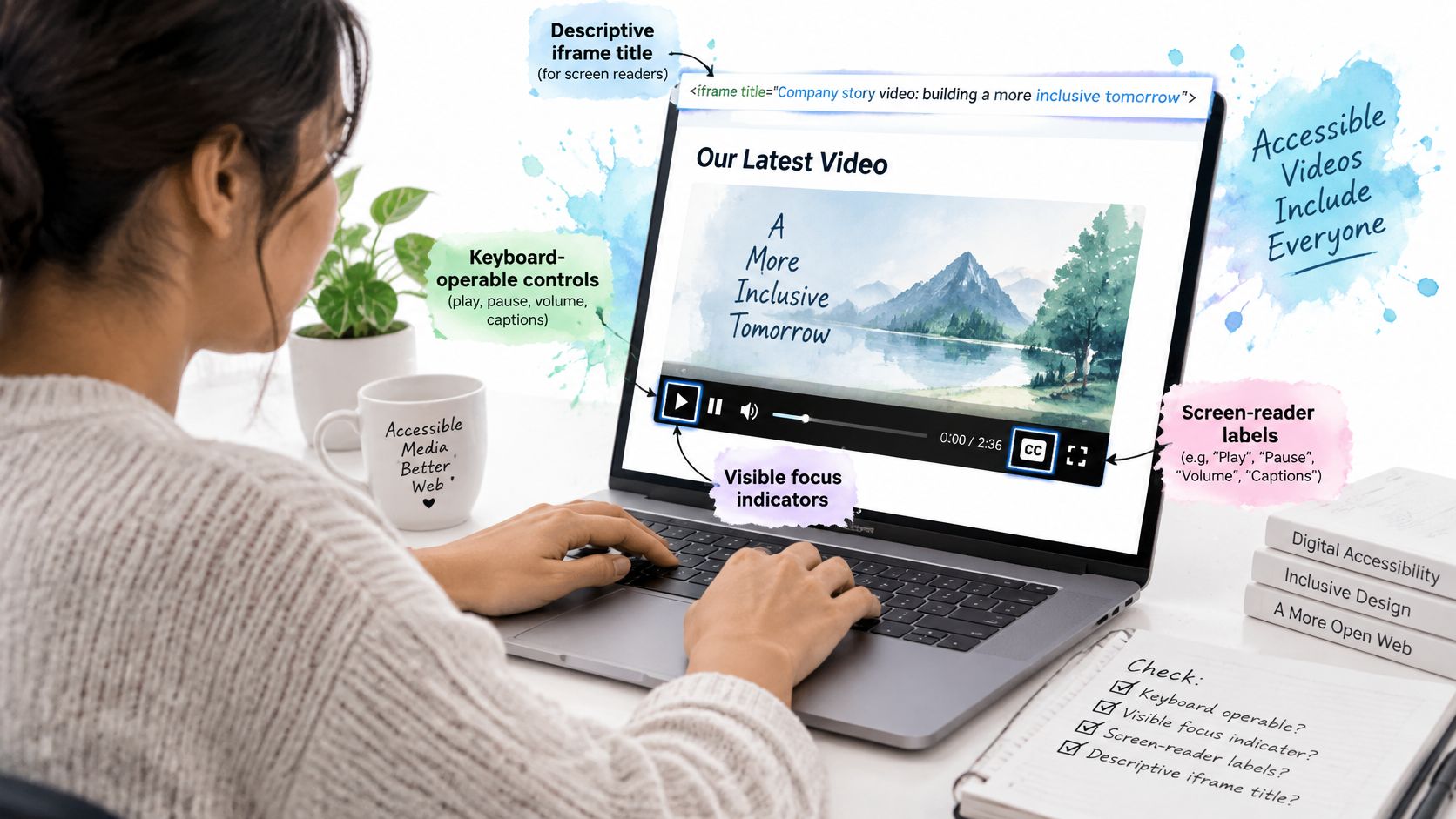
Here is the confusion that trips up most editors: the embed code arrives as a finished object, so it feels finished. It works more like a vending machine dropped into your lobby. The machine's buttons and display belong to the vendor, but the doorway, the floor space and the signage around it belong to you.
The Stanford guidance on accessible website media lists what embed implementations must be checked for. That includes keyboard-operable controls, visible focus indicators, screen-reader labels, descriptive iframe titles, editable human-created captions, and audio-description support. Auto-generated captions alone may not meet accuracy requirements, which matters when a misheard lyric is the whole reason someone visited.
European accessibility rules increasingly apply to digital services, so documenting these embed checks is practical compliance work as well as good fan care.
Where verified lyrics help
Artist-approved lyrics act as a complementary text alternative. They give deaf and hard-of-hearing readers the sung words in reliable form, and they give blind readers structured text a screen reader can read. When you're checking what a video says, even a tool that extracts YouTube video text for research only gets you a draft. It doesn't replace approved lyrics, just as knowing how to find song lyrics doesn't guarantee the version you found is correct.
A small example shows the upgrade. Replace a bare player with an iframe title naming the official video and artist, a note stating whether human-made captions are available, and the verified lyric text directly below. A screen-reader user now knows what's embedded before entering it, and a caption user knows what to expect.
So who owns what? The page owner remains responsible for the surrounding page, including the descriptive iframe title, the lyric text, keyboard access to the play control, and a working fallback. The provider controls the player's own features, such as caption presentation and audio description inside the player. You can't fix their player, but you can refuse to leave readers with only their player.
Real-World Embed Scenarios for Lyrics Pages
Abstract rules get easier when you picture the release meeting. These four situations cover most decisions you'll face.
An independent band has one official video. The band embeds it on the song page with a descriptive iframe title and the approved lyric text beneath it. Because most fans arrive from search to learn the chorus, they choose a click-to-load placeholder. The page stays fast, and the video is one intentional tap away.
A label manages several versions of one single. There's an official video, a lyric video, and a live session, and the temptation is to stack all three everywhere. Instead, the label links each version to its own clearly labelled song or album entry. Fans stop confusing the live arrangement with the studio lyric, and each page has one clear job.
A manager discovers regional restrictions. The official video plays in one market and shows as unavailable in another. Rather than leaving a broken-looking hole, the manager keeps the fallback live with the title and a link-out, then logs the restriction for review. Readers still get the verified lyrics, and the team gets a clean record to raise with the distributor.
A fan page carries an unofficial re-upload. The audio sounds right, but the channel isn't the artist's. The editor removes the embed, keeps the verified lyrics, and points readers to the official source until a confirmed video ID is available.
These outcomes are manageable when control sits with the right person. Once a rights holder claims a page, they can add artist-approved lyrics, chords or tabs, and media embeds to that song page. A claimed song page also lets the owner manage lyrics, chords, embeds, and their public profile, so fixing a bad embed doesn't mean rebuilding the whole presence.
Confirm Each Embed Before You Publish It
Treat this checklist as a gate, not a glance. Each row below exists because a different kind of failure hides behind it: a player that never loads, a screen reader that announces nothing, or an embed nobody on your team can revoke later.
| Check | Required value | Why it matters |
|---|---|---|
| Player size | Keep the player above the provider's minimum size in a responsive 16:9 box | Undersized players can fail to render or refuse playback entirely |
| Referrer policy | strict-origin-when-cross-origin | Missing Referer can block playback in some embed setups, so avoid suppressing it |
| Content Security Policy | frame-src limited to provider origins | Stops arbitrary framing and injection |
| Embed source | Provider ID from an approved allowlist, no raw iframe HTML | Keeps moderation auditable and revocable |
| Iframe title | Song title and artist name | Screen readers announce what the embed is |
| Keyboard and focus | Controls reachable by Tab, visible focus indicator | Keyboard-only users can start playback |
| Caption status | Record whether human-made captions exist | Auto-generated captions alone may not meet accuracy needs |
| Unavailable video | Fallback with title and link-out | Covers private, deleted or region-restricted videos |
Size the player first, then protect the request path. Strict referrer settings are a hardening measure, but stripping the header completely can cause the very playback outage the policy was meant to prevent.
Next, narrow who you trust. The Google support page on Privacy Enhanced Mode explains that this mode uses youtube-nocookie.com, and Google states that views from this mode are not used to personalize the viewer's YouTube browsing experience. Allow only the frame origins your embeds need, including that privacy-enhanced domain if you use it. Store provider IDs as immutable canonical identifiers, validate them against your allowlist, and reject arbitrary iframe HTML from submissions. That limits injection and clickjacking risk, and it means a disputed embed can be pulled without touching approved lyrics.
Test sandbox tokens before enabling them. Restrictive settings can disable scripts, navigation, or playback outright. Then confirm the iframe title, visible focus, and caption status with an actual keyboard pass through the player, since a visual check will miss what a Tab key reveals.
Finally, confirm authority inside the editor. A claimed artist can manage albums, songs, and official video embeds and publish their own lyrics, with a full editor before anything goes live, following the kind of process described in what an editorial review involves. Claiming a song page on House of Lyrics is free, and to claim an artist page the artist registers and verifies ownership with a one-time code placed in their X or SoundCloud bio. Submit, review, then publish.
If you're an artist, manager, or rights holder, claim your artist and song pages to pair artist-approved lyrics with verified official video embeds that you control. Verify ownership, use the full editor to check every embed before it goes live, and give fans one trusted place to read and watch. Start today at House of Lyrics and put the official version where your listeners are already looking for it.