There Is No Me Without You: Lyrics and Versions Guide
Find which work There Is No Me Without You is. Compare the Toni Braxton, Chairmen of the Board, Marcia Griffiths and Greene versions, with lyrics and videos.

There Is No Me Without You is not one song. The phrase is attached to a Toni Braxton recording dated June 18, 1996, a Chairmen of the Board track dated April 14, 2010, a Marcia Griffiths recording dated April 20, 1974, a 2024 album by Eight-O, and a 2006 nonfiction book by Melissa Fay Greene about a woman in Ethiopia who took in children orphaned by AIDS. The artist, the release and the date decide which one you've found. So why do lyric pages still answer the question as if only one work carries that wording?
Search the exact phrase and you'll get a soul ballad, a reggae side and a book review stacked in the same results list, each described as if it were the only claimant. That's a sorting problem before it's a lyrics problem. The sections below sort it: first the works themselves, then the book that made the phrase famous, then the metadata that keeps five different entries from collapsing into one.
Table of Contents
- Which Work Matches the Phrase
- The Book Behind the Title
- Metadata Fields That Keep Same-Titled Works Apart
- Credits and Versions for Each Recording
- Linking Song, Album and Artist Pages Together
- Verifying a Lyric Text Before It Goes Live
- Reading the Lyric Line Beyond Romance
- Confirm the Lyric Before You Publish or Claim a Page
Which Work Matches the Phrase
The wording is shared, not owned. Treating it as a unique song title guarantees a wrong attribution somewhere, so the honest starting point is a lookup table that shows each claimant next to its own performer and date. The associations below trace back to Apple Music's catalog pages, which record the performer and release for the commercial recordings.
| Work | Artist or author | Date | Release context |
|---|---|---|---|
| Toni Braxton recording | Toni Braxton | June 18, 1996 | Compilation You're Makin' Me High: The Best of Toni Braxton |
| Chairmen of the Board recording | Chairmen of the Board | April 14, 2010 | Album Treasure Chest |
| Marcia Griffiths recording | Marcia Griffiths | April 20, 1974 | Reggae-era recording, release context not confirmed |
| Eight-O album | Eight-O | 2024 | Album |
| Nonfiction book There Is No Me Without You | Melissa Fay Greene | 2006 | Book about Haregewoin Teferra and orphan care in Ethiopia |
| Unverified SoundCloud upload No Me Without You | User account | November 25, 2020 | Not an authoritative lyric source |
The Apple Music catalog entry for the track is the model for how a row should behave. It ties a recording to a named performer and a specific release rather than floating the title alone, which is why a rights-managed page has to store artist, recording title, release title, release date, territory, label or distributor, an ISRC for each recording and a UPC or EAN for each release.
How to read a row
Work left to right. The first column tells you what kind of thing you've found, a recording or a book. The second names who made it. The third dates the version you're hearing, and the fourth tells you where it was published.
That order matters because dates do most of the separating. The Marcia Griffiths entry sits twenty-two years before the Braxton recording, so a listener who hears a reggae arrangement has landed on 1974 and can ignore every other row immediately. Eight-O's entry is an album rather than a track, which means a reader looking for a single has probably found the wrong result. The Treasure Chest track and the You're Makin' Me High compilation share the phrase and nothing else: different artist, different release, fourteen years apart.
Two rows stay deliberately incomplete. Marcia Griffiths's release context isn't confirmed in the catalog evidence, so it stays open rather than being guessed into an album title. The SoundCloud upload is worse than incomplete, it's unverified, and the next sections treat it as a hazard rather than a version.
Practical rule: match the artist and the release first, then the date. A page that shows all three lets you confirm your result in under ten seconds.
It's the same sorting job that shows up whenever a phrase doubles as a song title and an everyday expression. A page like cats and dogs lyrics stays useful only when it names the artist and release up front instead of assuming the phrase identifies one recording.
The Book Behind the Title
Start with a widow in Addis Ababa and a teenager sleeping on the streets. Melissa Fay Greene's nonfiction book There Is No Me Without You: One Woman's Odyssey to Rescue Africa's Children follows Haregewoin Teferra, an Ethiopian widow whose home became a refuge for children orphaned or endangered by the HIV/AIDS epidemic, as documented in an account of Greene's book.
Teferra began in 1999 by accepting a 15-year-old girl who was living on the streets. The compound didn't stay small. It grew to house approximately 60 children and ran as an unofficial orphanage and day school, which is the detail that reframes the title: this is a story about a household absorbing a crisis, not a romance.
The crisis behind one household
The book places Teferra's work inside numbers that are hard to hold in your head. By 2000, HIV/AIDS had caused approximately 21 million deaths in Africa, and about 11% of Ethiopian children were reported to be orphans, according to the same account of Teferra's life and the book's context. Greene's underlying context puts the global figure at more than 13 million children orphaned worldwide, including about 12 million in sub-Saharan Africa, with Nigeria and Ethiopia together accounting for roughly 25% of that population.
Those figures explain why a caregiver's private decision became a public story. Family survival, community care and international adoption all became tangled together, and a widow running a day school sat at the intersection of all three.
Why adoption could not be the whole answer
Greene first met Teferra during a 2001 visit to Ethiopia as a prospective adoptive parent. By then the compound had become a recognized point of contact for agencies seeking care arrangements, particularly after the Ethiopian government permitted international adoption, as reported in coverage of the book.
The scale stayed brutal. Reporting on the book states that Ethiopia had hundreds of thousands of children orphaned by AIDS by 2005, and that approximately 60,000 Ethiopian newborns were HIV-positive in 2003. The same coverage estimated that for every African orphan adopted abroad, approximately 10,000 others remained in Africa without comparable international placement.
That ratio is the book's central tension. Adoption could transform one child's life and still reach a sliver of the children affected. Which is why Teferra's informal institution mattered: local caregivers filled gaps that public-health systems, family networks and international aid left open.
Orphans, Ethiopia or caregiving in a search result means you've found the book. An artist and a release date mean you've found a recording. Those two signals almost never cross.
The same four words carry a different weight here. In a soul ballad the phrase describes one person's need for another. In Greene's book it describes shared survival, where a child's life depends on an adult who has decided to stay. Keep that contrast in mind for the interpretation question later.
Metadata Fields That Keep Same-Titled Works Apart
A lyric page that merges entries by title alone will eventually attribute one artist's words to another. The fix is structural, not editorial: give every work its own record and populate the fields that identify it.
| Field | Attached to | Why it matters | Example |
|---|---|---|---|
| Artist | Recording and release | Stops same-titled works from merging | Toni Braxton or Chairmen of the Board |
| Recording title | Recording | Names the exact track | There Is No Me Without You |
| Release title | Release | Shows which album or compilation holds the track | You're Makin' Me High: The Best of Toni Braxton |
| Release date | Release | Dates the version the reader hears | June 18, 1996 |
| Territory | Release | Separates regional releases | Left blank until a documented market exists |
| Label or distributor | Release | Confirms the rights chain | Left blank until the release documents name one |
| ISRC | Recording | Identifies each recording uniquely | Stored per recording, never shared across versions |
| UPC or EAN | Release | Identifies each release uniquely | Stored per release, kept separate from the ISRC |
Recording and release are two different things
A recording is the performance, the thing with a fixed sound. A release is the package that carries it, an album, a single or a compilation. One release can hold many recordings, and one recording can appear on many releases over decades.
That split is why an ISRC attaches to the recording while a UPC or EAN attaches to the release. The Braxton track keeps one recording identity whether it surfaces on a 1996 compilation or a later digital reissue; the package around it changes, so the release-level identifiers change with it.
Lyric text is a third record entirely. It hangs off the recording, not the title, and it carries its own revision date and attribution. A shared vocabulary for these fields keeps the whole catalog consistent, and a working metadata management reference stops field names drifting between entries.
Show the context where readers can see it
Display the artist and release context near the top of the page, not buried under the lyric text. Prominent context cuts false attribution and helps search engines tell the works apart, which is the difference between ranking for the right query and confusing two artists forever. Fields without a confirmed value stay empty. An empty territory field is honest; a guessed one propagates into every downstream catalog that copies it.
Credits and Versions for Each Recording
Every credit belongs to a recording, never to a title. Songwriters, producers, performers, engineers and mixers all attach at the recording level, with the label or distributor appearing on the release. The Braxton entry, the Chairmen of the Board entry and the Griffiths entry each keep their own list, and a credit nobody has confirmed stays an empty field rather than being borrowed from a neighbouring version.
The version check
A remaster, a live take, a cover or a re-release carries its own release title and date. Credits don't travel between them. Here's how the check runs in practice: a page shows a credit list dated 2010, but the release underneath it is the 1996 compilation. The editor reads the release date, sees the mismatch, and either removes the credit or relabels it to the release it describes.
That sounds fussy until you watch a songwriter's name land on a record they never touched. Credit errors spread because they look plausible: the same title, the same artist, a familiar arranger. The release date is the cheapest way to catch it.
When in doubt, leave it blank. An unfilled producer field invites a correction. A wrongly filled one invites a dispute.
Credits follow the rights chain, so keep the two halves distinct. Songwriting credits identify the composer. Performer credits identify the recorded artist. The label or distributor belongs to the release, not the performance. Mixing them is how a publisher ends up chasing the wrong party.
The version problem gets worse on songs with long recording histories, which is why a page for a much-covered track such as All My Tears lyrics has to pin each credit list to one release instead of pooling them.
Corrections also need a paper trail. When an editor has to prove months later which file was approved, teams that keep every export in central storage for reusable post assets can point to the exact asset. Storing the corrected credit list next to the approved lyric revision means a later editor sees the whole history in one place.
Lyric text stays linked to the recording, so fixing a credit doesn't rewrite the lyric revision history. Two records, two timelines, one page.
Linking Song, Album and Artist Pages Together
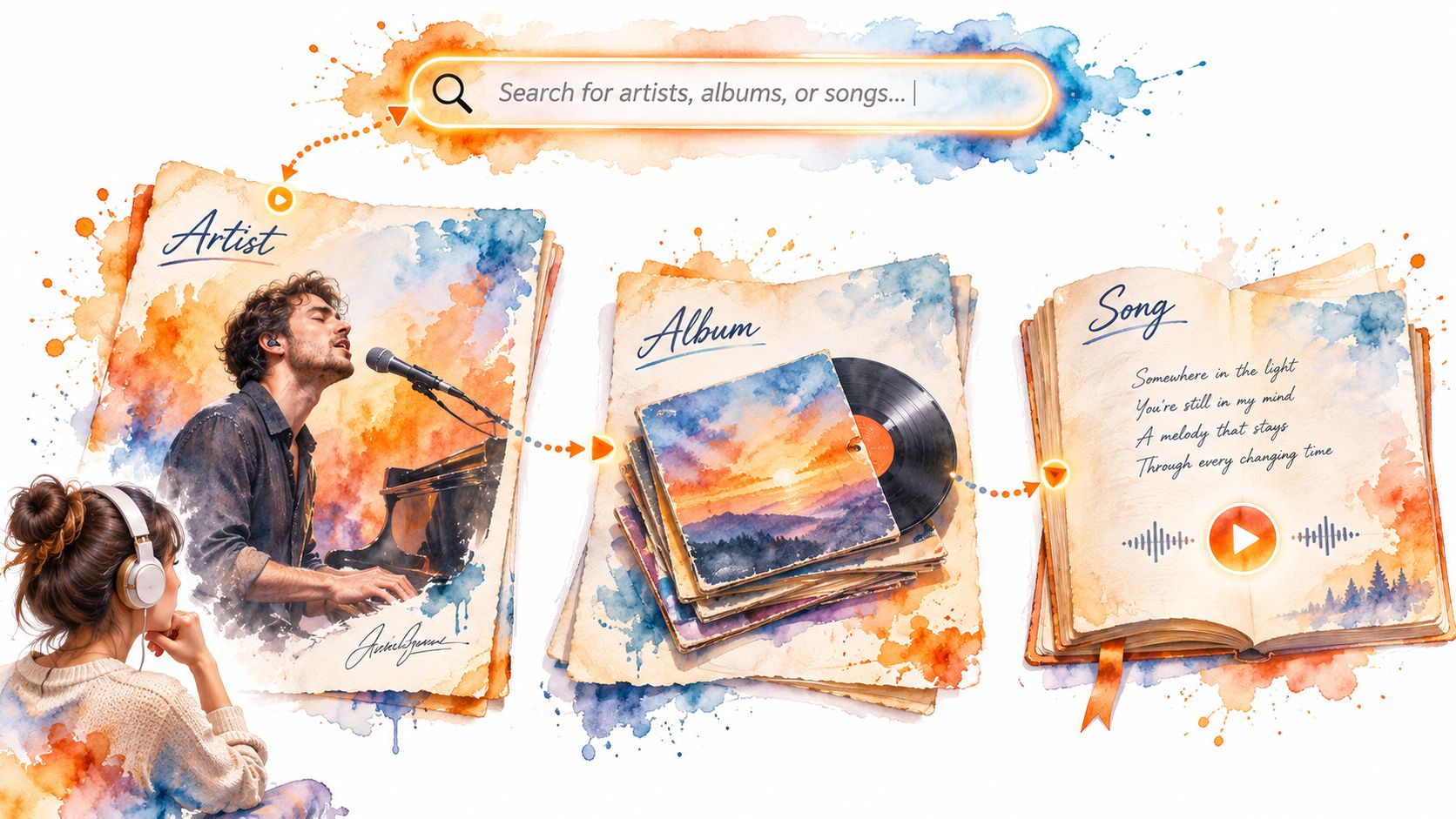
Three levels do the work. An artist page holds the catalog. Album pages group releases. Song pages hold the lyric, the credits and the video. A reader moves down that ladder, and each step answers a question the previous one couldn't.
Picture the path. A search for the phrase lands a reader on something that may or may not be the right track. The artist page confirms the performer. The album page shows the release date and the surrounding tracks. The song page delivers the lyric text and the official video.
The scale of that sorting job keeps growing. Paid subscription streaming accounts worldwide reached 752 million in 2024, a rise of 10.6%, according to IFPI's global recorded music report. More listeners, more catalog, more chances to land on the wrong entry with a familiar name.
A checklist for picking the right song page
Confirm the artist before anything else. Then the release year. Then the album the track sits on, and the ISRC if the page publishes one. Finally, check the video: the uploader should be the artist's or label's official channel, not a third-party reupload, because an official embed keeps the audiovisual reference tied to the artist's own release.
Cross-links between the Braxton, Chairmen of the Board and Griffiths entries do quiet work here. Each link shows a reader that the other versions exist and that they are separate works with separate credits, rather than alternate spellings of one song.
The Greene book doesn't belong inside the music catalog at all. It's a book, so it links to its own page and stays out of the artist and album hierarchy. A reader who follows that link expects bibliography, not a track list.
Once an artist page carries an accurate catalog, the same structure feeds show announcements, and gig promotion tactics that sell tickets picks up where the release page leaves off.
A clear navigation path lowers the odds of a reader landing on the wrong version and never noticing. That's the whole point of the ladder.
Verifying a Lyric Text Before It Goes Live
Lyric text is rights-sensitive editorial content, not user metadata. A publicly indexed SoundCloud entry published under No Me Without You on November 25, 2020 exposes a full lyric text attributed to a user account, and it sits in search results alongside commercially released works with near-identical titles, as the SoundCloud upload itself shows. That combination creates two risks at once: title collisions and provenance ambiguity.
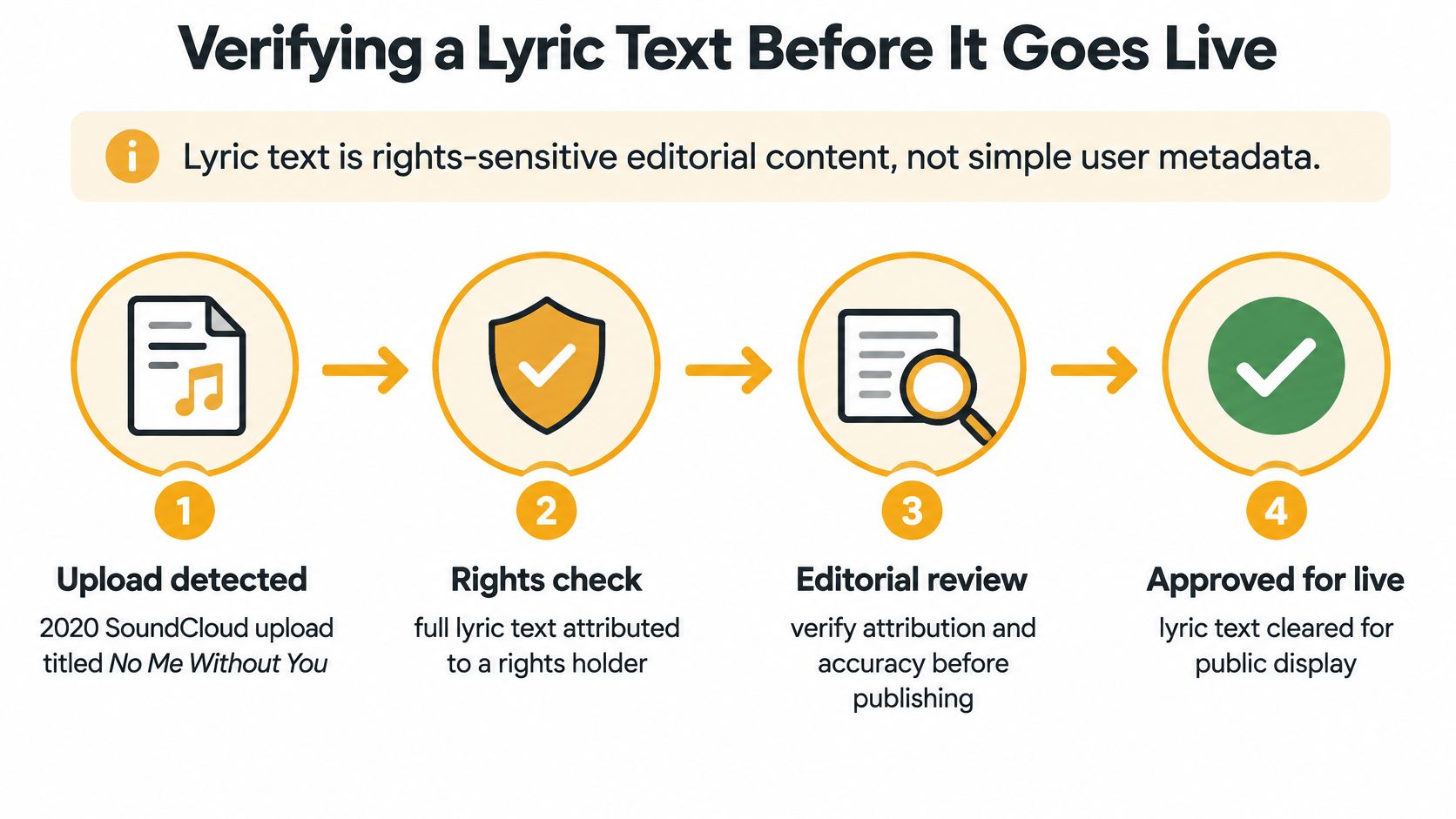
The six checks, in order
- Confirm the claimant controls the rights. Use a one-time code placed in an X or SoundCloud bio so the account and the claimant are provably the same party.
- Compare the submitted text against the claimed recording. Read the lyric while listening to the version named in the claim, not a version you assume is the same.
- Confirm the claimant holds the relevant rights for that recording, in that territory, rather than for a different release of the same title.
- Record the contributor's identity and approval status against the submission, so a later editor knows who approved what.
- Keep an immutable revision history and store lyrics apart from recording-level metadata, so corrections to one never rewrite the other.
- Display source attribution and the revision date on the live page.
The most common slip is treating a matching title as proof of ownership. It isn't. A title collision tells you two works share words; it tells you nothing about who wrote them, who recorded them or who controls the text.
Never import lyric text from an unverified public page, even when it appears at the top of search results. Discoverability is not ownership.
A public upload is useful evidence of two things: that readers can find it easily, and that collisions are live in the index. It is not authoritative proof of ownership or of canonical text. Reader-facing guidance on how to find song lyrics that match a specific recording is the other half of the job, because verification only helps if readers can tell which recording they're holding.
Reading the Lyric Line Beyond Romance
Take the line at face value and it makes an absolute claim: there is no me without you. Three readings fit, and they don't agree with each other.
Devotion, dependence, or abandonment
The first is devotion, where the line exaggerates love for effect. The second is emotional dependence, where a person's sense of self rests on someone else. The third treats the phrase as a portrait of recurring abandonment, in which the speaker keeps returning to a partner who keeps leaving.
Existing lyric-meaning coverage tends to summarize the plot as a partner leaving and returning, followed by repeated heartbreak, and then stops, as one widely read interpretation thread illustrates. That summary is accurate as far as it goes and thin on why the absolute language lands the way it does.
Poetic hyperbole versus a claim about identity
The distinction matters when a song describes real distress. Poetic hyperbole says "I'd be lost without you" and means it as emphasis. The healthier claim, that identity requires another person, is a different statement, and readers in the middle of a breakup hear the second one whether or not the writer intended it.
A 2025 mixed-methods evaluation of HIV/AIDS care and support services for orphaned and vulnerable children in Gondar, Ethiopia, found overall implementation fidelity of 67.35%, with dosage at only 45% and caregiver responsiveness at 70.6%, reported in the same interpretation discussion. Those figures complicate any easy story about support existing. Personal grief and gaps in caregiving systems turn out to be connected questions, not separate ones.
Test each reading against the lyric. Do the surrounding lines describe choice, fear, or repeated return? The canonical text settles it. Interpretation should follow the words, not lead them.
Keep the canonical lyric text separate from annotation, label every annotation as interpretation, and treat an artist-approved context panel as the strongest option when it's available. The book section offers the sharpest contrast: the same phrase reads as romantic partnership in one work and as shared survival in another.
Confirm the Lyric Before You Publish or Claim a Page
One decision settles everything else: confirm which work the page describes before you read, publish or claim a lyric. Everything downstream follows from that.
Work the checks in order. Match the artist, the release title and the date against the lookup table at the top of this article. Then check recording identifiers where the page publishes them, an ISRC for the recording and a UPC or EAN for the release. Then confirm the lyric text traces to a verified source rather than an upload that happens to rank.
For a fan, that means reading the release context before trusting a lyric page, and turning to the book if the search points to orphans, Ethiopia or caregiving. Same phrase, different shelf.
For an artist, manager or rights holder, the path runs through a claim. Ownership of the artist, album and song pages is confirmed with a one-time code placed in an X or SoundCloud bio, and edits to lyrics, credits and metadata are held for review before they go public. Artist-approved lyrics appear with visible attribution, and official video embeds sit on the song page rather than a reupload.
Errors usually start small, which is why a page that teaches readers to spot incorrect lyrics does more than a thousand corrections. Start with the table. Then open the matching song page, or start the claim.
House of Lyrics gives every version of There Is No Me Without You its own place: separate artist, album and song pages, artist-approved lyric texts with visible attribution, and official video embeds on the song page. If you're a verified artist or rights holder, claim your page with a one-time code in your X or SoundCloud bio and send corrections through an editorial review flow instead of watching them sit unfixed elsewhere. Browse the catalog or start your claim at House of Lyrics.