Fall in Love Again Lyrics: Find the Official Version
Fall in Love Again Lyrics: check the artist, album and release date, see the official video, and confirm credits before you sing along.
You searched fall in love again lyrics and a page handed you a finished block of text. Why would a title that belongs to more than a dozen separate releases ever have one correct lyric sheet?
A hit from 1992, an album cut from 2000, a short 2011 single, and a stack of 2021 to 2025 releases do not share a script. Covers, remixes, and titles with an extra word are different works. The useful answer is a version, named by artist, date, and album, before any line of text.
Match those three fields first. Then check the writers, the person who approved the words, and the video that belongs with that recording.
Table of Contents
- Match the Title to the Right Recording
- Use Sound and Metadata to Name the Recording
- Confirm an Official Lyric Page Before You Trust It
- Why Lyrics Differ Between Sites and How to Avoid Wrong Words
- Eddie Money's 1992 Hit and Its Chart Run
- Watch the Official Video With the Lyrics
- Report a Missing or Wrong Lyric Page
- Claim or Explore Your Fall in Love Again Page
Match the Title to the Right Recording
Fall in love again lyrics is a bad search if you stop at the title. The phrase is shared across a long list of separate recordings, so the top result hands you an identity, not a transcription. The only reliable sort is who sings it, when it came out, and which release carries it. Get those three fields and the lyric page follows. Skip them and you will memorize words that belong to a different song.
| Recording | Artist | Release date | Context |
|---|---|---|---|
| Fall in Love Again | Debelah Morgan | August 15, 2000 | Album Dance with Me |
| Fall in Love Again | Eddie Money | 1992 | Album Right Here; No. 54 Hot 100 |
| Fall in Love Again | Rotelli | October 23, 2025 | Single |
| Fall in Love Again (Female) | JourneyTune Media | September 14, 2025 | Shazam lists 106 BPM |
| fall in love again | Demxntia | August 16, 2024 | Apple Music |
| Fall In Love Again feat. MacKenzie | Family Company | November 6, 2024 | Shazam |
| Fall In Love Again (The Remixes) | Peppermint Heaven | May 23, 2025 | Five-song EP |
| Fall in Love Again and Again | Rose Hotel | June 7, 2024 | Shazam lists 85 BPM |
The Genius listing for Debelah Morgan places her track on Dance with Me, released August 15, 2000. Read that as the template for every other row: one page, one recording, one set of credits attached to it.
The Wikipedia entry for Eddie Money's single) records a 1992 release from Right Here that reached No. 54 on the U.S. Billboard Hot 100 and stayed on the chart 11 weeks, with peaks of No. 16 Adult Contemporary and No. 52 on Canada's RPM Top Singles. That is a guitar-framed rock single with a chart history. Nothing else in this table sounds like it, and none of them share its words.
The remaining rows split just as cleanly. Shazam's Rotelli entry dates that single to October 23, 2025. Shazam lists JourneyTune Media's Female version at September 14, 2025, and 106 BPM. Apple Music's Demxntia page dates August 16, 2024. Shazam's Family Company page dates the MacKenzie feature to November 6, 2024. Apple Music's Peppermint Heaven EP is a five-song set from May 23, 2025. Shazam's Rose Hotel entry dates June 7, 2024, at 85 BPM, under the longer title Fall in Love Again and Again.
Six years separate the oldest and newest rows in this table. The titles barely move.
How to use the table
Lead with the artist you heard. Then check the year, the album or single, and any feature or remix credit. A later date under the same title almost always means a different recording, not a reprint of the earlier words. When two rows sit close together in time, the album name is the tiebreaker, so confirm the release before you trust a single line of text.
Titles with added words are different songs. (Female), feat. MacKenzie, (The Remixes), and and Again each point somewhere else. Paste one page's words onto another row and you get lyrics nobody ever sang.
Practical rule: Identify the recording first, and only then open the lyrics.
Use Sound and Metadata to Name the Recording
Heard the song and still can't name the singer? Don't open a lyric page yet. Metadata will separate these versions faster than guessing the chorus.
- Play a short clip in a recognition app. Write down the artist, the release date, and any tempo the app shows. The table already splits a 106 BPM Female cut from an 85 BPM "and Again" song, so tempo narrows the field before you read a word.
- Read the title for a qualifier. (Female), feat. MacKenzie, (The Remixes), and and Again are not the same recording. If the app adds one of those tags, stay on that row.
- Compare the feel with what you heard. A 1992 guitar-framed power ballad will not match a dance remix, even when the main title is identical. Trust the arrangement, not the shared phrase.
- Confirm the platform and the date. Apple Music and Shazam do not list these cuts as one catalog entry. A 2024 Apple Music date, a May 2025 remix EP, and an October 2025 single are three matches, not one.
- Open the lyric page only after the match. Artist, qualifier, and release date together are enough to pick the recording.
Treat BPM and runtime as tie-breakers, not proof. Remixes and edits can share a tempo and still carry different words. A featured-artist credit or a parenthetical in the title beats a tempo match every time.
Keep those fields with the song, the way a careful catalog stores metadata on each recording. If two apps disagree on the artist, play a longer clip and check the album title before you commit.
Confirm an Official Lyric Page Before You Trust It
A finished-looking page can still belong to the wrong record. Before you copy a line, prove the page describes the recording you heard: same artist, same album, same year.
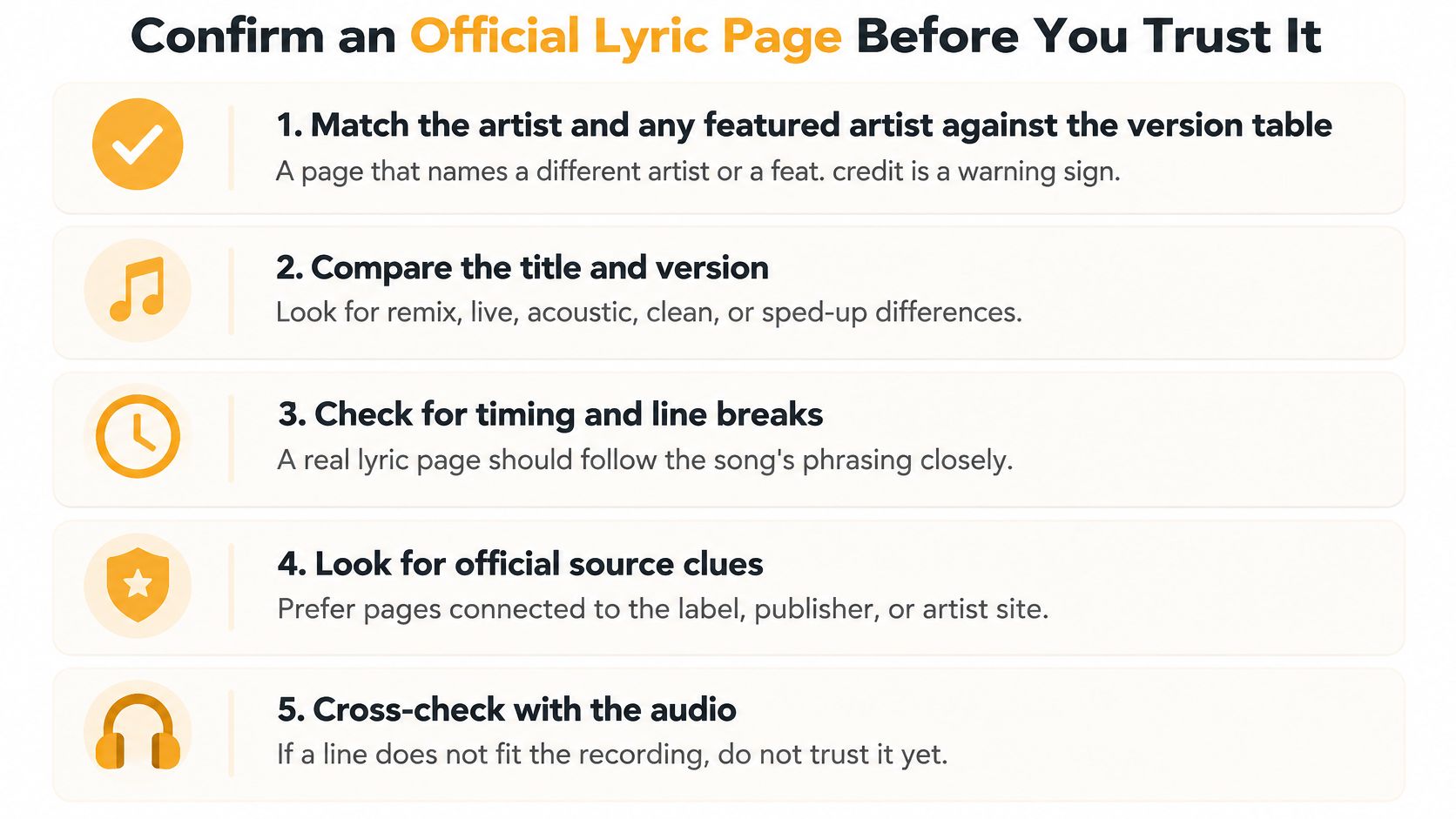
- Match the artist, including any feature. A different lead name, or a feat. credit you didn't hear, means a different recording. The words may be polished and still be the wrong song.
- Match the album and the release date. A later year usually signals a cover, a remix, or a reissue, not the cut you streamed. Check the date before you read a single line.
- Look for named writers and a publisher. The Genius listing for Rag'n'Bone Man's Fall in Love Again names Rory Graham and Ben Jackson-Cook and ties that song to a 2021 album. Blank credits are a warning, not a style choice.
- Check track position and any recording ID. An ISRC, when the page shows one, pins the text to one sound recording. Track order does the same job on an album.
- Read who supplied or approved the text. You want a named approver, not an anonymous upload. No writer and no approver means the page is unverified. Leave it.
What a trustworthy page is built to show
Lyrics are musical-work records, not comment-thread scraps. A serious page stores a versioned text, named lyricists, a rights-holder credit, and an edit history, so you can see who wrote the line and who changed it last.
House of Lyrics only hosts lyrics submitted by the artist or rights holder. The song owner or our editors review that text before it appears, with an approval time and a trail of earlier versions. Unattributed submissions do not go up. Public pages show attribution and recording context rather than an open copy of every verse.
A confirmed page shows the right artist, album, and year, named writers, a visible approver, and a matching video. For the wider method, start with how to find song lyrics. If those fields are missing, do not quote the page.
Why Lyrics Differ Between Sites and How to Avoid Wrong Words
There is no single correct text hiding behind this title. A song holds two protected works, and they do not travel as one file.
The U.S. Copyright Office's guide for musicians treats the musical composition and the sound recording as separate works, often with different owners. Lyrics live in the composition. The performance you streamed is the recording. A search for fall in love again lyrics can mean another artist, a cover, a live tape, a remix, or a market-specific cut, and those texts should not be merged.
WIPO's music guidance adds that print rights cover permission to transcribe and distribute lyrics, including digitally. Streaming the audio is not the same permission as posting the words. For independent artists, a copied, altered, or miscredited line is a rights problem, not a typo.
Three ordinary reasons the words change
- Studio versus live. A live take can drop a verse, repeat a hook, or change a rhyme. A caption built from a concert video will not match the album.
- Radio edit versus album cut. A shorter edit can remove a bridge. The longer text is not "more official" if you heard the edit.
- Regional or later releases. A new market or a remix can carry a revised line. The older page can still be approved and still be the wrong release.
An approved text can still differ from a live performance, a radio edit, or a regional issue. Transparency beats a badge that says perfect. More unverified text does not make the search better. Provenance does.
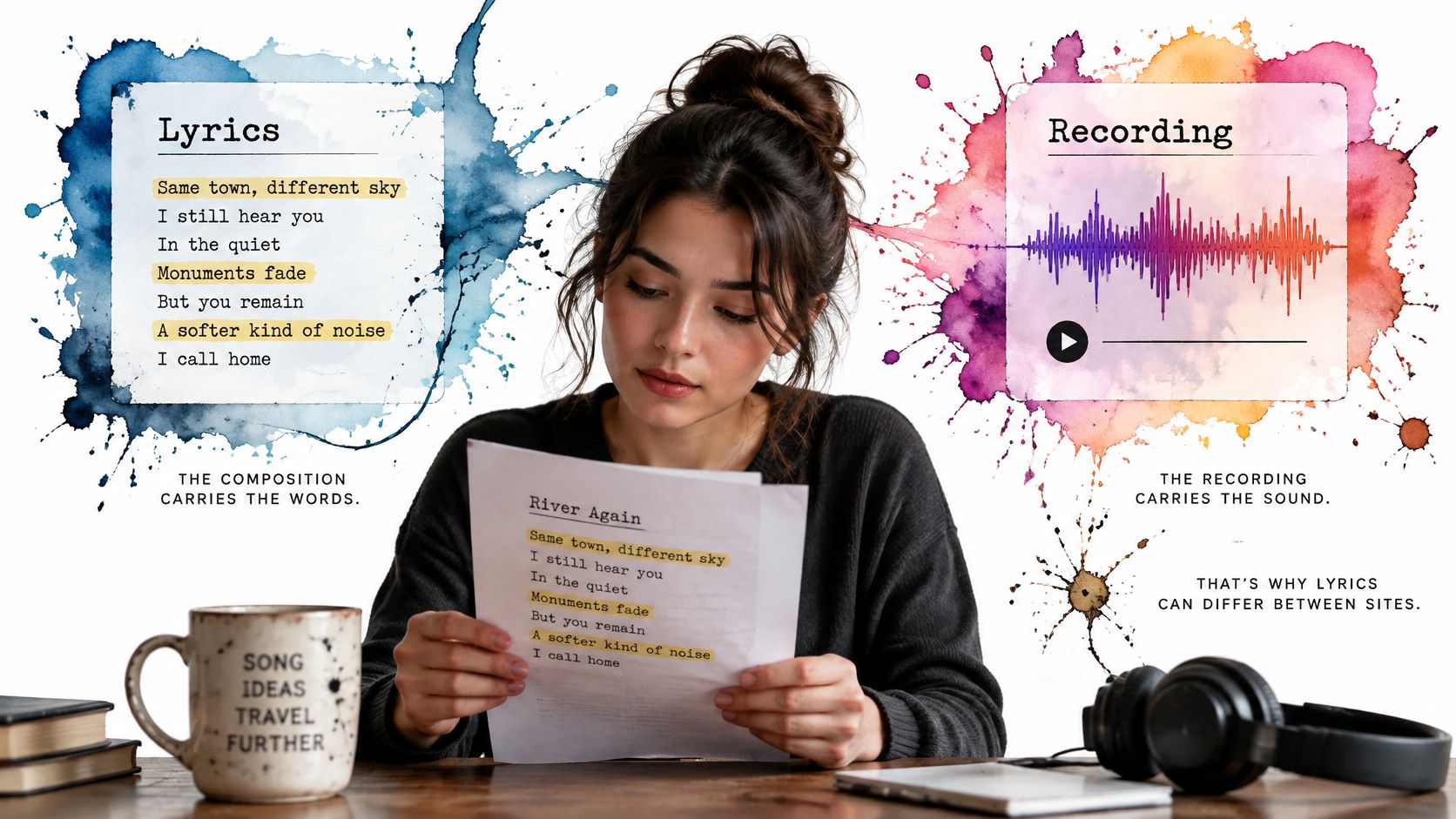
When two sites disagree, prefer the page that names who supplied or approved the text and which release it matches. The most visited page is not always the accurate one. A fan transcription can carry mishearings and lines that never shipped.
Three mistakes that survive a correct title match
- Copying a live transcription into a studio caption. Check whether the page says live. If it does, don't use it for the album cut.
- Quoting a fan transcription. Open the attributed page first. If nobody claims the line, don't put it in a message.
- Assuming an extended title shares the text. (Female), feat., and and Again are separate works. Do not borrow lines across them.
Open the page that shows attribution before you copy a line into a caption, a comment, or a cover video.
Eddie Money's 1992 Hit and Its Chart Run
Many recordings share this title, so the chart history is your fastest filter. Eddie Money's "Fall in Love Again" is the 1992 release from his album Right Here. If the chorus is the one you heard on an oldies station, match those three details first: Eddie Money, 1992, Right Here. A same-title single from another decade is a different recording until its credits prove otherwise.
The chart run supports that match. The song reached the Billboard Hot 100 and the adult contemporary chart in the United States, and it made Canada's RPM chart. That is a commercial release with a public record behind it, which is why lyric pages keep borrowing the title and attaching the wrong words to his name.
What separates this cut
Album and year do the sorting. A page that cites Right Here and 1992 is on Eddie Money's recording. A page that cites a later R&B album, a pop album from the 2000s, or a streaming reissue has left this single behind.
Chart context does the same job without asking you to memorize a lyric. National airplay in the United States and Canada gave this version a documented life beyond a single flash on the Hot 100. That chart presence is the evidence you need when a search result offers several songs with the same title.
If the credit line names another artist, close the tab even when the chorus looks familiar.
Use the House of Lyrics artist page for Eddie Money when you want this recording kept apart from later songs that reused the title. The album and year belong on the song's own page, and the approved lyrics belong there once the rights holder claims it.
Watch the Official Video With the Lyrics
The official video is the canonical picture of a release. It shows the performance the label or artist put forward, which makes it the right companion to an approved lyric page. A random upload with the same title is not that source.

Not every clip with the title deserves the same trust.
- Music video. The label or artist issued it for that release. This is the one to pair with the lyric page.
- Official lyric video. The words are designed to be read, but you still match the artist and the year. A lyric video for a remix is not the studio single.
- Fan upload. Someone else timed the words. Useful as a hint, unsafe as a source.
- Re-upload. The picture may be the actual video under a new channel. Credits and edits can still be wrong.
Four checks before you press play
- Match the video's year to the release. A 1992 ballad and a 2025 single should not share a clip. The year on the upload is part of the identity.
- Check the uploader. Prefer the artist or a verified label channel. A fan channel with a million views is still a fan channel.
- Compare the runtime with the recording. Use the length on the version you already identified. A clip that runs far longer or shorter is probably a different edit.
- Use the embed on the song page. A re-upload can swap the audio or crop the credit line. The embed tied to the claimed page is the stable copy.
Once a rights holder claims a song page, that owner can add artist-approved lyrics, chords or tabs, and media embeds. The video then sits next to text the owner has already cleared. That is the point of keeping the official video with the lyrics.
Play the video and read the page together. If a line on the page never arrives in the audio, stop and check the credit line before you share it.
Report a Missing or Wrong Lyric Page
Sometimes the right recording has no page. Sometimes the page exists and the words do not match the release you identified. Either case needs evidence, not a drive-by comment.
- Write down the artist, album, year, and track position you already verified. A report that only says "wrong lyrics" cannot be matched to one row in a crowded title.
- Compare the disputed line with the official release or the approved video. Note whether the page reflects a live take or a radio edit rather than the studio cut. That note stops a real alternate version from being "fixed" into the wrong text.
- Send the evidence through the report option on the page. We keep the prior version and the edit trail, so a correction can be checked against what the page showed before.
- If the artist has not claimed the page, use the claim path. The owner can then review and correct the text. A fan report alone does not overwrite approved words.
Corrections go to review before the public page changes. Readers see a new line only after the owner or an editor approves it. Each recording keeps its own page, so a remix or a live take is never folded into the studio version.
A good report names the release and the line. A vague report just creates another argument.
Claim or Explore Your Fall in Love Again Page
A page only helps if it matches the recording you already identified by artist, date, and album. Fans should open the artist or song page for that exact version, read the attribution line, and play the embedded video before trusting any lyric text. House of Lyrics indexes 1,533 songs, so the title alone is not enough. The right page will name the version and show the evidence next to the words.
If you own the recording, claim the page. House of Lyrics has 595 artist pages waiting to be claimed, and claiming a song page is free. Find your page on House of Lyrics, follow the claim steps shown there, and place the one-time code in your X or SoundCloud bio. Once verified, you can add artist-approved lyrics, chords or tabs, and media embeds, then manage the page's public profile. Every edit is reviewed by the song owner or House of Lyrics editors before it appears. The library only hosts lyrics submitted by the artist or rights holder, and each song has its own page, separate from the rest of the artist's catalog.
House of Lyrics pairs artist-approved words with the official video for the recording you mean. That pairing is what makes a crowded title usable. Fans can browse attributed pages. Rights holders can claim a page and correct credits before a stranger's text spreads. Visit House of Lyrics and open the version that matches the artist, the date, and the album.