I Love Your Presence Lyrics: Official Words and Credits
Get the authoritative i love your presence lyrics from Bethel Music. Explore official credits, video embeds, and how to verify rights on House of Lyrics.

I Love Your Presence is track 4 on Bethel Music's live album Here Is Love (Live), released in October 2010. The song is identified by its repeated chorus, “I love, I love, I love Your presence” and “I love, I love, I love You Jesus.”
That context changes what a search for “I Love Your Presence lyrics” really means. A listener may want words for worship, a musician may need a dependable text for rehearsal, and a rights holder may need to confirm that the lyric, recording, contributor credits, and official video all refer to the same work. Industry commentary says 81% of listeners search for lyrics online, while roughly 90% of recorded songs still lack transcribed lyrics in major platform contexts, making provenance as important as speed (industry commentary on lyric transcription).
Table of Contents
- Why Accurate Worship Lyrics Matter
- The Official I Love Your Presence Lyrics
- Song History and Release Details
- Catalog Variations and Similar Versions
- Integrating Official Video Embeds
- Metadata Best Practices for Artists
- Claiming and Verifying on House of Lyrics
- FAQ - Lyrics, Rights, and Verification
Why Accurate Worship Lyrics Matter
A lyric page can look useful while still creating confusion. A user might find a line copied from a different live arrangement, a phrase altered by a misheard upload, or credits that identify the performer but omit the songwriter and publisher. For a worship song built around repetition, even a small change can affect how a congregation sings, how a musician prepares an arrangement, and how a catalog matches the composition to the recording.
The search for I Love Your Presence lyrics therefore has two layers. The first is retrieval, finding words that appear quickly. The second is verification, determining whether those words belong to Bethel Music's recording, a Vineyard version, or another song that uses the same worship motif.
Practical rule: A lyric is more trustworthy when its text, recording, artist, album, contributors, and ownership information point to the same canonical release.
Accuracy also protects the artistic and legal identity of the work. Music metadata guidance separates songwriter and lyricist credits, publisher interests, master ownership, and composition ownership rather than treating every contribution as one undifferentiated credit (Music Metadata Style Guide). That distinction matters because the person singing a live recording may not be the only person responsible for the underlying composition.
For fans, provenance reduces uncertainty. For churches and musicians, it supports respectful performance preparation. For artists and rights holders, it creates a record that can remain consistent across lyric services, streaming platforms, publishing databases, and official pages.
An editorial process can add another layer of confidence by checking the source, version, formatting, and attribution before publication. Readers who want to understand how that kind of review works can explore this guide to what an editorial review is.
The Official I Love Your Presence Lyrics
The verified lyric record for Bethel Music's song centers on a compact, highly repetitive structure. The chorus repeats:
I love, I love, I love Your presence
I love, I love, I love You Jesus
The opening verse begins:
In the glory of Your presence
I find rest for my soul
In the depths of Your love
I find peace makes me whole
These lines are documented in the Bethel Music lyric entry on Genius. They establish the song's central movement, from an encounter with divine presence to rest, peace, and an expression of love toward Jesus.
A responsible lyric page should preserve the original line breaks and stanza relationships. Apple's lyric guidance recommends single-spaced lines and clear spacing between stanzas, because visual structure helps readers follow a song without confusing separate phrases or repeated sections. Formatting isn't decoration here. It helps distinguish a verse from a chorus and makes the text easier to read during worship or rehearsal.
The available verified data confirms the key verse opening and repeated chorus, but it doesn't provide a complete authorized transcription of every section. For that reason, a careful archivist shouldn't manufacture missing lines or present an incomplete excerpt as the entire lyric. The safest practice is to use the official release, an authorized lyrics service, or a rights-holder-approved page when a full text is required.
The official audiovisual context can also help listeners confirm the version they're hearing:
When comparing a written lyric with a recording, listen for the arrangement, the lead vocal, the repeated sections, and the album association. Those checks prevent a reader from treating every song titled I Love Your Presence as the same recording.
Song History and Release Details
Bethel Music's I Love Your Presence is identified as track 4 on the live album Here Is Love (Live). Multiple music databases place its release in October 2010, with one listing October 12, 2010. Another record associates the track with October 14, 2009 for composition metadata, which appears to describe an earlier metadata relationship rather than the album's stated release date. Those distinctions should remain visible instead of being flattened into one supposedly exact date.

The song's design explains why the lyric is easy to recognize. Its chorus repeats the title phrase and the direct address to Jesus, while the verse uses short lines about presence, rest, love, peace, and wholeness. That structure gives the song a congregational quality. People can join the central refrain even when they're hearing the arrangement for the first time.
The historical setting is also useful. The recording belongs to the early-2010s worship catalog, a period when live worship releases were distributed through mainstream music services as well as chord and lyric websites. Its continued presence in services such as Apple Music and Shazam indicates that the recording moved beyond a narrowly local setting and became part of a durable international worship repertoire, as reflected in the documented lyric and catalog record.
Repetition isn't a lack of lyrical substance. In congregational music, repetition gives a room time to participate, remember, and respond.
The title's later reuse makes version identification essential. A search result may lead to Bethel Music, Vineyard Music, or another artist using similar language. Readers researching other live worship texts can apply the same catalog-first method to Did You Feel the Mountains Tremble lyrics, checking the artist and release before relying on the lyric text.
Catalog Variations and Similar Versions
The phrase I Love Your Presence appears across multiple Christian music catalogs. That doesn't mean every result is a duplicate of Bethel Music's recording. It means the phrase became a recurring worship motif, especially in live albums and digitally distributed collections.
Vineyard Music has a version associated with Worship Anthems Live from Vineyard USA, Vol. 1. Vineyard Worship also has a separate live album titled I Love Your Presence (Live), released on January 10, 2012, with 13 songs spanning 1 hour and 18 minutes, according to the catalog information collected by Invubu. Later recordings include a 2013 track by Jake Hamilton and the Sound, along with Planetshakers-related songs using similar wording.
Version Comparison Table
| Artist | Album | Release Date |
|---|---|---|
| Bethel Music featuring Jenn Johnson | Here Is Love (Live) | October 2010 |
| Vineyard Music | Worship Anthems Live from Vineyard USA, Vol. 1 | Not specified in the verified record |
| Vineyard Worship | I Love Your Presence (Live) | January 10, 2012 |
| Jake Hamilton and the Sound | Track using the title phrase | 2013 |
| Planetshakers-related recordings | Songs with similar wording | Various later entries |
The table shows why a searcher should never identify a song by title alone. Artist, album, recording type, and release date work together as a practical identity key. If someone wants the Bethel Music version, the relevant combination is Bethel Music featuring Jenn Johnson, Here Is Love (Live), track 4, from October 2010.
This approach also helps musicians select the right arrangement. A Vineyard live recording may use different vocal phrasing, instrumentation, pacing, or congregational responses even when the title and central phrase overlap. The same catalog discipline applies when researching Body Electric lyrics, because artist and album context can prevent a similar-title match from becoming a false identification.
Integrating Official Video Embeds
A lyric page becomes more useful when it connects the written text to the recording that establishes its canonical context. An official YouTube embed lets a publisher display the original hosted video without downloading, re-uploading, or presenting a copied media file as its own.
YouTube's documented workflow uses the Share menu and its embed option. The publisher copies the provided HTML and places it on the page, while the video remains hosted by YouTube through its original source workflow (YouTube's official embedding instructions).
A dependable embed workflow
Identify the official upload. Confirm that the video belongs to the artist, label, ministry, or another authorized channel. Don't assume that a fan upload represents the canonical recording.
Use the platform's embed function. Copy the embed code supplied by YouTube rather than downloading and rehosting the video. This keeps the audiovisual reference connected to its original platform presence.
Place the video beside version-specific metadata. The page should identify the artist, album, featured performer where applicable, and recording context. A video without that information can still leave visitors unsure which version they're hearing.
Pair it with readable lyrics. Preserve line breaks and stanza spacing so the viewer can follow the words while listening. Clean formatting supports both accessibility and consistent presentation across services.
Official embedding also separates display from ownership. The page displays the hosted video, but it shouldn't imply that the publisher owns the master recording or the composition. Rights information belongs in the metadata and credits, not in an assumption created by the embed.
For artists and channel managers, a publishing schedule can make official video references easier to maintain. A practical YouTube content calendar can help teams coordinate uploads, lyric-page updates, release announcements, and catalog checks without treating unofficial copies as substitutes for canonical media.
Metadata Best Practices for Artists
A lyric page is only as reliable as the record supporting it. Treat the words as one field in a metadata system, like a label on a file folder. The folder should identify the exact recording, its contributors, its rights information, and the source approved for publication.
Start by separating the composition from the sound recording. The composition is the underlying musical and lyrical work. The master is one recorded performance of that work. A live version may use the same composition as a studio master while having different performers, producers, engineers, release details, and ownership information.
Record roles in the right fields
Role names become useful when they tell platforms where to place each credit:
- Primary artist: The act shown in the display-artist field, rather than a general contributor field.
- Featured artist: A named performer shown in the public artist credit for that recording.
- Songwriter or composer: The person or people credited with the underlying work.
- Lyricist: The contributor identified specifically for the words, where that field is used.
- Producer and engineer: The professionals credited for production and recording work.
- Label and copyright owner: The parties recorded in release and ownership fields.
A live recording shows why these fields matter. The studio master of “I Love Your Presence” might list the worship act as primary artist, while a live release could add a featured vocalist, a different engineer, and a live album association. The composition credit can remain unchanged, but the recording-level metadata must describe the performance the listener is actually hearing.
The Music Metadata Style Guide supports clear contributor roles, consistent legal names, confirmed splits, and accurate publishing or performing-rights identifiers. Keep those details with the approved lyric text, recording title, album relationship, and authorization record.
Make the verification trail visible
Use a short review sequence:
- Confirm the exact recording and album.
- Check the lyric against the approved source.
- Standardize contributor names and role fields.
- Confirm publishing and ownership information.
- Send the record through editorial review before publication.
This trail works like a chain of custody for a manuscript. It shows why a lyric belongs to a particular version and gives the next editor, platform, musician, or fan enough context to preserve the canon. Artists planning the wider release process can also use this guide on how to release music.
Claiming and Verifying on House of Lyrics
An artist looking for a page connected to I Love Your Presence lyrics must first establish editorial authority. A public lyric page can contain an incorrect title, credit, or transcription if anyone can edit it through an unverified email address or unsupported ownership statement. Verification works like checking a manuscript's provenance before adding it to an archive: it connects the edit to a person who can substantiate the record.
House of Lyrics uses a one-time code placed in a social media bio to confirm control of an eligible artist profile. The process is outlined on the House of Lyrics claim page, where a rights holder can begin the request and follow the verification instructions.
A practical catalog scenario
An independent worship artist finds an artist page with an outdated song title, incomplete credits, and lyrics that do not match the approved recording. The artist starts a claim, places the supplied code in an eligible social profile, and submits the page for review.
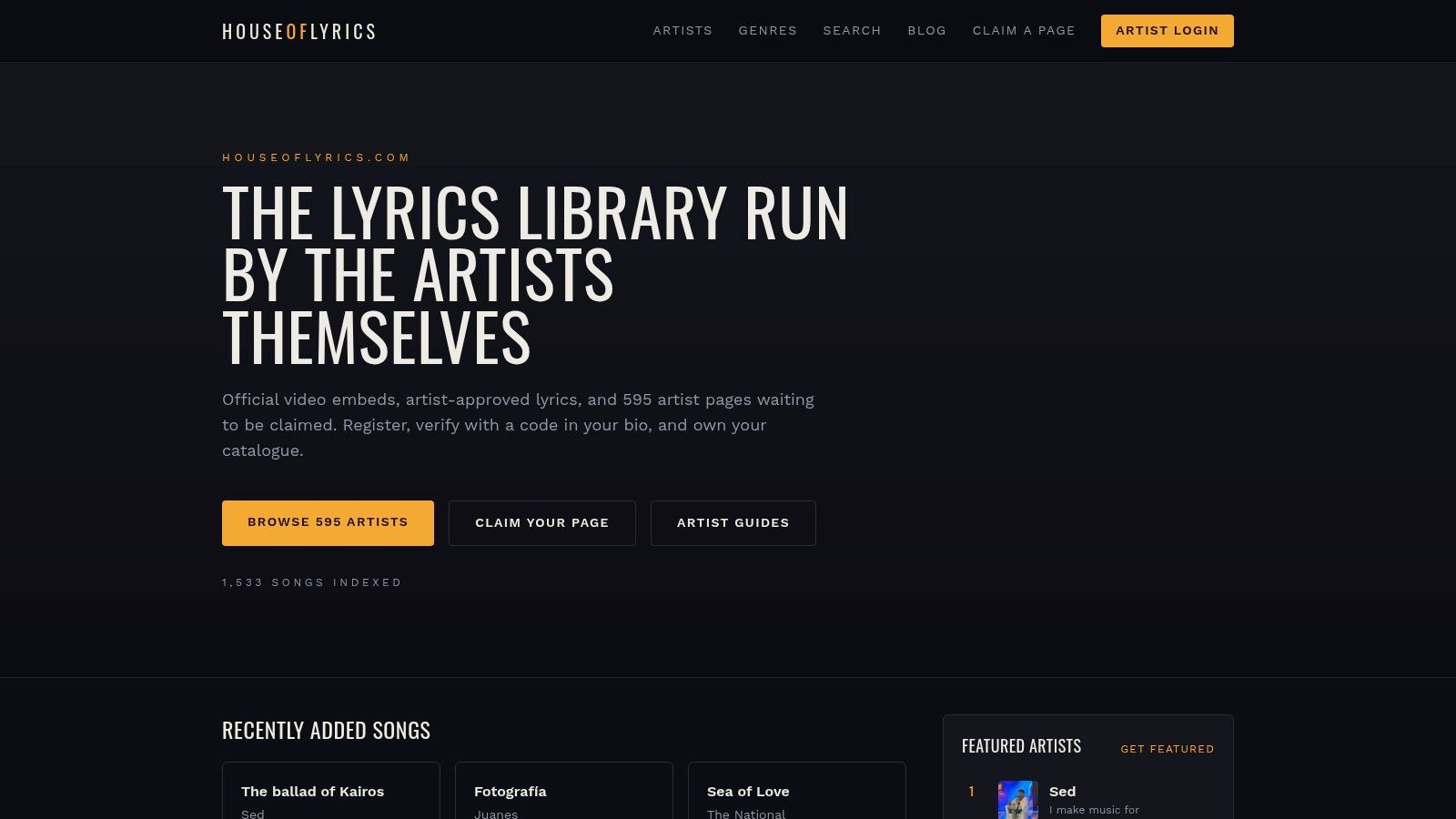
After approval, the rights holder can use the editor to revise lyrics, credits, album information, and related metadata. Edits remain subject to review before publication, creating a useful checkpoint between private changes and the public page. At that checkpoint, the owner can compare the transcription with the approved recording, confirm contributor roles, verify the album relationship, and check the official video attribution.
The editor also supports relationships that make corrections practical. Because a song record links to its album record, correcting the album title on the album page can update the release context shown on the song page. The rights holder edits that relationship once instead of repeating the correction across lyric pages. This is different from treating each lyric as an isolated text file.
Verification does not replace contracts, permissions, or ownership records. Rights holders organizing those materials can consult this overview of ownership and licensing for artists. Together, documented rights and a verified editorial account give the public catalog a clearer chain of responsibility.
FAQ - Lyrics, Rights, and Verification
Are the Bethel Music and Vineyard versions the same recording?
No. The title and worship phrase overlap, but the catalog entries belong to different artists and releases. Use the artist, album, and release information to identify the recording before comparing lyrics or arrangements.
Why shouldn't a lyric page publish an unverified full text?
A page shouldn't present missing or uncertain lines as canonical. The verified record for Bethel Music confirms the repeated chorus and the opening verse lines, but a complete authorized transcription requires a source that supplies and approves the entire text.
Does an official video embed transfer copyright?
No. An embed displays media hosted by the original platform. It doesn't transfer ownership of the composition, master recording, lyrics, or video to the site displaying it. Those rights should remain accurately attributed in the page metadata.
What should an artist update first?
Start with the exact recording identity, then check the lyric, contributor roles, album relationship, official video, and ownership details. Updating only the visible words can leave the catalog inconsistent elsewhere.
Why do line breaks matter?
Line and stanza structure helps readers follow the recording and reduces confusion between verses, choruses, and repeated phrases. It also supports cleaner presentation across lyric services and music platforms.
What makes a lyric page authoritative?
Authority comes from source provenance, version matching, visible attribution, structured credits, and rights-holder control. A fast copy is useful only when it can be traced to the correct work and recording.
House of Lyrics brings artist-approved lyrics, structured artist, album, and song pages, official video embeds, and a review workflow into one catalog experience. If you're verifying I Love Your Presence lyrics or managing another release, visit House of Lyrics to explore the platform and its claim process.