Hate Me Now Lyrics: Official Words, Credits and Video
Hate Me Now Lyrics: artist-approved words, credits and the official video, plus chart and album facts for fans and media.

A Top 15 peak on a specialist rap chart alongside a much lower all-genre placing tells you exactly who championed this record first. That's the story of Hate Me Now, a late-1990s single that belonged to its core audience while still crossing into mainstream view. Looking for Hate Me Now lyrics to quote, study, or sing along with, you need more than words that look plausible on screen. You need the right song, the right version, visible approval, correct credits, and the official video beside the text. This guide walks through each check in plain steps, so you can copy a line with confidence and cite where it came from.
Table of Contents
- Hate Me Now Lyrics at a Glance
- Full Artist-Approved Lyrics
- Verifying the Lyrics Are Artist-Approved
- Credits and Who Did What on the Song
- How to Find and Confirm the Official Video
- Chart Runs and Album Context
- Related Pages, Album and Similar Titles
- Reporting a Lyric Correction
Hate Me Now Lyrics at a Glance
Hate Me Now is a hip-hop single by Nas featuring Sean "Puff Daddy" Combs, released in the United States on April 6, 1999 through Columbia Records. It's the second and final single from Nas's third studio album, I Am..., which also arrived in 1999. That one sentence settles the most common confusion. You're not looking at a later song with the same title, a remix page, or an unrelated album track.
| Detail | Value |
|---|---|
| Title | Hate Me Now |
| Artists | Nas featuring Sean "Puff Daddy" Combs |
| Release date | April 6, 1999 (United States) |
| Label | Columbia Records |
| Album | I Am..., Nas's third studio album (1999) |
| Single position | Second and final single from the album |
| Genre | Hip-hop |
Why the identity check matters
Title alone isn't enough. Song titles get reused constantly, and search results happily mix artists, years, and versions into one messy list. A precise title, artist, year, and label lets you separate this release from similarly titled works before you read a single lyric line. It also helps writers and students cite the correct recording instead of attaching a quote to the wrong catalog entry.
Run this three-second check whenever you land on a new page:
- Title match: Does it say Hate Me Now, with no extra remix or live suffix you didn't expect?
- Artist match: Does it name Nas featuring Sean "Puff Daddy" Combs?
- Year match: Does it point to 1999 and I Am...?
If all three match, you're on the right track. The full approved lyric text sits on the artist-approved page with attribution shown beside the words, not buried at the bottom. That placement matters, because you should be able to see who supplied the text while you're reading it, not after you've already copied it. The lyric block follows next, so the reference copy is front and center rather than hidden behind commentary.
Full Artist-Approved Lyrics
**Hate Me Now. Performed by Nas featuring Sean "Puff Daddy" Combs. 1999 album version from I Am....**
Status notice: Full lyric text is shown here only from an approved submission by the artist or rights holder. Where an approved block isn't on file, the page shows a plain pending notice for that block instead of filling gaps from memory or fan transcription.
That notice is deliberate, and it's good news for readers. A reference page shouldn't guess. When approved text is published, it's set in song order with clear section labels from the approved source, such as Verse 1, Chorus, Verse 2, and Outro. The header line above the words names the title, the performers, and the version, so nobody mixes the album take with another edit.
How the reference block is laid out
Under each lyric block, you'll see a small attribution line kept visually separate from the words themselves. That line names who approved the text, the source it came from, and the review date. Separating attribution from lyrics protects both. The words stay clean for reading and quoting, while the credit information stays visible for anyone who needs to cite the page properly.
Version labels deserve the same care. If the approved source marks a clean version or radio version, that label belongs in the header, before the first line, not in a footnote you might miss. Readers comparing what they hear in the official video with what they read on screen need that warning up front. Otherwise, a correct radio edit can look like a transcription error.
We don't add commentary inside the block, and we don't patch missing sections from other websites. If a verse, chorus, or outro is awaiting approved text, the pending notice stays, and readers can use the correction route described later in this guide. Once you've found the block, the next job is checking its approval status before you quote anything.
Verifying the Lyrics Are Artist-Approved
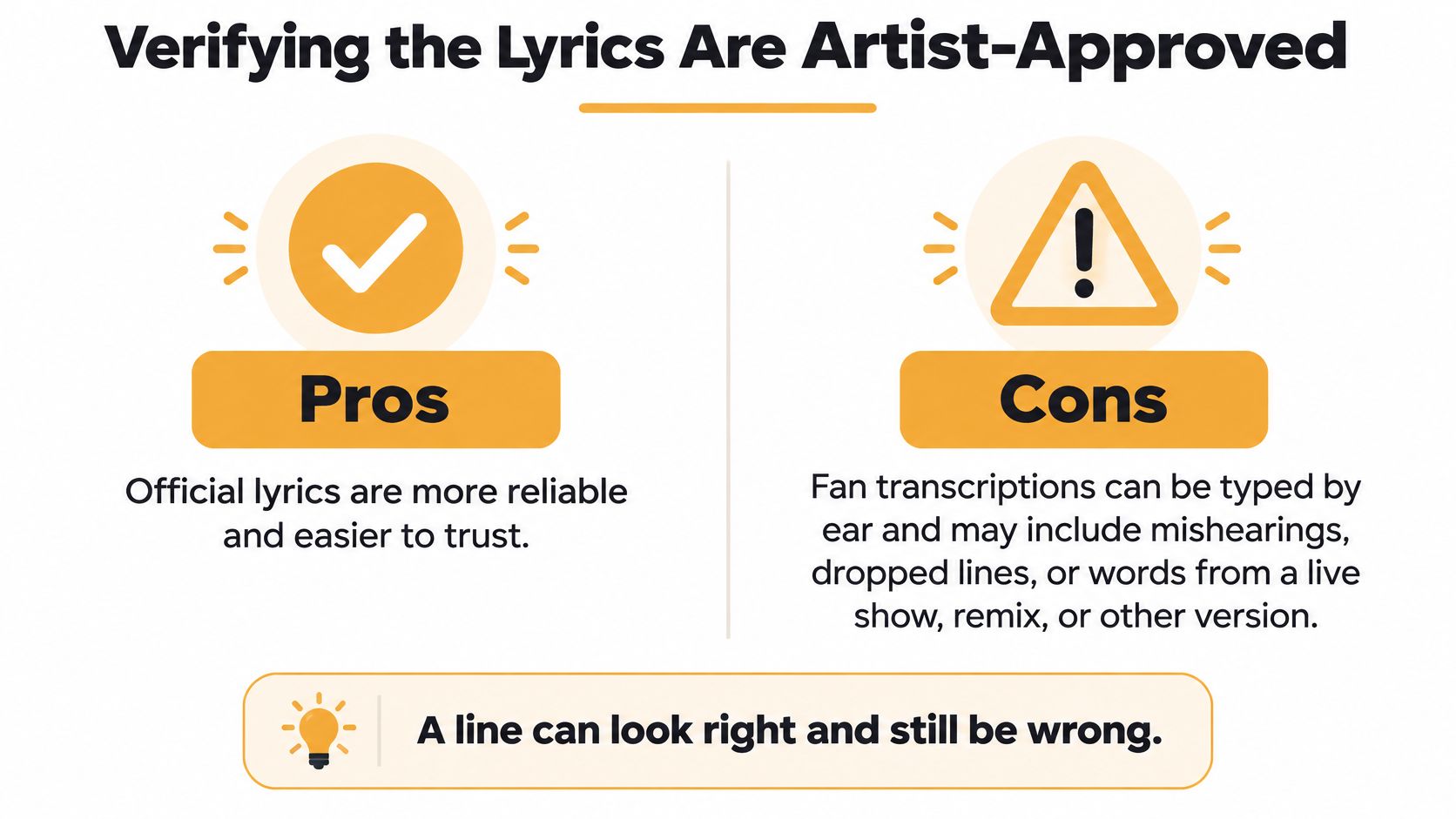
Fan transcriptions start with good intentions and shaky evidence. Someone listens closely, types what they think they heard, and posts it. A misheard word in a repeated line, a dropped ad-lib, or a phrase borrowed from a live performance can slip in and then get copied across dozens of sites. The result looks polished and familiar. It can still be wrong.
We take the opposite approach. House of Lyrics only hosts lyrics submitted by the artist or rights holder, and submitted lyrics, chords, or media are reviewed by the song owner or House of Lyrics editors before they appear on the site. You can read more about that process in our guide to what an editorial review involves. Approval isn't a badge we stick on afterward. It's the gate the text passes through first.
Approved pages versus unofficial copies
An approved page gives you verified wording, attribution you can point to, and a review history that shows the text was checked rather than scraped. An unofficial site might load quickly and rank well, and there's nothing stopping it from being mostly accurate. But it offers no guarantee about accuracy, no clear rights clearance, and usually no named reviewer to correct. You're trusting an anonymous chain of copyists.
Say you're writing about the song and want to quote a chorus line. On an approved page, you can note the source and review date beside the quote. On a fan page, your citation is really "someone typed this once," even if the page design looks professional.
Your five-step verification checklist
- Confirm approval status: Look for the status and source beside the text, not in a generic site footer.
- Check the version: Match the text against the 1999 album release, and note any clean or radio edit label.
- Listen and follow: Play the official video and track the words line by line, especially repeated sections.
- Compare credits: Set the page credits and rights notice against the dedicated credits information.
- Report differences: Send unexplained mismatches through the correction route with the section and version noted.
Most mismatches have ordinary causes. A hearing error survives because a repeated line gets copied instead of rechecked. A live transcription captures a changed word from one performance. A remix verse or compilation version gets pasted under the album title. Naming the cause helps an editor fix the right thing.
Before quoting any line anywhere, look for the approval status and attribution first. If you can't find them, don't quote yet.
Credits and Who Did What on the Song
A song credit is like a map of the recording: each role marks a different contribution. Lyrics show the words; credits identify performers, writers, producers, engineers, label, and rights notice. Keeping those roles distinct helps readers cite the right person for the right work.
| Role | Contributor(s) |
|---|---|
| Performers | Nas and Sean "Puff Daddy" Combs |
| Songwriters | Nasir Jones, Gavin Marchand and Anthony Moody |
| Producers | D. Moet, Pretty Boy and Poke & Tone |
| Recording engineers | Rich Travali, Kevin Crause and Steve Souder |
| Mixer | No separate credit listed |
| Label | Columbia Records |
| Rights notice | Sony Music Entertainment (1999, per Apple Music) |
The composition credits name Nasir Jones, Gavin Marchand, and Anthony Moody. Production credits list D. Moet, Pretty Boy, and Poke & Tone, while the recording engineers are Rich Travali, Kevin Crause, and Steve Souder. Apple Music identifies Sony Music Entertainment as the 1999 rights notice. The official Nas YouTube presence is the video source, not evidence for that rights notice.
Why each role stays separate
A songwriter credit and a rights notice answer different questions. Mixing them up can lead to repeated citation errors, such as naming a rights holder as a songwriter or a producer as an engineer. Structured metadata management for music pages keeps performer, songwriter, producer, mixer, recording engineer, label, and rights notice in separate fields, with each attribution tied to its role.
The mixer row illustrates why precise wording matters. The available credits show no separate mixer credit, so "No separate credit listed" is more accurate than guessing a name. Song metadata and lyric text can also have different sources and rights owners, so a careful page keeps their attribution and approval details distinct.
When citing a credit, name both the role and the contributor: “Songwriters Nasir Jones, Gavin Marchand, and Anthony Moody” makes the claim clear. “Credits include Gavin Marchand” leaves readers guessing what contribution is meant.
How to Find and Confirm the Official Video
The official video is distributed through Nas's official YouTube channel. Start there when matching the recording to the lyrics: the channel identifies the source, while the video gives you the performance to follow line by line. For more on pairing a lyric page with its video, see this guide to using official lyrics alongside an official video.

Five checks before you trust a video
- Open the channel: Confirm that the uploader is Nas's official YouTube channel.
- Read the title: Check that it identifies the song and artist, rather than describing a remix or fan edit.
- Check the description: Look for details that match the song's release information.
- Look for verification: If YouTube displays a verification badge, use it as another way to identify the channel.
- Check the source: Choose the video distributed through Nas's official channel instead of a re-upload or lyric-overlay clip.
These checks help distinguish the recording the lyric text is meant to accompany from a different edit, live version, or altered clip. Once the source is clear, play the video and follow the words on the page at the same time.
Chart Runs and Album Context
Charts give this song its historical footing. Without them, it's easy to describe Hate Me Now in vague terms like "popular" or "well known." With them, you can say precisely where it landed and with which audience.
| Chart | Peak position |
|---|---|
| U.S. Billboard Hot 100 | No. 62 |
| Hot R&B/Hip-Hop Songs | No. 18 |
| Hot Rap Songs | No. 14 |
The Wikipedia entry for Hate Me Now records that the song reached No. 62 on the U.S. Billboard Hot 100, No. 18 on Billboard's Hot R&B/Hip-Hop Songs chart, and No. 14 on Hot Rap Songs. Read those three numbers together and a clear pattern emerges. The all-genre peak sits well below the genre peaks, which means the single performed most strongly with its core rap and R&B audience while still earning measurable crossover visibility on the mainstream chart.
What the gap between peaks tells you
That gap isn't a weakness. It's a map of where the record lived. Specialist audiences embraced it first and hardest, and the pop-oriented chart registered it without redefining it. In 1999, rap singles were increasingly crossing from specialist radio into pop charts and music television, and this release sits squarely inside that shift. A few years earlier, a record like this might never have troubled the all-genre ranking at all.
Within Nas's catalog, the song carries a specific weight. As the second and final single from I Am..., it was the last push from that album cycle, the closing argument for the project rather than an opening statement. Fans comparing eras can place it confidently, and writers building a timeline have a firm anchor. Readers who enjoy that kind of catalog context often explore our breakdown of 99 Problems lyrics and its place in hip-hop next.
Citation habit: Name a specific peak on a named chart, such as No. 14 on Hot Rap Songs, instead of calling a song "a hit" and leaving readers to guess what you mean.
Those placements establish Hate Me Now as a nationally charting late-1990s release rather than merely an album cut. That's the sentence worth borrowing, because every word in it can be checked.
Related Pages, Album and Similar Titles
A good catalog feels like a well-labeled record shelf. From this song page, you can move to the Nas artist page, step into the I Am... album page, or browse other songs from the same album, and each move keeps the song you came for one click away. Start exploring from the Nas artist page on House of Lyrics and work outward.
We organize artist, album, and song as separate linked entities for exactly that reason. A press writer hunting credits, a collaborator checking an album sequence, and a fan on a late-night catalog dive all need different paths, and linked pages serve each of them without forcing everyone through a search box. If studying how established songs are built makes you want to try writing your own, Isolate Audio's songwriting guide is a friendly place to begin.
Three cross-reference paths worth saving
- Song to album to artist: Move upward when you need catalog context for a single track.
- Artist to other songs by year: Move sideways when you're comparing eras or tracing a sound.
- Album to charts and credits: Jump into the chart and credits details when a factual claim needs support.
Similar titles are the one trap to watch. Other songs share the Hate Me Now name, so search with artist plus title plus year, and check the album link before trusting any page you land on. If the album doesn't lead back to I Am..., you're reading about a different song.
For a sensible reading order, start with the song facts, then the credits, then the video. That sequence confirms identity, establishes who did what, and finishes with the listening check, which is the order that prevents the most mistakes.
Reporting a Lyric Correction
Spotted a line that doesn't match what you're hearing? Don't just shrug and copy it anyway. A clear correction report takes a minute and improves the page for every reader after you. Since each song has its own page on House of Lyrics, separate from other songs by the same artist, your report lands on exactly the right entry.
How to file a useful report
- Note the exact line: Record the line, its section label, and the song version shown on the page.
- Check the recording: Compare it against the official video and the 1999 album release.
- Read the attribution: Look at the approval status and source beside the text to see who approved it.
- Submit with evidence: Use the page correction route and include the timestamp in the official video plus the version you heard.
- Wait for review: Editors review the submission before publication, so an approved change replaces unverified copy properly.
A timestamp transforms a report. "The second verse sounds off" sends an editor searching. A line, a section, and a moment in the video lets them verify in one listen.
Artists and rights holders have a direct route too. Artist-approved lyrics, chords or tabs, and media embeds can be added to a song page by the rights holder once the rights holder claims the page, and claiming a song page on House of Lyrics is free. The owner review process runs the same checks, so the standard doesn't drop for anyone.
If you write about music, quote only lines that show approval status and attribution, and note the correction date when a page changes. Your readers deserve words they can trace, not words they have to take on faith.
Ready to read, quote, and cite Hate Me Now with total confidence? Visit House of Lyrics to find artist-approved lyrics with visible attribution, structured credits, and official video embeds on dedicated song pages. Bring your timestamped corrections, claim your own pages if you're a rights holder, and enjoy a catalog built for people who care about getting the words right.