Joy to the World Lyrics and Official Song Guide
Discover the official Joy to the World lyrics, historical meaning, and credits. Explore artist-verified texts and official video embeds on House of Lyrics.

Have you ever noticed that “Joy to the World” sounds like a Christmas song, yet its lyrics barely describe the Nativity at all? That gap between familiar performance and original meaning is why a simple lyric search often leaves listeners with more questions than answers. The words point toward kingship, renewal, judgment, and the restoration of a damaged world, not only toward a manger scene.
For singers, choir directors, historians, and artists preparing a cover, the exact text is only the beginning. Joy to the World lyrics carry a long editorial history, and different hymnals, arrangements, and performances may present them with small variations. A reliable reference should preserve the standard text while making its language understandable.
Table of Contents
The Complete Artist-Verified Lyrics
The familiar version of “Joy to the World” is usually sung in four stanzas. Its structure moves outward in widening circles. First, the world receives its King. Then the earth itself joins the song. Next, the hymn imagines sin, sorrow, thorns, and the curse being overcome. Finally, it describes a reign marked by truth, grace, righteousness, and love.
That progression explains why the song feels larger than a conventional Nativity carol. It doesn't focus on characters, travel, or a birth scene. Instead, it presents a public proclamation, one that invites heaven, nature, fields, floods, rocks, hills, and plains into a shared act of praise.
Because lyric traditions vary, singers should check the edition or arrangement they're using. A church hymnal may repeat a closing line for musical emphasis, while a recording may shorten the text, alter capitalization, or use a modernized spelling. Those changes don't necessarily indicate an error, but they can make two lyric pages look different.
The standard four-stanza text
Joy to the world! The Lord is come
Let earth receive her King
Let every heart prepare Him room
And heaven and nature sing
And heaven and nature sing
And heaven, and heaven, and nature singJoy to the Earth! The Saviour reigns
Let men their songs employ
While fields and floods, rocks, hills, and plains
Repeat the sounding joy
Repeat the sounding joy
Repeat, repeat, the sounding joyNo more let sins and sorrow grow
Nor thorns infest the ground
He comes to make His blessings flow
Far as the curse is found
Far as the curse is found
Far as, far as, the curse is foundHe rules the world with truth and grace
And makes the nations prove
The glories of His righteousness
And wonders of His love
And wonders of His love
And wonders, wonders, of His love!
For readers comparing lyric pages, the most useful habit is to distinguish the underlying stanza text from repeated musical lines. Repetition often belongs to the arrangement rather than to a separate verse. Artists researching a cover can also compare presentation choices with the editorial approach used for other lyric references, such as All This Time lyrics.
The words are public-facing and familiar, but their authority still matters. A verified lyric page should identify the edition being presented, preserve meaningful wording, and avoid blending lines from unrelated adaptations without notice.
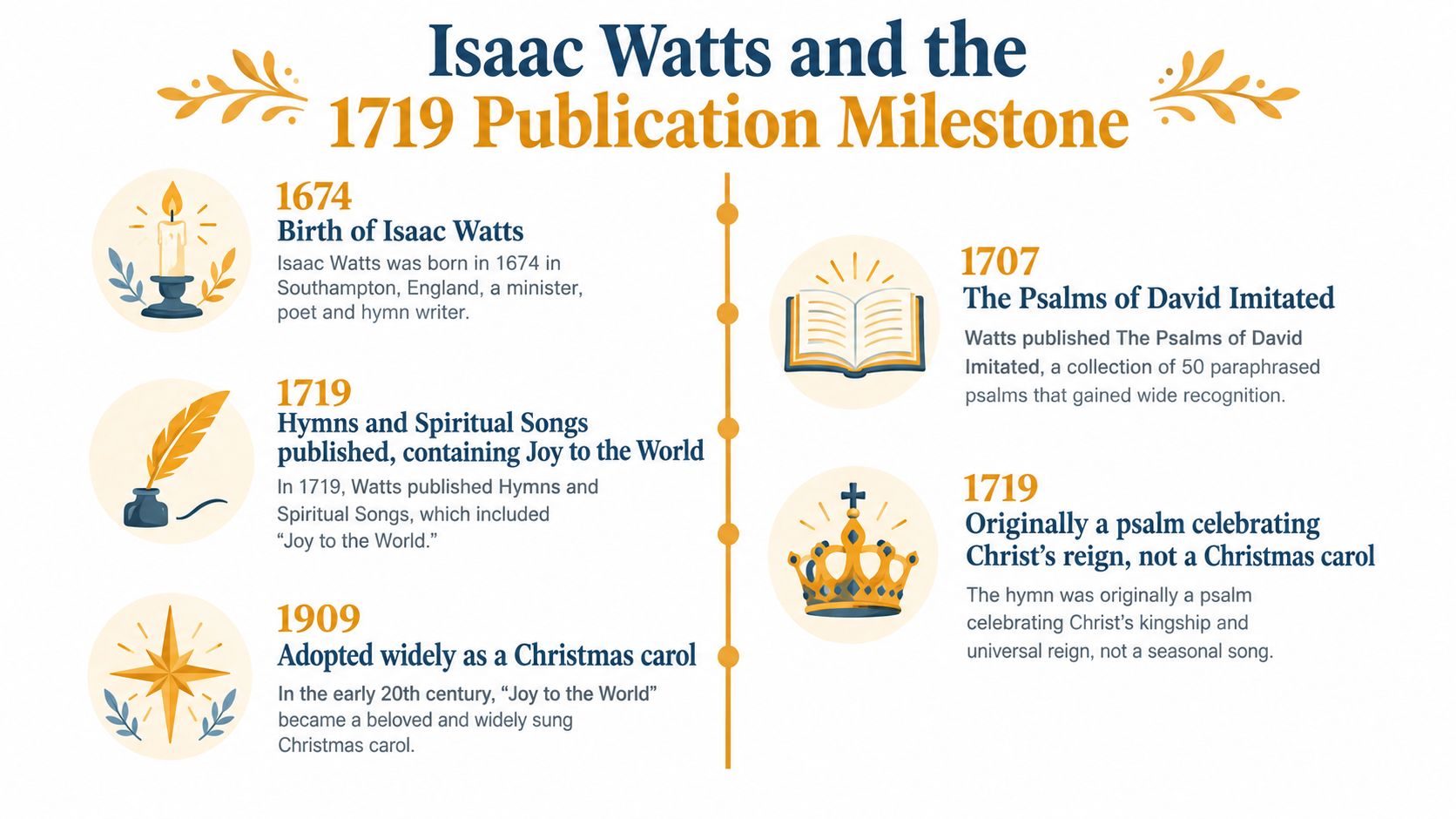
Isaac Watts and the 1719 Publication Milestone
How should readers hear a carol whose familiar words began as a poetic interpretation of scripture?
The text began as biblical poetry, not as a song written specifically for a Christmas service. Isaac Watts first published “Joy to the World” in 1719, under the title “The Messiah's Coming and Kingdom.” The poem appeared in The Psalms of David: Imitated in the Language of the New Testament, and applied to the Christian State and Worship.
That title frames the opening line differently. “The Lord is come” announces more than a child's birth. It presents a ruler and calls the earth to receive him as King. Watts reshaped the Psalms for Christian worship, like a translator carrying an older text into a new musical and theological setting.
Psalm 98 as the central foundation
Psalm 98 provides the strongest biblical foundation, joining salvation with universal praise. Its imagery reaches beyond a human congregation: fields, rivers, hills, and plains join the song. Watts' paraphrase tradition also shaped hymns like Amazing Grace as documented in the House of Lyrics catalog.