He Stopped Loving Her Today Meaning: The Twist Explained
Discover what He Stopped Loving Her Today meaning reveals: a love that lasts until death. Lyric-by-lyric analysis, history and George Jones's story.
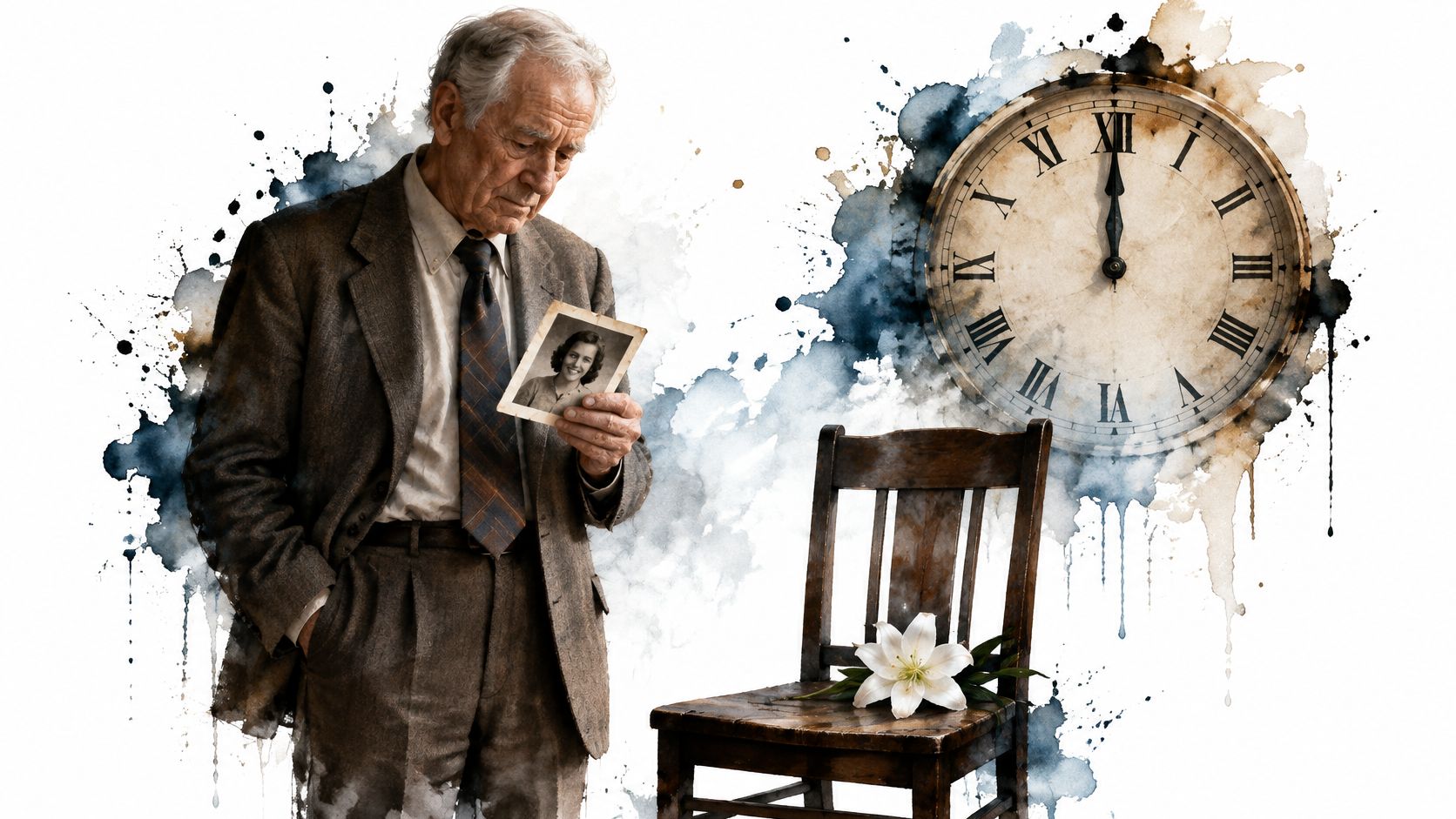
In “He Stopped Loving Her Today,” today is the day the man dies, so his love lasts until death. The phrase means he remained emotionally faithful, not that he finally moved on.
That makes the familiar advice to hear this as a beautiful example of never giving up only half useful. Say you help a friend put an old partner's photographs into a drawer. You might take that as progress, until you discover your friend still opens the drawer every evening.
George Jones's recording lives in that gap between what an action looks like and what someone feels. Its brilliance isn't that the ending is sad. It's that you hear an ordinary expression of emotional recovery, supply its reassuring meaning yourself, and then discover how terribly you've misunderstood it.
Table of Contents
- What the Title Really Means
- Walking the Song and the Delayed Reveal
- The Writers the Singer and the Era
- Chart Success and Why It Became a Classic
- Romance, Tragedy or Unhealthy Fixation
- Listen with the Official Video and Verified Lyrics
What the Title Really Means
The breakup reading sounds reasonable until you ask a basic question: what changed for this man? He hasn't chosen a new life, stopped hoping, or found peace with the separation. His attachment ends because his life ends.
The Library of Congress essay on the recording describes a man whose love endured over many years and identifies the song as George Jones's April 12, 1980 release, written by Bobby Braddock and Curly Putman for the album I Am What I Am. Those credits establish the recording's background; the dying man's enduring attachment establishes its emotional subject.
The title works because stopped loving ordinarily describes a change of feeling. We expect a decision, a disappointment, or the gradual disappearance of affection. Here, the writers give us the result before they let us understand its cause.
Surface Reading Versus the Final Meaning
| Phrase or detail | First impression | What the ending reveals |
|---|---|---|
| He stopped loving her | Breakup and emotional closure | He never stopped while alive; his love lasts until death |
| Today | A recent decision to move on | The day he dies |
| Removed reminders | Deliberate healing | Putting reminders away isn't discarding them; keeping them preserves her presence |
| Others think it is over | Public acceptance of the split | An outward ending can conceal continuing private devotion |
The reminders require particular care. Put away doesn't necessarily mean thrown away. A photograph in a drawer can represent a boundary, but it can also represent a private shrine. The surrounding story, not the storage place, tells you which reading fits.
Likewise, other people's belief that a relationship has finished tells us little about whether someone has emotionally accepted its end. A separation is an event between people. Letting go is an internal change, and this man never makes it.
The crucial distinction: His life reaches an ending. His feelings never reach a resolution.
That's why a straightforward “He Stopped Loving Her Today” meaning needs more than the word heartbreak. The song joins grief to denial and devotion to mortality. It lets the language of recovery describe something that isn't recovery at all.
The phrase means he remained faithful until death, not that he moved on.
Walking the Song and the Delayed Reveal
Say the recording comes on while you're driving, and you catch the title before you've absorbed the story. You hear what sounds like news about someone who has finally let go. As the narrator supplies intimate details, you begin to realize that the apparent announcement doesn't fit the man being described.
That mismatch is the pleasure, and the pain, of listening closely. The narrator gives you enough information to feel the attachment before you fully understand the occasion on which he's speaking.
Follow the Objects Before the Explanation
Start with the letters and photographs. These aren't interchangeable symbols of sadness. A letter preserves someone's words; a photograph preserves their appearance. Keeping both lets the man maintain a relationship with a remembered version of the woman even though the actual relationship has ended.
Consider the difference between storing correspondence and repeatedly treating it as evidence that someone might return. The physical action can look identical. The expectation changes everything.
The man's continuing hope supplies that difference. He isn't merely remembering a meaningful relationship while accepting his present circumstances. He still imagines a future shaped by her return, so the keepsakes belong to an unfinished emotional life.
A simple visual helps separate the apparent ending from the information that changes it.
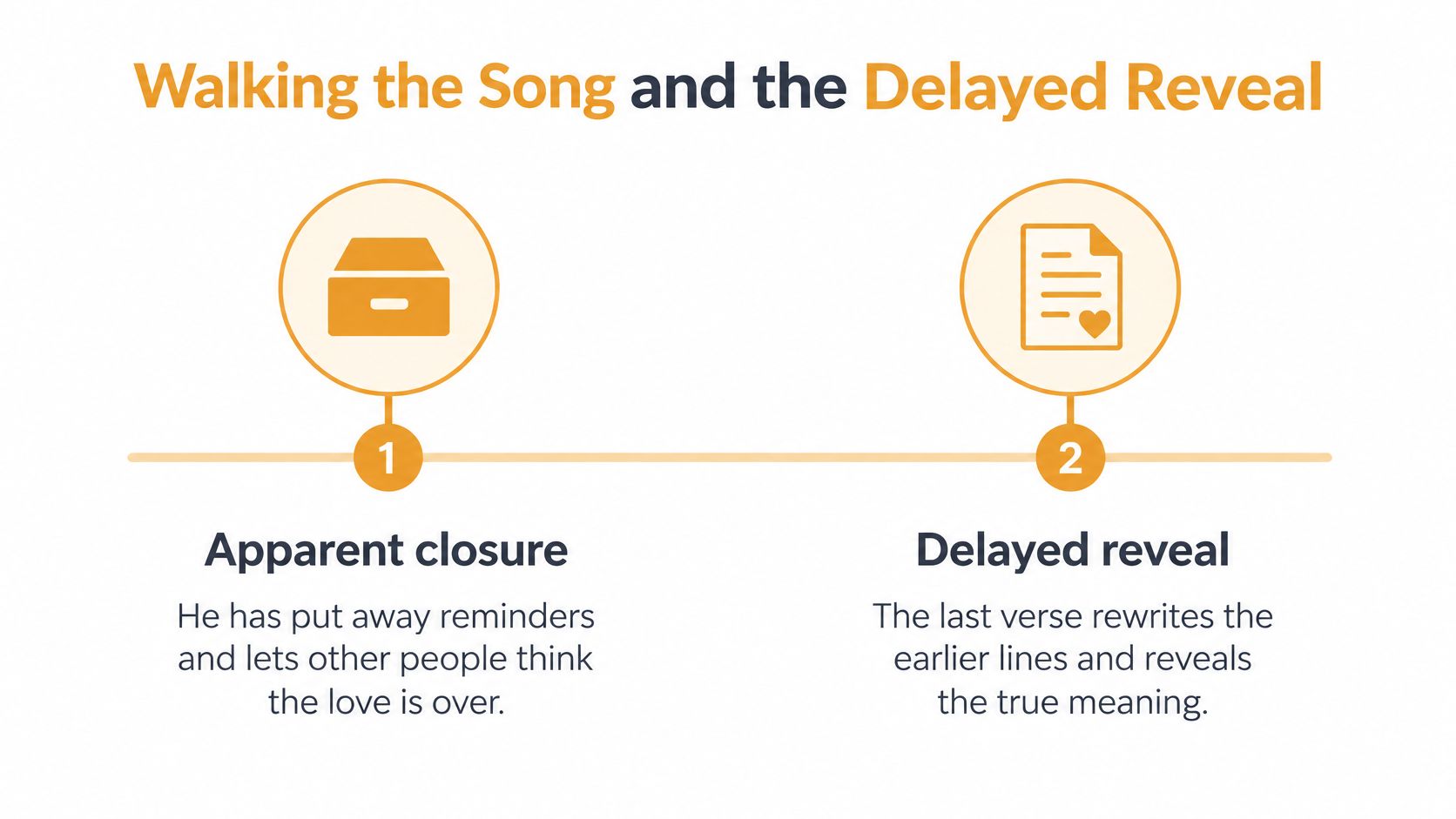
As the funeral context becomes clear, the narrator's earlier account acquires a different weight. The woman's appearance isn't the return the man imagined. She comes when a living reunion is no longer possible.
That detail makes the ending more than a surprise announcement of death. The person he waited for finally occupies the same scene, but the possibility that gave his waiting meaning has disappeared.
Why Withholding the Cause Matters
The Library of Congress analysis of the song's development notes that earlier versions revealed the death too soon, weakening the dramatic effect. Delaying that information lets listeners interpret the central phrase before they know what event it describes.
Think of a card trick in which the final card changes your understanding of every earlier move. The performer hasn't replaced the earlier actions. You've discovered what those actions were preparing you to see.
The song does something similar with language. The words remain stable while their meaning changes. On another listen, you can't recover your original innocence, but you can hear exactly where you supplied an assumption the narrator never guaranteed.
For vocabulary that separates verses, choruses, and other recurring parts, Drumloop AI's guide to song structure is a useful companion. A broader guide to song structure also helps distinguish where a section sits from what dramatic work it performs.
Try this listening test:
- List the narrator's claims. Note what he says about the man's behavior, rather than what you assume that behavior means.
- Mark the apparent closure. Identify the phrase you initially hear as emotional progress.
- Find the unnamed event. Ask what concrete occurrence could make that phrase true in a concrete sense.
- Reconsider the ending. Check whether the earlier observations were false, or whether your explanation of them was incomplete.
The distinction matters for songwriters, too. A twist feels earned when listeners can return to the setup and recognize its fairness. Merely withholding random information produces surprise; withholding the decisive context can produce recognition.
The ending doesn't cancel the story you heard. It changes what you understand the story to have been.
That's the recording's emotional logic: he stayed faithful until death. The delayed explanation lets you experience the distance between those words and the comforting breakup announcement you expected.
The Writers the Singer and the Era
A songwriter can write a devastating sentence and still lose its effect by explaining it too quickly. A singer can deliver every word clearly and still miss the tension between a narrator's restraint and a character's suffering. This recording brings those jobs together: Braddock and Putman supply the narrative construction, and Jones makes the account feel spoken by someone carrying its weight.
The artistic relationship matters more than an imagined story about what anyone privately intended. We can examine the credited writers, the singer, the album, and the recorded sequence. We can also hear how the performance gives ordinary language room to become unbearable.
This illustration brings the writers and performer into the same frame.

What the Performance Contributes
Jones doesn't need to turn the narrator into the abandoned man. The slight separation between the person telling the story and the person suffering makes the account feel witnessed rather than pleaded.
Listen for the difference between describing pain and demanding sympathy. When a singer lets a plain statement stand, listeners have space to picture the room, the keepsakes, and the absent woman. You participate in the emotion instead of receiving an instruction to feel sad.
That's a useful way to approach the wider country song tradition: follow concrete actions before assigning a general mood. A stored photograph can tell you more about a character than a large declaration of loneliness.
Where Documentation Ends
There's no direct explanation from Braddock or Putman in the accounts considered here that settles every question about their private motives. Calling the title a deliberate trap describes its observable construction, not an invented quotation from either writer.
Keep these distinctions separate:
- Documented credits identify who wrote and performed the song.
- Recorded choices show where listeners receive important information.
- Interpretation explains why those choices may make you feel loyalty, dread, pity, or discomfort.
For musicians who want to study how writing and performance interact beyond a single recording, The Online College of Art & Design offers an opportunity to explore flexible music study. The productive exercise here is specific: sing the central phrase as reassuring news, then sing it with full knowledge of the funeral.
The words don't need to change. Your understanding of what the narrator knows changes the delivery. That's where composition and interpretation meet.
Chart Success and Why It Became a Classic
A devastating story doesn't automatically become a career-changing recording. In Jones's case, listeners bought the record, country radio embraced it, and award organizations recognized both the composition and the performance.
The Country Music Hall of Fame's Bobby Braddock biography identifies it as Jones's first million-selling record and explains its role in restoring his standing at country radio. The milestones below show the concentrated recognition surrounding that return.
Chart, Award and Recognition Milestones
| Milestone | Year | Detail |
|---|---|---|
| First million-selling record for George Jones | Release era; sales milestone date unspecified | Helped revive his career after a late-1970s slump |
| Billboard country singles chart | 1980 release era | Number one for one week, 18 weeks on the chart |
| First number-one country single in six years | 1980 release era | Jones's first chart-topper in six years |
| Country Music Association Song of the Year | 1980 and 1981 | Two-time winner |
| Academy of Country Music Song and Single of the Year | 1980 | Honored for the recording |
| Grammy for Jones's performance | 1980 | Accounts use Best Country Recording or Best Male Country Vocal Performance |
| Radio & Records Country Song of the Century | Later recognition; year unspecified | Named by the trade publication |
The sales milestone and radio return establish commercial impact. The songwriting honors establish recognition of the composition, while the performance recognition reminds us that the lyric didn't reach audiences as words on a page alone.
The category descriptions attached to Jones's Grammy aren't consistent across the accounts summarized here, so the safe conclusion is the performance recognition itself. There's no need to turn uncertainty about a label into a more confident claim than the evidence supports.
Reputation Beyond the Original Release
Later audience responses offer a different kind of evidence. According to American Songwriter's account of a 2024 X poll, a discussion of the saddest country song attracted nearly 200 comments, and Jones's recording won the majority vote.
That's a snapshot of participating fans, not a representative verdict from every country listener. Its value is narrower and still meaningful: people continue to reach for this recording when they want to name an exceptionally painful song.
For a contrasting listening exercise, consider the emotional vulnerability in Patsy Cline's “Crazy”. Ask how much of your response comes from the situation described and how much comes from the singer's treatment of a familiar word.
Jones's achievement joins those forces. A story about an ending became an artistic renewal, giving the recording a career significance beyond its fictional tragedy.
Romance, Tragedy or Unhealthy Fixation
Admiring the song doesn't require admiring the man's entire way of living. You can be moved by the scale of his attachment and still feel that he has mistaken waiting for a life.
These overlapping emotional possibilities are worth keeping visible.

American Songwriter's discussion of the song describes love that survives separation and ends only with death. That supports the romantic reading, but it doesn't require us to treat the character's conduct as relationship advice.
Three Readings of the Song and What Supports Each
| Reading | Evidence in the song | Takeaway |
|---|---|---|
| Romantic ideal | Lifelong loyalty that survives separation | An intense vow, celebrated within country storytelling |
| Tragic meditation on grief | Death ends the devotion and reunion is impossible | Love as permanent, unresolved loss |
| Unhealthy fixation | Preserved letters, photographs, and hope she returns | Obsession rather than a relationship model |
| Literary versus advice lens | A stylized narrative, not practical guidance | Admire the craft without copying the behavior |
The romantic reading deserves a fair hearing. The man's feelings aren't temporary or convenient. Listeners may hear an extraordinary refusal to let absence erase someone's importance.
The tragic reading asks what that constancy costs him. His imagined future remains attached to someone who isn't sharing it. The funeral completes the narrative, but completion isn't the same as reconciliation.
Then there's fixation. Keeping meaningful objects isn't, by itself, evidence of unhealthy attachment. What makes this portrayal troubling is the combination of those objects with continuing expectation and the apparent inability to imagine another emotional future.
Hear the performance with those distinctions in mind.
Being Moved Isn't the Same as Agreeing
A shiver, a tear, or a caught breath tells you that a performance reached you. It doesn't settle whether the behavior depicted is wise. Million Whys' discussion of why music gives us chills offers a companion question about your response, separate from the moral judgment you make about the character.
Try a similar separation with Dolly Parton's “Jolene”: identify the speaker's fear without assuming that every belief expressed in that fear should guide your own relationships.
My clearest reading is stylized tragedy. The devotion supplies its grandeur; the absence of a livable resolution supplies its horror.
You can respect the depth of a feeling without treating lifelong captivity to it as an ideal.
The recording's reputation establishes cultural importance, not psychological health. Admire how the writers make the vow matter, while allowing yourself to wish the man had found a way to keep living differently.
Listen with the Official Video and Verified Lyrics
Return to the recording with the text available, but resist reading ahead immediately. Give yourself a chance to notice the difference between hearing a line unfold and seeing the whole narrative at once.
Use an official recording where available, and check the attribution attached to any lyric text you consult. A guide to official lyrics and video can help you understand why the connection between the words, their credited source, and the performance matters.
A Listen-and-Check Routine
Listen without annotating. Follow the narrator's voice and notice when the central phrase first feels settled in your mind. Don't stop to explain every image.
Check the text's provenance. Look for visible writer credits and artist or rights-holder attribution. Don't assume that a polished lyric page is necessarily an approved transcription.
Mark only the recurring title phrase. Leave the rest of the text unmarked for the moment. The aim is to hear how your understanding changes around an unchanged expression.
Choose a concrete detail. Follow the photographs, the letters, or the woman's arrival. Write down what you thought that detail meant before the funeral context became clear.
Name your interpretation. Choose romantic vow, tragic grief, or unhealthy fixation, then write a sentence explaining which action in the story supports your choice.
Don't write only that the song is sad. Try a sentence such as: the tragedy lies in his waiting for a reunion that becomes possible only when he can no longer experience it. That gives you an interpretation someone else can examine, rather than a mood they can only share or reject.
Try the Ending With Another Listener
Play the recording for someone who doesn't know the story, and pause before the funeral context becomes unmistakable. Ask what they think the title means, without hinting that there's a trick.
Then play the rest and ask the same question. The gap between their answers makes the construction audible: they haven't heard a different title, but they've discovered a different event behind it.
Listen again for that exact change. That's where today becomes a death, not a decision to move on.
Visit House of Lyrics to explore an artist-run library pairing artist-approved lyrics, visible attribution, and official video embeds. Bring this listening exercise to another country favorite, follow its concrete details, and compare what the words seem to promise with what the performance finally reveals.