Lyrics to the Prayer: Full Text, Versions, and Meaning
Get the complete lyrics to the Prayer by Celine Dion and Andrea Bocelli, plus version differences, credits, official video, and meaning explained.
You're probably here because you searched for lyrics to The Prayer, found three different lyric blocks on three different sites, and none of them quite matched the recording in your head. That happens all the time with this song. Some pages show only English. Some switch into Italian without warning. Some paste a duet text even when you need the solo version for a recital, memorial, choir folder, or translation exercise.
A lyric librarian's first job is to stop that confusion. With The Prayer, the key question isn't just “what are the lyrics?” It's which version, in which language, sung by which performer. Once that's clear, the song becomes much easier to follow, perform, and interpret accurately.
Table of Contents
- Which Version of the Prayer Do You Actually Need
- The Origin Story Behind Two Solo Recordings
- Three Lyric Versions Worth Knowing
- Complete Lyrics to the Prayer Duet
- English Solo and Italian Solo Lyric Versions
- What the Prayer Actually Means
- Songwriters, Performers, and Release Credits
- Rights Provenance and Why Verified Lyric Pages Matter
- Watch the Official Recording on This Page
- Quick Reference for Singers, Translators, and Event Planners
- Common Questions About the Prayer Lyrics
Which Version of the Prayer Do You Actually Need
People don't need a generic lyric block. They need the right text for the right use.
If you're singing along with the famous recording by Céline Dion and Andrea Bocelli, you need the bilingual duet. If you're preparing a solo performance in English, you need Céline Dion's English version. If you're working from the Italian tradition, you need Andrea Bocelli's Italian version. Those are not interchangeable, and that's where many lyric pages go wrong.
Why version choice matters
Different readers arrive with different goals:
- Singers need a text that matches their arrangement.
- Choirs need to know who carries which line in the duet.
- Translators and educators need to keep English and Italian traditions separate.
- Event planners need to know whether the song reads as devotional, ceremonial, or broadly reflective.
- Fans often just want to follow the official performance without guessing where the language shift happens.
That's why a mixed, unlabeled lyric block creates problems. A bilingual duet page can be useless if you need a single-language solo.
Practical rule: Before you copy or rehearse any lyrics to The Prayer, identify the recording first, then match the text to that recording.
If you also turn to songs and prayers for comfort during hard seasons, a thoughtful companion resource is HolyJot's prayer guidance, which speaks to the same emotional space many listeners bring to this song.
For readers who like precise song-page organization, it can help to compare how version-aware lyric writing works on other catalog pages, such as this song page example. The point is simple. One title can point to multiple valid texts, and your job is easier when those texts are separated cleanly.
The Origin Story Behind Two Solo Recordings
The history of The Prayer explains almost every lyric mismatch you see online.
The song did not begin as the famous bilingual duet. It began as two separate solo recordings for the 1998 animated film Quest for Camelot. Céline Dion recorded the English version, and Andrea Bocelli recorded the Italian version, according to the song's discography overview). That single fact is the reason there isn't one universal lyric block.
How the duet became the version most listeners encounter first
Later, the duet arrangement became the best-known form of the song. It appeared on Dion's These Are Special Times in 1998 and Bocelli's Sogno in 1999, and it was issued as a promotional single in March 1999 rather than a standard commercial single. Even with that limited single format, the recording reached No. 6 on Canada's RPM Adult Contemporary chart and No. 22 on the U.S. Billboard Adult Contemporary chart, then later reached No. 70 on the Billboard Hot 100 after digital availability renewed interest.
Two major live performances helped cement the duet in public memory. Dion and Bocelli performed it at the 41st Grammy Awards in February 1999 and the 71st Academy Awards in March 1999. Those televised moments, combined with the chart placements above, anchored the duet as the recording audiences hear before any solo version.
Why lyric pages still look inconsistent
Once you know the song began in parallel, the inconsistencies make sense:
- Some pages reflect the English solo lineage
- Some follow the Italian solo lineage
- Some combine both into the later duet
- Some fail to label which tradition they're using
A page about another multi-version song, like this catalog example, works as a useful reminder that titles alone rarely tell the full story. With The Prayer, the title is stable. The performed text isn't.
Three Lyric Versions Worth Knowing
Before you read any lyrics to The Prayer, sort the song into one of three principal versions. That one step removes most of the confusion.
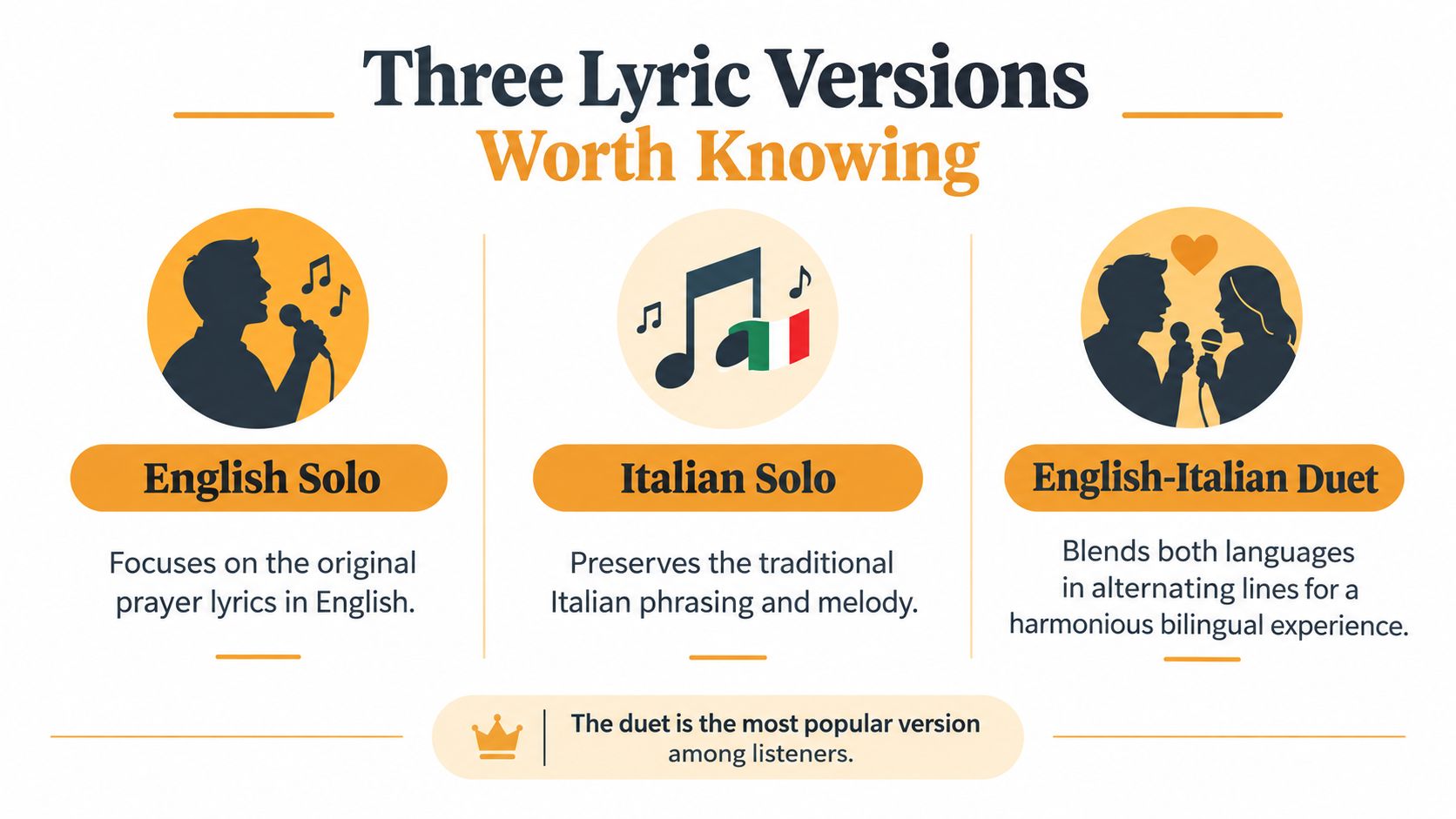
The three versions at a glance
The English solo is the clearest choice when a singer, student, or ceremony organizer wants one continuous English text. The Italian solo serves readers who need the Italian wording as a complete standalone tradition. The duet alternates English and Italian, which is beautiful in performance but easy to misread if the page doesn't label sections.
| Comparing the Three Principal Versions of the Prayer | |||
|---|---|---|---|
| Version | Language | Performer | Best For |
| English solo | English | Céline Dion | Solo singers, English-only ceremonies, lyric study |
| Italian solo | Italian | Andrea Bocelli | Italian-language performance, pronunciation work, translation comparison |
| English-Italian duet | English and Italian | Céline Dion and Andrea Bocelli | Following the famous recording, weddings, memorials, duet performance |
How to choose the right one fast
Use this short filter:
- Need the most familiar public version. Pick the duet.
- Need one language only. Choose the matching solo.
- Need line assignments for rehearsal. Use a labeled duet text.
- Need textual comparison. Keep the English and Italian versions separate before mapping them together.
The biggest mistake isn't choosing the wrong lyric page. It's assuming all pages with the same title point to the same performed text.
This is why version labeling matters more than a long theme summary. If the page doesn't tell you who sings what and which language you're looking at, it isn't yet a reliable reference.
Complete Lyrics to the Prayer Duet
A singer preparing The Prayer for a ceremony may find several pages carrying the same title, yet each may show a different language mix or performer assignment. The familiar duet by Céline Dion and Andrea Bocelli joins English and Italian, so the text should function like a clearly labeled score, not one uninterrupted block.
How to identify the duet text
In the duet, Céline Dion is associated primarily with the English passages, while Andrea Bocelli is associated primarily with the Italian passages. Their exchange creates the song's distinctive shape. A page that removes those labels leaves readers guessing whether they are viewing the duet, an English solo, or an Italian solo.
The approved lyric text should therefore appear with performer labels, language labels, and a short version note. A structured reference, such as this structured lyrics page example, shows why page organization matters: readers can identify the text they need before studying or singing it.
Where to find the complete approved text
Full lyrics should be read on the approved House of Lyrics song page when that page provides the authorized text for the relevant recording. This article uses that source rather than reproducing an unverified transcription, because a guessed line could blur the distinction between the duet and either solo version.
A reliable duet layout includes:
- Céine Dion labels for her English sections
- Andrea Bocelli labels for his Italian sections
- Clear marks for shared or alternating lines
- A visible note whenever the language changes
- A warning against replacing duet wording with solo wording
Metadata beside the lyric text
The surrounding details should answer four questions quickly: which version is this, who sings each part, what languages appear, and which recording the wording represents. A short provenance note should also state whether the page presents approved text or an unverified transcription.
| Field beside the duet text | Purpose |
|---|---|
| Version label | Separates the duet from both solo recordings |
| Language note | Shows where English and Italian alternate |
| Performer attribution | Assigns each passage to the correct singer |
| Recording context | Connects the wording with the intended performance |
| Provenance note | Identifies the text's source status |
That format gives singers, translators, and ceremony organizers a usable reference while keeping the canonical duet distinct from related versions.
English Solo and Italian Solo Lyric Versions
The solo versions deserve their own space. Too many pages treat them like fragments of the duet, when they're better understood as standalone lyric traditions connected to distinct recordings.
The English solo version
Choose the English solo when you want a single-language performance, a classroom reading, or a ceremony where bilingual alternation would distract from the flow. This version tracks the English expression associated with Céline Dion's solo recording for Quest for Camelot. It's often the easiest entry point for listeners who know the melody but not the Italian phrasing.
A well-built English solo page should include:
- Performer name
- Language marked as English
- Solo version label
- Any adaptation note if the text differs from the duet flow
- Clear separation from the duet arrangement
The Italian solo version
The Italian solo is not just “the duet without the English parts.” It follows the Italian presentation associated with Andrea Bocelli's solo recording, and readers often seek it for pronunciation practice, repertoire preparation, and side-by-side interpretation.
That matters because Italian lyric pages can get muddled in two ways. Some mix duet lines into the solo text. Others present a translation as though it were the original wording.
Editorial caution: A translation and an original-language lyric are not the same thing, even when they convey similar meaning.
Why separate solo pages help readers
A solo page should help the reader answer three practical questions immediately:
- Is this all in one language?
- Does it match a solo recording or a duet arrangement?
- Am I reading original wording or an adapted translation?
When those questions are answered up front, singers stop splicing lines together from random websites. That's especially important for lyrics to The Prayer, because the song's public identity is famous, but its textual versions are easy to confuse.
What the Prayer Actually Means
The Prayer works because it supports more than one honest reading. Many listeners hear it as a spiritual prayer for guidance, safety, faith, and grace. Others hear it as a human appeal for peace, kindness, justice, and hope that can resonate across religious lines. That dual reading is one reason the song remains useful in ceremonies where the audience may not share one belief tradition.
A music commentary source discussing the song's meaning notes that it is often chosen for memorial services and describes it as spiritual rather than narrowly doctrinal, which helps explain why it travels so well across settings and communities in this interpretation of the song's themes.
The spiritual reading
The spiritual reading comes from the song's language of prayer, faith, grace, and a watching power beyond the self. In that frame, the song sounds like a petition. The singer asks not for status or victory, but for protection, wisdom, and moral direction.
That makes it suitable for settings where listeners are comfortable with sacred imagery, including funerals, remembrance events, and some wedding ceremonies.
The humanistic reading
The broader reading is just as strong. The song's emotional center rests on wishes that many people share regardless of doctrine:
- Safety
- Hope
- An end to violence
- Justice
- Kindness
- Human solidarity
Those themes don't require one specific creed. They invite listeners into a shared moral imagination.
Choosing it for an event
A careful event planner usually asks whether the song will feel inclusive. In many cases, the answer is yes, if the context fits the tone.
| Event type | Likely fit | Why |
|---|---|---|
| Memorial or funeral | Strong fit | Reflective, consoling, spiritual without being overly narrow |
| Wedding | Conditional fit | Works best when the couple wants solemn, aspirational language |
| School performance | Good fit | Peace-centered themes can suit mixed audiences |
| Interfaith ceremony | Strong fit | Religious imagery and universal hopes can coexist |
| Secular gathering | Possible fit | Best when introduced as a song of peace and guidance |
Readers often want a simple answer. The Prayer isn't only a Christian hymn, and it isn't only a generic inspiration song either. It sits in the meaningful space between those labels.
Songwriters, Performers, and Release Credits
A good lyric page starts with the credits, because the credits tell readers what they are looking at. With The Prayer, that means separating the composition, the solo recordings, and the duet version that many listeners know best.
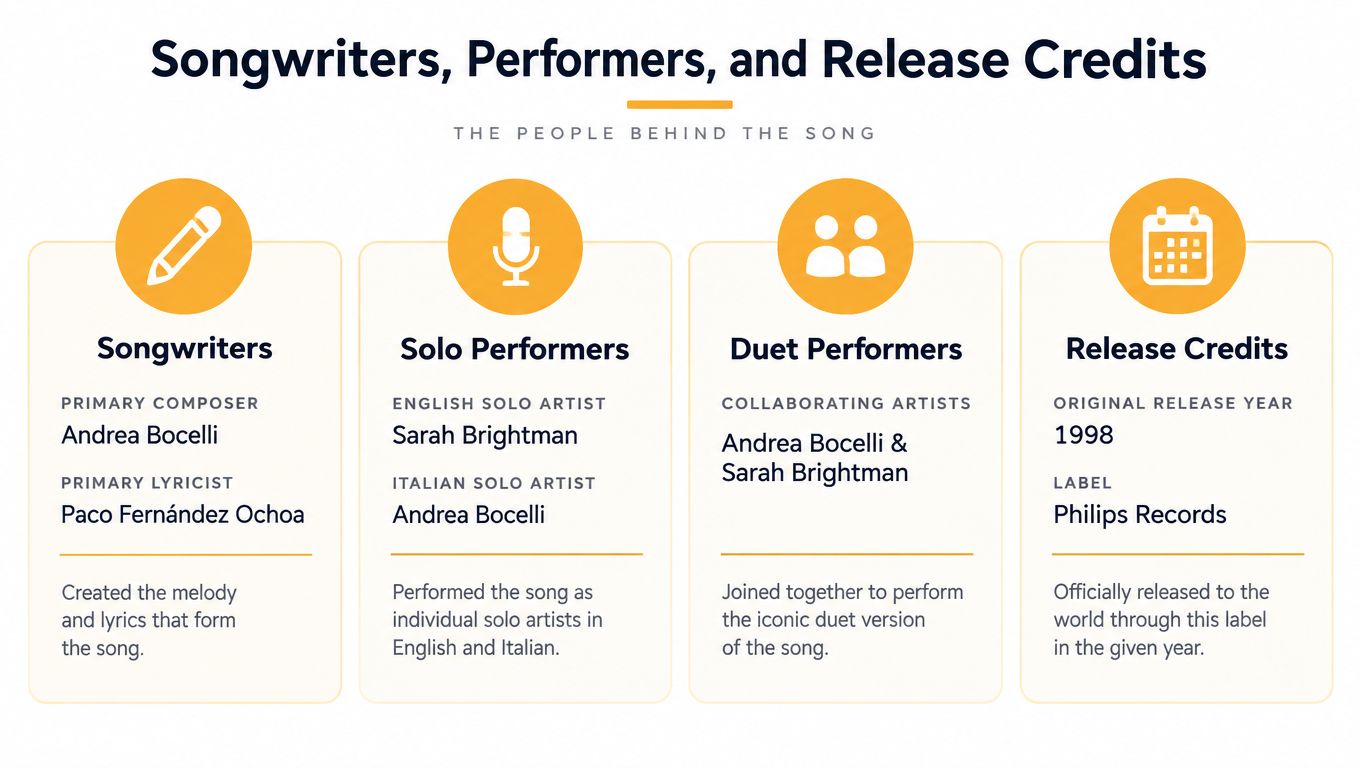
Core provenance readers should see
The song is credited to David Foster, Carole Bayer Sager, Amy Sky, and Tony Renis. That songwriter list belongs on the page, because it names the people behind the work before any one performance entered circulation.
The recording history also matters. The duet grew out of separate solo recordings tied to Quest for Camelot, with Céline Dion singing the English version and Andrea Bocelli singing the Italian version, as noted in the published release and performance history). That context helps readers keep the versions straight, the way a library label distinguishes one edition from another.
A credit block should also name the release context and rights trail. The song was released in association with major album circulation and later performance life, so a reader should be able to see the publisher or rights-holder line alongside the performers, not buried elsewhere.
Why credit lines matter on a lyrics page
Credits stop confusion before it starts. They show the difference between the underlying composition and a specific recording, between a solo version and the duet, and between a film-linked origin and later album use.
A page without that structure can leave readers guessing whether the lyrics match the version they have in mind. That problem is even clearer on songs with multiple language forms, which is why a credits-aware page such as this structured lyric entry is easier to use. It gives the reader a clean path from title to performer to version, instead of forcing them to sort it out by memory.
Rights Provenance and Why Verified Lyric Pages Matter
A lyric page can look simple while hiding a messy rights problem underneath. With songs like The Prayer, the title may point to a musical work, while the audio or video a reader recognizes may point to a specific recording. Those are not the same asset.
The U.S. Copyright Office explicitly explains that a sound recording and the music, lyrics, words, or other content included in it are separate copyright-protected works in its guidance for musicians at the Copyright Office's creator resources. That one distinction clears up why sloppy lyric cataloging causes so much confusion.
The metadata that keeps pages accurate
A production-grade lyric record should preserve at least:
- Normalized song title
- Credited artist
- Lyricist and composer roles
- Publisher or rights-holder attribution
- Language
- Version label
- Release context
- Provenance status
The same rights and metadata guidance also points toward keeping composition identifiers distinct from recording identifiers. The UK government's streaming metadata agreement, summarized in that copyright and standards discussion, identifies ISWC as the preferred identifier for a song or composition, while ISRC identifies a sound recording, and the ISO standard for musical-work coding formalizes ISWC as a unique identifier structure for distinguishing musical works in databases and rights administration in the ISO 15707 overview.
What that means in plain language
A trustworthy lyrics page should do three things:
- Reject uncertain title plus artist matches
- Store alternate titles and version labels as aliases
- Keep the composition record separate from the recording record
That's the difference between a page that merely displays text and one that can survive real editorial review, as discussed in this explanation of editorial review standards. For readers, the benefit is simple. You can trust that the lyric block belongs to the work you intended to look up.
Watch the Official Recording on This Page
Many readers don't just want the words. They want to hear the authoritative performance while reading. That matters even more with a bilingual song, because the ear catches transitions that a plain text block can't fully convey.
A good song page should pair the verified lyric text with an official recording embed, not a random user-uploaded copy. When the recording is canonical, the listener can follow the language changes, vocal entries, and phrasing without wondering whether the arrangement has been altered.
Here's the kind of visual pairing that makes a lyrics page more useful during rehearsal or personal listening:

Why official video beats unofficial uploads
Unofficial media creates two problems. First, it can point readers to the wrong arrangement. Second, it weakens provenance. A lyric page is most helpful when the text, performer credit, and embedded video all agree on what version the reader is using.
That alignment is what turns lyrics to The Prayer from a search query into a practical reference.
Quick Reference for Singers, Translators, and Event Planners
Some readers return to a page like this again and again. They don't want the full explanation every time. They want the fastest route to the right version.
Use this chart when time is short
| Quick Reference for the Prayer by Use Case | |||
|---|---|---|---|
| Use Case | Recommended Version | Language | Notes |
| Singing along with the famous recording | Duet | English and Italian | Best when you want the widely recognized arrangement |
| Solo performance in English | English solo | English | Keeps the text continuous for one singer |
| Solo performance in Italian | Italian solo | Italian | Better for Italian diction and phrasing work |
| Choir planning a bilingual arrangement | Duet | English and Italian | Label line assignments by singer or section |
| Translation comparison | Both solo versions side by side | English and Italian | Don't substitute a translation for the original text |
| Memorial service | Duet or English solo | Mixed or English | Choose based on audience comfort with bilingual delivery |
| Interfaith ceremony | Duet | English and Italian | Works well when introduced as a peace-centered song |
The fastest decision rule
If you know the recording, choose the matching lyric version.
If you know the event, choose the version whose language and tone best fit the audience.
That small discipline prevents most mistakes singers, planners, and educators run into with this song.
Common Questions About the Prayer Lyrics
Is The Prayer appropriate for secular events
Yes, often it is. The song uses spiritual language, but its central themes of hope, safety, peace, and human kindness can work in secular settings when the audience is comfortable with reflective or ceremonial language.
Why does the duet mix English and Italian
Because the song's history includes separate English and Italian solo recordings, and the later famous duet combines those traditions into one performance. The bilingual format is part of what gives the duet its distinctive emotional shape.
Are the film, album, and duet lyrics always identical
Not necessarily. Version drift is one of the main reasons lyric pages should label solo, duet, language, and recording context instead of pasting everything into one block.
Where should I look for the version that matches what I hear
Start by identifying the performer and arrangement. Then use a page that separates the English solo, Italian solo, and duet clearly, with visible credits and an official recording match.
Why are so many pages confusing
Because they collapse composition, recording, translation, and arrangement into a single entry. That works badly for bilingual songs, and The Prayer is one of the clearest examples of why.
If you want a cleaner way to find and verify lyrics like these, House of Lyrics brings together artist-approved lyric texts, official video embeds, and structured song-page metadata in one place. It's especially useful for songs like The Prayer, where version labels, performer credits, and recording context make the difference between a helpful page and a confusing one.