Me and Jesus Lyrics Matched to the Right Song
Me and Jesus lyrics by artist and year, with credits, album, and the official video for Hall, Paisley, or Stellar Kart.

The usual advice for finding lyrics is to type the title and open the first result. For Me and Jesus lyrics, that can send you to the wrong song. Start with the performer, not the words: a country-gospel recording and a Christian-rock single can share a title without sharing a songwriter, a story, or an approved lyric text.
Table of Contents
- Which Me and Jesus You Actually Heard
- Two Song Families and the Same-Title Collisions
- The Tom T. Hall Country Gospel Line
- Stellar Kart Rock Single From 2006
- Credits Provenance and the Approved Text
- Lyric Variants Between Recordings
- Artist Album and Related Song Links
- Open the Matching Lyric Page Next
Which Me and Jesus You Actually Heard
A shared title works like a shared folder name: several unrelated files can sit inside it, and opening the first one is how you end up reading the wrong document. With Me and Jesus, the files are recordings. Identify the performer before you read a single line.
Me and Jesus versions to match before reading lyrics
| Artist | Album or appearance | Songwriter | Lyric identity |
|---|---|---|---|
| Tom T. Hall | Mercury release | Tom T. Hall | Originating country-gospel text |
| George Jones and Tammy Wynette | We Love to Sing About Jesus (1972) | Tom T. Hall; Billy Sherrill produced | Hall composition, duet recording |
| Brad Paisley | Moonshine in the Trunk (2014) | Tom T. Hall | Hall composition, later country recording |
| Sundance Head | The Voice performance (November 2016) | Tom T. Hall composition | Hall composition, television performance |
| Craig Wayne Boyd and Jason Crabb | The Inbetween | Separate credit from the Hall song | Separate same-title track |
| Stellar Kart | We Can't Stand Sitting Down (2006 single) | Adam Agee and Ian Eskelin | Different Christian-rock song |
The sections below examine each family in turn. Read the songwriter column as the sorting key: when it names Hall, the recording belongs to his composition, and when it names Agee and Eskelin, you are looking at a different song that happens to carry the same title.
The George Jones and Tammy Wynette lyric page on Genius identifies a particular artist recording, which is the useful starting point for this search. A page labeled only with the song title leaves a listener without that distinction.
Match the singer before comparing lines
If you remember a country vocal telling a testimony-style story, start with the Hall-associated recordings. Hall, Jones and Wynette, Paisley, and Head share one composition lineage: their recordings trace to the same underlying work, though verse order, repetitions, and vocal assignments can still differ from performance to performance.
If you remember a rock band, start with Stellar Kart. Trying to reconcile its chorus with a country-gospel lyric page means the title matched and the composition did not.
Use the remaining clues deliberately:
- Album memory: A remembered album title narrows the search faster than a general sense that the song sounded religious.
- Voice memory: A duet, a solo country singer, and a band performance each point to a different row.
- Listening context: A television performance may need its own version label rather than an album recording's text.
- Credit memory: A songwriter name can settle a match when the title cannot.
Keep only the matching recording
Once you have chosen a row, set the other lyric blocks aside. Reading several same-title texts side by side can lodge a line from the wrong song in your memory, especially when each one leans on familiar religious language.
For another title-focused search, the Cats and Dogs lyrics guide offers a separate place to continue browsing. For this title, stay with the performer and recording you matched.
Practical rule: A matching title is a search result. A matching artist, album, and songwriter is a usable identification.
No complete lyric text appears here. The goal is to reach the correct, attributed recording before you read or submit its words.
Two Song Families and the Same-Title Collisions
Two filing groups cover most results for this title: Tom T. Hall's country-gospel composition and separate same-title works that each need independent identification. The second group is a holding category. Placing artists in it says nothing about whether they share a composition.
The filing rule stays simple: require artist plus album or release year, then check the songwriter. A matching title, a familiar religious phrase, or a similar musical feel cannot join two records on its own.
The diagram illustrates the split between a confirmed composition lineage and title collisions.
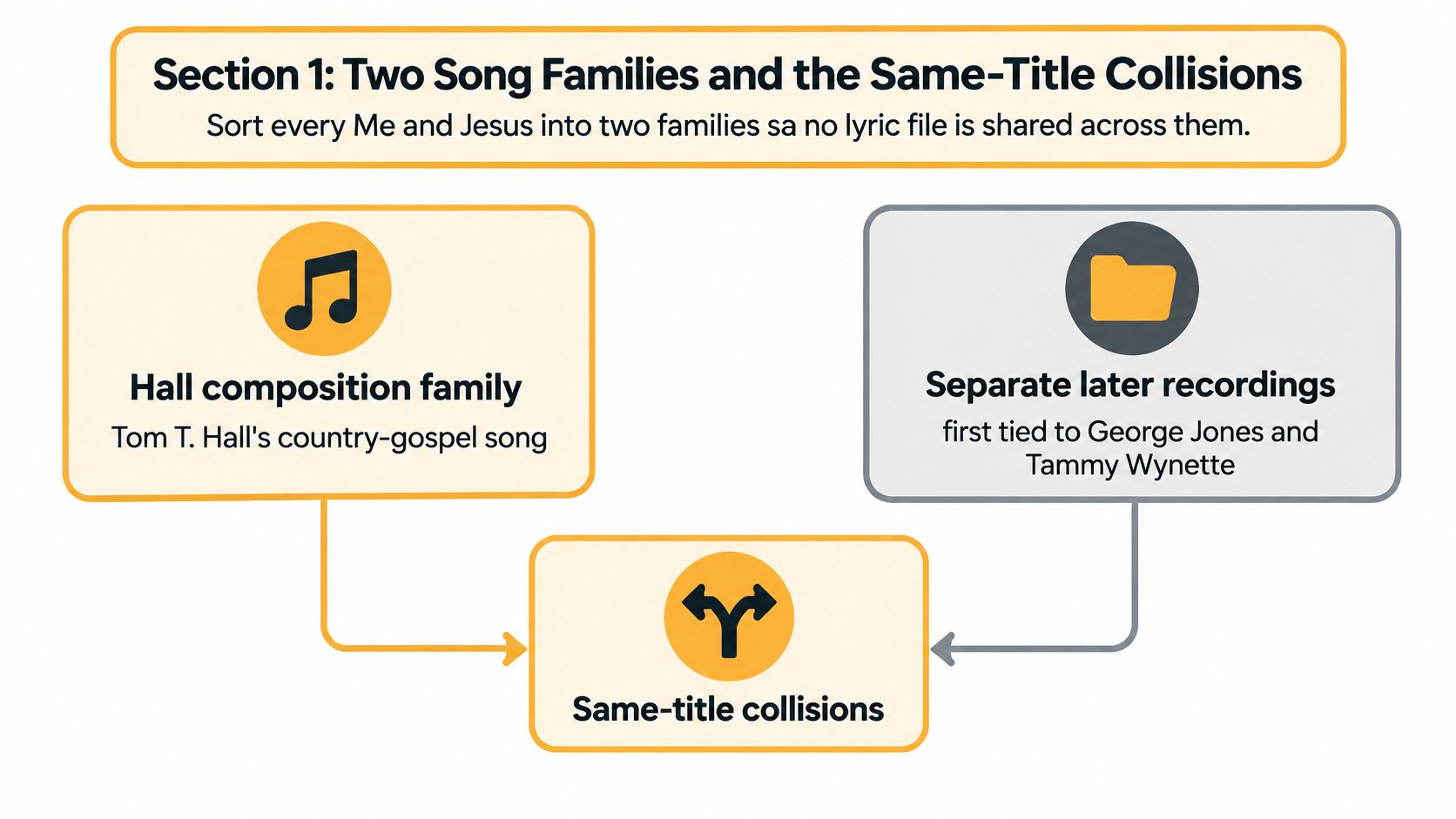
The Hall composition and its later performances
The country-gospel lineage includes the song first tied to George Jones and Tammy Wynette on We Love to Sing About Jesus in 1972, Paisley's Moonshine in the Trunk recording in 2014, and Sundance Head's November 2016 television revival, as described in the recording history associated with this Spotify track listing.
Those are different performances inside one songwriting lineage. A listener may enter through an album, a duet, or a television appearance and still be looking for Hall's composition.
By contrast, Craig Wayne Boyd and Jason Crabb's same-title track appears on The Inbetween, dated 2019 at approximately 3:27 in the Spotify recording listing. The Hall-associated narrative concerns a formerly sinful or drunken man and a personal relationship with Jesus. That narrative must not be assigned automatically to another artist's same-title release.
Near titles need their own checks
Other results make title-only matching even less reliable:
- Steven Wood: Shazam's Steven Wood listing dates his version to June 20, 2025, and lists 84 BPM. Those details identify a listing, not its relationship to Hall's composition.
- Noël Mio: Shazam's Me & My Jesus listing gives a release date of October 31, 2025, and 103 BPM. Notice the additional word in the title.
- Ak fire: Gaana's Hindi album listing identifies a 2024 release containing one song, with a total playtime of 3 minutes 29 seconds.
Suppose you're checking a Paisley recording credited to Hall. Keep it with the Hall work while preserving Paisley's recording identity. If you're checking a Stellar Kart recording credited to different writers, open a separate work record.
Tempo cannot settle that decision, and neither can a dance arrangement, an acoustic introduction, or gospel-style delivery. Writer and recording credits establish the relationship; musical resemblance only helps you search.
The Tom T. Hall Country Gospel Line
Say you heard the song in a country playlist, then found a newer compilation. The catalog question isn't when that compilation appeared. It's which recording the compilation contains, who wrote the work, and whether you've found the original release or a later package.
SecondHandSongs' work history places Hall's recording session on December 21, 1971, and the first release in February 1972. Its associated recording history identifies a 1972 Hall version of approximately 3:21 with Mercury Records, while later compilations can carry different release dates and ownership notices.
The timeline separates the original recording reference from later interpretations.
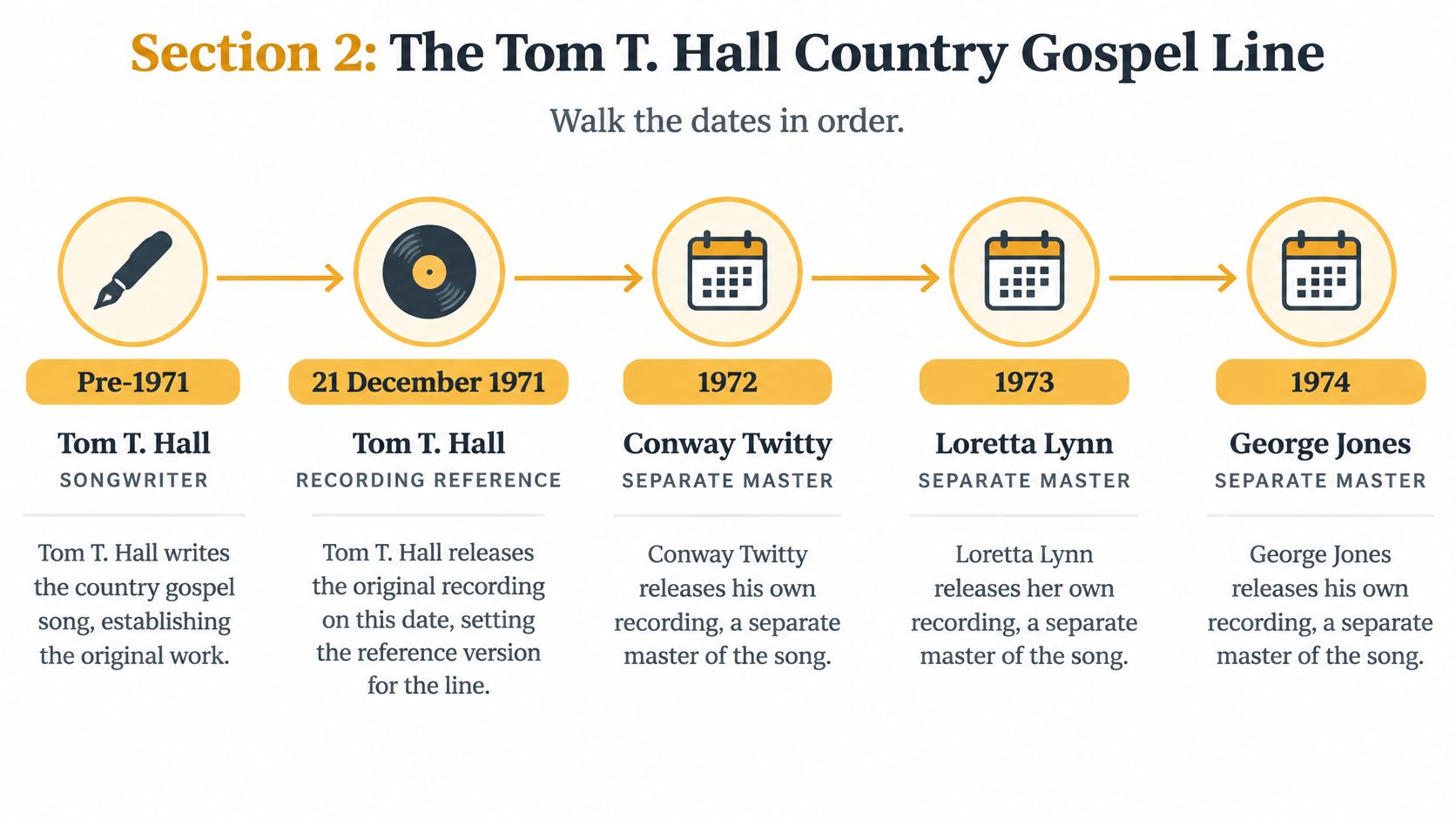
Follow the writer while the performer changes
Hall is the originating songwriter and recording reference. When Jones and Wynette enter the history, the recording artist changes, and Billy Sherrill belongs in the producer field. Hall remains the writer.
Paisley's Moonshine in the Trunk was released on August 25, 2014, and credits Hall for the composition, according to the same work history. Head's television rendition belongs to that composition lineage too, but its performance identity must remain distinct from the album recordings.
This is why an editor shouldn't replace the original recording's date with the date printed on a later compilation. The compilation describes a release package. It doesn't automatically establish a new performance or a newly written song.
Keep the work and the recording separate
A useful catalog entry distinguishes these fields:
- Work title and songwriter: Identify the underlying composition.
- Recording artist and version label: Name the performance the reader will hear.
- Album and release date: Identify the relevant release, not an unrelated reissue.
- Label and producer: Preserve their separate roles when known.
- Recording identifier: Include the ISRC when it's available and verified.
The distinction matters beyond tidy credits. A composition and a sound recording are separate rights objects, so identifying the singer doesn't by itself establish who controls every use of the words or audio.
Use the embedded performance as a listening reference, and verify its artist and edition before attaching any text to it.
If you're building a visual accompaniment for an authorized performance, you can explore AI tools for worship videos through AIMVG. Resolve the composition, recording, and permissions first; choosing a visual tool doesn't resolve those credits.
For more listening within the genre, browse the country catalog. If the recording you remember features a rock band rather than a country vocal, don't force it into Hall's lineage.
Stellar Kart Rock Single From 2006
Stellar Kart's Me and Jesus needs its own song entry. The song's release and award history identifies a July 2006 single from We Can't Stand Sitting Down, written by Adam Agee and Ian Eskelin and issued through Word Entertainment.
That history also records its 2007 GMA Dove Award for Rock/Contemporary Recorded Song of the Year and an additional nomination for Song of the Year. These credits establish a distinct Christian-rock release, not a rock subtitle attached to Hall's country-gospel work.
What the release evidence establishes
The same history reports seven weeks at number one on Christian radio and a position as the 11th-most-played song on Christian radio during 2006. Its documented runtime is approximately 3 minutes 24 seconds, and its later catalog appearances include the 2009 compilation Life Is Good: The Best of Stellar Kart.
Those details explain why a listener might recognize the song from radio or encounter it through a best-of collection. They don't establish that every person searching the title means Stellar Kart. The country recordings remain separate answers to the same search phrase.
For a catalog editor, the important result is the combination of band, album, writers, and issuing label. Together, those details distinguish this song even when a search result truncates its description.
| Display field | Correct identification |
|---|---|
| Recording artist | Stellar Kart |
| Album | We Can't Stand Sitting Down |
| Songwriters | Adam Agee and Ian Eskelin |
| Issuing label | Word Entertainment |
| Composition relationship | Separate from the Hall song |
Put the identity before the lyric text
A page heading should make Stellar Kart visible immediately. The album and writer credits should appear before the lyric block, so someone arriving from a search snippet can check the match without reading the entire song.
The official audiovisual source should identify the same recording. If the page embeds a different performance, label that performance rather than allowing the reader to assume the audio and displayed text are interchangeable.
Useful listening clues include:
- Band recognition: A remembered Stellar Kart performance belongs under the band's entry.
- Award recognition: A remembered Dove Award connection supports this identification.
- Story recognition: A remembered testimony about a formerly drunken man points away from this entry and toward the Hall-associated work.
Don't paste country-gospel verses into the page because the title matches. Don't assign Hall's writing credit to Agee and Eskelin's song, either. Both mistakes turn a correct artist result into an incorrect lyric reference.
Readers looking for neighboring band recordings can browse the rock catalog. That genre route is useful for discovery, but the individual song's credits remain the deciding evidence.
Credits Provenance and the Approved Text
A lyric page needs more than convincing words. It needs provenance, meaning a clear account of who supplied the text, which recording it represents, and who reviewed it.
At House of Lyrics, we only host lyrics submitted by the artist or rights holder. Submitted lyrics, chords, or media are reviewed by the song owner or House of Lyrics editors before they appear on the site. Apply that gate to the exact recording, not merely to every page sharing its title.
The checklist shows how attribution, review, and recording identity belong together.
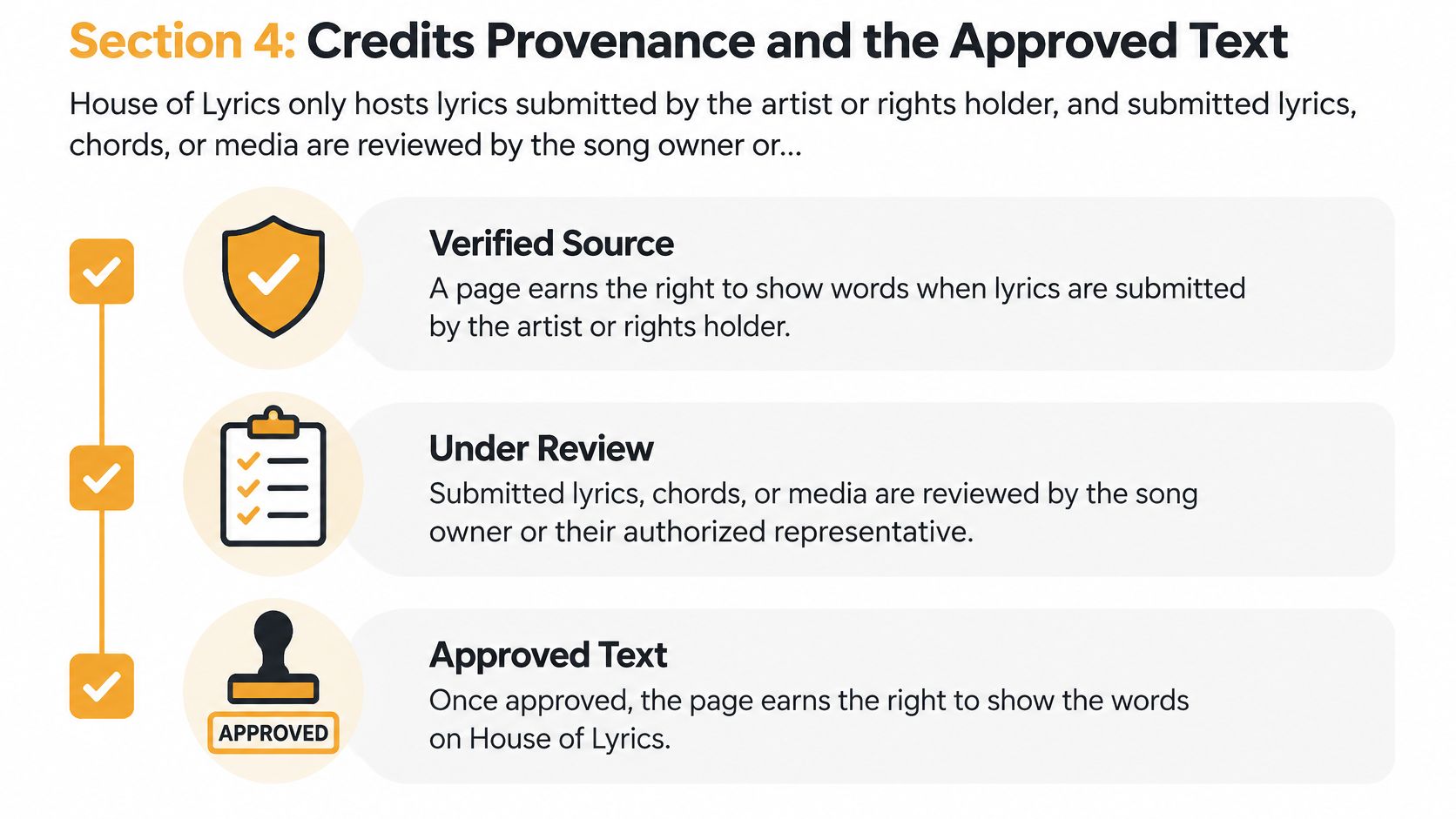
Make the source of the words visible
A public credit line should distinguish songwriter, recording artist, and text attribution. These roles can belong to different people or organizations. Naming the singer alone doesn't explain who wrote the composition or supplied the approved transcription.
For a Hall-family recording, keep Hall in the songwriter field while identifying the performer separately. For Stellar Kart, preserve Agee and Eskelin's writing credit and Word Entertainment's issuing-label credit. A shared title is no reason to transfer any of those roles.
Use this publication checklist:
- Identify the contributor: Confirm that the submission comes from the artist or rights holder.
- Identify the recording: Match the artist, album or appearance, and version label.
- Review the text: Compare the submitted words with the authorized reference and resolve disagreements.
- Display attribution: Let the reader see which text and performance the page represents.
Treat the embed as evidence, not permission
An official video helps a listener confirm the voice, arrangement, and performance. It doesn't automatically authorize someone to copy lyrics from elsewhere. The audiovisual reference and the lyric submission serve different purposes.
If the text includes a verse that the embedded recording omits, investigate the difference. The text may represent another edit, another performance, or a transcription problem. Don't combine them into an apparently definitive version.
Editorial safeguard: When the artist, writer, or recording details conflict, hold the text for clarification rather than publishing a confident-looking mismatch.
An uncredited copy on another site may help locate a phrase, but it cannot explain its own approval history. Repetition across several sites doesn't resolve that missing attribution.
Readers exploring another religious song title can use the All My Tears lyrics guide as a separate reference. Keep its song identity separate too: a shared theme is useful for discovery, not for transferring text or credits.
Lyric Variants Between Recordings
Two approved texts within the Hall lineage can differ without either being wrong. The editor's job is to identify what kind of difference appears, then preserve it under the correct recording label.
Don't start by asking which wording appears on more websites. Start by asking which wording the authorized source assigns to the performance you're publishing.
Classify the difference before changing anything
| Difference type | What it means | Appropriate treatment |
|---|---|---|
| Adaptation | A writer or rights holder authorizes changed written lines | Preserve the authorized adaptation and its attribution |
| Duet arrangement | Singers divide, alternate, or share lines | Retain performer assignments where confirmed |
| Shortened edit | A performance omits a verse, section, or repetition | Label the edit without restoring unheard material |
| Transcription error | The candidate text conflicts with the recording or approved source | Hold the disputed wording for confirmation |
These are editorial categories, not claims that every listed Me and Jesus recording contains each type. A duet credit alone doesn't prove a particular line split, and a shorter runtime alone doesn't prove that a verse was removed.
Suppose a Jones and Wynette submission includes confirmed singer assignments. Preserve those assignments for that duet. Suppose a Paisley submission contains a line absent from a Hall reference text. Treat that as a question to resolve, not proof that Paisley introduced an authorized adaptation.
Resolve and publish the specific version
- Compare against the exact recording's approved source. Don't use an unrelated cover as the final authority, even when you recognize most of its words.
- Name the difference. Record whether you're dealing with an adaptation, duet arrangement, edit, or suspected error, and identify the affected performance.
- Hold uncertain wording. If the difference looks like a transcription error, seek rights-holder confirmation before publication. Don't choose the phrase that happens to rhyme better.
- Publish confirmed variants separately. Give an adaptation or edit its own version label rather than merging it into a composite lyric block.
The reader-facing label should be specific enough to explain what they're hearing. Duet arrangement, shortened performance, or authorized adaptation tells a listener more than an unexplained alternate-lyrics heading.
Formatting also matters. Keep repeated choruses, backing-vocal cues, and singer names consistent with the approved source instead of adding them from memory. Punctuation can improve readability, but it shouldn't conceal uncertainty about an actual word.
A composite text creates a performance that nobody may have recorded. Keeping confirmed variants separate lets fans follow their chosen recording and lets editors correct one version without changing every related page.
Artist Album and Related Song Links
A correctly identified lyric page should give the reader a useful next destination. That means linking by musical relationship, not by repeated words in the title.
For the Hall lineage, the path runs from the selected performance to its recording artist, then to its album or appearance, and finally to confirmed performances of the same composition. For Stellar Kart, the path stays with the band's song and its own release history.
The hierarchy illustrates how a matched recording can connect to relevant artist and album information.
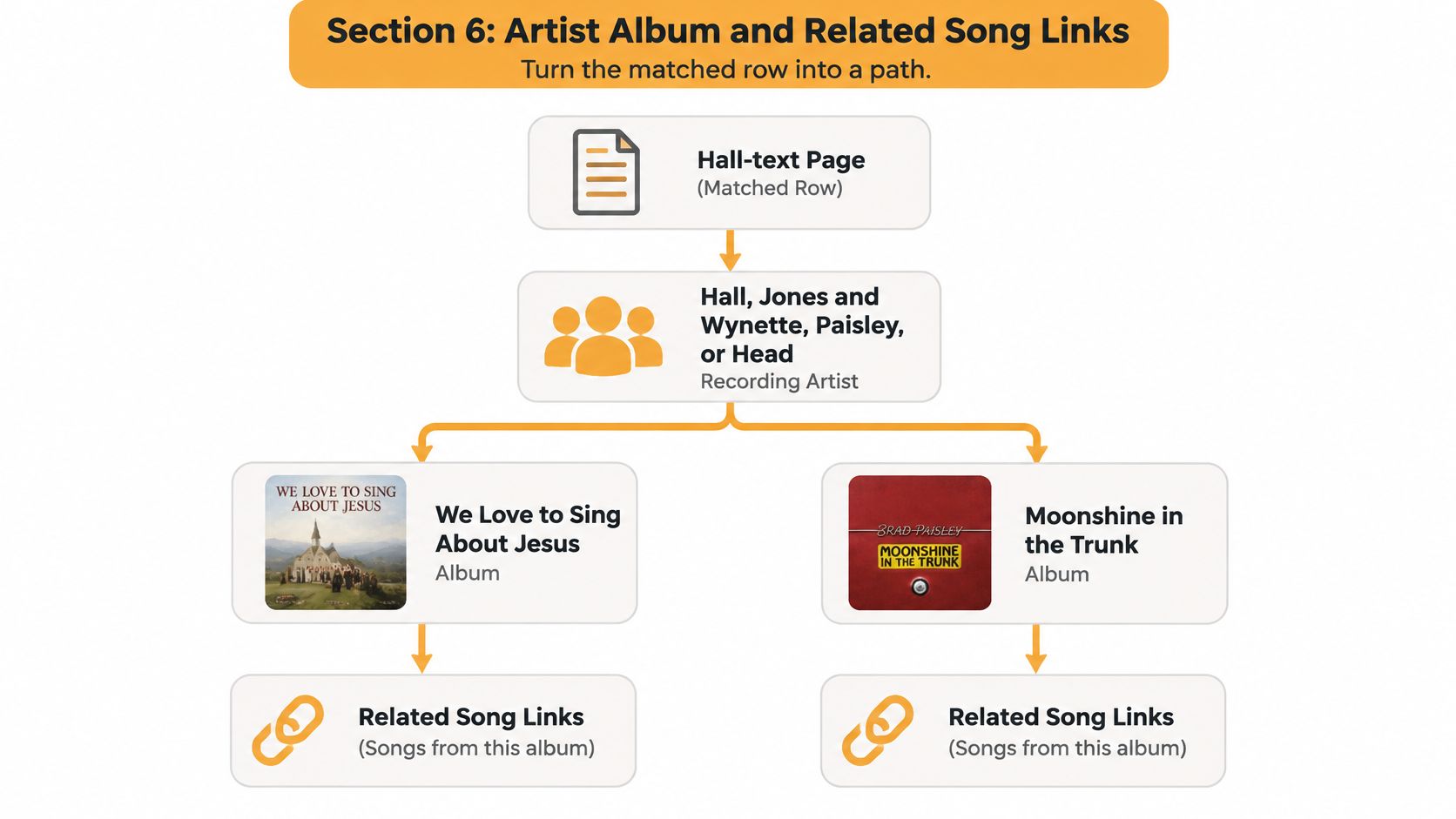
Build the Hall path around the selected singer
A Jones and Wynette performance should lead to those artists and We Love to Sing About Jesus. A Paisley performance should lead to Paisley and Moonshine in the Trunk. A television performance should identify its appearance rather than being assigned an unrelated studio album.
Related-performance labels should name the singer. A reader choosing Hall's original reference shouldn't have to open several identical titles to discover which one is a duet or a later cover.
Useful navigation labels include:
- Recording artist: The performer heard on this page.
- Album or appearance: The release or program associated with that performance.
- Same composition: Other confirmed interpretations, labeled by artist.
- Different works with similar titles: A separate discovery note, not a list of covers.
Keep the Stellar Kart path independent
A Stellar Kart page should connect to the band, We Can't Stand Sitting Down, and the song's later best-of appearance. A compilation is a later catalog home unless the recording evidence identifies a different performance. It isn't automatically a new composition.
Keep Boyd and Crabb outside both confirmed cover trails. Steven Wood, Noël Mio, and Ak fire also need independent work checks before any composition relationship is asserted. They can appear in a clearly marked similar-title note without being presented as Hall or Stellar Kart variants.
For thematic browsing, the Hold Me Jesus lyrics guide belongs on a separate song-discovery path, not inside a list of Me and Jesus covers. That distinction helps fans explore related subjects without confusing the credits.
Musicians planning visuals for an authorized recording might also consider revid.ai's AI Music Video Generator. Carry the exact artist and version information into the project description, and don't substitute generated visuals for an official recording reference.
Press writers and playlist editors need the same precision. Cite the selected performer's recording, not a generic title result. Every approved page should offer these core destinations: artist, album or appearance, and other confirmed versions of that same composition only.
Open the Matching Lyric Page Next
Choose the recording before choosing the text. You don't need to become a discographer, but you do need enough information to distinguish a familiar title from the performance you heard.
Use these listening cues to make the next click deliberate:
- A country testimony story: Choose the Hall, Jones and Wynette, or Paisley entry that matches the performer and release you recognize. Don't select a modern singer solely because that result appears first.
- A performance remembered from The Voice: Look for Sundance Head and the specific appearance. A studio cover and a televised performance shouldn't be treated as interchangeable without checking.
- A Christian-rock band or Dove Award connection: Choose Stellar Kart. The writer credits should match that band's song, not Hall's composition.
- A newer release or the title Me & My Jesus: Treat it as an independent identification task. A release date or near-matching title doesn't establish that it's a cover.
- Uncertainty between entries: Match artist first, then album or appearance, then the selected recording's duration. Leave unresolved songwriter credits unresolved until you can verify them.
Read the words and credits together
On the matched page, check the approved text, attribution line, and official video together. If the voice doesn't match your memory, return to the artist identification rather than trying to make the displayed lyric fit.
If you're a rights holder and your recording needs attention, claiming an artist page is free, and claiming a song page is free. A claimed artist can manage albums, songs, official video embeds, lyrics, chords, and their public profile through the editor, with submitted material reviewed before it appears publicly.
Prepare the exact recording identity before submitting: performer, work title, songwriter, album or appearance, version label, and the authorized text. Include known label and producer credits without using one as a substitute for the other.
That preparation gives readers a page they can recognize and cite. It also keeps your performance from being confused with another artist's work because both recordings share a title.
House of Lyrics pairs artist-approved lyrics with official video embeds so you can read the words alongside the recording they belong to. Visit House of Lyrics to find the matching artist and song, or claim your page and submit the text and credits for your own Me and Jesus recording.