Goodnight My Love Lyrics: Which Version and Who Wrote It
Find the right Goodnight My Love lyrics: compare versions, check verified credits, and watch the official video. Jesse Belvin's 1956 original explained.
Could you recognize the right “Goodnight My Love” lyrics from the title alone? Not reliably. Before you compare a verse or sing along, you need to know which artist, composition, and recording you're hearing.
The useful distinction is simple: a song title isn't a song's complete identity. Start with the performer and release details, then check the writers and version. You'll avoid mistaking a cover for a different composition, or treating an omitted verse as a transcription error.
Table of Contents
- Which Goodnight My Love Song You Mean
- Verify the Version Before Trusting the Lyrics
- Jesse Belvin's 1956 Original and Its Legacy
- Who Wrote and Recorded It
- Why Lyrics Differ Between Pages and Versions
- Quick Answers to the Questions Readers Ask Most
- Moving From a Song to Its Artist and Album Pages
- Claim a Song Page If You Hold the Rights
Which Goodnight My Love Song You Mean
The title “Goodnight My Love” points to several different works and recordings. The table separates the Jesse Belvin composition from other same-title entries, so you can identify the right version before comparing lyrics.
Goodnight My Love versions and what separates them
| Version | Artist | Year | Key Detail |
|---|---|---|---|
| Original song | Jesse Belvin | 1956 | Modern Records release associated with the Motola and Marascalco composition |
| Later composition | The Happenings | 1960s | Written by Sandy Linzer and Denny Randell |
| Cover of the later composition | The Duprees | Recording year unconfirmed | Associated with the Happenings song; reportedly omits its final verse |
| Swing-era recording | Benny Goodman and Ella Fitzgerald | Not confirmed | Separate work from the Belvin song |
| Recording | Rudy Vallée | Not confirmed | Separate recording that needs its own identity check |
| Pleasant Dreams version | Paul Anka | Not confirmed | Listed as “Goodnight My Love (Pleasant Dreams)” |
| Orchestral release | The Melachrino Strings and Orchestra | Not confirmed | Same-title catalog entry; don't assume it supplies a vocal lyric text |
| Recording | Ruth Etting | Not confirmed | Separate catalog entry under the title |
A cover interprets an existing composition; another song with the same title is a separate work. That distinction determines which lyrics belong with a recording. Covers of the Belvin song should also carry their own version labels, since a recording may not reproduce every word identically.
For entries with unconfirmed dates, compare the release details and writer credits rather than relying on the title alone. The same approach helps with other lyric searches, such as this guide to “Cats and Dogs” lyrics.
Practical rule: Match the artist and release first, confirm the writer, then compare the words.
Verify the Version Before Trusting the Lyrics
Treat a lyrics page like a catalog record: its details should agree with each other. The performer shown above the text, the release information, and the accompanying audio or video should identify the same recording.
A concrete reminder appears in Apple Music's Goodnight My Love listing, which identifies a release associated with The Melachrino Strings and Orchestra. Finding the title in a major catalog doesn't establish that you've found the vocal performance you meant.
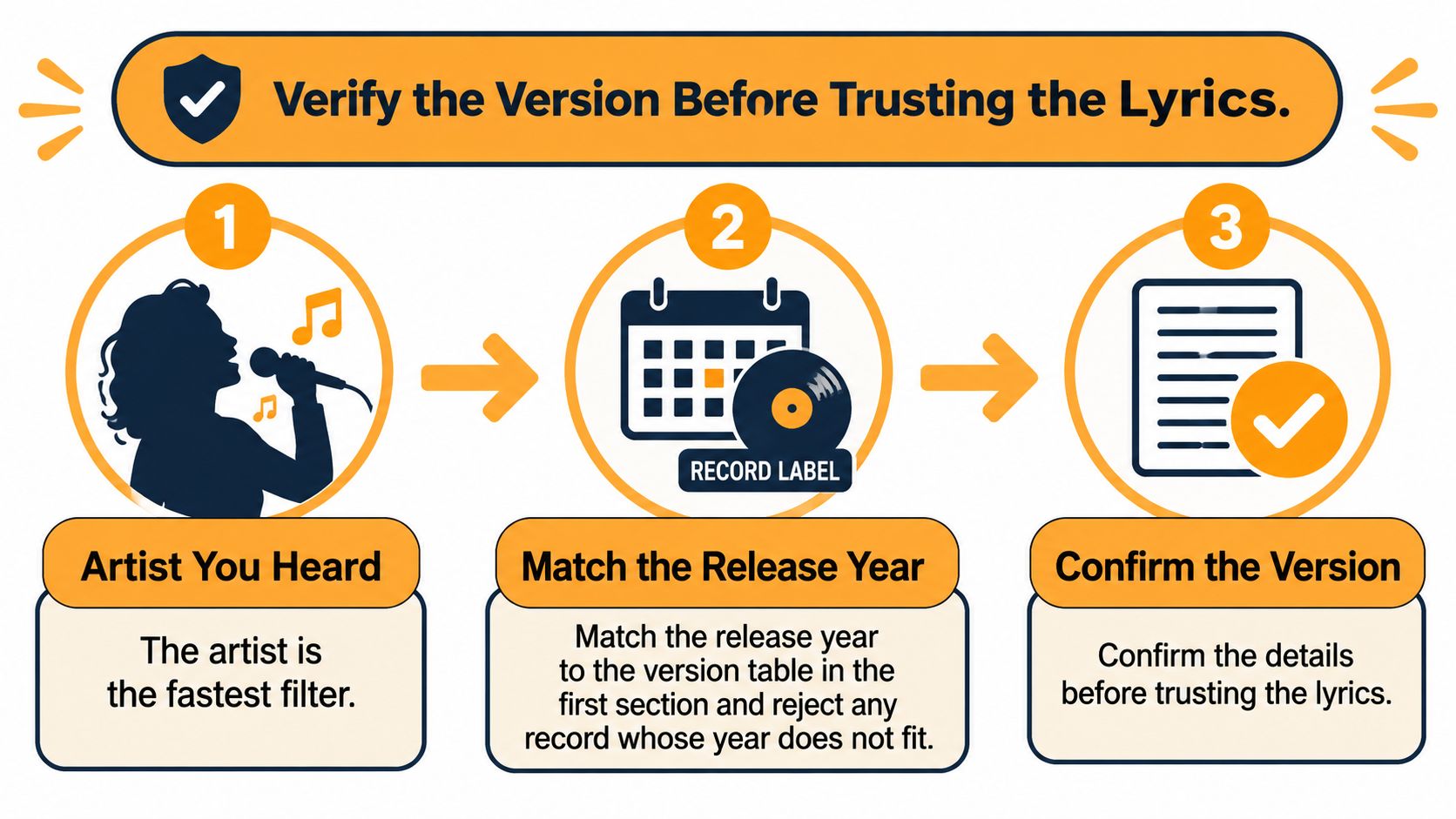
Use this visual as a quick orientation before checking the fuller record.
Check the recording's identity
Write down the artist you heard. Use the performer shown on the release or an authoritative artist upload. A playlist name or uploader's username isn't necessarily the performer's name.
Match the release year carefully. Distinguish the recording's original release from a later compilation or reissue. Reject an unexplained date mismatch, but don't discard a valid recording merely because a catalog displays its reissue date.
Confirm the credited writers. Check the composition credits rather than assuming the singer wrote the song. If accounts describe an uncredited contribution, keep that account separate from the formal writer field.
Identify the album and version type. Original studio recordings, covers, live performances, medleys, and translations need distinct labels. Say you heard a concert performance: a studio lyric page may not document the singer's changed introduction or repeated ending.
Look for a work identifier where available. An ISWC identifies the musical work, not the particular recorded performance. It can help distinguish similarly titled compositions, but you still need the artist and version to identify the recording.
Check the accompanying video. Confirm the artist, release context, and performance. Don't treat a video as authoritative solely because it appears beside a convincing lyric transcription.
Pause when details conflict. If the text can't be linked unambiguously to an artist-version pair, treat it as unverified. For an editor, that means holding publication until the conflict is resolved.
Recognize an incomplete page
Warning signs include missing writer credits, no version label, unattributed text, and a video featuring another artist. None proves that every word is wrong, but each removes evidence you need to trust the match.
The same listening discipline is useful with a remembered fragment, such as the phrase discussed in our And I Wonder guide. Keep the identity record compact enough to compare at a glance:
Artist · Writer · Release year · Album or release · Version type · Work identifier, when available
Jesse Belvin's 1956 Original and Its Legacy
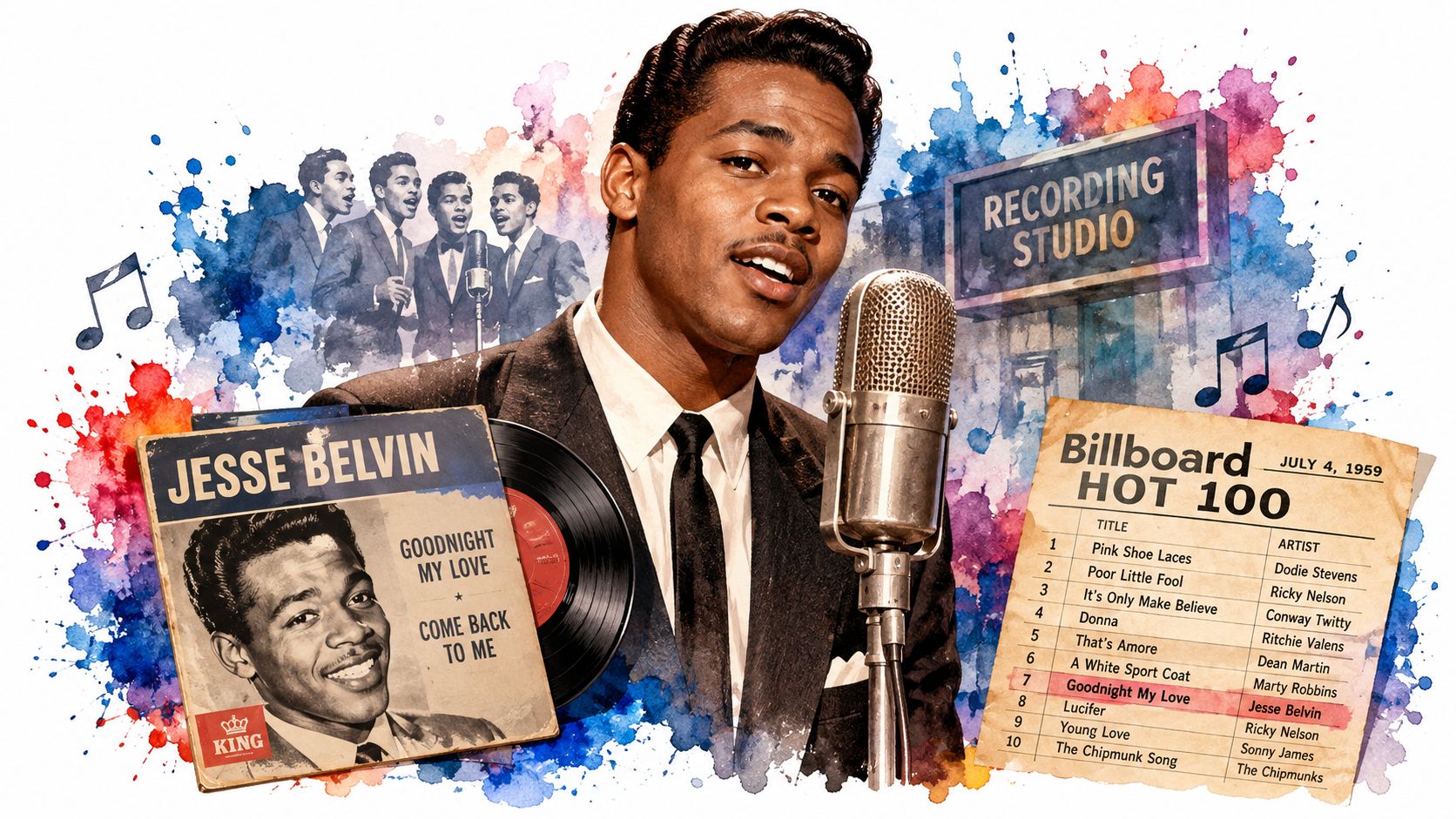
Which recording gives “Goodnight My Love” its place in early rock-and-roll history? Jesse Belvin's 1956 release on Modern Records is a key reference point. The Wikipedia account of the song) reports that it reached No. 7 on the U.S. Billboard R&B chart.
The recording also became the closing theme for Alan Freed's rock-and-roll radio programs. Repeated at the end of broadcasts, it became associated with the moment a show signed off, giving its legacy a radio connection beyond its chart position.
Keep the history and credits distinct
George Motola and John Marascalco are the credited songwriters. Belvin reportedly contributed material to the bridge, but that account does not change the formal writing credits.
The session story calls for similar care. Some accounts attribute the piano performance to a young Barry White, while others differ. Treat that as a qualified historical account, not a settled personnel credit.
Listen to the embedded recording as a reference, and check its upload attribution and release information independently.
For a clear record, separate the composition, the recording, credited writers, and session details. They answer different questions: who wrote the song, who performed this version, and who may have played on the session. Keeping those fields distinct makes it easier to compare Belvin's recording with other works and versions titled “Goodnight My Love.”
Who Wrote and Recorded It
Credit fields a verified lyrics page should show
| Credit Field | What It Covers | Belvin Example |
|---|---|---|
| Composition | The music and lyrics as a musical work | Credited to George Motola and John Marascalco |
| Co-writing claim | Contributions not formally credited | Belvin reportedly contributed to the bridge |
| Sound recording | The recorded performance and its owner | Modern Records release; confirm current owner |
| Performer | The artist on the recording | Jesse Belvin |
| Session personnel | Musicians on the recording | Barry White attributed as pianist; accounts differ |
| Lyric display authorization | Permission to show the lyric text | Confirm with the relevant rights holder |
The distinction behind this table is legal as well as editorial. The U.S. Copyright Office's guidance on musical compositions and sound recordings explains that a musical composition includes music and lyrics, while a sound recording is the recorded performance; these are distinct works that may have different owners.
Owning or controlling a recording therefore doesn't, by itself, establish authority to authorize a lyric display. A release label identifies useful recording history, but it doesn't settle present ownership of the underlying words.
What a credible rights record contains
A claimant should supply documents connecting their authority to the relevant work and intended use. Writer or publisher documentation may support composition rights; recording ownership documentation addresses a different part of the record.
Editors should check that every credited lyricist or co-writer is represented accurately. They should also preserve the submitted text, its version date, claimant identity, approval decision, and subsequent corrections. That record lets an editor explain why a change was accepted instead of relying on an undocumented recollection.
- Composition evidence: Connect the credited writers and relevant rights holder to the musical work.
- Recording evidence: Identify the performance and the party controlling that recording.
- Display authority: Establish permission for the lyric text rather than inferring it from either of the other fields.
At House of Lyrics, we only host lyrics submitted by the artist or rights holder. Submitted lyrics are reviewed by the song owner or our editors before they appear on a page.
Readers browsing another title, such as our All My Tears lyrics guide, should expect the same distinction between who performs a song and who wrote it. Those roles can overlap, but a reliable page never assumes they do.
Why Lyrics Differ Between Pages and Versions
What looks like a missing line may reflect a different performance, a shortened arrangement, or an entirely separate song. The Duprees' cover of the later Happenings-associated composition is reported to omit its final verse. A transcription of that recording should reflect what is sung, rather than insert words from another version.
Common lyric mismatches, causes and checks
| Mismatch | Likely Cause | How to Check |
|---|---|---|
| Missing final verse | A shortened cover, such as the Duprees' version | Compare the recording credits and version label |
| Different bridge | An alternate treatment or rewritten cover | Check the cover label, then listen to that passage |
| Different song entirely | Two compositions share a title | Compare the writer, release period, and artist |
| Extra or changed lines | A live performance or medley | Check the version type |
| Lyrics in another language | A translation | Confirm the translation label and original credit |
Diagnose before correcting
These are possible explanations, not automatic verdicts. A missing verse could also mean the transcription is incomplete. A different bridge deserves a close listen: an arrangement may change how a passage sounds without changing its words.
Start with the exact recording. Then check whether the page identifies that performance or names only the song. A correction should match the recording the page claims to document, not another version you happen to know.
Song, artist, and album relationships help keep different recordings and compositions distinct. Alternate text should be labeled rather than combined into a single set of lyrics.
If you remember only part of a line, this guide to finding song lyrics can help you identify a candidate. Listen to that recording before deciding whether a lyric page needs correction.
Quick Answers to the Questions Readers Ask Most
Which version is this?
Check the performer attached to the recording. Match that name to the release information, not just the search-result title. If you're listening through a compilation, open its track credits so you don't mistake the compilation artist or release date for the original performance's identity.
Who wrote it?
For the Belvin-associated song, George Motola and John Marascalco are the formal writer credits. The decisive check is the composition's credited writers, not the artist name displayed most prominently on the cover. Keep any account of an uncredited contribution in an explanatory note rather than substituting it for those credits.
Is the Happenings song the same as Belvin's?
No, they're separate compositions. Check the writer names: the Happenings-associated work is credited to Sandy Linzer and Denny Randell. Shared titles don't make the songs covers of each other, and similarity in mood or subject doesn't establish a shared composition either.
Why do different pages show different verses?
Check the version label and listen to the disputed passage. A shortened cover, a live performance, a medley, a translation, or a different composition can explain the difference. If the page claims to document the exact recording you're hearing but leaves out sung words, you may have found an incomplete transcription.
What if I still can't identify it?
Use a neutral description instead of forcing a match: performer unconfirmed, release unconfirmed, or version unconfirmed. Save the recording reference and inspect its credits before relying on any lyric text. It's more useful to preserve an honest gap than to attach a confident but incorrect artist name.
Moving From a Song to Its Artist and Album Pages
Follow the catalog outward from the song, through the album or release, to the artist. Each level answers a different question, and moving between them lets you test whether the details agree.
The song record should identify the performance through its credits, version label, and reference media. The release record supplies context, including track order and release information. The artist record helps you distinguish that performer's catalog from recordings by similarly named artists or other interpreters.
Apply the path to a Belvin search
Start with a result attributed to Belvin, then inspect the release it names. If it points to a compilation, distinguish that compilation's details from the original release information. Open the artist record only after confirming that the track attribution matches the singer you intended.
- At the song level: Check the performer and version before reading the text.
- At the release level: Look for consistent track credits and an explained release context.
- At the artist level: Explore related recordings without treating them as interchangeable lyric sources.
If credits or version information are absent, keep the text marked unverified. Do not fill the gaps from another artist's page just because the titles match.
That care also helps when a lyric inspires something beyond listening. For ideas about presenting a song reference in a social post, Instagram caption inspiration from Gainsty offers a relevant creative resource. Identify and attribute the correct song first, and remember that caption inspiration doesn't itself establish permission to reproduce copyrighted lyrics.
Claim a Song Page If You Hold the Rights
A page claim should connect editorial control to verifiable authority. This illustration highlights the documentation involved; it isn't an example of an accepted ownership document.
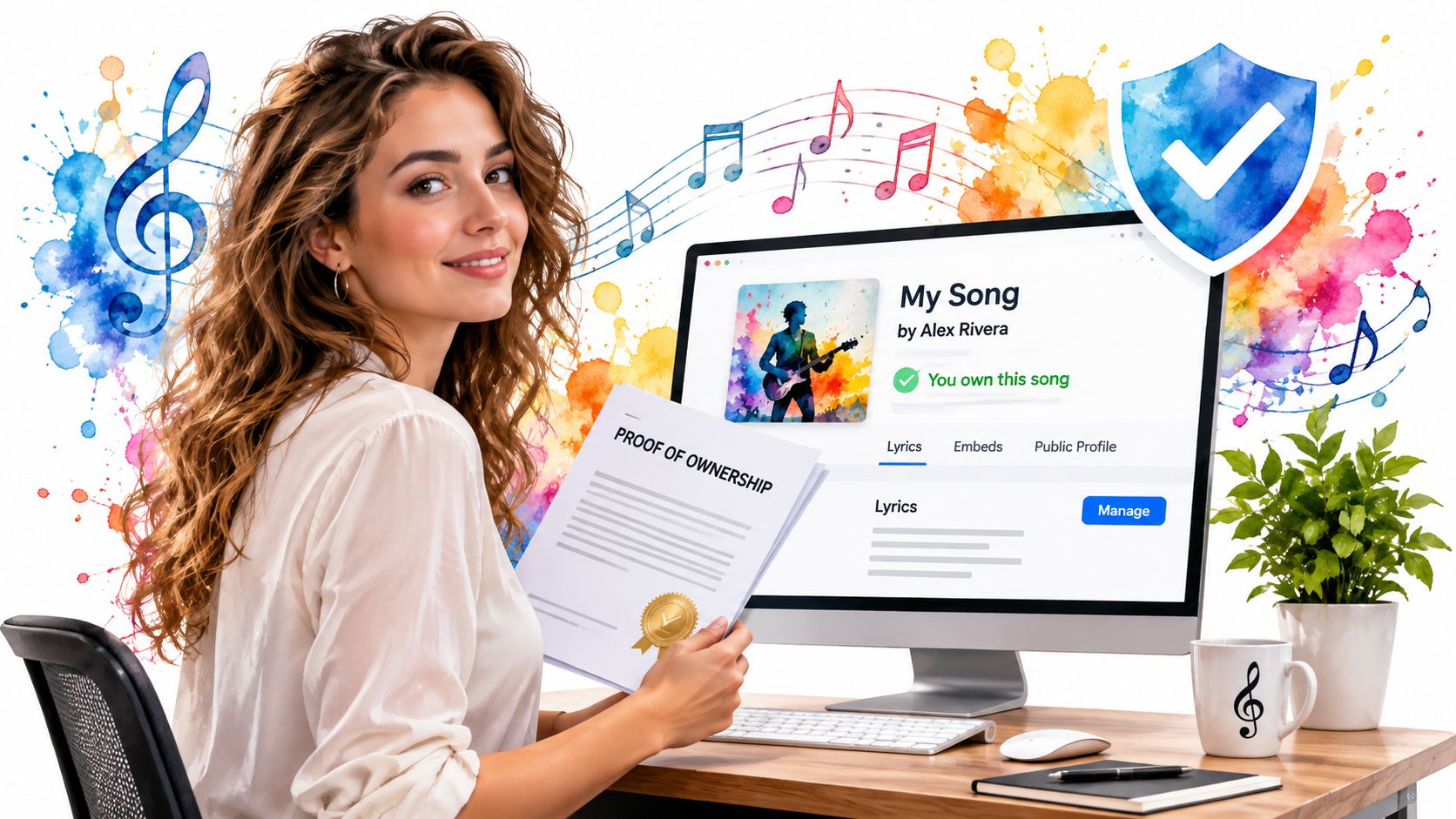
Confirm your authority. Gather writer or publisher documents and relevant recording documentation. A matching official video helps identify the performance but doesn't replace evidence of lyric rights.
Complete verification. Use our song-page claim process and follow its ownership-verification instructions. Claiming is free.
Submit the approved text and credits. Identify the exact version. The song owner or our editors review submissions before publication.
Manage the confirmed page. Once claimed, the rights holder can add artist-approved lyrics, chords or tabs, and media embeds, and manage the public profile. Edit control remains with the owner, with changes reviewed before they go live.
Resolve uncertain ownership first
If competing claims or unclear documentation need legal attention, LA Law Group, APLC's overview of copyright and patent protection in LA provides context for seeking advice. Patent protection and lyric copyright are different subjects; a lyric dispute needs advice relevant to copyright.
Fans should verify the artist and credits before trusting the words. Rights holders should claim the relevant page and submit version-specific, approved text.
Visit House of Lyrics to explore artist- and rights-holder-submitted lyrics alongside official video embeds. When you search for “Goodnight My Love” lyrics, match the artist and version before reading, and if you hold the rights, help document the recording with accurate credits and approved words.