Boogie with Stu Lyrics: Full Song, Credits, and Origins
Find the full Boogie with Stu lyrics, songwriting credits, album context, and the story behind Led Zeppelin's studio jam featuring Ian Stewart.

A loose piano figure, a borrowed rock-and-roll refrain, and a title aimed at a Rolling Stones insider turned a discarded Led Zeppelin jam into one of Physical Graffiti's most revealing tracks. The “Boogie with Stu” lyrics are short, playful, and easy to misread if the credits and provenance are left out.
Table of Contents
- How Boogie with Stu Came Together in 1971
- Complete Lyrics to Boogie with Stu
- Song Structure and Arrangement Explained
- Who Is Stu and Why Ian Stewart Is in the Credits
- The Richie Valens Connection and the Borrowed Refrain
- Official Songwriting and Performance Credits
- Album Context and the Physical Graffiti Release
- Interpreting the Lyrics Without Overreading Them
- Verification and Attribution for Rights Holders
- Quick Reference Card for Boogie with Stu
How Boogie with Stu Came Together in 1971
At Headley Grange in 1971, Led Zeppelin's mobile recording setup captured more than carefully arranged album material. The country-house sessions also preserved loose performances that might otherwise have stayed in the tape archive. “Boogie with Stu” came from that informal side of the work, built around a piano-led boogie instead of a fully developed composition.
Ian Stewart, the Rolling Stones' road manager and pianist, was present during the session. His playing helped define the track's character, and his name supplied its title. The recording came from sessions associated with Led Zeppelin IV, although the band held it back rather than placing it on that album. It remained unreleased until February 24, 1975, when Physical Graffiti brought it into Zeppelin's official catalog.
A studio accident with a recognizable guest
The performance sounds relaxed because the musicians approached it as a social, collaborative piece. Stewart's piano provides the center of gravity, while the band settles around it with a compact arrangement. The groove wobbles and breathes, giving the recording the feel of an after-hours room performance rather than a carefully staged statement.
That atmosphere distinguishes the track from the solemn scale of “Stairway to Heaven” and the heavy architecture of “Black Dog.” The song's value lies in its directness. Its vocal lines, piano figures, and repeated boogie cues work together as evidence of musicians responding in the room, not as parts of an elaborate narrative.
A jam with this shape could remain outside the main album sequence because its purpose was not immediately obvious. When Jimmy Page and Peter Grant later revisited older recordings for Physical Graffiti, the performance offered a different kind of material. Its warmth and humor broadened an album already known for moving across contrasting styles.
Why the release gap matters
Listeners encountered “Boogie with Stu” in 1975, not as a new release from the Led Zeppelin IV period, but as part of a double album that drew on earlier sessions. That placement made the recording both a private-sounding document and a fixed part of Zeppelin's public history.
Listening clue: Hear the track first as a record of collaboration, then as a conventional composition. Its relaxed delivery is part of the provenance.
The release gap also gives the credits unusual weight. By the time the song reached listeners, its title, Stewart's contribution, and the borrowed Richie Valens refrain were presented within a finished album package. The result is a short, playful performance whose lyrics page needs more than transcription alone. Credits and borrowing explain what the words and arrangement are doing.
Complete Lyrics to Boogie with Stu
A trustworthy lyrics reference begins with provenance. The verified record identifies the recurring refrain with Richie Valens' “Ooh My Head” and connects the title to Ian Stewart. The words therefore belong to more than a Zeppelin vocal moment. They point toward an earlier rock-and-roll source while also acknowledging a musician who played on the recording and appears in its credits.
The text is brief and repetitive, matching the performance's loose boogie. Its phrases work as cues within the groove rather than as steps in a developing story. The invitation to have a good time returns to the same social idea, while the “Ooh my head” refrain provides the clearest connection to Valens.
The complete copyrighted lyrics cannot be reproduced here. Readers seeking a reliable transcription should consult an authorized lyrics source or the official Physical Graffiti booklet, then compare that wording with the song's credited provenance. An unverified lyrics page may capture the sounds without clarifying their source.
Reference points in the vocal arrangement
The vocal sections serve distinct recurring functions:
- Opening verse: The singer introduces the playful situation in direct, conversational language.
- Refrain: The repeated “Ooh my head” phrase links the track to Richie Valens' “Ooh My Head.”
- Boogie hook: The invitation to boogie with Stu and the listener turns the title into a participatory chant.
- Closing repetitions: The performance continues through repetition instead of reaching a narrative conclusion.
That pattern explains why isolated lyric fragments can seem more mysterious on the page than they sound in the room. Plant delivers the words as rhythmic material, while the band supplies much of the expression through its groove. The returning refrain makes the performance communal rather than confessional.
What a trustworthy lyrics page should identify
A useful reference should identify the song as a 1971 recording released in 1975, name Ian Stewart, and flag the Richie Valens connection. It should separate the text being performed, the people credited as writers, and the earlier song that supplied the borrowed refrain.
That separation shapes the song's documented identity. Commentary on “Boogie with Stu” often blurs lyric source and credited authorship. A plain text transcription can reproduce the words while leaving unresolved the more useful questions: which lines are inherited, who receives writing credit, and why Mrs. Valens appears in the songwriting information? These details make the lyrics page a reference to check, not merely a block of text.
Song Structure and Arrangement Explained
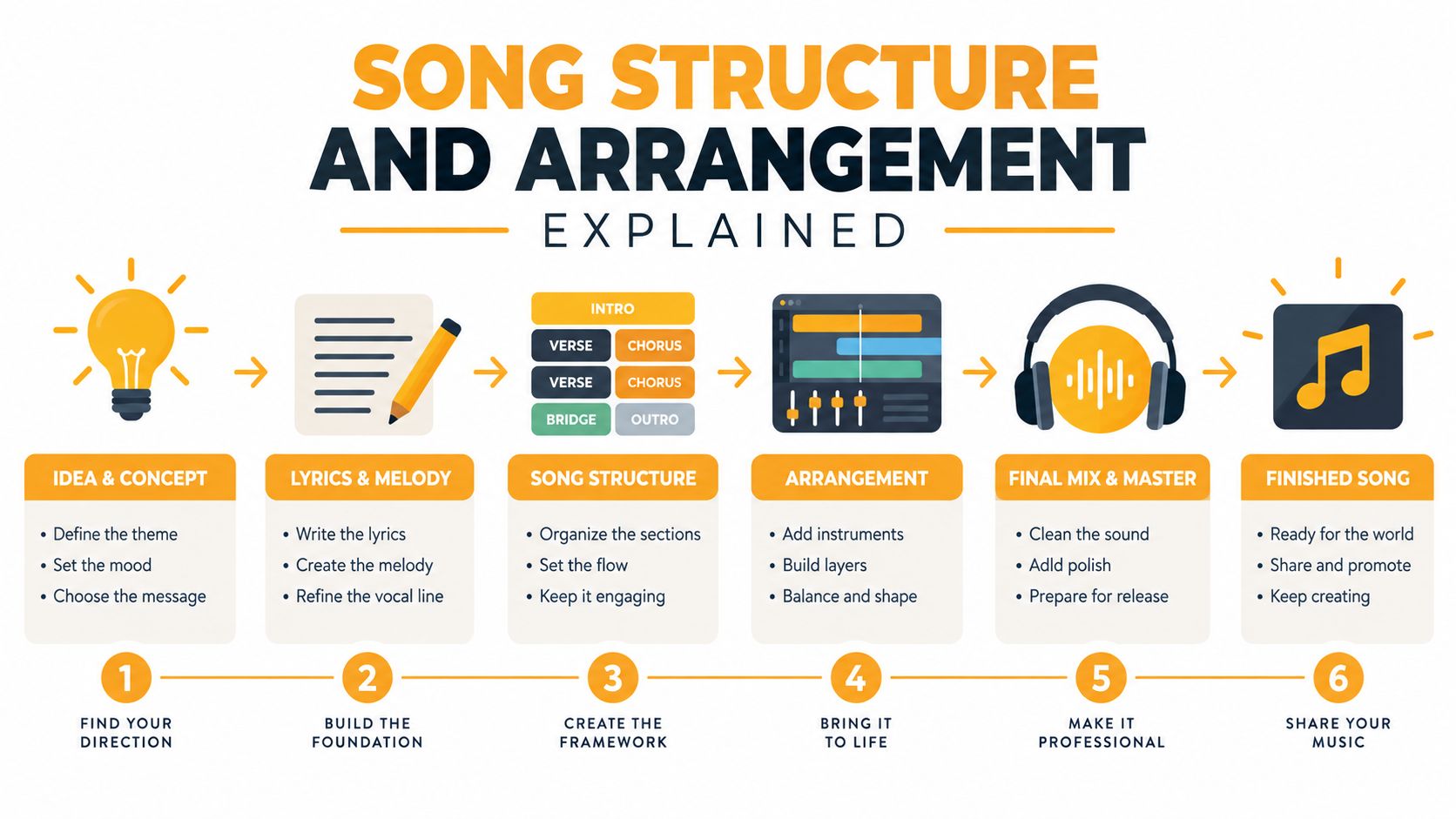
“Boogie with Stu” announces itself through texture. The mandolin-led opening gives the track a bright, wood-grained sound, far removed from the electric attack many listeners associate with Led Zeppelin. John Paul Jones' mandolin carries the lead character, while Ian Stewart's piano sits inside the groove and keeps the performance grounded.
The song's shape is compact and blues-based. The verses sit over a 12-bar blues framework, and the refrain works through call and response rather than through a large melodic development. Plant's vocal lines invite an answer, and the band responds with the kind of rhythmic certainty that makes a loose performance feel finished.
Why the instrumentation changes the mood
The arrangement's unusual balance is the point. Page's stringed textures and Jones' mandolin avoid the weight of a standard Zeppelin riff, while Stewart's piano gives the track a barroom pulse. John Bonham doesn't overpower the performance. His drumming supports the shuffle and helps the ending feel like a natural release from the jam.
For a practical primer on how sections such as introductions, verses, refrains, and endings work together, this guide to song structure provides useful general context.
The studio version also explains the song's limited role in Zeppelin's live habits. Its appeal depends on a particular combination of guest piano, mandolin color, vocal spontaneity, and a compact groove. Recreating that exact balance on a large concert stage would have offered less flexibility than the band's heavier, more expandable material.
A brief Bonham shuffle closes the track, preserving the sense that the musicians are finishing a room performance rather than unveiling a monumental finale. The arrangement doesn't ask the listener to chase virtuosity. It asks the listener to settle into the groove.
Who Is Stu and Why Ian Stewart Is in the Credits
“Stu” is Ian Stewart, the Rolling Stones' pianist and road manager. His connection to the track isn't a hidden nickname discovered by later fans. The title directly identifies the musician whose piano presence helped define the performance, and the credit line extends beyond the four members of Led Zeppelin.
Stewart occupied an unusual place in British rock. He was closely associated with the Rolling Stones while also functioning as a trusted musician and road figure. His piano style favored direct rhythm and blues feeling over display, which made him a natural fit for a loose boogie built in a communal studio setting.
More than a guest appearance
The important distinction is between playing on a track and being named in its authorship. Stewart isn't presented merely as an anonymous session contributor. The song is credited to all four Led Zeppelin members, Stewart, and Mrs. Valens, giving the title's personal reference a formal counterpart in the album credits.
That decision makes sense musically. The piano isn't decorative. It helps establish the track's identity, and the performance's relaxed character depends on the interaction between Stewart's keyboard part and the band's response. The credit therefore reads as recognition of participation in the song's creation, not just a courtesy attached to a cameo.
For readers tracing Stewart's wider place in rock history, the Rolling Stones artist archive offers a useful cataloging reference.
Why the title carries weight
The title turns a personal nickname into a musical instruction. “Boogie with Stu” sounds like an invitation to join the room, not a grand piece of mythology. It tells the listener who the gathering revolves around and preserves the track's informal spirit.
That informality can obscure the seriousness of the credit. The performance may be playful, but provenance still matters. Stewart's name explains the piano, the atmosphere, and the song's place outside Zeppelin's standard four-person authorship pattern.
The Richie Valens Connection and the Borrowed Refrain
The song's provenance turns on its refrain. “Boogie with Stu” uses a recurring phrase associated with Richie Valens' “Ooh My Head,” a rock-and-roll performance whose vocal idea was placed over Led Zeppelin's boogie groove.
The connection concerns a borrowed refrain, not a claim that Led Zeppelin reproduced the earlier song in full. Plant and the band set the recognizable cry inside a different performance, shaped by mandolin, piano, shuffle rhythm, and the group's studio interplay. The lyrics therefore work as a reference point for tracing borrowed material, rather than as evidence of a complete remake.
Why Mrs. Valens appears in the credits
Mrs. Ritchie Valens appears in the credited writing information because the Valens estate is tied to the source composition. Her name records an authorship connection outside Led Zeppelin and explains why the refrain matters to the official credit.
That distinction answers a question many lyric pages leave open. The phrase can sound like a spontaneous exclamation, yet its provenance affects who receives recognition. Ian Stewart's connection belongs to the performance and title, while the Valens connection belongs to the borrowed vocal material.
The available account of the song's origins also separates the lyric source from the credited writers. The distinction can be stated plainly:
- Who performs the refrain in this recording? Robert Plant, within Led Zeppelin's arrangement.
- Where does the recognizable refrain come from? Richie Valens' “Ooh My Head.”
- Why is a Valens-related name in the credit? The song acknowledges the source's authorship and estate connection.
This is credited borrowing with a traceable source. It belongs to a different category from the broader history of disputed blues adaptations, because the documentation identifies the Valens connection instead of leaving the borrowed refrain unacknowledged.
Official Songwriting and Performance Credits
The safest way to read the credits is to separate contributors, creative roles, and performance roles. “Boogie with Stu” is credited to Jimmy Page, Robert Plant, John Paul Jones, John Bonham, Ian Stewart, and Mrs. Ritchie Valens, with the Valens name representing the source connection discussed above.
The available verified information doesn't support a detailed publisher split, engineering credit list, or precise instrument-by-instrument credit sheet for this song. Those details shouldn't be filled in from assumption, even when they appear in fan-made databases or copied catalog pages.
| Contributor | Role | Credit Type |
|---|---|---|
| Jimmy Page | Led Zeppelin member and musical contributor | Songwriting credit |
| Robert Plant | Led Zeppelin member and vocalist | Songwriting credit and lead vocal |
| John Paul Jones | Led Zeppelin member and instrumental contributor | Songwriting credit |
| John Bonham | Led Zeppelin member and drummer | Songwriting credit and drums |
| Ian Stewart | Rolling Stones pianist and title subject | Songwriting credit and piano contribution |
| Mrs. Ritchie Valens | Connection to the borrowed Valens material | Credited source-related authorship |
How to read the unusual credit line
The first four names establish the expected Led Zeppelin core. Stewart's inclusion identifies the guest musician whose piano helps define the track, while the Valens-related credit identifies the earlier material represented in the refrain.
That arrangement prevents two common errors. One is to treat the song as a standard Zeppelin composition with a random guest appearance. The other is to treat the refrain as an uncredited quotation. Both interpretations erase part of the record's provenance.
Credit-reading rule: A lyric page should never present the words without also identifying the source connection and the people named in the official authorship line.
For final rights work, readers should verify current registration records through the relevant performing-rights organizations and official album documentation. Credit databases can vary in formatting, especially when estates and source compositions are involved.
Album Context and the Physical Graffiti Release
“Boogie with Stu” reached listeners through Physical Graffiti, Led Zeppelin's double album released on February 24, 1975. The track had been recorded earlier at Headley Grange, so its album appearance gave an older performance a new setting. Alongside heavier and more expansive material, the loose piano-led piece provides a brief change of pace.
That variety reflects the album's broad design. Physical Graffiti brought together recordings from different periods, moods, and arrangements, allowing the band to present more than one version of its working identity. “Boogie with Stu” reads as part of that larger catalogue statement, not as a discarded jam added at the last moment.
An outtake with a second life
The recording dates to 1971, while its release came with Physical Graffiti in 1975. That interval matters to how the track is heard. Its informal performance belongs to an earlier creative moment, yet the finished album places it within later sequencing and production decisions. The homespun sound becomes part of the record's deliberate range.
The album context also clarifies why the song's provenance deserves attention. Heard alone, a casual studio performance might seem minor. On a major Led Zeppelin release, however, the piano contribution, title reference, borrowed refrain, and songwriting line all enter the public record together. The credits connect the track to Ian Stewart and to the Richie Valens material, details that a bare lyrics page can easily leave unexplained.
Readers seeking wider band context can consult the Led Zeppelin artist archive. The song's value does not depend on matching Zeppelin's largest recordings. Its place on Physical Graffiti documents how an informal gathering, shaped by borrowed musical history and a guest pianist, became part of the band's official catalogue.
Interpreting the Lyrics Without Overreading Them
The words invite interpretation because they're vivid but incomplete. Phrases involving boogie, having a good time, and the repeated “Ooh my head” refrain suggest pleasure, movement, and rock-and-roll familiarity. They don't provide a conventional plot with a beginning, conflict, and resolution.
One reading treats the lyrics as playful studio language, shaped around the piano figure and the needs of the groove. Legendary Cover's commentary on “Boogie with Stu” describes the track as light and low-pretension, with words that can seem almost meaningless. Under that interpretation, the point isn't hidden autobiography. The point is the sound of musicians enjoying a familiar form.
The case for a richer reading
Another perspective hears more history in the borrowed refrain. A line connected to Richie Valens can function as a nostalgic nod to early rock and roll, a literal vocal phrase, or an improvisational prompt that carries old musical memory into a new setting. That reading doesn't require the song to contain a secret narrative. It recognizes that borrowed language can bring cultural associations with it.
Fans may also hear the title as a direct salute to Stewart. That interpretation has stronger grounding than speculative symbolism because “Stu” refers to Ian Stewart and his contribution is part of the track's documented identity.
The most cautious conclusion is also the most satisfying. The lyrics work as rhythmic, communal, and deliberately loose, while their borrowed phrase gives them a traceable history. You can enjoy the nonsense without denying the provenance, and you can hear the rock-and-roll echo without forcing every line into a coded confession.
For writers interested in balancing natural phrasing with memorable hooks, this guide to writing better lyrics offers broader craft context. It's useful here because the song demonstrates how a small number of repeated words can carry arrangement, personality, and lineage at once.
Verification and Attribution for Rights Holders
A reliable rights reference starts with the release itself, then works outward to the song's source material. The documented identifiers associated with “Boogie with Stu” include the original album release and later catalog information, but not every detailed label or publishing claim supplied in secondary summaries can be confirmed from the verified material available here.
| Field | Value |
|---|---|
| Official title | “Boogie with Stu” |
| Recording origin | Recorded in 1971 during the Led Zeppelin IV sessions |
| Release | Physical Graffiti |
| Release date | February 24, 1975 |
| Songwriting connection | Led Zeppelin members, Ian Stewart, and the Ritchie Valens source-related credit |
| Rights question | Separate the Zeppelin recording from the borrowed Valens material |
What to verify before publication or licensing
Writers, editors, and sync researchers should check the official album booklet, current performing-rights databases, and the relevant rights administrator before publishing a definitive credit line. Search records under the Led Zeppelin contributors, Ian Stewart, and the Valens-related name, then compare the results with the release documentation.
The difference between writing about a song and licensing a song matters. A useful primer on the permissions questions surrounding recorded compositions is Isolate Audio on cover permissions. It can help separate performance rights, composition rights, and permission issues without treating a lyrics page as a substitute for clearance research.
For editorial standards and attribution workflow, this guide to editorial reviews provides relevant background. The central rule remains simple: identify the recording, identify the source material, and avoid presenting uncertain administrative details as settled fact.
Quick Reference Card for Boogie with Stu
| Field | Detail |
|---|---|
| Official title | “Boogie with Stu” |
| Recording year | 1971 |
| Recording context | Led Zeppelin IV sessions |
| Release year | 1975 |
| Parent album | Physical Graffiti |
| Title reference | Ian Stewart, “Stu” |
| Source connection | Richie Valens' “Ooh My Head” |
| Core credited writers | Jimmy Page, Robert Plant, John Paul Jones, John Bonham, Ian Stewart, and Mrs. Ritchie Valens |
| Vocal role | Robert Plant |
| Piano connection | Ian Stewart |
| Album function | Previously unreleased session recording used on the double album |
| Lyrics takeaway | Playful, repetitive boogie language with a borrowed rock-and-roll refrain |
The quickest accurate description is this: a 1971 Led Zeppelin studio jam, shaped by Ian Stewart's piano, released on Physical Graffiti in 1975, and marked by a credited Richie Valens connection. That combination is why the song deserves more than a bare lyrics transcription.
If you want artist-approved lyrics, verified credits, and official video references in one place, visit House of Lyrics. It's a useful destination for checking songs like “Boogie with Stu” without separating the words from the people and sources behind them.