What Is Metadata? a Music Guide for Artists
What is metadata in music? Learn how ID3 tags, ISRC codes and songwriter credits drive discovery, royalties and accurate song pages.
You've just released a song, shared the link everywhere, and a fan messages you with a simple question. Why does one app show a different release year, a misspelled featured artist, and lyrics from an old demo? Nothing is wrong with the audio itself. The facts attached to it don't agree, and those facts are what listeners, platforms, and royalty systems read first.
Table of Contents
- What Metadata Means for Your Songs
- The Music Metadata Fields Every Artist Should Know
- Why Metadata Decides Who Finds You and Who Gets Paid
- Where Metadata Breaks Down and Why Sources Disagree
- How to Publish Accurate Metadata on House of Lyrics
- Audit One Song Page Before Your Next Release
What Metadata Means for Your Songs
A fan searches for your new track on three apps and sees three different stories. One lists the right release year, another shows the year you uploaded the demo, and a third credits only you instead of you and your featured vocalist. The song sounds identical everywhere, so why does it look different everywhere?
The direct answer to what is metadata is this. Metadata is structured information that describes a resource so people and software can find, interpret, organize, exchange, and manage it. It's often summarized as "data about data" in the Library of Congress framework overview, which also traces the idea to MARC, or Machine-Readable Cataloging, developed during the 1960s, with its pilot project completed in 1968.
The Jam Jar Test
Think of a jar of jam in your kitchen. The jam inside is the content. The label on the glass tells you the flavor, who made it, when it was made, and what's inside. You don't need to open the jar to answer those questions, and a shop doesn't need to taste every jar to stock it on the right shelf.
Your song works the same way. The audio recording is the content. Its title, artist, album, release date, genre, songwriter credit, file format, duration, and rights status are the label. A streaming app reads that label to file your track, show it in search, and connect it to your artist page.

That label idea is older than streaming, and older than the web. Librarians learned to encode catalog cards into machine-readable records so libraries could exchange them electronically instead of retyping every description by hand. Music catalogs run on the same principle today. When your distributor sends a release to a platform, software exchanges structured records, and nobody retypes your credits from scratch if the record is built well.
Is this the sound itself, or a fact about the sound? If it's a fact about the sound, you're looking at metadata.
Try it with your latest release. Put the audio file and lyric text in a content column. Put the title spelling, featured artist, album name, release date, writers, and genre in a metadata column. If you've ever organized photos, posts, or files into a searchable library, PostSyncer's digital asset library guide walks through that same sorting logic, and it maps neatly onto a song catalog. Once your two columns are clear, the specific fields in that second column stop feeling abstract. They become a checklist you can complete.
The Music Metadata Fields Every Artist Should Know
Music metadata isn't one flat list. It works in four layers, and each layer answers a different question. The file layer describes what's stored inside the audio file itself. The recording layer identifies one specific performance. The composition layer identifies the underlying song that could be performed again by someone else. The rights layer says who owns what and who should be paid.
The diagram below stacks those layers so you can see where each field belongs.
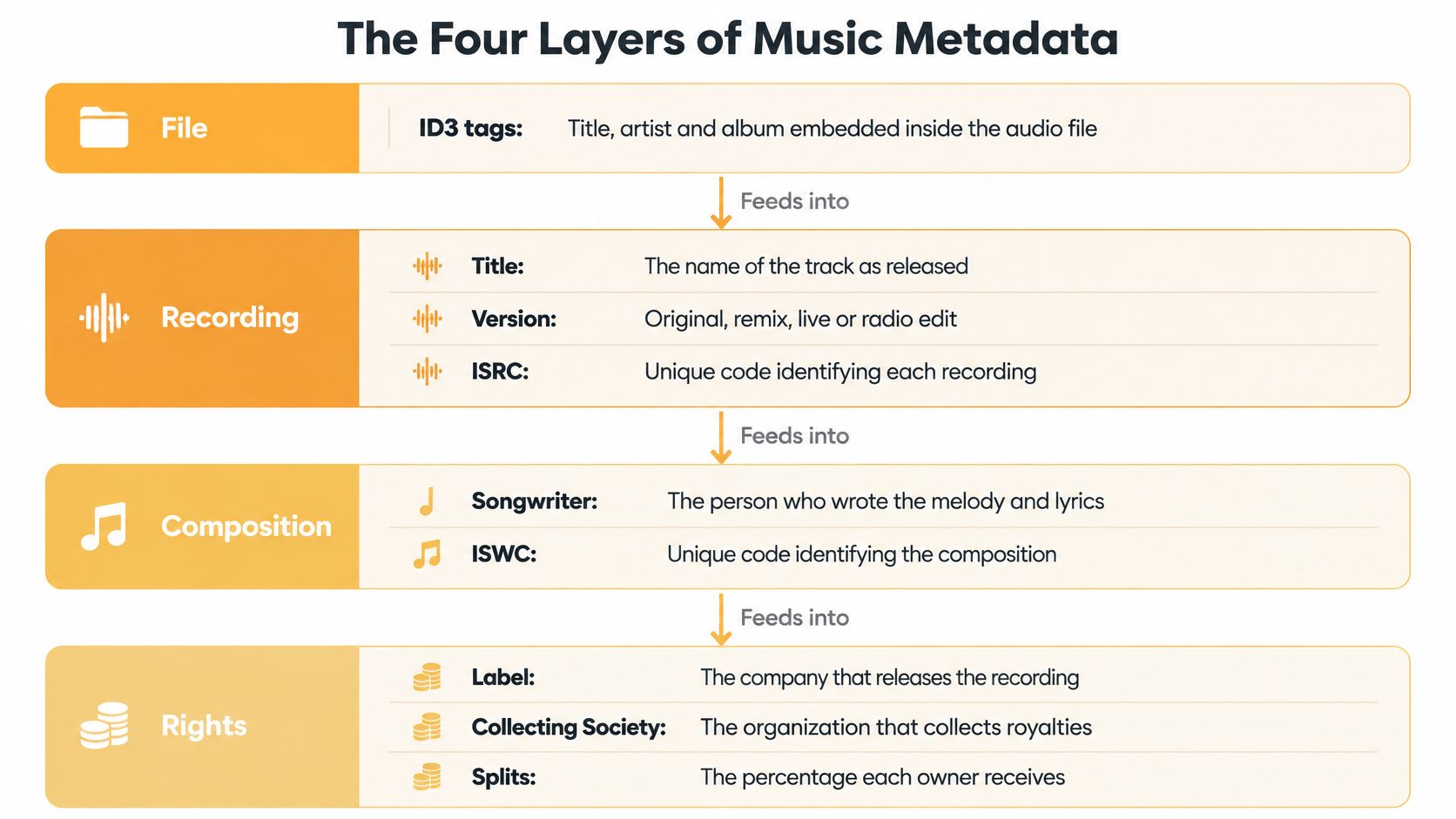
Two codes confuse almost everyone at first, so let's separate them clearly. An ISRC identifies one sound recording. Record a live version or release a remix, and that new recording gets its own ISRC, because it's a different performance captured in a different file. An ISWC identifies the underlying composition, the melody and lyrics themselves, so the studio version, the live version, and a cover can all point back to the same composition. Distributors usually assign the ISRC when they deliver your release. Publishers or collecting societies register the ISWC when they register the work.
Where the Core Fields Live
| Field | What It Identifies | Example | Where It Lives |
|---|---|---|---|
| Title and version | the recording name and edit | Midnight Harbor (Radio Edit) | file tags and distributor form |
| Artist and featured artists | who performed the recording | Jane Doe feat. Sam Roe | ID3 artist tag and DSP artist page |
| ISRC | one code per sound recording | USHBR2500001 | distributor delivery and DSP credits |
| ISWC | one code per musical composition | T-345.678.901-2 | publisher and collecting-society registrations |
| Songwriter and composer credits | who wrote the words and the music | Lyrics: Jane Doe; Music: Jane Doe, Sam Roe | publishing agreement and PRO registration |
| Publisher and split shares | who controls the composition and in what percentage | Harbor Songs; Jane Doe 60%, Sam Roe 40% | publishing agreement and collecting societies |
| Release date and label | when and by whom the release came out | March 14, 2025; Harbor Records | distributor record and DSP release page |
| Genre and language | how the track is categorised and sung | Indie folk; English | distributor form and DSP metadata |
| Duration and file format | length, codec and sample rate | 3:42; WAV, 44.1 kHz | the audio file itself |
| ID3 tags (MP3) | title, artist, album, track number and embedded artwork | TRCK 3/10 | inside the MP3 file |
ID3 tags are the title, artist, album, track number, and artwork stored inside an MP3 file, so the file carries its own label wherever it travels. Other formats hold similar embedded tags, which is why a downloaded file can still display the right cover art offline.
These fields aren't loose notes. They're connected records. A recording links to its artist, album, lyric work, ISRC, release date, and official video, a relationship model reflected in the W3C Resource Description Framework schema, which represents metadata as relationships among resources using named properties and values. That's why consistent spelling and stable identifiers matter so much. If Sam Roe appears as "Sam Roe" in one place and "S. Roe" in another, software can't be sure it's the same person.
If you also post short clips to grow the song, the metadata tips for TikTok discovery from Taja AI cover how titles and descriptions help platforms surface video, which pairs well with the broader release strategies in this guide to promoting your music.
The short video below walks through these identifiers in action.
Now scan your own catalog with fresh eyes. Which fields are blank? Which ones don't match between your distributor form and your streaming pages? Which details exist in only one place, like a split sheet in a drawer? Those gaps are your starting point.
Why Metadata Decides Who Finds You and Who Gets Paid
Say you co-wrote a song with a friend, split the writing evenly, and celebrated the release together. Months later, your royalty statement arrives and hers never does. Her name was left off the credits during delivery. She doesn't appear in the song's recommendation data either, because as far as the systems are concerned, she was never part of the record.
That's not a paperwork glitch. It's metadata acting as a system of accountability and payment.
Discovery Runs on Labels
Search boxes, playlists, lyric search, and recommendation systems read your title, artist name, credits, and genre to decide who sees your song. They're not listening the way a person listens. They're matching fields. A missing or wrong genre tag can keep an indie folk track out of the results where indie folk fans browse. A featured artist spelled two ways can split attention across two profiles instead of building one audience.
Payment Runs on Ownership Fields
Licensing, royalty allocation, and enforcement depend on knowing who wrote, performed, and owns each share. As a Journal of Intellectual Property Law and Practice article explains, music metadata includes identifiers, contributor roles, ownership shares, licenses, territorial information, and usage data, and gaps can leave royalties in "black box" revenues that are difficult to allocate. When nobody can match a use to a documented owner, the money doesn't wait politely. It pools, gets redistributed by other rules, or never reaches the poorly documented rights holder at all. If you license music into other media, the music compliance for branded shows guidance from Podmuse shows how clearly documented rights make those placements easier to clear.
Trust Runs on One Accurate Page
Press writers, sync supervisors, and potential collaborators check your public record before they email you. One clean page per song, with correct credits, dates, and lyrics, tells them you're organized and easy to license. A messy record raises questions they'd rather not spend time asking. For independent artists, this matters even more, because there's usually no publisher or manager catching errors behind the scenes. If you don't check it, nobody does. A structured approach to managing your music rights turns that checking into a habit instead of a rescue mission.
Ask yourself: For your current release, which stake is biggest right now, being found, being paid correctly, or being trusted by the people who check your credits first?
Where Metadata Breaks Down and Why Sources Disagree
Here's the part most explanations skip. The usual problem isn't an empty field. It's conflicting records held by legitimate parties. Your label, publisher, collecting society, distributor, and you can each hold a slightly different version of the same song, and each party may believe its version is the correct one.
That's not a rare edge case. The Association for Electronic Music industry research published in 2026 found that 11 of 22 surveyed music-technology companies identified conflicting metadata across databases as their largest structural challenge. The same report noted that identifiers are frequently added retrospectively rather than captured when a work is created, which means the linking codes arrive after the confusion has already spread.
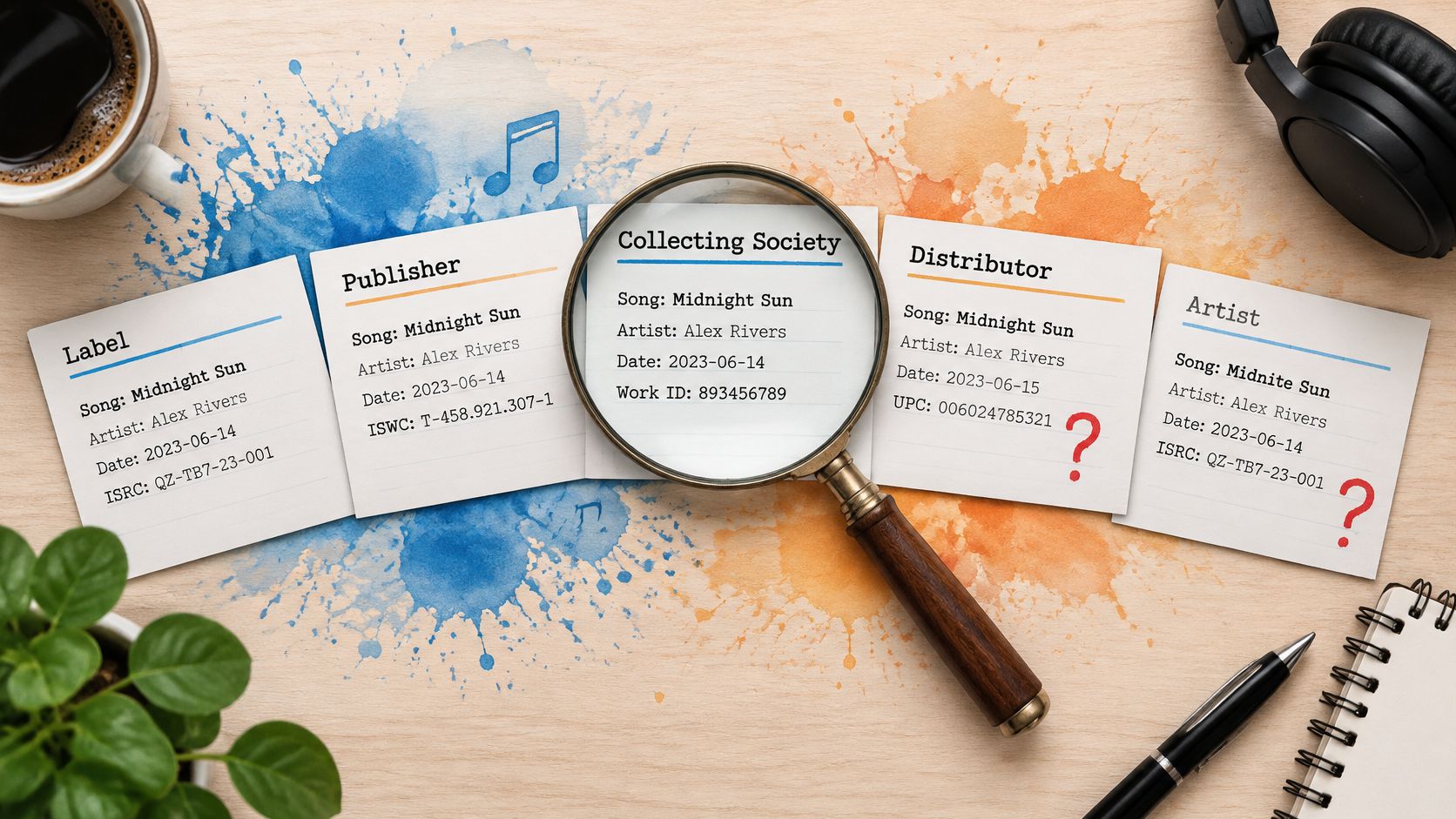
An identifier helps, but it doesn't settle everything. An ISRC can link two records and confirm they're talking about the same recording. It can't prove the lyrics are current, the credits are complete, or the release date is right. Linking is not the same as verifying.
Common Breakdowns and Who They Hurt
| Problem | What It Looks Like | Who Pays the Price |
|---|---|---|
| Conflicting release dates | two platforms show different release years | fans, playlist curators and chart reporting |
| Missing co-writer | a co-writer is absent from the credits | the unlisted writer, who gets no royalty statement |
| Outdated lyric version | lyrics predate a final edit | listeners and press quoting the wrong line |
| Duplicate artist pages | two pages for one act split the catalog | fans and collaborators, plus lost streams |
| Late identifiers | an ISRC or ISWC is added months after release | licensing and royalty matching |
So what makes a record trustworthy when several parties can claim authority? It needs provenance, a clear note of where each value came from. It needs role-based control, so only verified owners can change key fields. It needs verification and editorial review before changes go public, plus a visible history of what changed and when. That review step is exactly what an editorial review process is built to provide.
Look at the table again and be honest with yourself. Which pattern is already affecting your catalog? Most artists find at least one, and naming it is the first step to fixing it.
How to Publish Accurate Metadata on House of Lyrics
Good intentions don't fix records. A repeatable workflow does. The steps below take you from claiming your pages to publishing details that listeners and rights holders can trust, and each step exists for a specific reason.
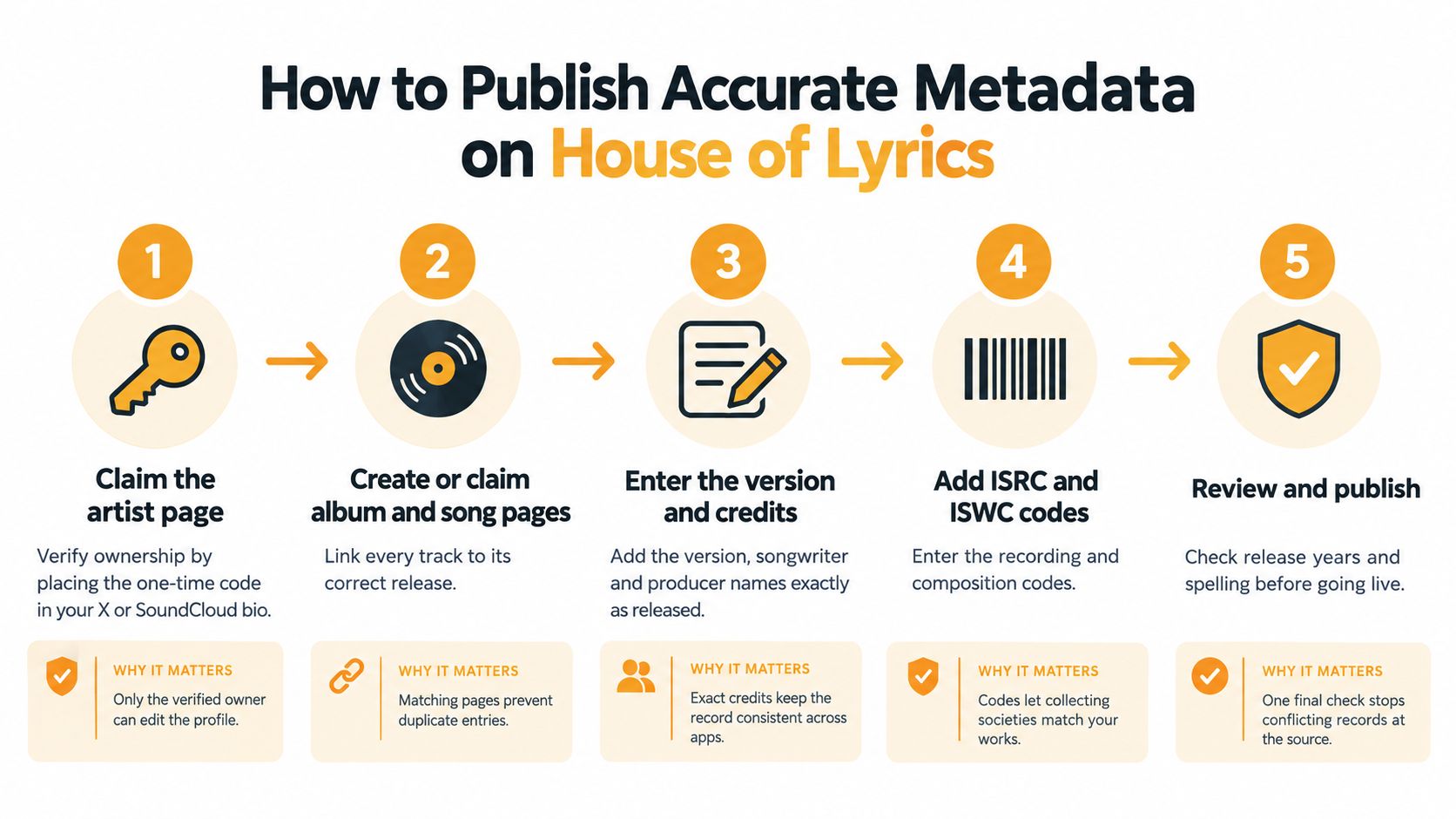
The Seven Step Workflow
- Claim the artist page and verify ownership: Place the one-time code in your X or SoundCloud bio to prove you control the account. This stops impersonation and ensures only the verified owner can edit the profile. You can start that process on the claim page.
- Create or claim the album and song pages: Link every track to its correct release and to your artist page. Connected pages prevent duplicate entries that split your catalog.
- Paste the artist-approved lyric text: Add visible attribution naming the verified rights holder who supplied it. Listeners and press can then see exactly who stands behind these words.
- Enter credits for each song: Name writers, performers, and their roles, with splits that add to 100 percent. Splits aren't decoration. They drive how royalties get allocated.
- Add the official music video embed: Use the video from the artist's own channel so the page points to the canonical source, not a re-upload.
- Submit the changes for editorial review: Edits are held before going live, and that approval step is what separates an authoritative page from an unreviewed draft.
- Check the public page against your distributor record: Compare title spelling, dates, credits, and codes line by line. Catching one mismatch here stops it from spreading to every system that reads your page.
Keep Two Kinds of Fields Separate
As you work, keep descriptive metadata apart from administrative metadata. Descriptive fields cover the title, artist, album, and identifiers. Administrative fields cover the rights holder, approval event, revision timestamp, previous version, and publication status. That separation follows the same principle behind the Library of Congress PREMIS standard, an international preservation-metadata standard whose version 3 data model organizes information around Objects, Events, Rights, and Agents.
On House of Lyrics, that structure means every change stays traceable. You can show who approved a lyric, when it changed, and what it replaced. For a listener deciding which version to trust, or a collaborator checking a credit, that visible trail is the difference between a guess and a reference.
Descriptive fields say what the song is. Administrative fields say who vouched for it, and when.
If you can't place the verification code, or a review takes longer than expected, contact the platform with the same evidence you used for verification. Bring the links, codes, and distributor records you'd want an editor to check. You'll get a faster, cleaner resolution than sending a general complaint.
Audit One Song Page Before Your Next Release
Pick your newest release and run these cross-source checks today. One song is enough to learn the habit.
- Match the ISRC: Confirm the code on the song page matches your distributor delivery exactly.
- Link the ISWC correctly: Make sure it points to the composition, not just the recording.
- Compare date and label: Check that the release date and label name agree across your distributor record and the main streaming services.
- Read the lyrics against the master: Confirm the text matches the final recording, not an earlier demo.
- Search for a duplicate artist page: Make sure no second page is splitting your catalog without you noticing.
Treat a single mismatch seriously. One wrong field can be enough to stall licensing or break royalty matching, because systems match on exact values. Run the checklist this week, fold it into your routine for releasing new music, and submit corrections through the review flow so your page becomes the reference other people can trust.
Your songs deserve pages as accurate as the recordings themselves, with approved lyrics, correct credits, and official videos in one place. Visit House of Lyrics to claim your artist page, verify ownership, and publish metadata your fans and collaborators can rely on.