El Cuarto De Tula Lyrics and Version Credits
El Cuarto de Tula lyrics by recording, with credits, album dates, and how to match the version you heard.

A common shortcut says there's one definitive lyric sheet for “El Cuarto de Tula.” That's exactly where fans can get misled. The title belongs to a composition with multiple recorded interpretations, and the words can shift with the singers, arrangement, and improvisation of a particular performance.
A useful guide to El Cuarto de Tula lyrics should help you identify the recording before you compare lines. The aim isn't to flatten a lively, changing performance into one supposedly universal text. It's to keep the song, each recording, and its credits connected without confusing them.
Table of Contents
- Why El Cuarto de Tula Lyrics Depend on the Version
- Recording Categories for El Cuarto de Tula
- Credits on the 1997 Buena Vista Recording
- Other Performances and Changing Vocal Lines
- Cross References from Song to Album and Video
- Quick Reference Checks Before You Trust a Lyric
- How to Choose a Reliable Lyrics Page
- Take the Next Step with the Right Recording
Why El Cuarto de Tula Lyrics Depend on the Version
One lyric block may look close enough to another to seem interchangeable. But a transcription that doesn't name its recording can leave you unsure whether a difference is an error, a repeated chorus, or a line improvised by the musicians. Provenance matters more than another copy of text without a version attached.
That confusion is especially understandable in the Buena Vista Social Club performance, where Ibrahim Ferrer, Manuel “Puntillita” Licea, and Eliades Ochoa improvise together. A listener may hear a line associated with one voice or performance moment and then find a lyric page that presents it as fixed wording. The safer approach is to label the passage by recording and performer, rather than treating every heard variation as a correction to a single master lyric.
Start with the recording you heard
The title has a performance history beyond the best-known Buena Vista Social Club track. Earlier history is associated with Eliades Ochoa and Cuarteto Patria, and catalog listings also include performances by Celina González and Eliades Ochoa. A 2025 Original Broadway Cast release adds another distinct version to the title's recorded life. Those recordings may share a composition, but they aren't one performance or one automatically identical lyric source.
Before reading a transcription, look for four clues:
- Performer: Who sings or performs this version?
- Recording: Which specific performance does the page describe?
- Release date: Is the page tied to a dated release, or does it leave the version unclear?
- Passage type: Does it distinguish a recurring chorus from an improvised or version-specific passage?
This small check helps resolve the common mismatch between the track a listener has in mind and the text a search result displays.
Practical rule: Treat a changed line as a question about version and performance first, not as proof that one transcription must be wrong.
The approach also protects the music's character. A jam-style performance can invite musicians to improvise, so variation isn't automatically a flaw to erase. A useful lyric reference documents what belongs to the named recording and makes uncertainty visible, rather than forcing every version into the same text.
Recording Categories for El Cuarto de Tula
A lyric page can be accurate for one recording and misleading for another. “El Cuarto de Tula” is a composition credited to Luis Marquetti, recorded by Buena Vista Social Club, Eliades Ochoa and Cuarteto Patria, Celina González, and other performers. Keep the composition's identity separate from each performance's singers, arrangement, release details, and improvised lines.
The well-known Buena Vista Social Club recording appeared in 1997. Catalog listings also document versions on releases from 2000 and 2005, but a release date identifies a particular issue or recording, not a different composition.
Sort the recording details by category
For the lively, jam-style performances associated with Cuban son, a fixed lyric sheet may not capture every sung line. Musicians can improvise, so a catalog should identify which words belong to a particular recording and leave uncertain passages marked as uncertain. That preserves the shared song without treating every performance as interchangeable.
The Buena Vista Social Club recording has its own introduction and arrangement. Record those details with that performance rather than attaching them to other artists' versions. The distinction works like a book and its editions: the underlying work can be shared while each recorded interpretation has its own particulars.
| Record level | What to store | What must not be merged |
|---|---|---|
| Composition | Canonical title, songwriter, and links to its recordings | A particular singer, arrangement, or recording's improvised lines |
| Buena Vista Social Club recording | Ensemble, version details, release information, and performance notes | Other performers' vocals, masters, or release details |
| Other artist recording | Named performer, release, and details specific to that interpretation | Buena Vista Social Club's introduction, vocal parts, or audio master |
| Remaster | Remaster status and audio metadata, linked to the original recording | A new composition identity or unrelated performance credit |
For a broader guide to Latin music genres, House of Lyrics offers useful context. For this song, start by identifying whether the lyric page describes the composition or a named recording. That choice keeps performance details and release metadata attached to the right entry.
Credits on the 1997 Buena Vista Recording
The best-known Buena Vista Social Club recording did not make its performers the songwriters. Luis Marquetti is credited with writing “El Cuarto de Tula,” while Buena Vista Social Club is the ensemble on the album Buena Vista Social Club, released through World Circuit on June 23, 1997. These are separate catalog facts: one identifies the composition's writer, the other identifies the musicians on this recording.
Production credits describe another layer. Ry Cooder is credited as producer, Jerry Boys as recording and mixing engineer, and Bernie Grundman as mastering engineer. Apple Music lists the same songwriter and production credits for the 2021 remaster. Record that release as remastered audio, so it is not confused with the original 1997 album entry.
Read the credit block by role
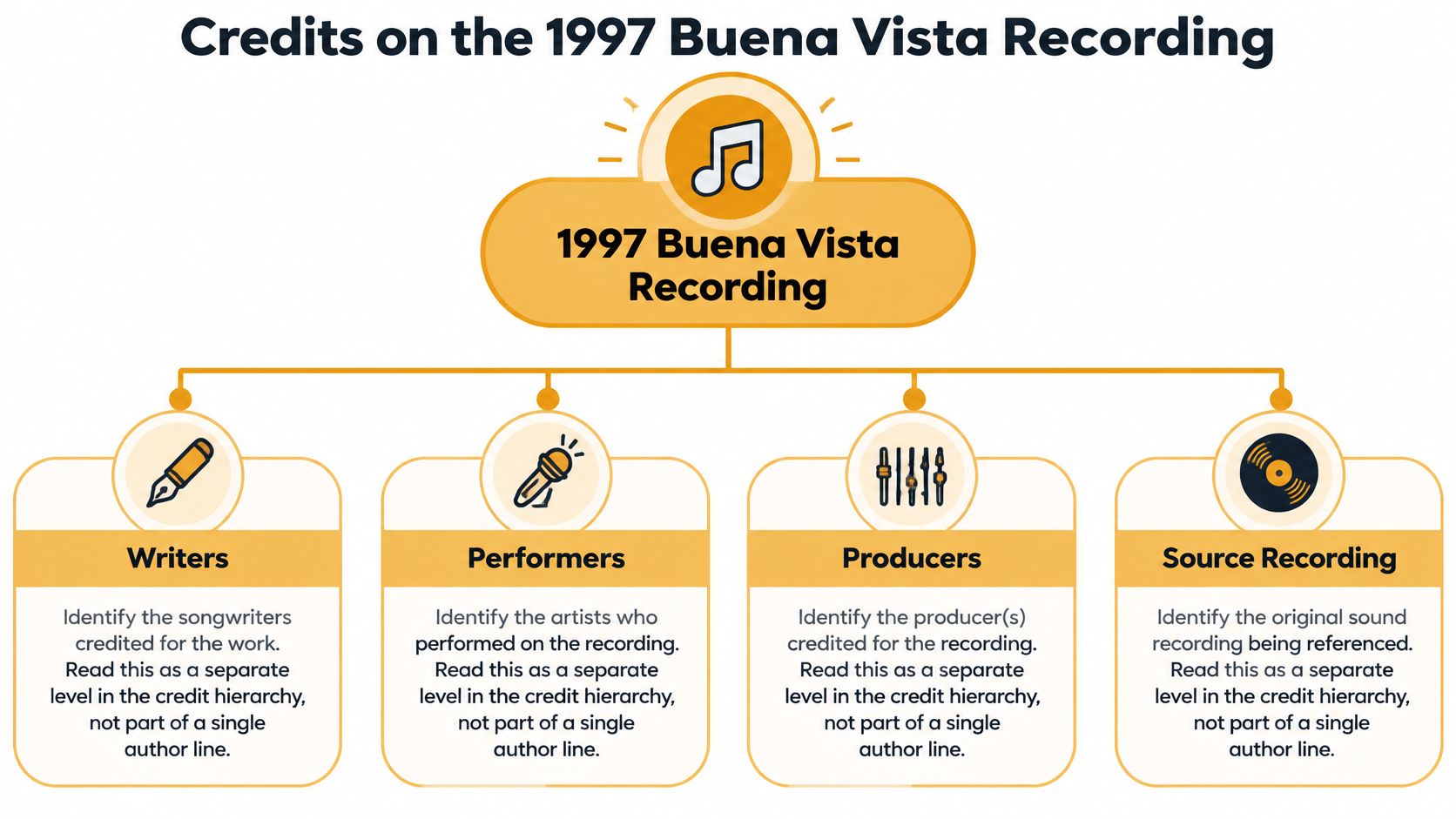
A catalog entry works like a set of labeled shelves: each credit belongs in its own place, and readers can see who did what.
- Canonical title: The title used to identify the composition.
- Songwriter or composer: Luis Marquetti.
- Vocalists and performing ensemble: The credited singers and Buena Vista Social Club.
- Album and original release date: Buena Vista Social Club, released June 23, 1997.
- Label: World Circuit.
- Production team: Producer Ry Cooder, recording and mixing engineer Jerry Boys, and mastering engineer Bernie Grundman.
- Version status: Original release, remaster, or another specified audio version.
For a rights holder checking an attribution, the distinction is practical: the songwriter field credits the composition, while the performer field identifies the people on a particular recording. Editors can use music credit advice for video creators to present attribution clearly. For help organizing those fields, consult House of Lyrics' guide to music metadata management.
Other Performances and Changing Vocal Lines
Cuarteto Patria's association with “El Cuarto de Tula” offers a useful starting point for hearing the song as a composition with multiple lives. The 1997 Buena Vista Social Club recording is one interpretation, not a template for every performance. A lead singer, introduction, or improvised passage can change while the underlying composition remains the same.
Give each performance its own record
The Buena Vista recording and a Cuarteto Patria performance should have separate entries. The same applies to a Celina González version, another artist's recording, a later remaster, or a Broadway cast release. Each entry should identify the specific performance and its release, rather than borrowing details from a different version.
For example, a listener comparing recordings may hear a different vocal emphasis or introduction. Editors can describe that difference on the relevant recording page, leaving the composition connected to its songwriter without assigning one performance's lines or musicians to another.
A difference can be part of the performance
A changed introduction, a different lead voice, or an improvised passage may call for a version-specific note, not a correction to every lyric page. Labeling the variation helps readers understand why transcriptions differ and which recording each one follows.
The same approach works for other songs: a composition can connect to several recordings, each with its own identity. House of Lyrics' “Mi Princesa” lyrics guide offers another song-focused reference point. For “El Cuarto de Tula,” check which performance a lyric page describes before treating its words as definitive.
Cross References from Song to Album and Video
A well-organized catalog gives a reader a clear route from the composition to a specific recording, then from that recording to its album and matching audiovisual source. The links should clarify relationships, not collapse them. The composition can connect to several performances; the 1997 Buena Vista Social Club recording can connect to its album; and the album can point back to the musicians and session behind that performance.
The historical context helps explain why the 1997 recording became so prominent. The project was recorded at Havana's EGREM studios in 1996, and the album was released internationally on June 23, 1997. Accounts describe the recording project as completed in approximately six or seven days. Veteran musicians involved included Eliades Ochoa, Ibrahim Ferrer, Rubén González, Omara Portuondo, and Compay Segundo. The album's scale gave its repertoire, including “El Cuarto de Tula,” exposure as part of a performance-centered Cuban son revival rather than as a lyric text circulating on its own. Buena Vista Social Club's album information provides a reference point for that recording history.
Connect the right records
The commonly distributed version of the track runs approximately 7 minutes and 25 seconds. The album sold more than 8 million copies worldwide and won a Grammy in 1997, and it was added to the U.S. Library of Congress National Recording Registry in 2022. Those milestones belong to the album's history; they don't turn the album's recording into the only valid performance of the composition.
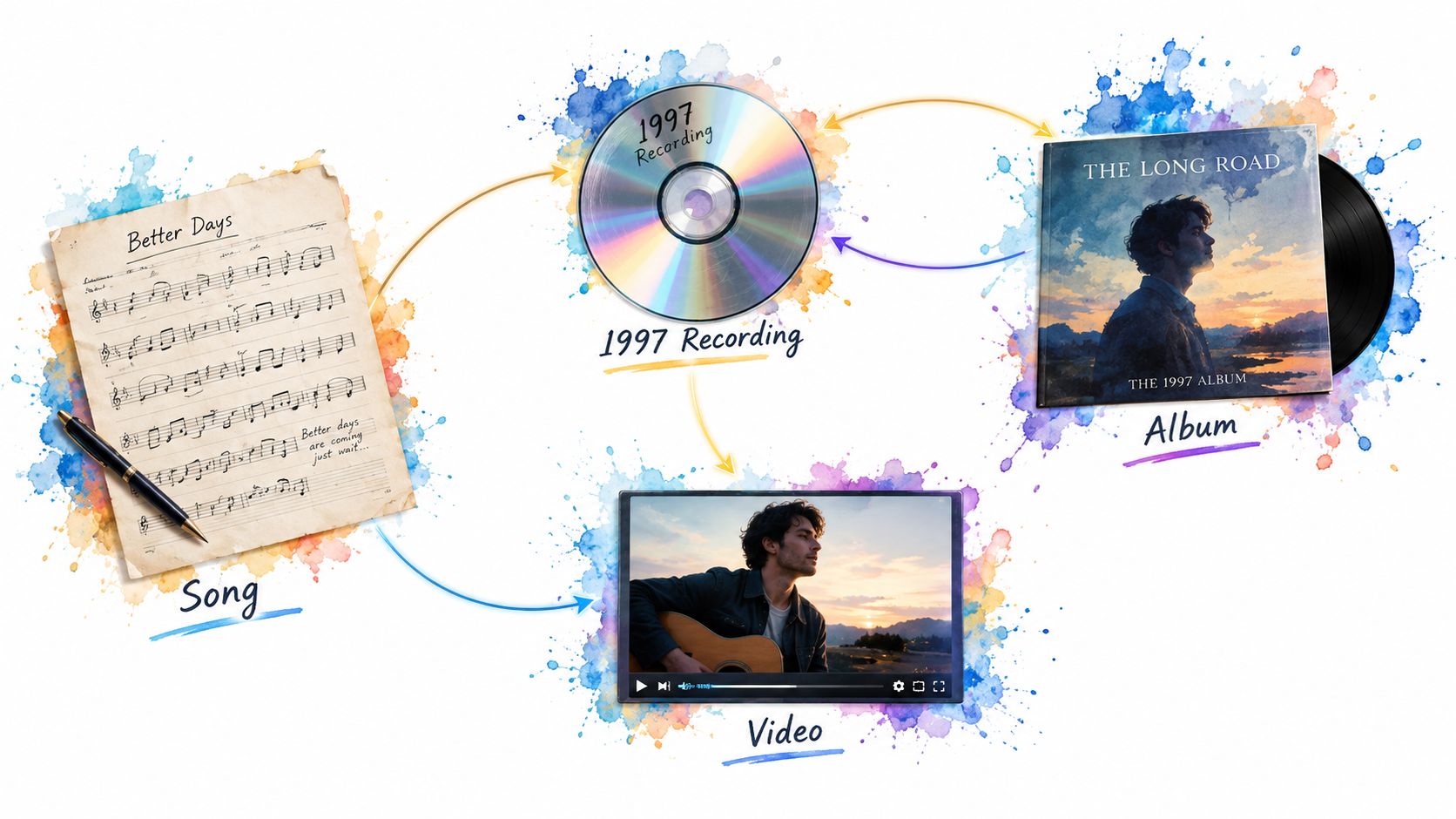
An official video embed belongs on the page for the recording it depicts. It shouldn't appear on every page that shares the title, because viewers need to know whether the footage and sound match the Buena Vista Social Club performance, another artist's recording, or a different release. A journalist or fan should be able to follow a simple path: composition, chosen recording, album, then matching official video.
That path is useful when a lyric search begins with a remembered voice, arrangement, or video rather than a precise release name. Clear cross-references let the reader confirm the intended recording before comparing text, while the album page supplies context without taking over the identity of other performances.
Quick Reference Checks Before You Trust a Lyric
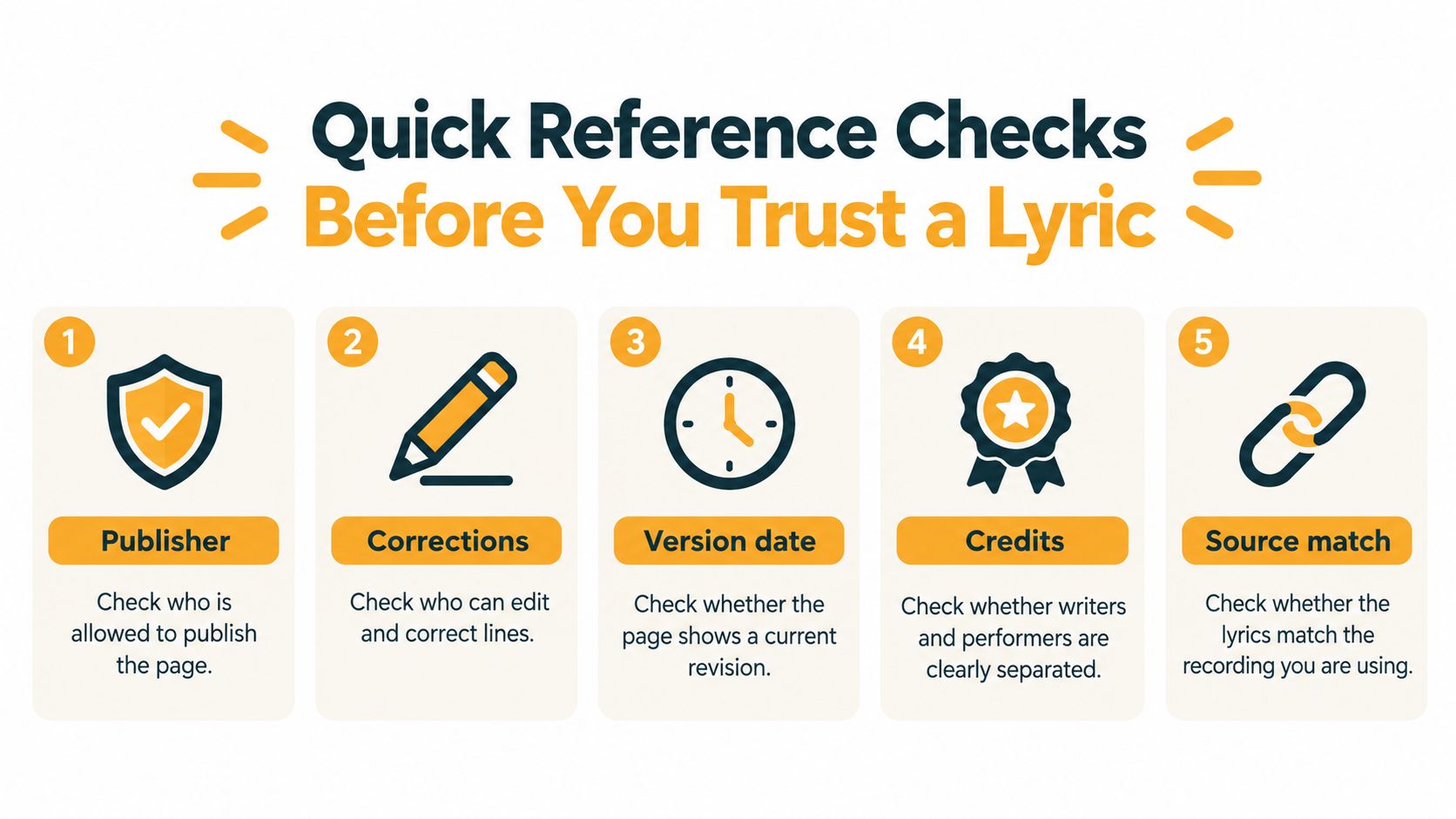
A lyric page can match the composition and still misrepresent a recording. Start by identifying the performance, then check whether the credits and notes belong to that version. The same song title is a label for the work, not a guarantee of identical vocal lines.
Check the identifying fields
- Title and composition: Confirm the page names “El Cuarto de Tula” and credits Luis Marquetti as songwriter. The songwriter credit identifies the composition, while the recording credit identifies who performed it.
- Performer and ensemble: Look for the vocalist or vocalists and the group. Marquetti remains the songwriter whether the voices are Ferrer, Licea, Ochoa, or another performer.
- Album and release: Check the album title and release date. A remaster's date describes that edition, not necessarily the recording's original release.
- Label and production: For the 1997 Buena Vista Social Club recording, check World Circuit, Ry Cooder, Jerry Boys, and Bernie Grundman in their respective label and production roles.
- Recording duration: Compare the listed length with the specific audio version. An alternate recording or remaster may have different audio metadata.
- Variation notes: Check whether the page marks improvised or version-specific passages instead of presenting them as universal lyrics.
Recognize a pass or a fail
A page passes a basic catalog check when it names the recording, distinguishes the songwriter from the performers, and says whether its date refers to an original release or a remaster. A 2021 remaster can have its own audio metadata while remaining the same composition.
Be cautious if a page omits the performer or release year, or treats one transcription as automatically valid for Cuarteto Patria, Buena Vista Social Club, Celina González, and a cast recording. Those performances may differ. A useful editor's note can identify the distinction without reproducing a disputed line: “Buena Vista Social Club recording: distinct introduction and arrangement; passage marked as performance-specific.” Readers then know which recording to check.
For a fuller explanation of editorial review, see the guide to reviewing and approving catalog content. Fans can use these checks to select a lyric page that matches the performance; editors can apply them before publishing an entry.
How to Choose a Reliable Lyrics Page
A lyrics page is only useful when readers can tell which performance it describes. An anonymous mirror may offer a quick transcription but leave the singer, release, and source unclear. A crowd-edited page can collect corrections, though it may still mix lines from different recordings.
House of Lyrics uses an artist-run catalog that connects artist, album, and song pages with artist-approved lyrics and official video embeds. Verified artists and rights holders can claim pages, manage lyrics and credits, and submit metadata changes for review before publication.
Compare who can contribute and correct
The verification process asks a rights holder to place a one-time code in an X or SoundCloud bio to confirm control of a page. After verification, that person can manage the relevant catalog entry and show attribution. Submitted edits are reviewed before they appear publicly.
For “El Cuarto de Tula,” this structure can keep a composition's credits distinct from details belonging to a particular recording. It also gives readers a way to see who supplied or approved the information. A catalog connection does not, by itself, confirm that a specific transcription is hosted or approved.

Before trusting a page, ask: Who can publish or correct it? Does it name the recording? Are the credits and video tied to that performance? If those details are absent, use the page as a starting clue, not as a definitive lyric reference.
For practical search guidance, see this guide to how to find song lyrics. Choose a source that makes the version and attribution clear; easy access alone does not show that its words match the recording you heard.
Take the Next Step with the Right Recording
A lyric page should point to a performance, not just a title. Start with the version you heard: for the 1997 Buena Vista Social Club album track, choose an entry that names the ensemble and release. For a remaster or another artist's interpretation, check its own recording details. Match any official video to that same performance before comparing vocal lines.
Fans can check the performer, release information, and source audio without settling every catalog question at once. If a page leaves those details unclear, treat its lyrics as a possible clue, not a transcription for every version.
For artists, managers, and rights holders
If you manage or control the material, claim the relevant artist, album, and song pages, then confirm control with the social-bio code. Submit lyrics, credits, and embed details for the specific recording through the editor. Changes can be reviewed before publication.
Keep each credit attached to the right recording. For example, select the 1997 Buena Vista Social Club album track or a later performance, then add the performer and production details for that version. Keep Marquetti in the songwriter field, and connect an official video only to the recording it shows.
Fans can browse indexed artists and songs, recent additions, and featured artist showcases. Choose the recording that matches the performance you heard.
House of Lyrics connects artist, album, and song pages. Verified rights holders can manage artist-approved lyrics, credits, and official video embeds there. Use its catalog to search for the specific recording behind a performance.