Wayfaring Stranger Lyrics and Official Versions Guide
Find the complete Wayfaring Stranger lyrics with credits, song history, famous artist versions, and the official video — all in one verified reference page.

Wayfaring Stranger is a traditional American folk-gospel song with no single known author, so multiple differing lyric versions can all be legitimate. Its documented print history reaches from a related 1816 text to the 1858 printed lyrics, while recorded versions continue to expand, with one catalog estimating 314 versions.
You may have searched for the Wayfaring Stranger lyrics, opened three results, and found three slightly different texts. One page may say “Poor Wayfaring Stranger,” another may credit “The Wayfaring Pilgrim,” and a recording you know may include a verse missing from both. That doesn't automatically mean one source is wrong.
The useful question is not “Which page has the one real lyric?” It's “Which version am I reading, who performed it, and how does it relate to the traditional song?” This guide brings those answers together with the traditional text, historical context, notable recordings, version notes, rights guidance, and an official video reference.
Table of Contents
- "Your Complete Wayfaring Stranger Lyrics Reference"
- "Where the Wayfaring Stranger Song Came From"
- "The Traditional Wayfaring Stranger Lyrics"
- "What the Lyrics Mean"
- "Notable Recordings from 1930 to Today"
- "Why You Keep Finding Different Lyric Versions"
- "Credits, Rights, and the Official Video"
- "Quick Reference for Identifying the Version You Heard"
- "Wayfaring Stranger Questions Fans Ask Most"
"Your Complete Wayfaring Stranger Lyrics Reference"
The most reliable way to approach this song is to treat it as a song family, not as a fixed modern composition with one definitive author and one unchangeable sequence of verses. The traditional core remains recognizable, but singers and arrangers have carried it through gospel, folk, country, bluegrass, and popular music.
A useful reference should help you do four things quickly:
- Read the traditional text: Use the commonly circulated lyric as a baseline, while remembering that stanza order and wording can vary.
- Understand the credits: Identify the song as traditional, then separate the performer's arrangement and recording from the underlying text.
- Match a recording: Check the title, performer, era, instrumentation, and included verses rather than relying on the title alone.
- Watch the right performance: Pair a lyric transcription with an official audiovisual source whenever one is available.
The title itself creates much of the confusion. “The Wayfaring Pilgrim” appears in the earliest known commercial recording, while “Poor Wayfaring Stranger” became a common later title. “Wayfaring Stranger” is also widely used as the shorter form. These labels point toward the same traditional repertoire, but they don't guarantee identical arrangements.
Practical rule: A lyric page should identify the exact recording before presenting a performer-specific text.
The sections below separate the song's history, words, interpretation, recordings, metadata, and rights. That structure lets a casual listener find a familiar verse while giving musicians, researchers, and rights holders enough information to distinguish traditional material from a modern arrangement.
"Where the Wayfaring Stranger Song Came From"
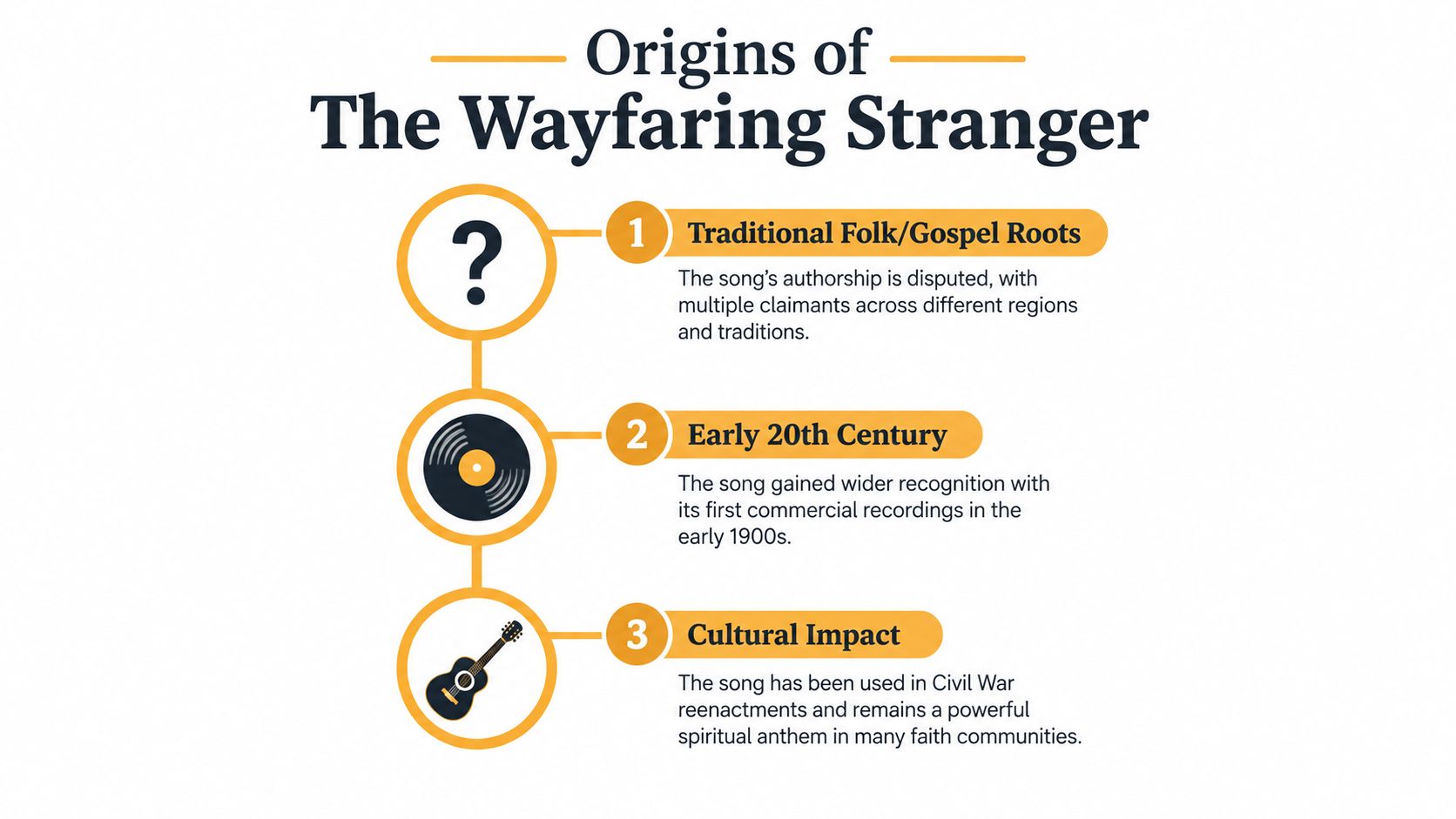
Wayfaring Stranger is a traditional American folk-gospel song, but its exact authorship and place of origin remain uncertain. One commonly cited theory places its roots in the southern Appalachian Mountains during the late 1700s, yet oral tradition rarely leaves a neat author credit or a single first performance to document.
The printed record is clearer than the presumed oral history. An earlier related text called “Judgement” is associated with the 1816 collection Kentucky Harmony, although historians debate how directly that text connects to the later song. The lyrics appeared in print in 1858 in Joseph Bever's Christian Songster, a collection of popular hymns and spiritual songs. That documented trail spans at least 107 years, from the 1816 reference to the 1858 printed version, while the song's oral history may reach further back.
Why traditional authorship matters
Calling the song “traditional” isn't a way of avoiding credit. It describes a different kind of authorship history. The widely circulated wording developed through oral transmission, printed variants, and later arrangements, so it shouldn't automatically be assigned to a single modern songwriter.
That distinction matters when a lyric page lists credits. The underlying traditional text, a performer's adapted wording, a new melody treatment, and a commercial recording can have separate attribution and rights information. A page about another traditional religious song, such as God Never Fails, can raise similar questions about how inherited repertoire is documented.
The song's first-person traveler gives the text its portability. The narrator speaks about earthly hardship, death, reunion, and reaching a better destination. Those themes work in a church setting, a family singing tradition, a folk revival performance, or a country arrangement without requiring the performer to erase the song's older identity.
"The Traditional Wayfaring Stranger Lyrics"
The traditional lyric is best read as a first-person account of a traveler who feels displaced in the present world and looks toward release, reunion, and a home beyond earthly suffering. The wording below represents the commonly circulated traditional text. It isn't a claim that every historical singer used exactly this stanza order or every line.
A commonly circulated traditional text
I am a poor wayfaring stranger
While traveling through this world of woe
Yet there's no sickness, toil, or danger
In that bright land to which I go
I'm going there to see my father
I'm going there no more to roam
I'm only going over Jordan
I'm only going over home
I know dark clouds will gather round me
I know my way is rough and steep
Yet beauteous fields lie just before me
Where God's redeemed their vigils keep
I'm going there to see my mother
She said she'd meet me when I come
I'm only going over Jordan
I'm only going over home
I'll soon be free from every trial
My body will sleep in the churchyard
I'll drop the cross of self-denial
And enter on my great reward
I'm going there to see my Savior
To sing His praise forevermore
I'm only going over Jordan
I'm only going over home
How singers should use this baseline
Treat the stanzas as a reference, not as a compulsory performance script. A singer may repeat the refrain after each verse, omit a family-reunion stanza, change “father” or “mother,” or use a different opening title. Those choices affect the emotional focus without necessarily creating a separate song.
For citation, describe the work as traditional, then name the source or recording whose wording you're using. If you're transcribing a particular artist, identify the artist, release, arrangement status, and recording source. Don't present an artist-specific adaptation as though it were the only traditional text.
Small wording changes can move the song from a general meditation on mortality toward a more personal account of family, faith, or freedom.
"What the Lyrics Mean"
The song's emotional power comes from its simple movement between present hardship and a hoped-for destination. The narrator is a traveler, but “wayfaring” carries more than physical movement. It suggests a person passing through a difficult world, conscious of mortality and longing for rest.
Four themes shape the lyric:
- Mortality: The world contains sickness, toil, danger, trials, and death.
- Pilgrimage: The narrator is traveling rather than settling, which gives the song its restless forward motion.
- Reunion: References to a father, mother, or Savior turn the destination into a place of relationship.
- Hope: The final home is imagined as freedom from suffering and a better spiritual condition.

Why the River Jordan matters
“Crossing the River Jordan” can signify Christian passage into the afterlife. In that reading, Jordan is the boundary between earthly struggle and heavenly home, and the repeated line turns death into a crossing rather than an ending.
The image also carries another interpretive history. It has been read as coded language associated with escape and freedom in African American spiritual traditions. That doesn't cancel the Christian meaning. It shows why the same lyric can sound devotional in one performance and historically charged in another.
A listener should therefore avoid reducing the song to a single summary such as “a hymn about heaven.” The words leave room for religious belief, grief, longing, resistance, and the desire to reach safety. Arrangement choices make those possibilities audible, especially through tempo, vocal restraint, harmony, and instrumentation.
Here's an official performance reference to hear how the song's plain language can gather different emotional weight in performance:
"Notable Recordings from 1930 to Today"
The recording history shows how a regional folk-gospel song became part of several American musical traditions. Vaughan's Texas Quartet made the earliest known commercial recording in 1930, using the title “The Wayfaring Pilgrim.” Burl Ives followed with “Poor Wayfaring Stranger” in March 1944, then recordings appeared from Jo Stafford in April 1948, Pete Seeger in 1954, and Eddy Arnold in September 1955.
By 1958, versions had been released or documented by Bob Gibson, Frances Archer and Beverly Gile, and Bill Monroe. That sequence covers 28 years, from the 1930 quartet recording to a broader folk and country presence in 1958. Later documented performers include Roscoe Holcomb, Frankie Laine, Jimmie Rodgers, the Oak Ridge Boys, Doc and Merle Watson, and Dolly Parton.
The dates and titles below come from the documented performance history at SecondHandSongs.
| Performer | Year | Title Used |
|---|---|---|
| Vaughan's Texas Quartet | 1930 | The Wayfaring Pilgrim |
| Burl Ives | March 1944 | Poor Wayfaring Stranger |
| Jo Stafford | April 1948 | Wayfaring Stranger |
| Pete Seeger | 1954 | Wayfaring Stranger |
| Eddy Arnold | September 1955 | Wayfaring Stranger |
| Bill Monroe | 1958 | Wayfaring Stranger |
| Roscoe Holcomb | 1960 | Wayfaring Stranger |
| Frankie Laine | August 1962 | Wayfaring Stranger |
| Jimmie Rodgers | January 1963 | Wayfaring Stranger |
| Oak Ridge Boys | December 1963 | Wayfaring Stranger |
| Doc and Merle Watson | 1992 | Wayfaring Stranger |
| Dolly Parton | 1994 | Wayfaring Stranger |
One catalog estimates 314 recorded versions, though the figure is a catalog estimate rather than an official global total, and databases can define “version” differently. New recordings continue to appear, including a 2025 single titled “Wayfaring Stranger,” so version identification remains a living catalog problem.
A listener searching for a specific artist may need more than a title match. For example, a Johnny Cash artist page should be treated as a starting point for catalog context, then checked against the exact recording and lyric text.
"Why You Keep Finding Different Lyric Versions"
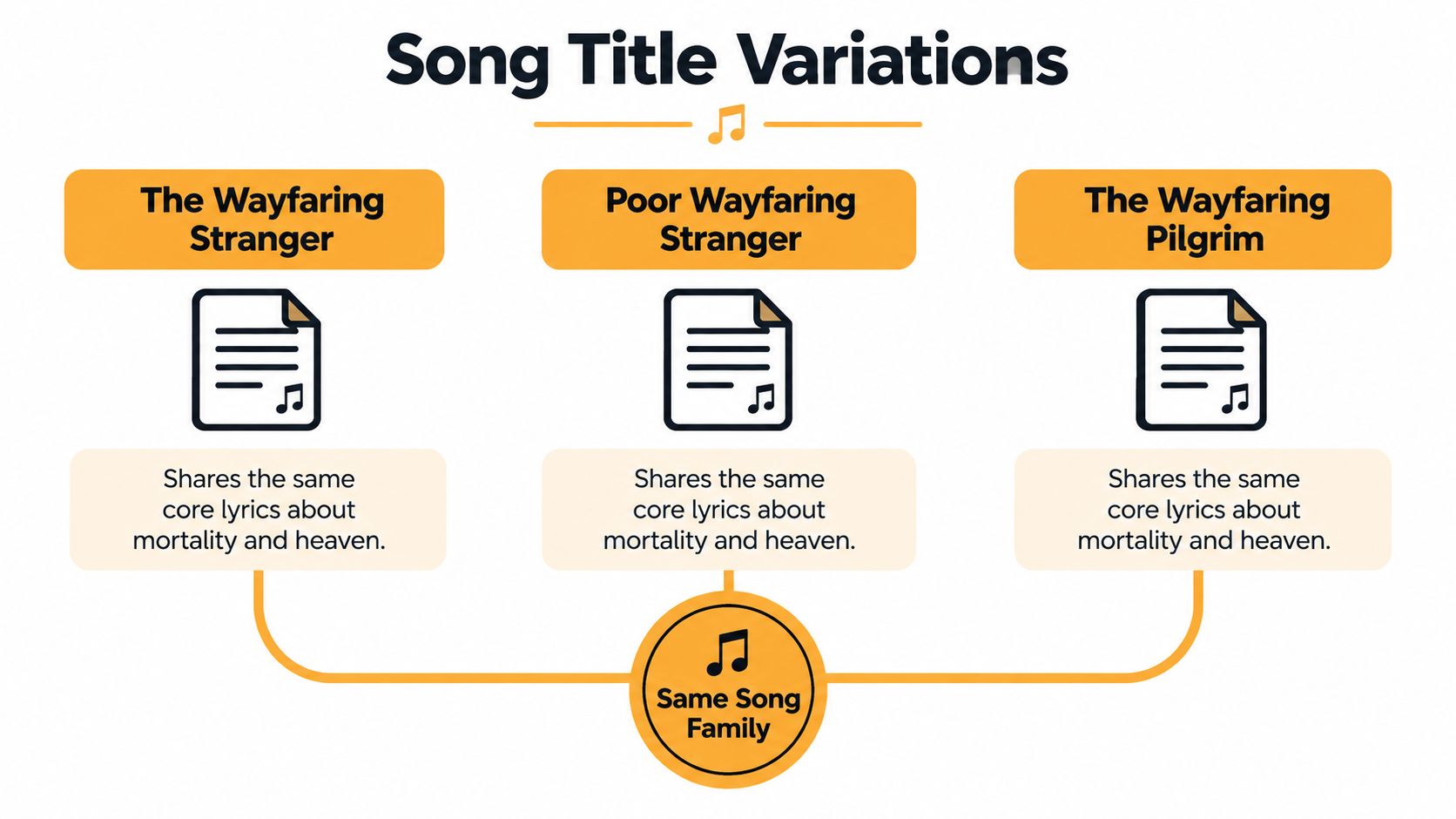
The three recurring titles below usually identify the same traditional song family. They aren't interchangeable labels for every recording, but they help explain why a search engine can return several apparently different answers.
| Title | Historical or common use | What to check |
|---|---|---|
| The Wayfaring Stranger | Short form widely used for the traditional song | Compare the performer and stanza set |
| Poor Wayfaring Stranger | Used by Burl Ives and common in lyric searches | Check opening wording and repeated refrain |
| The Wayfaring Pilgrim | Title used by Vaughan's Texas Quartet in 1930 | Verify whether the recording uses the traditional core |
Differences that change the reading
A title can change the narrator's emphasis. “Stranger” highlights someone who doesn't belong to the present world, while “pilgrim” emphasizes spiritual travel. Adding “poor” makes the speaker's vulnerability more immediate.
Verse selection matters just as much. A performance that includes the father stanza may feel focused on reunion. One that foregrounds the mother stanza can sound more intimate and familial. A version that emphasizes the Savior or the crossing into the next world may sound more explicitly devotional.
Pronoun and line changes can also matter. “I am” and “I'm” carry the same basic meaning, but a singer's phrasing can make the statement sound formal, conversational, mournful, or resolute. Artist-added verses should be marked as adaptations rather than absorbed into the traditional baseline without notice.
Metadata helps keep these distinctions clear. Fields for title variants, performer, recording date, arrangement, lyric source, and rights status prevent a searcher from treating every result as the same asset. A structured approach such as metadata management for music catalogs is especially useful when one song has many titles and recordings.
"Credits, Rights, and the Official Video"
A traditional lyric and a commercial recording aren't the same rights object. A careful lyric page separates at least four layers:
- Traditional text: The inherited song words and melody family.
- Performer arrangement: The choices a singer or band makes in tempo, harmony, instrumentation, sequence, and adapted wording.
- Sound recording: The captured performance released by a particular artist or label.
- Specific transcription and video: The written text prepared for a page and the official audiovisual source used to represent the performance.
The Library of Congress catalog record documents a 1937 collection item from Middle Fork, Kentucky, associated with Alan Lomax, Elizabeth Lyttleton, and G. E. Norris, and identifies the digitized catalog card as public domain. That status applies to the cataloged archival item, not automatically to every later arrangement or recording of the song.
Smithsonian Folkways separately identifies Bill Monroe's 2004 release as a 4:32 English-language performance with credited vocals, mandolin, acoustic guitar, and fiddle. Another Folkways entry documents a 5:10 bluegrass performance by Cullen Galyean and the Virginia Mountain Boys. These records illustrate why performance details belong beside lyrics rather than being treated as optional decoration.
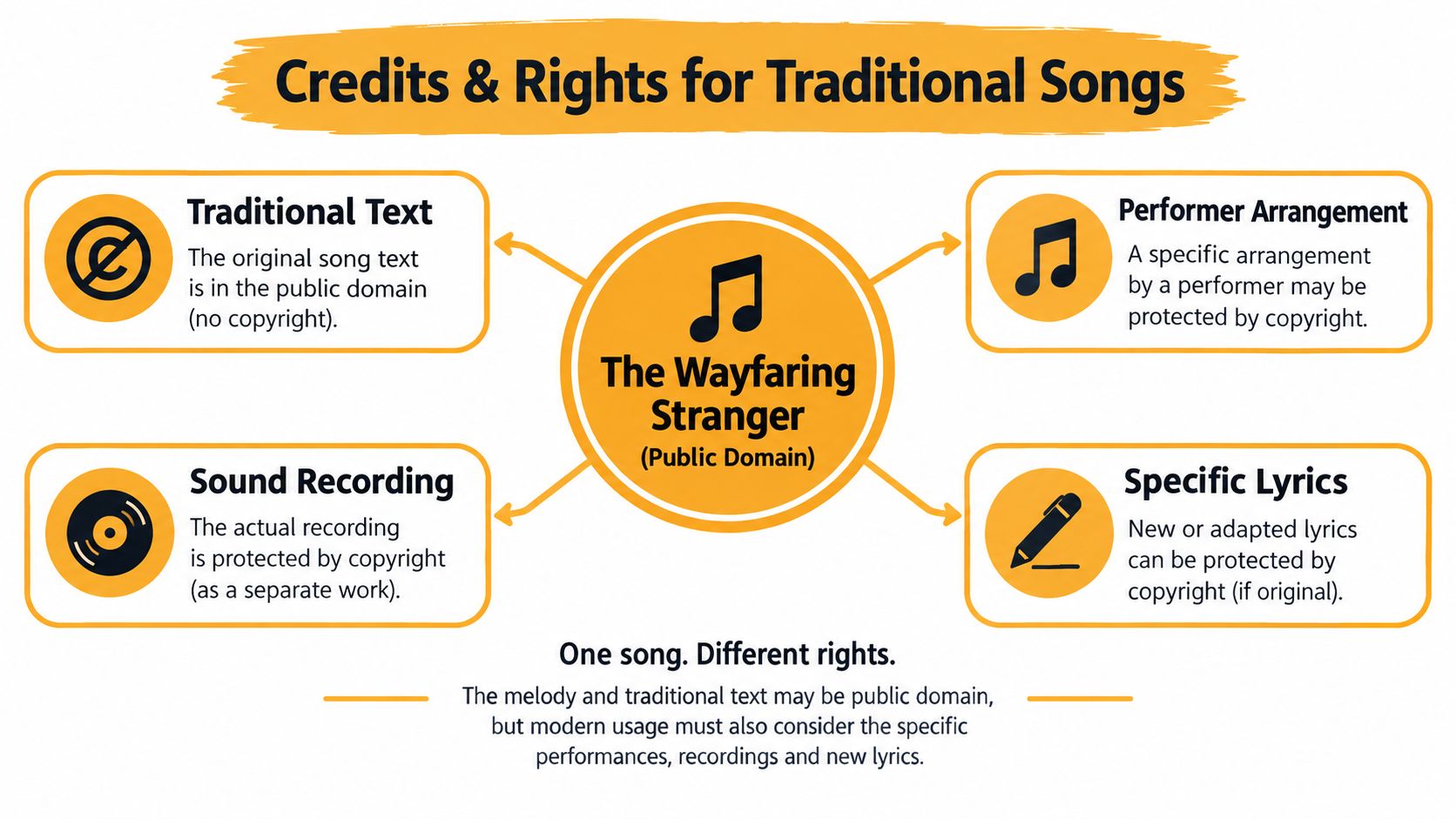
Rights-aware practice: A public-domain traditional lyric doesn't make every arrangement, transcription, sound recording, or video reusable.
For a trustworthy page, list the performer, release year, label or catalog identifier where available, duration, arrangement credit, lyric provenance, and video source. An artist-approved transcription paired with an official video gives the listener a practical reference while preserving the distinction between the inherited song and the recorded performance.
Editorial review also matters. A documented workflow, such as the one described in what an editorial review means, helps catch misattributed verses, incorrect performers, and copied lyrics that belong to another arrangement.
"Quick Reference for Identifying the Version You Heard"
You don't need to be a music historian to identify the right lyric page. Start with the evidence you already have, then narrow the result by comparing the recording rather than trusting the title alone.
A fast lookup checklist
- Write down the title you heard. Was it "The Wayfaring Stranger," "Poor Wayfaring Stranger," or "The Wayfaring Pilgrim"? Treat the title as a clue, not a final answer.
- Name the performer if you can. A vocalist, band, soundtrack, or radio host gives you a stronger identifier than the song title.
- Estimate the recording period. Compare the sound with the timeline above. A bluegrass mandolin arrangement points you toward a different performance context than a restrained folk vocal.
- Match the opening line. Check whether the singer begins with "I am a poor wayfaring stranger" or uses a related opening.
- Count the distinctive stanzas. Listen for the father, mother, Savior, or trial-related verses. The omitted or added stanzas often reveal the adaptation.
- Verify the official source. Use a label, artist, archive, or official video rather than an unattributed upload.
- Record the credit accurately. Write "traditional," then add the performer and arrangement details for the version you heard.
A short lyric fragment can still lead you astray if you search it without context. The same refrain may appear under different titles, and a transcription may combine stanzas from more than one performance.
For comparison, use the traditional baseline above and the recording table, then consult related lyric references such as Body Electric lyrics only as separate song pages, not as evidence that every online lyric archive uses consistent credits.
"Wayfaring Stranger Questions Fans Ask Most"
Can an artist add verses and still call the song traditional?
Yes, but the page should label the result clearly. The inherited song can remain traditional while the artist's added verse, altered stanza, or new arrangement is credited to that performer or writer. A good entry identifies which words belong to the traditional baseline and which belong to the adaptation.
Can I perform the song publicly?
That depends on the exact material and use. The traditional source text may have a different status from a modern arrangement, a copyrighted transcription, a sound recording, or an audiovisual production. Check the rights attached to the arrangement and recording you plan to use, rather than assuming that the traditional label clears every element.
Why do films and commercials still need licensing?
A production may license a particular recording, arrangement, synchronization, or newly prepared performance even when the underlying traditional song is treated separately. The permissions concern the exact creative assets used in the project, so credits and provenance should be documented from the start.
Where should I explore next?
Start with other folk-gospel songs that use pilgrimage, mortality, reunion, or hope as their emotional center. Then compare how different performers alter tempo, instrumentation, stanza order, and vocal perspective. Those listening choices reveal why Wayfaring Stranger has remained open to reinterpretation without losing its identity.
House of Lyrics offers artist-approved lyrics, official video embeds, and structured artist, album, and song pages with credits managed by verified rights holders. Visit House of Lyrics to explore reliable song references and help keep your catalog's words and recordings connected.