One Day in Your Life Lyrics, Credits and Official Video
Read the artist-approved lyrics to One Day in Your Life, with verified credits and the official music video, all on House of Lyrics.

What makes an unnamed lyric page seem as if the artist approved it?
Sleep, work, meals, household responsibilities, and leisure already fill most of the 1,440 minutes in a day. You need a page that lets you check whether the words to One Day in Your Life match the right recording, without spending an afternoon comparing lyric sites.
Say you're in the car after a late soundcheck. The chorus sticks, and you want the line exactly as the owner approved it before sharing it in a group chat. A scraped page may offer a guess. A trustworthy page shows who supplied the lyrics, when they were reviewed, and which recording they belong to. For this song, the approved opening verse isn't published yet, so there's no verified text to share from the page.
For lyrics and credits, look for a clear connection to the artist or a verified rights holder. Check whether the page identifies the recording and attributes the material to an owner, rather than presenting an unattributed transcription as official. Those details help you distinguish reviewed information from copied or guessed words. The same checks apply before trusting credits or a video link: confirm that the page identifies what it covers and who supplied the information.
Table of Contents
- Full Artist-Approved Lyrics for One Day in Your Life
- Confirm Which One Day in Your Life This Page Describes
- Credits, Writers and Release Details at a Glance
- Official Music Video and Where to Watch It
- Approved Lyrics Versus Unofficial Copies
- How Verified Owners Keep Lyrics and Credits Accurate
- Connected Artist, Album and Song Pages
- Key Terms and Quick Reference for This Song Page
Full Artist-Approved Lyrics for One Day in Your Life
What can you quote when the lyric text for One Day in Your Life has not been approved for publication? For now, there are no artist-approved lines to reproduce here. A guessed verse or chorus can turn into a false lyric once it is copied into captions, comments, or a cover description.
Check the song's credits and official video to make sure you have the right recording. The credits show which details are available on the page, while the video helps you compare the song with an official audiovisual source. Neither is a substitute for an approved lyric text, but together they can help you avoid attaching a transcription to the wrong version.
For a reviewed lyric block, look for visible attribution showing that the words came from an artist or verified rights holder. On House of Lyrics, verified owners can manage song pages and submit lyrics, credits, and metadata through an editor. Submitted changes are reviewed before they appear publicly. Until approved lyrics are published, treat other transcriptions as unofficial, even if they look complete.
What the missing text means
No lyric lines are available to quote from this page yet. That includes the verse, pre-chorus, chorus, bridge, and any repeated or alternate lines. Without text supplied and approved by a verified rights holder, there is no reliable basis for reproducing those sections here.
That restraint matters when a song is familiar. A single guessed word can change a rhyme or meaning, and a transcription copied from an unverified page can spread without showing who supplied it. An empty lyric block cannot confirm the words. Visible attribution and an approval process can show whether the text was provided by an authorized page owner and reviewed before publication.
Where to look in the meantime
Use the credits to check the information listed for the recording, then open its official video embed to compare the source with the song you know. If you find lyrics elsewhere, don't assume they are artist-approved just because they are arranged into familiar sections. Look for clear attribution to an artist or verified rights holder and for evidence that the page's owner can manage the song entry.
A rights holder who controls the page can submit lyric text for review along with any relevant credits or metadata. Once the review is complete, approved material can appear on the song page. Until then, there are no published alternate lines to compare, and no outside transcription should be presented as the approved text for this recording.
Confirm Which One Day in Your Life This Page Describes
One Day in Your Life isn't a unique title. More than one recording carries it, and those recordings don't share one lyric sheet or one credit list. Before you quote a line, match the page header to the song you heard.
- Artist name: Compare the artist in the header with the artist you searched for, or with the name the radio host said.
- Release year: Match the year in the release record with the year you know. A later reissue can sit next to an older album and still use the same title.
- Recording version: Read the version line. A studio original, a remix, an edit, or a live take can carry different lyrics and credits. A live take with an audience isn't the album track just because the chorus sounds familiar.
- More than one release: If the album page lists more than one release containing this title, open each one and compare its credits table before you quote anything.
Say the header names a different artist from the one on your playlist. Stop. Don't "make it fit" by skipping a verse that doesn't match what you hear. Use the artist page to find the correct song, the same way you'd narrow a search when looking up song lyrics and several results share a title.
When you share a link or cite the song, name the artist, the album, and the year together so the next reader lands on the same recording.
That trio is the difference between a useful citation and a mix-up. "One Day in Your Life, live" is not the same object as the studio recording, even when a friend swears the words are identical. Check the header first, then read.
Credits, Writers and Release Details at a Glance
Credits for One Day in Your Life on this page come only from the verified owner record and the release record. Empty fields stay empty.
| Role | Source record |
|---|---|
| Lead vocal | Not yet recorded on the verified owner record |
| Songwriter | Not yet recorded on the verified owner record |
| Producer | Not yet recorded on the verified owner record |
| Mixing engineer | Not yet recorded on the verified owner record |
| Mastering engineer | Not yet recorded on the verified owner record |
| Label | Not yet recorded on the release record |
| Release date | Not yet recorded on the release record |
What each role is doing
Lead vocal is the featured singer on this recording, not everyone who sang a harmony in the room.
Songwriter wrote the words and the melody. Fans often paste that name into the producer slot, and the two jobs aren't the same.
Producer shapes the recording: arrangement, performances, and the sound you hear. A producer credit doesn't mean that person wrote the lyric.
Mixing engineer balances the recorded parts into the mix you stream. Mastering engineer prepares that mix for release. Neither credit is a writing credit.
Label is the company named on the release record. Release date is the publication date for that release, which tells you which era of the song the table describes.
Credits change when the recording changes
A remix, an edit, or a live version can list different people even when the title stays put. The release date and the version line tell you which recording this table describes. Don't copy a producer name from a deluxe edition onto the original single.
Check a name by comparing it with the artist page and the album page. Our metadata management workflow is built for that comparison: one field, one source record, no blended guesses. If the header and the album page disagree, flag the mismatch to the verified owner instead of picking the spelling you like. The owner reviews it. You don't resolve it in the comments.
Official Music Video and Where to Watch It
What should you check before pressing play on the video beside a song's lyrics? Say you have the lyric notice open on your phone. The official embed should lead to the audiovisual version released by the artist or rights holder, not a user upload with a clipped intro and lyrics that compete with the approved text.
In 2025, 26% of U.S. adults surveyed by YouGov said they listened to music for a little while each day, while 18% said they listened for multiple hours each day. However long you listen, a familiar title alone does not confirm that a video is official. Check the source before treating its words or recording as authoritative.
Before playing the embed, look at three details:
- Title: Does it match the song, rather than label a different take as a lyrics video?
- Channel: Is the source the artist or the label?
- Year: Does the release year match the date in the credits, once that date appears on the release record?
Then follow the lyric sections in order. Start with verse one, even if the approved text is not published there. Use the repeating chorus as a sing-along anchor. When the bridge arrives, compare the lyric block with what you hear, and note any difference without entering it as approved wording. A mismatch is a reason to check the source, not to guess at a correction.
If the embed will not load, return to the song page later rather than relying on an unofficial upload. A copied video may use another recording version or altered lyrics. Keep the official music link with your notes so you can return to the same source, and use this guide to check an official lyrics video when the picture and words are meant to match. A song page has a different purpose from tools that turn Amazon links into product videos: its video should help you identify the song's official recording and compare it with the approved text.
If the picture and the credit year do not match, you may be watching a different version of the song.
Approved Lyrics Versus Unofficial Copies
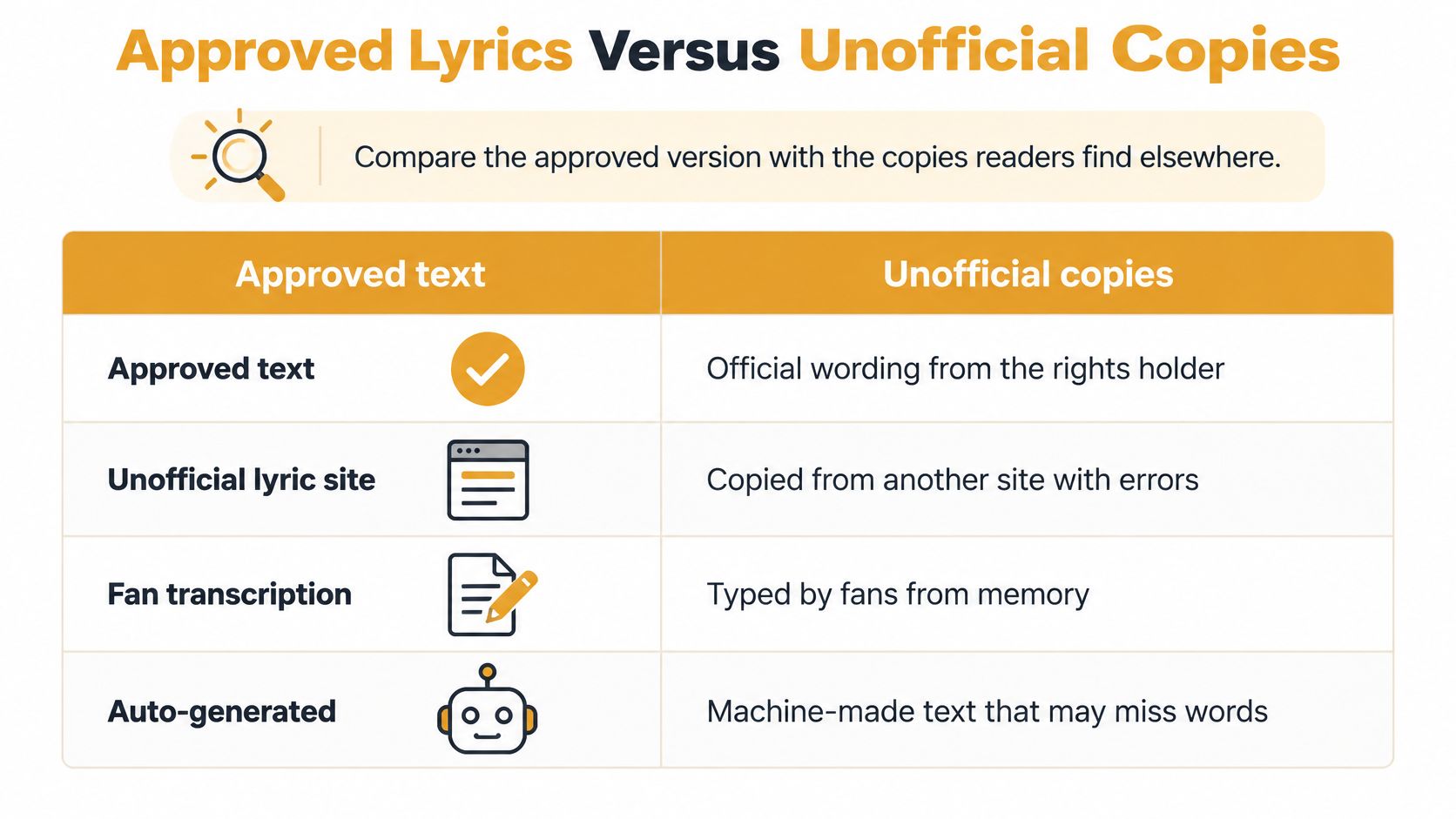
| Version | Supplied by | Attribution shown | Reviewed before publication |
|---|---|---|---|
| Artist-approved text on this page | Verified rights holder | Yes, named and dated | Yes |
| Unofficial lyric site | Unknown contributor | Usually none | No |
| Fan transcription | Anonymous listener | None | No |
| Auto-generated caption text | Software | None | No |
The approved row is allowed to be empty. Empty and attributed beats full and anonymous. An unofficial lyric site often copies another site, typos included. A fan transcription is typed from memory after one listen. Auto-generated captions are software output. They miss words, split lines in the wrong place, and never name a reviewer.
Four spot checks
- Named source and date: Look for who supplied the text and when. No name and no date means it isn't the approved row.
- Structure: Check whether the sections match verse, pre-chorus, chorus, and bridge on this page.
- A distinctive line: Compare one line you know against the official video, not against a second unofficial site.
- Review history: Note whether the page shows a review or a revision log. That log is what an editorial review leaves behind.
Small differences matter. One changed word can bend a meaning or break a rhyme, and the next person will quote your quote.
Approved pages
- Attribution: You can see who stood behind the text and the date they did it.
- Review: A person compared the recording, the role, and the source before fans saw it.
- Slower on purpose: Nothing goes live the moment someone pastes it.
Copied pages
- Speed: They're often the first hit, which is why they spread.
- Errors: Typos, missing sections, and invented lines travel with them.
- No trail: When two copies disagree, there's no dated decision to settle it.
When versions differ, trust the attributed, reviewed text and report the discrepancy to the verified owner. Don't average the two wordings into a third guess.
How Verified Owners Keep Lyrics and Credits Accurate
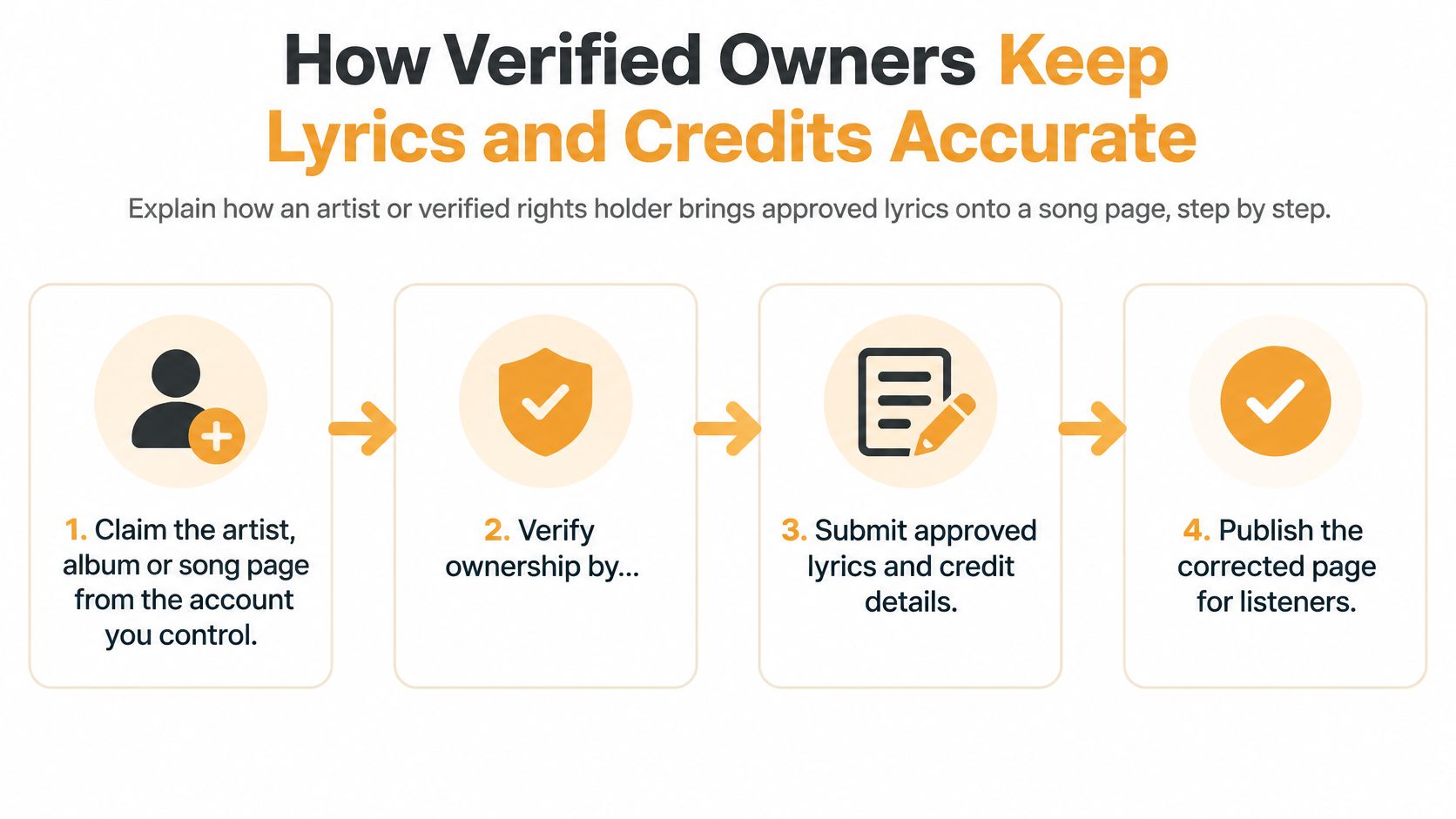
Say an artist spots a guessed lyric on a song page. They can claim the page, confirm control of a public profile, submit corrections, and have them reviewed before publication. The NIST identity-proofing guidance explains identity proofing as collecting and validating evidence about an applicant. A profile code helps confirm profile control, but it does not establish copyright ownership.
Gather the approved lyric text, credit list, and official video URL before starting. Then follow the claim and review process:
- Claim the page. Start with the artist, album, or song page you want to update. The House of Lyrics claim flow gives you a place to submit the claim.
- Confirm profile control. Place a one-time code in your X or SoundCloud bio so the review team can check that you control that public profile. The code does not prove that you own the lyrics or rights.
- Submit the corrections. Provide the lyric text and credits, along with the official video URL when it is relevant. Keep each detail tied to the recording described by the page.
- Wait for review. A reviewer checks the submission before it goes live. That step helps catch lyrics attached to the wrong version and gives the team a chance to clarify unclear details.
- Check the result. Once approved, the page displays the supplied text with attribution. If the reviewer needs clarification or does not approve the submission, address the request before relying on the page as corrected.
The distinction matters: a code in a social bio confirms control of that profile, while the review considers the submitted lyrics and credits. Neither should be mistaken for the other. Share material that reflects the artist's approved version, and make the source clear so readers can distinguish it from copied or guessed text.
A featured placement costs $49.99 per day for one day. It can put the updated page in front of listeners during that day, but it does not replace review. Approved lyrics and credits still need to pass through the review process before publication.
Connected Artist, Album and Song Pages
Start on the artist page. It lists the songs. Open the album that holds One Day in Your Life. Then open the song page, which links back to both. That walk is the catalog. You're not memorizing a schema. You're refusing to quote the wrong object.
A recording is one specific mix or edit. It can carry a title, an artist credit, a duration, and an identifier. A release is the published product: release date, country, label, catalog number, and status. MusicBrainz's schema separates artists, recordings, releases, release groups, works, labels, and relationships for this reason. One song title can sit on several releases and still point at different recordings.
Why a shared title needs its own record
Live, remixed, edited, and re-recorded versions may share the title and not the lyrics or the credits. Each one gets its own linked record. If you attach verse one from the album take to the live take, you've described a performance that didn't happen.
Each entity gets a stable internal ID. An external identifier such as an ISRC is an optional cross-reference, not the only key. Editorial changes are versioned at the recording or at the lyric document, because alternate mixes aren't interchangeable just because the titles match.
Follow these links when you leave the song page:
- Artist page: Every song tied to that artist, so you can see what else belongs in the same catalog.
- Album page: The release that holds this title, with its date and label once those fields are filled.
- Other versions: Live, edit, remix, or re-record, each with its own credits.
- Related songs: Other tracks tied to the same writers, when those writer credits are on the owner record.
Move in that order every time. Artist, then album, then the version you mean. If a link lands on a different version, go back to the artist page instead of forcing the lyric block to match what you hear.
Key Terms and Quick Reference for This Song Page
| Term | Meaning | Where it appears | Example |
|---|---|---|---|
| Approved text | Lyrics supplied and checked by a verified owner | Lyrics section | Verse one as published, or the not-yet-published notice |
| Attribution | Named source and date of the lyric text | Footer of the lyrics block | Supplied by the verified owner, with a date |
| Verified owner | Person or rights holder who proved control of the page | Page header | Artist confirmed by a bio code |
| Release | Published product with date, country, and label | Album section | Album with its release year |
| Recording version | One specific mix, edit, live, or remixed take | Song header | Live take with different credits |
| Credits | Roles and names for the recording | Credits table | Producer and engineers, or an empty owner field |
| Official embed | Video from the artist or rights holder | Video section | Label-channel upload |
| Revision history | Dated log of approved edits | Page footer | Lyric correction logged with its date |
Use the table as a lookup, not as a second checklist. The listening checks and the copy checks already live with the video and with the comparison. When a term is unclear, read its row, then look at the place it names.
- Bookmark the song page for this artist, album, and year so you don't land on another recording tomorrow.
- Follow the artist page for new releases instead of trusting a repost that skips the credits.
- Watch the official video with the lyrics open, including the not-yet-published notice, so you return to the same text.
That last pass takes one visit. You'll know which one day in your life this page describes, which fields the owner has filled, and which lines are still waiting for a reviewed text. Keep the table handy and come back whenever a label on the page looks fuzzy.
House of Lyrics is the artist-run library where verified owners claim a page, attach approved lyrics and credits, and place the official video beside the words. If you're checking One Day in Your Life or filing the text that isn't published yet, do it on a page that keeps attribution and review in view. Visit House of Lyrics to open the song, confirm the recording, and follow the claim path when the words are yours to approve.