99 Problems Lyrics: Jay-Z Full Song and Meaning
Read the full 99 Problems lyrics by Jay-Z, explore the legal and racial narrative, official video embed, and production credits on House of Lyrics.
What do listeners often miss when they search for “99 Problems lyrics”? They usually remember the chorus, but the chorus is only the doorway. Jay-Z's 2004 recording is also a tense story about a traffic stop, legal awareness, racial profiling, media pressure, and the struggle to protect yourself when authority treats suspicion as proof.
That deeper reading changes the song's famous phrase. The “problems” aren't romantic frustrations, and the track isn't just a swaggering boast. Its verses turn a memorable hook into a framework for examining who gets watched, searched, threatened, and believed. For readers who want the full text, context matters just as much as the words themselves. A reliable lyric page should preserve the song accurately while helping listeners understand the history behind it.
Table of Contents
- Understanding the 99 Problems Narrative
- Release History and Chart Performance
- Songwriting Credits and Sampling Origins
- Full Verified 99 Problems Lyrics
- Official Video and Media Embeds
- Why Accuracy Matters in Music Libraries
- How House of Lyrics Ensures Quality
- Claim Your Artist Page and Manage Content
Understanding the 99 Problems Narrative
Everyone recognizes the central line. It has become a shorthand for having many difficulties while refusing to let one particular concern define your life. Yet Jay-Z's version uses that familiar phrase as a moving target. Its meaning shifts as the verses move from personal pressure to a confrontation with law enforcement.
The song opens with a driver facing a choice during a traffic stop. The situation is tense because the narrator knows that the officer's questions may lead toward a search. He responds with caution, confidence, and a clear awareness that words can shape what happens next. The scene feels cinematic, but its force comes from how ordinary the fear is: a routine stop can become a threat when the person in the car expects to be judged before being heard.

The lyric's famous legal language shouldn't be treated as a complete guide to police procedure. Instead, it dramatizes legal literacy as self-defense. The narrator knows enough to question an illegal search, but he also understands that knowing a right and successfully exercising it aren't the same thing. That tension gives the verse its urgency.
The hook changes meaning
The chorus sounds like a relationship joke when isolated. Inside the full song, however, the word at its center takes on another meaning during the policing narrative. A reference to a police dog makes the line about surveillance and potential evidence, not dating.
That double meaning is why lyric pages that show only the hook give readers an incomplete picture. The most useful place to study Jay-Z's catalog is an artist-focused page such as Jay-Z's artist profile, where the song can be considered alongside its broader creative context.
Listen for the shift: the chorus stays recognizable, but the verses keep changing what the “problem” represents.
The racial dimension is equally important. The narrator isn't describing an abstract legal puzzle. He's describing a Black man's encounter with policing, suspicion, and the expectation that he must remain controlled while someone else holds institutional power. The song's confidence therefore carries defensive energy. It isn't confidence without danger. It's confidence under pressure.
Release History and Chart Performance
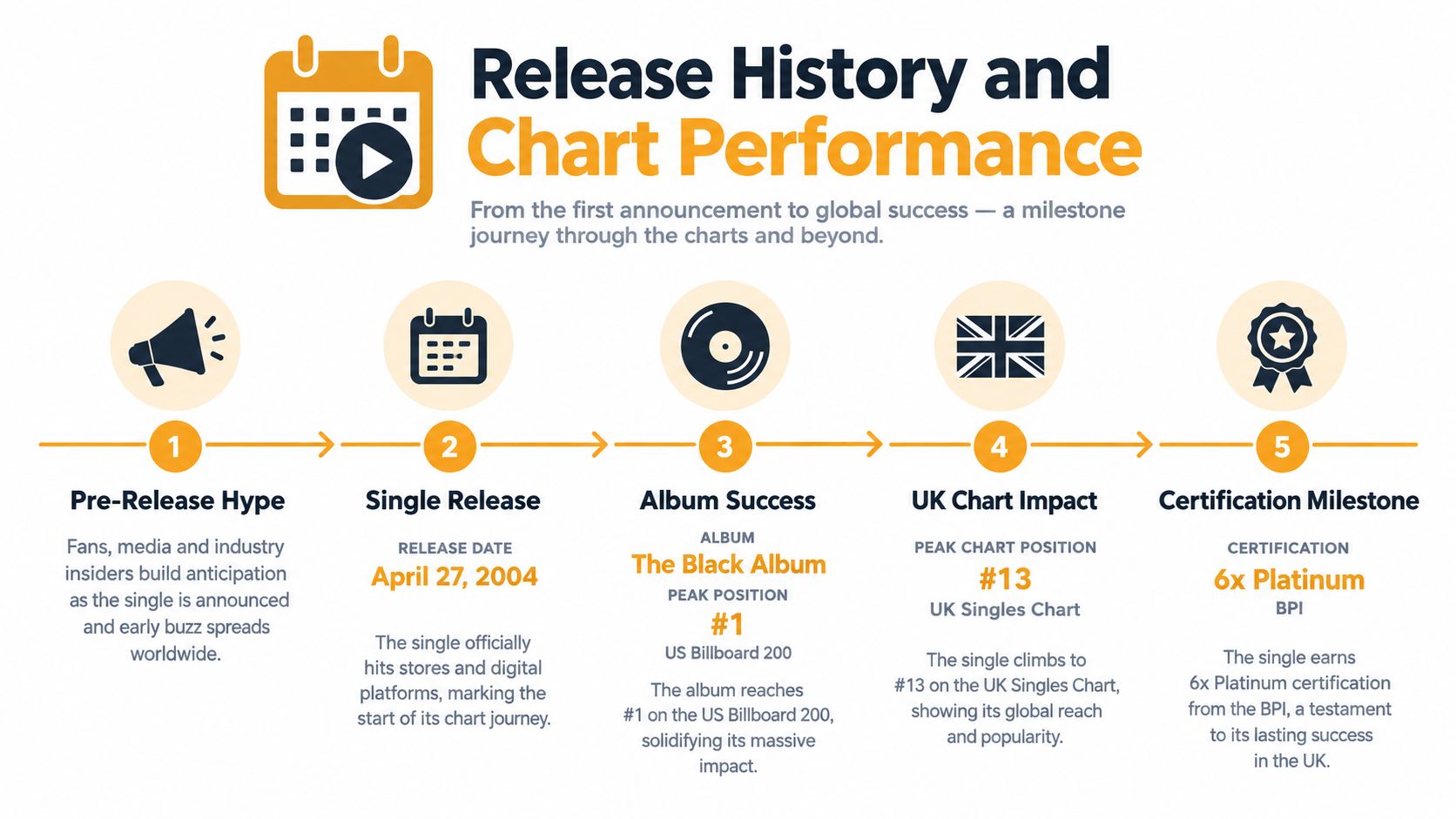
Jay-Z released “99 Problems” as a single on April 27, 2004, after The Black Album arrived in November 2003. The track's timing placed it within a carefully staged mainstream campaign. US radio rollout began on May 24, 2004 for rhythmic contemporary and urban contemporary formats, followed by contemporary hit radio on June 8, 2004, according to the song's documented release history.
That sequence matters because the song's reach wasn't accidental. It moved from an established album into radio formats that could expose it to different audiences, while its aggressive rock-inflected production gave it a sonic identity beyond a conventional rap single. The result was a track that felt rooted in hip-hop but designed to travel across format boundaries.
A cross-market success
The song reached No. 30 on the US Billboard Hot 100, No. 12 on the UK Singles Chart, No. 2 on the UK Hip Hop/R&B chart, No. 23 in Ireland, and No. 67 in Germany, as recorded in the same release and chart history. Those results show strong cross-market performance for a rap single in the early 2000s, particularly one whose subject matter includes a detailed confrontation with policing rather than a simple pop narrative.
| Market | Peak position |
|---|---|
| US Billboard Hot 100 | No. 30 |
| UK Singles Chart | No. 12 |
| UK Hip Hop/R&B chart | No. 2 |
| Ireland | No. 23 |
| Germany | No. 67 |
The song's life didn't end with its original chart cycle. It returned to the UK Top 40 in 2008 after Jay-Z's Glastonbury performance and returned to the US Hot 100 in 2012 after a televised cover performance. Those later appearances indicate that the recording remained culturally active, with new performances giving listeners fresh reasons to revisit it.
For artists studying release strategy, the timeline also illustrates how a single can develop through album placement, radio support, live performance, and cultural reinterpretation. A practical overview of the broader process appears in how to release music, but “99 Problems” remains a particularly vivid example of how a track can outlive its original promotion.
Songwriting Credits and Sampling Origins
The recording's architecture is more complicated than a listener might expect. Coverage of the track identifies at least six sampled source recordings, making “99 Problems” a legal and musical collage rather than a song built from one isolated text or beat. The hook and title connect to Ice-T's earlier recording, while the production draws on rock material including Billy Squier's “The Big Beat” and Mountain's “Long Red,” as described in the Financial Times' account of the song.
That distinction helps separate three elements that casual lyric pages often blend together:
- The inherited hook: Ice-T recorded “99 Problems” for Home Invasion, released on March 23, 1993. Jay-Z retained the recognizable phrase, giving it a new setting. The earlier song's lyric history is documented in Ice-T's “99 Problems” lyrics.
- Jay-Z's new verses: Jay-Z replaced Ice-T's original verse structure with writing about critics, race, policing, and media pressure. The hook remained familiar, but the narrative around it changed.
- The production collage: Rock fragments and sampled source recordings give the beat its abrasive, guitar-driven character. That sound helps the track feel confrontational before the verses even explain why.
Why credits need precision
A catalog entry shouldn't treat the recording as a single-text asset. Reliable metadata should distinguish performer, writer, producer, and sampled-source credits, because each category answers a different question about how the song exists.
The history also creates a useful lesson for lyric writers and producers. A memorable phrase can travel between artists, but its meaning depends on the new verses, arrangement, delivery, and cultural moment. The phrase's lineage connects West Coast rap from the early 1990s with Jay-Z's mainstream East Coast hip-hop in the early 2000s. Learning to build that kind of layered writing is more valuable than copying a surface-level slogan, which is why guidance on how to write better lyrics should include structure, perspective, and context alongside rhyme.
Full Verified 99 Problems Lyrics
Readers searching for the full 99 Problems lyrics usually want a clean reference that follows the recording from the opening scene through the chorus and later verses. The complete text is protected by copyright, so it can't be reproduced here in full. A responsible lyric resource should provide the authorized text through the appropriate rights arrangement rather than copying it into an article without permission.
You can still study the song effectively by using a verified page and following a simple reading method:
- Read the chorus first. Identify the phrase you already know, but don't assume it explains the whole song.
- Read each verse without interruption. Notice who speaks, what the speaker fears, and how the power relationship changes.
- Mark repeated words. Pay attention to terms connected with searching, driving, police authority, and public judgment.
- Return to the chorus. Ask how the surrounding verse has changed its meaning.
- Separate text from interpretation. The lyrics present a character and a situation. Legal analysis should come from qualified legal sources, not from a rap performance alone.
What to listen for
The opening verse establishes movement and risk. The narrator is driving, sees police presence, and weighs whether to stop. That moment creates the song's central conflict: survival requires judgment, but every choice may carry consequences.
The next passages focus more directly on authority, documentation, weapons, searching, and the limits of consent. The narrator's confidence comes from knowing that an officer's request isn't automatically the same as lawful permission. At the same time, the performance communicates vulnerability. The speaker must calculate rapidly while facing a system with greater power.
The language then broadens into criticism of public narratives. Jay-Z presents himself as someone whose success doesn't protect him from suspicion. Fame, money, and confidence can't erase the racial assumptions that shape the encounter.
Reading rule: Don't quote the chorus as if it were the entire argument. The verses supply the legal and racial context that makes the hook carry more than one meaning.
A verified lyric page should also preserve line order, repeated sections, punctuation choices where available, and visible attribution. Those details help musicians rehearse, journalists quote responsibly, and listeners compare the recorded performance with the written text. They also prevent a common mistake, treating a misheard line as an official lyric just because it has circulated widely online.
Official Video and Media Embeds
What changes when you watch “99 Problems” instead of reading its lyrics? The official video adds a visual argument to Jay-Z's account of movement, suspicion, and confrontation. Its black-and-white shooting style, directed by Mark Romanek, gives the scenes a stark, documentary-like quality. The restrained images keep attention on faces, cars, police encounters, and the tension surrounding the narrator.
Watch the traffic-stop verse alongside the video. The lyric describes a person making rapid decisions under pressure, while the visuals frame that encounter as a public performance shaped by authority and racial judgment. The contrast matters: Jay-Z's controlled delivery can sound confident, but the scene also shows how little control the speaker has over what happens next. The video therefore works like a visual lens, narrowing the viewer's attention to the risk beneath the famous hook.
A careful reader can compare four elements:
- Delivery: Jay-Z's timing can make a line sound controlled, sarcastic, or suddenly threatening.
- Production: The distorted guitar material gives the beat a hard edge that suits the confrontation.
- Structure: The repeated hook creates familiarity, while each verse changes the stakes.
- Visual framing: The black-and-white images encourage viewers to read the track as a narrative and social critique, not only as a boast.
The official media also clarifies which recording a reader is hearing. Search results may place live performances, fan edits, lyric videos, or altered uploads beside the original. House of Lyrics provides the artist-approved destination for full lyrics and official media, giving listeners a dependable way to connect the written words with the intended performance.
That pairing helps different audiences for different reasons. A new listener can follow the traffic-stop scene without reducing it to a meme. A long-time fan can revisit how the video's stark presentation reinforces the song's legal and racial themes. The media belongs beside the lyrics because sound, image, and context work together to show what the song is saying.
Why Accuracy Matters in Music Libraries
A wrong lyric can change the story. If a line about a police encounter is misheard as a boast about something else, the reader loses the song's central tension. If a chorus is presented without its surrounding verses, a layered narrative can collapse into a meme.
That problem becomes sharper with songs built from inherited phrases, samples, and multiple credited contributions. A reliable music library needs to show not just words, but provenance. Readers should be able to tell whether a lyric came from an artist or rights holder, whether a page has editorial oversight, and which recording the text belongs to.
Unvetted pages versus verified pages
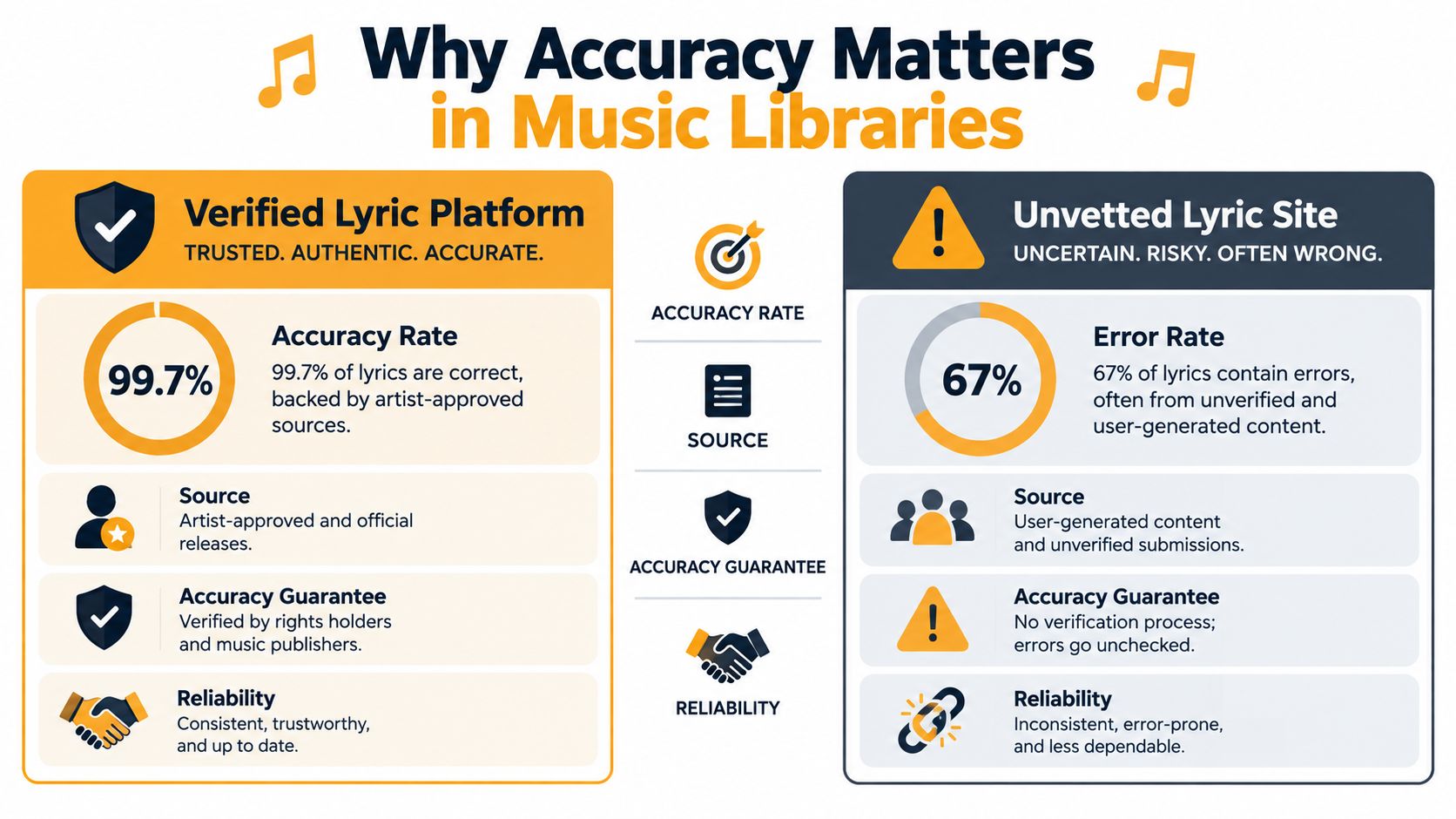
| Unvetted lyric page | Verified lyric library |
|---|---|
| Text may come from anonymous user submissions | Text is connected to an identified artist or rights holder |
| Errors can remain visible without a clear review path | Changes can pass through an editorial review process |
| Credits may be incomplete or blended together | Artist, album, song, and credit information can be separated |
| Media may point to unofficial uploads | Official video embeds can identify the canonical audiovisual source |
This comparison isn't about dismissing fan knowledge. Listeners often catch mistakes that automated systems miss, and fan communities preserve valuable history. The issue is whether a correction has a transparent route from discovery to publication.
Accuracy protects meaning and ownership
Correct words protect more than sing-along convenience. They preserve an artist's phrasing, support accurate journalism, improve accessibility for listeners who rely on text, and reduce confusion between alternate recordings. Proper attribution also acknowledges the writers, producers, performers, and sampled creators whose work shaped the final track.
Editorial review gives that accuracy a process instead of a promise. A practical explanation of that process appears in what an editorial review is, including why human checking remains valuable when lyrics carry cultural, legal, and historical meaning.
How House of Lyrics Ensures Quality
Quality begins with control over who can submit or change catalog information. On an artist-led platform, a page claim should establish that the person managing the profile has a legitimate relationship with the artist, song, album, or rights organization. That makes the public record more accountable than a page built from anonymous edits.
The verification workflow uses a one-time code placed in an X or SoundCloud bio. The code confirms control of a public social profile, creating a practical identity check before an artist or rights holder manages catalog content.
From verification to publication
The process can be understood as a sequence:
- Claim the relevant page. An artist or verified rights holder identifies the artist, album, or song page connected to their work.
- Place the one-time code. The code appears in an X or SoundCloud bio, providing a public signal that the claimant controls the account.
- Complete verification. Once control is confirmed, the claimant can access the editing workflow.
- Update the catalog. The full-page editor supports lyrics, credits, and metadata, keeping related information together.
- Submit changes for review. Edits remain held until the editorial process checks them before public publication.
- Embed official media. The song page can surface an authoritative music video alongside the approved lyric text.
This sequence balances artist control with public reliability. The artist or rights holder knows the catalog can be corrected, while readers receive a page that has passed through an approval step.
A consistent editorial identity also matters across an artist's website, social profiles, press materials, and lyric pages. Teams developing that alignment may find a consistent brand voice framework useful, especially when several people manage one catalog.
The system is particularly relevant to songs such as “99 Problems,” where the lyric, sample lineage, performer identity, and official video all need clear relationships. Accuracy isn't one isolated check. It's the result of connecting the right people, text, credits, and media in one structured record.
Claim Your Artist Page and Manage Content
Artists and rights holders can claim an artist, album, or song page through House of Lyrics' claim process. Verification uses a one-time code placed in an X or SoundCloud bio, helping confirm that the person requesting control manages the relevant public identity.
After verification, the full-page editor lets the page owner manage lyrics, credits, and metadata. Submitted changes are held for review before they appear publicly, so corrections can improve the catalog without turning the page into an open, unmoderated edit field.
That control has a wider cultural value. When artists preserve the exact text, credit contributors, and connect songs to official videos, fans can study music without guessing which version is authentic. A song like “99 Problems” deserves that care because its famous hook carries only part of its meaning.
House of Lyrics brings artist-approved lyrics, structured credits, and official video embeds together so listeners can explore songs with confidence. Visit House of Lyrics to find verified music pages or claim control of your own catalog.