Fuera Del Planeta Lyrics: Artists & Versions
Explore Fuera del Planeta lyrics across artists and versions. Find the official guide to the song's meaning, context, and more.

You hear a hook in a clip, remember only the phrase “fuera del planeta,” and search for the lyrics. The first result looks convincing, until the artist name or recording doesn't match the song in your head. A similar title, a collaboration, or a remix can send you to a different track before you've even read the first line.
That's the catch with “Fuera del Planeta”: the title alone doesn't identify one recording. To find the right lyrics, check the artist lineup, version label, release context, and credits, then use those details to confirm you're following the intended song. If you're searching for lyrics to use as a caption, find caption lyrics for growth offers a separate guide to choosing a lyric for that purpose.
A reliable lyric search starts with the same practical habit as a guide to finding song lyrics: match the words to the recording, not just the title. That distinction matters especially for Latin urban catalogs, where collaborations and remixes can have their own performers, metadata, and histories.
Table of Contents
- Why a Simple Search for These Lyrics Often Goes Wrong
- All the Songs That Share or Resemble This Title
- The Randy Nota Loca and Eloy Single and Its Credits
- How the 2008 Remix Becomes Its Own Song Entity
- Streaming Reach and Why It Confirms Separate Tracks
- How House of Lyrics Presents the Lyrics, Video, and Credits
- Reading Along in Spanish With VersebyVerse Notes
- Why Fan Sites Get the Credits Wrong
- Quick Reference for Every Documented Version
- Why Version Control Matters for Every Spanish-Language Hit
Why a Simple Search for These Lyrics Often Goes Wrong
Search results can make a familiar phrase look like a unique identifier. But a page headed “Fuera del Planeta” may refer to the Randy Nota Loca and Eloy single, a remix with additional performers, or another catalog listing. Someone searching after hearing a short clip may click the first lyric page, only to find that its artist credit doesn't match the voice they recognize.
The misleading assumption is simple: the top result must be the right song. In practice, search pages often place different recordings and similarly titled songs side by side. A lyrics page may show text without making clear whether it belongs to a solo release, a collaboration, or a remix. That leaves the reader to infer the version from a name, an image, or a line of lyrics that might itself have been copied from elsewhere.
The better test is to look for identity markers before reading along:
- Artist lineup: Do the performers match the voices you heard?
- Version label: Does the page say original, solo, collaboration, or remix?
- Release context: Does the date or album listing fit the recording you're trying to find?
- Credits: Are songwriters and producer named, or is the page just an unattributed transcript?
These details help distinguish a valid match from a page that merely shares a title. They also make it easier to check whether a video and a lyric transcription refer to the same recording.
Practical rule: Confirm the performer and version first. Treat the title as a search clue, not proof of identity.
Once those checks are in view, “Fuera del Planeta lyrics” becomes a more precise search: it can point to a particular recording rather than an uncertain bundle of results.
All the Songs That Share or Resemble This Title
The main source of confusion is that “Fuera del Planeta” isn't tied to just one catalog entry. Search results can surface recordings associated with Randy Nota Loca, Eloy, Jowell y Randy, and Zion, as well as a separate ballad whose title begins with “Afuera.” Those names aren't interchangeable credits for one standardized track. They point to different recordings or release contexts that need their own labels.
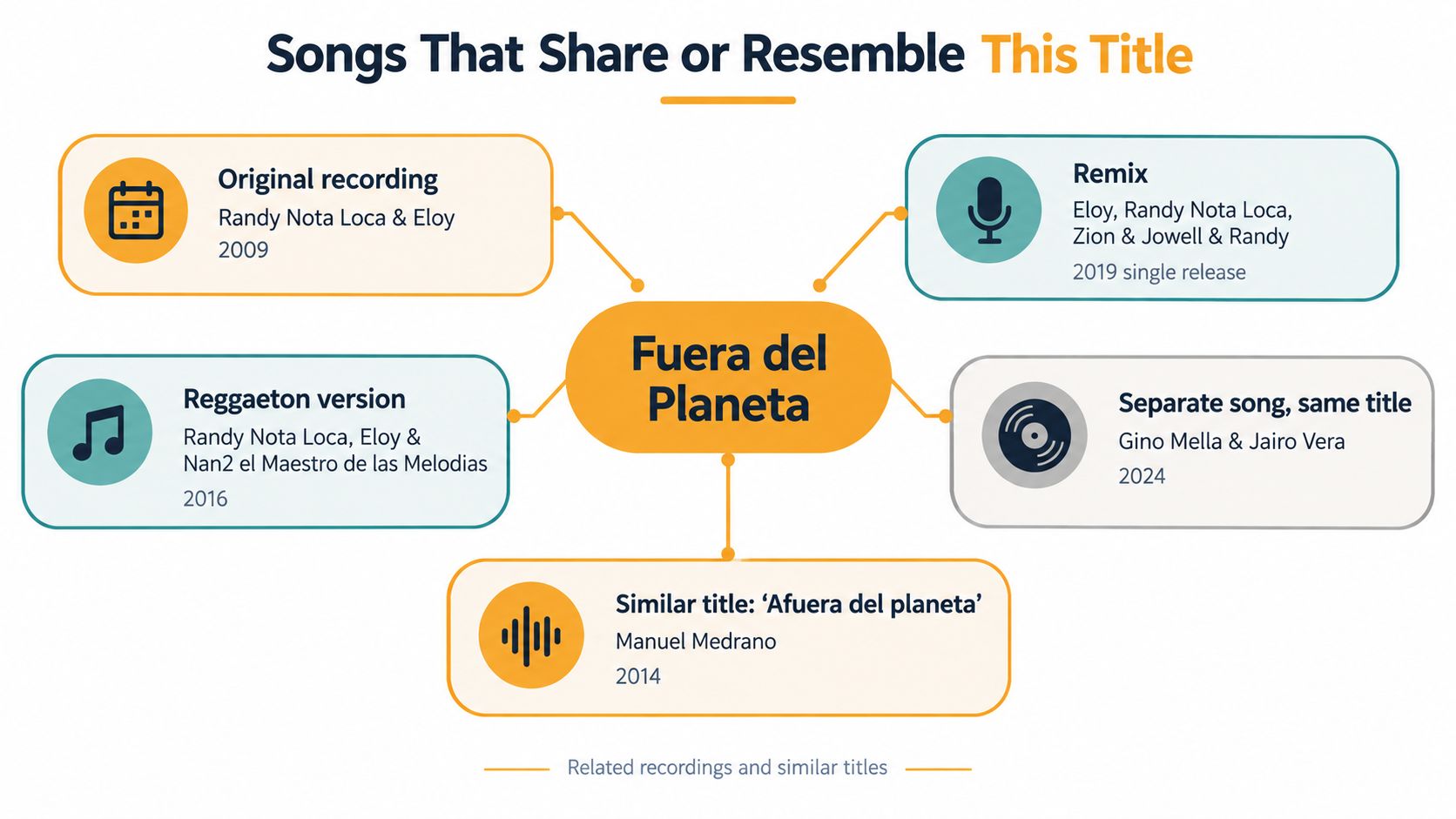
The documented urban entries include the Randy Nota Loca and Eloy single dated March 19, 2009, and a remix credited to Eloy, Randy Nota Loca, Zion, and Jowell & Randy with a January 1, 2008 date. A separate catalog listing places a Randy & Eloy version on Éxitos De Un Romance, dated September 10, 2008. These dates describe different release contexts; they don't establish that every listing refers to an identical recording or lyric text. Shazam's listing for “Fuera del Planeta” provides performer and contributor details for the Randy Nota Loca and Eloy recording, while the available catalog information identifies the remix separately.
There are also listings for Eloy solo and Jowell y Randy versions. Their appearance in search results makes artist names especially important, but the available evidence doesn't provide a complete, independently verified release history for every listing. Treat those entries as possible matches to investigate, not as proof that one lyric transcription applies across them.
Then there's “Afuera del Planeta,” Manuel Medrano's separately titled Colombian ballad, identified as a 2015 recording in the available search results. The initial “a” isn't a trivial typo: it helps distinguish Medrano's song from the urban recordings titled “Fuera del Planeta.” A lyrics page focused on another similarly titled song won't necessarily match the musical style or performer a searcher has in mind. A related Spanish-language song reference also illustrates why a title search is more useful when paired with an artist name.
A dependable search therefore includes both the title and the performer. If the result names extra collaborators or says “remix,” check that label before treating its lyrics as the text for a different release.
The Randy Nota Loca and Eloy Single and Its Credits
A lyric page that names only "Fuera del Planeta" leaves the reader guessing which recording it transcribes. The two-artist single offers firmer ground. Apple Music lists Luis Eloy Hernández Del Valle and Randy Ortiz Acevedo as lead vocalists and identifies Walde The Beatmaker as producer, with songwriting and composition credits going to Félix Ortiz Torres, Joel A. Muñoz Martínez, Randy A. Ortiz Acevedo, and Luis Eloy Hernández. Apple Music's recording and credits listing gives readers a concrete reference for checking those names against any lyric page they find.
| Role | Name |
|---|---|
| Lead vocalist | Luis Eloy Hernández Del Valle |
| Lead vocalist | Randy Ortiz Acevedo |
| Songwriter and composer | Félix Ortiz Torres |
| Songwriter and composer | Joel A. Muñoz Martínez |
| Songwriter and composer | Randy A. Ortiz Acevedo |
| Songwriter and composer | Luis Eloy Hernández |
| Producer | Walde The Beatmaker |
The dates deserve the same scrutiny as the names. Apple Music dates the single to March 19, 2009, while another catalog listing places a Randy & Eloy version on Éxitos De Un Romance with a September 10, 2008 release date. Two dates, two release contexts. A reader who treats one listing's date as universal may mislabel a reissue or assume the album version and the single are the same entry.
Read the credit trail as part of the song identity
Each credit type answers a different question. Performer credits say who sings, songwriter and composer credits record who wrote the underlying work, and producer credits identify who shaped the recording. Pages that collapse these roles into a bare artist name strip out the evidence a reader needs to confirm which version a transcription belongs to.
That evidence matters when citing the track or comparing lyric pages side by side. If a page uses the Randy Nota Loca and Eloy title but omits the credited performers, songwriters, and producer, its text could belong to any similarly titled release. House of Lyrics offers guidance on metadata management for music pages that explains why consistent labeling of names and roles keeps a catalog trustworthy.
How the 2008 Remix Becomes Its Own Song Entity
The remix credited to Eloy, Randy Nota Loca, Zion, and Jowell & Randy has its own release context, dated January 1, 2008. Its lineup differs from the Randy Nota Loca and Eloy single, so it shouldn't be treated as a duplicate entry that merely adds a subtitle. The additional performers are part of the recording's identity.
That distinction has practical consequences for lyrics and credits. If a page merges the remix with the two-artist single, a reader may not know which performers belong to the version playing in a clip. The page can also obscure which release date and contribution list apply. Keeping the recordings separate preserves a clearer record for fans and for anyone checking attribution.
The chronology may initially seem counterintuitive: the remix's listed date comes before the single's date. That's a reason to read version labels alongside dates, rather than sorting results by year and assuming the earliest entry must be the original. Catalog dates reflect specific release contexts; by themselves, they don't prove how the recordings relate or establish that their lyrics and credits are interchangeable.
Choose the page that matches the recording
- Choose the remix entry when the artist lineup includes Zion and Jowell & Randy, alongside Eloy and Randy Nota Loca.
- Choose the Randy Nota Loca and Eloy entry when that two-artist credit matches the recording you're checking.
- Pause on a vague listing when it gives the title without a clear performer lineup or version label.
This is the same principle that helps listeners with other songs whose titles overlap across releases, such as a separate lyrics reference for “Body Electric”: a song page needs enough identifying detail to show exactly which recording it describes.
Streaming Reach and Why It Confirms Separate Tracks
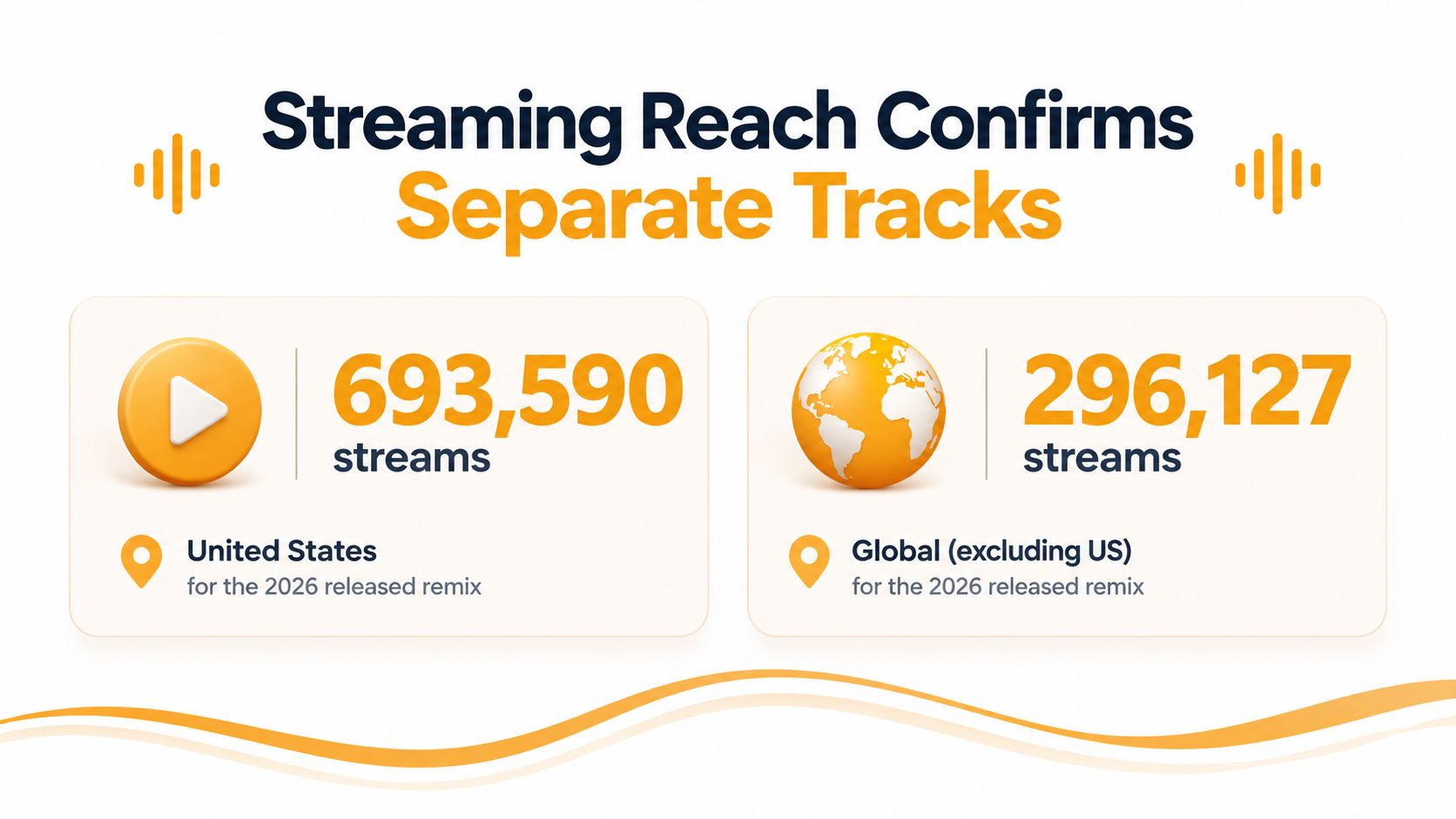
Chart data does something a lyric transcription cannot: it shows which recording listeners streamed. The streaming-history figures on record attach to the "Fuera Del Planeta (Remix)" credited to Eloy, Randy Nota Loca, Zion, and Jowell & Randy, not solely to the Randy Nota Loca and Eloy single. In one listed market, the remix has 693,590 cumulative streams and a peak position of 130; in another, it has 296,127 streams and a peak of 113. The chart-history entry also records 590,965 streams and a peak of 133 in a further market, and 139,633 streams with a peak of 121 in another. These figures are attached to the remix in the chart-history entry for the track.
The same entry lists smaller totals of 5,442 and 2,048 streams, with peak positions of 187 and 24. Those market labels matter. The figures should be read as values in particular listed markets rather than relabeled as US or global totals without confirmation. They show circulation across more than one market, yet they cannot compare the remix and the single on equal terms unless the chart data identifies both recordings separately.
A chart figure only helps if it belongs to the right track. Before citing one, a reader should confirm four details:
- The displayed title: Does it include "Remix"?
- The performers: Does the lineup include Zion and Jowell & Randy?
- The chart entry: Does it refer to the same song entity as the recording in question?
- The market label: Is the figure attached to a specific country or other listed market?
Numbers tied to a remix have no place in a different recording's history. When attribution is correct, the chart data describes what it measures, and separate catalog entries stay separate instead of collapsing into a misleading comparison.
How House of Lyrics Presents the Lyrics, Video, and Credits
A lyric page is more useful when it identifies the recording and shows where its text and supporting details came from. House of Lyrics is an artist-run music and lyrics library that pairs artist-approved lyrics with official video embeds and structured credits. Its song pages sit within linked artist and album pages, giving fans a way to move through a catalog without relying on title alone.
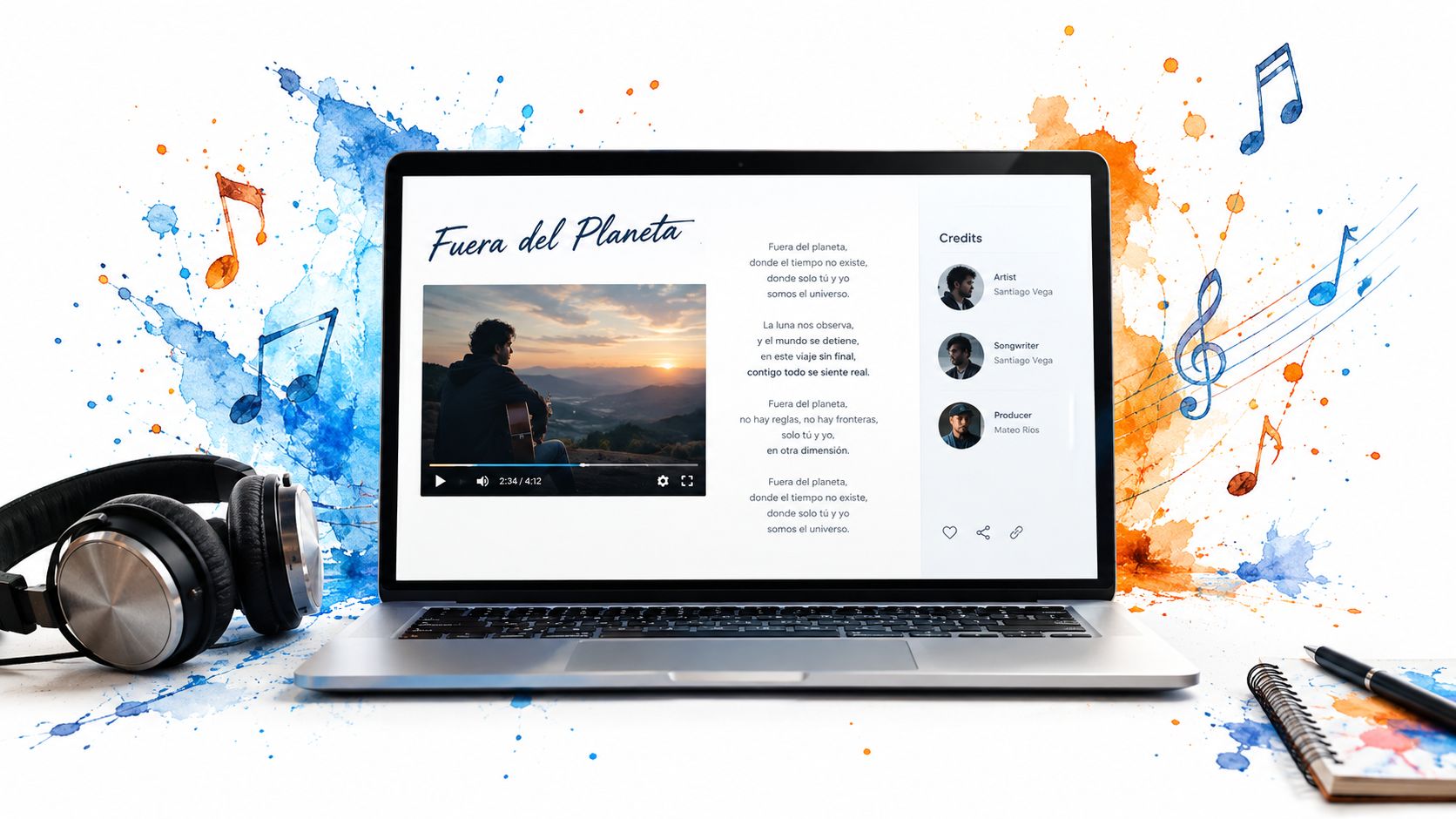
The practical checks are straightforward:
- Read the version label. Look for a clear distinction between a solo-artist recording, a collaboration, and a remix.
- Inspect the credits. Confirm the listed performers and other named contributors before sharing or citing the lyrics.
- Use the video as a recording check. An official music video embed gives the reader audiovisual context alongside the text, though the video should still be matched to the version label.
- Check who supplied the text. Visible attribution helps distinguish artist-approved lyrics from an unverified user transcription.
House of Lyrics also allows verified artists and rights holders to claim artist, album, and song pages. Verification uses a one-time code placed in an X or SoundCloud bio. The page owner can edit lyrics, credits, and metadata through a full-page editor, and changes go through editorial review before appearing publicly. That workflow provides a way to correct a page without presenting every submitted change as automatically approved.
For “Fuera del Planeta,” those features make the page's version label and credits central to the reader's decision. An official video and an attributed lyric text can support identification, but the performer lineup still needs to match the recording someone has in mind.
Reading Along in Spanish With VersebyVerse Notes
The title can be read as “out of this world” or “off the planet.” In a song title, that wording can function as hyperbole for something extraordinary rather than a literal reference to space. The exact meaning still depends on the recording and its context, so it's best not to infer a full lyrical theme from the title alone.
For a Spanish learner, listen for the song's overall attitude before translating individual phrases. The documented Randy Nota Loca and Eloy recording belongs to a Puerto Rican urban music context, and a party-forward delivery may carry meaning through rhythm, performance, and slang as much as through literal vocabulary. “Planeta” can work as an emphatic image; it doesn't automatically signal a science-fiction setting.
A segmented lyric page makes it easier to follow the track without turning the listening experience into a word-by-word puzzle. Use the layout as a guide:
- Identify the sections. Repeated refrains are easier to recognize when the page marks returns clearly.
- Read one verse at a time. Note a verse's general mood or subject before looking up every unfamiliar term.
- Treat slang as contextual. A phrase can have a local or performance-specific meaning that a direct dictionary translation won't capture.
- Match the page to the audio. A correct translation is still unhelpful if it belongs to another recording.
This is a useful approach for other Spanish-language lyric searches as well. A reference such as “Amor Prohibido” lyrics can help readers see why title, artist, and readable song structure belong together, while the actual phrasing should always be checked against the intended recording.
Why Fan Sites Get the Credits Wrong
Credits tend to drift at the exact point a transcript gets copied. A page built on user submissions can drop a songwriter, merge two performers into one line, or carry wording from the 2008 remix onto the single without flagging the switch. Once that version is reposted, the same gap travels with it, and a reader has no way to tell which recording the text was checked against.
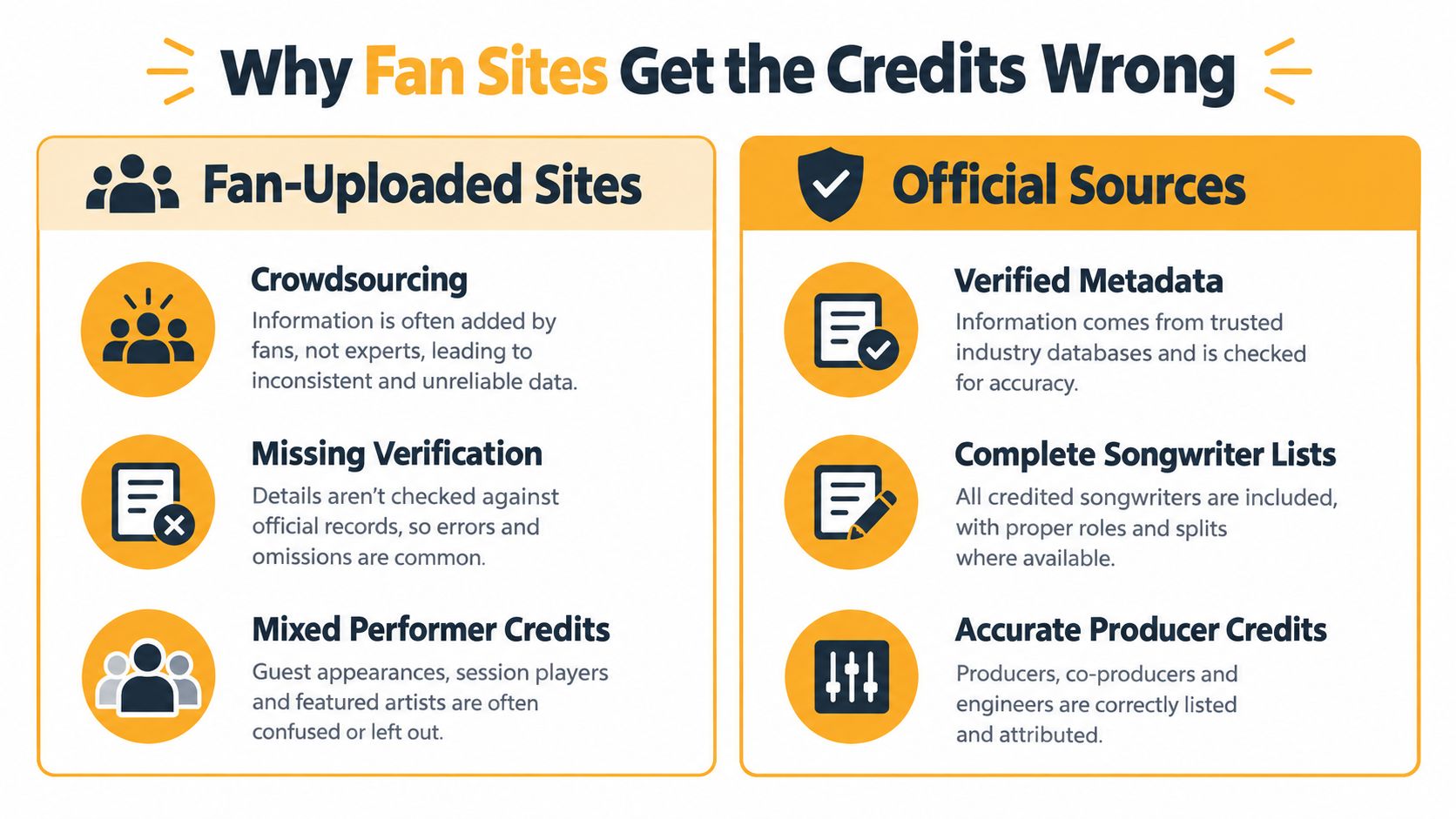
The problem is rarely that a fan page is wrong on purpose. It is that its provenance is hard to see. Before repeating a credit as fact, compare the artist lineup, named writers, producer, and version label against a catalog listing. A misattributed composer causes more harm than a trivia slip because it misstates who made the work.
House of Lyrics runs a different contribution model: verified artists and rights holders claim pages and submit edits that are reviewed before publication, so page-owner submissions stay distinguishable from unverified edits. That contrast matters more than any single correction, because it shows whether a change came from someone accountable for the recording.
Readers who want to assess these differences can consult House of Lyrics' guidance on music metadata management. The working habit stays the same either way: treat an unclear lyric page as a lead, then look for a source that names the recording and makes its credits traceable.
Quick Reference for Every Documented Version
| Version | Artists | Release year | Credit notes |
|---|---|---|---|
| Single | Randy Nota Loca and Eloy | 2009 | Lead vocalists, songwriters, and producer are listed in Apple Music credits. |
| Album listing | Randy & Eloy | 2008 | Catalog entry on Éxitos De Un Romance. |
| Remix | Eloy, Randy Nota Loca, Zion, and Jowell & Randy | 2008 | Separate performer lineup and remix-specific chart history. |
| Solo listing | Eloy | Not established here | Appears as a separate search result; confirm the exact recording and credits. |
| Similar title | Manuel Medrano, Afuera del Planeta | 2015 | A separate ballad, not a recording titled Fuera del Planeta. |
The table separates documented release contexts from listings whose dates and full credits aren't established here. Check the relevant song page for its lyrics, video, and contributor details; rights holders can claim a page to manage its metadata.
Why Version Control Matters for Every Spanish-Language Hit
“Fuera del Planeta” offers a transferable lesson for searching Spanish-language music: a title is only part of a song's identity. Collaborations, remixes, aliases, similar spellings, and alternate release contexts can all put different recordings under nearly identical search terms. Readers get a more dependable match by checking the artist, version, and credits before citing lyrics or sharing a video.
That's a publishing issue as much as a listening issue. Clear change records help editors and rights holders track what was updated and why; TheContentMap's editorial workflow tips offer broader context for thinking about review and version control. The same principle applies to music pages: preserve the distinctions that let readers verify what they've found.
Visit House of Lyrics to browse song pages that pair artist-approved lyrics with official video embeds and structured credits. If you represent a recording or its rights holders, claim the relevant page and submit corrections so fans can find the right version with confidence.