Mi Princesa Letra: Lyrics, Artists, and Where to Find Them
Find the full mi princesa letra across David Bisbal, Remmy Valenzuela, and more. Includes verified credits, official videos, and song context.

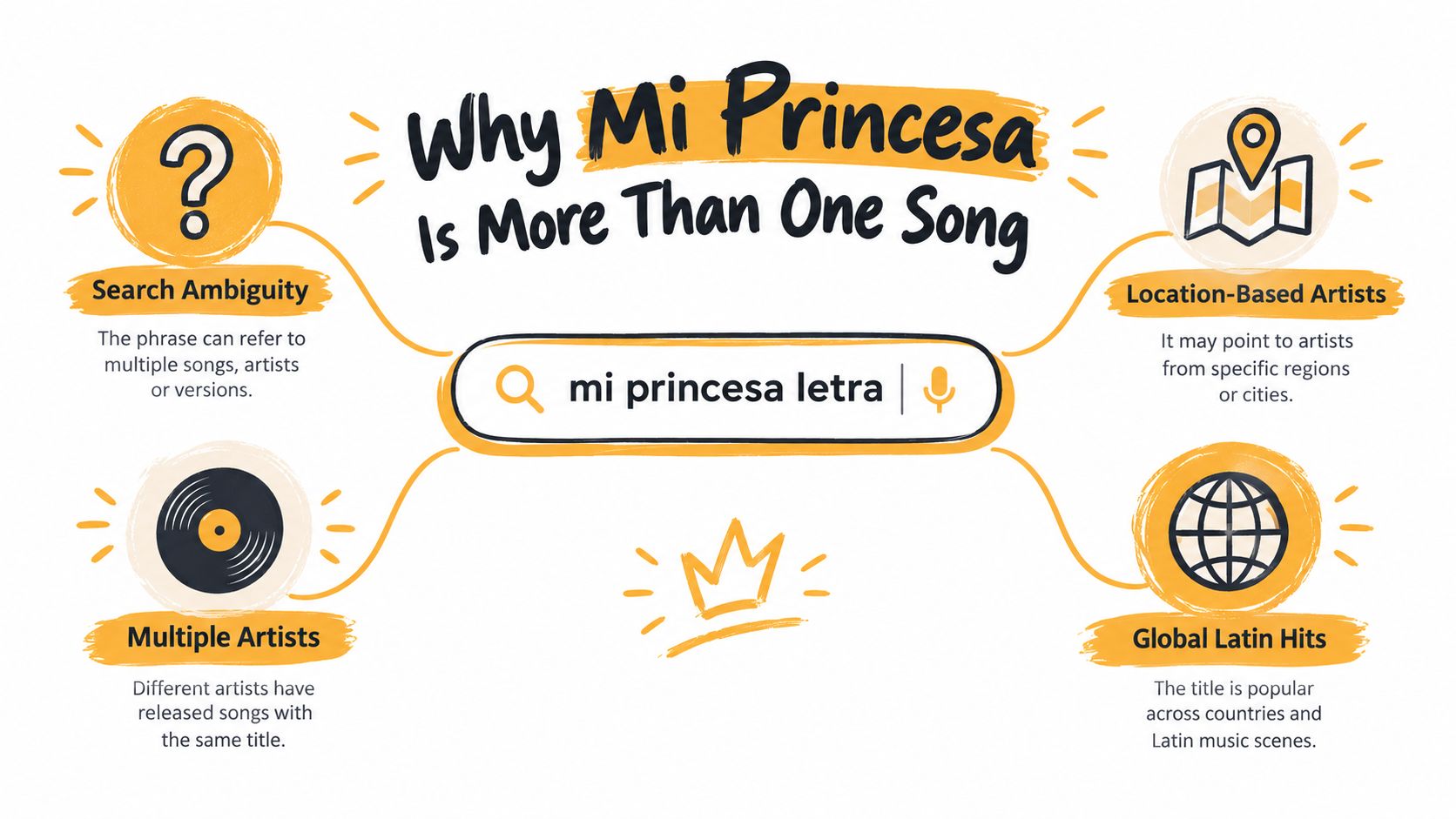
Have you ever searched for “Mi Princesa letra” and assumed the results all pointed to one song? That assumption is the main source of confusion. Mi Princesa is a recurring Spanish-language music title, and several artists have used it for songs with different melodies, arrangements, subjects, and credits.
The best-known search result is usually David Bisbal's romantic pop recording, but it isn't the only documented version. This guide treats the phrase like a music librarian would: first identify the artist, then verify the album, release context, genre, and available metadata before trusting a lyric page.
Table of Contents
- Why Mi Princesa Is More Than One Song
- David Bisbal's Mi Princesa and Its Signature Lines
- Verified Credits and Album Context for the Bisbal Recording
- Remmy Valenzuela's Música Mexicana Interpretation
- Other Documented Mi Princesa Recordings Across Artists
- Music Metadata Fields Behind Every Version
- Official Video Embeds and Content ID Attribution
- Romantic, Family, and Devotional Readings of the Lyrics
- How Artist, Album, and Song Pages Connect on House of Lyrics
- Navigating the Catalog With Cross-References
- Quick Reference of Documented Mi Princesa Recordings
- Common Questions About Mi Princesa Lyrics
Why Mi Princesa Is More Than One Song
A song title is only useful when it identifies the recording behind it. Mi Princesa, however, functions as a repeated romantic and devotional title across Latin music catalogs. David Bisbal's recording is tied to Sin Mirar Atrás and is listed by major music services with a release date of 2009-10-20, while Remmy Valenzuela has a separate Música Mexicana release dated 2015-10-06. These entries represent different recordings, not alternate pages for the same track. Catalog references for the recurring title show how the name has been reused by artists working in different styles.
The phrase is easy to reuse because it's short, emotionally direct, and immediately understandable. “My princess” can address a lover, a daughter, a family member, or a spiritual figure. That flexibility allows the title to travel from Latin pop to regional Mexican, Christian, and other Spanish-language settings without carrying one fixed meaning.
Start with the artist, not the title
If the page shows David Bisbal, you're likely looking for the polished Spanish pop ballad associated with his catalog. If it names Remmy Valenzuela, expect a Música Mexicana context instead. Other documented entries include songs by Carolyn Chajón, Waleska Morales, Josh Morales, Miel San Marcos, Víctor Muñoz, and others.
A lyric fragment can help, but it shouldn't be your only test. Compare the performer, album, genre, and release information, then confirm whether the page identifies an original recording or a version with the same title. That simple process is more reliable than choosing the first result.
For a broader lesson in separating songs that share a phrase, compare how lyric searches can also become ambiguous with other song-title searches. The same principle applies here: the title gets you close, but the catalog context tells you where you are.
David Bisbal's Mi Princesa and Its Signature Lines
David Bisbal's “Mi Princesa” is the version many listeners mean when they type the search phrase. Its emotional center is a direct address to an idealized beloved, with the narrator using the image of a princess to express admiration, longing, and devotion.
The most recognizable lyric fragments include:
“Qué milagro tiene que pasar para que me ames”
and:
“Eres la princesa de mis sueños encantados”
Those lines matter for identification because people often remember a phrase from the chorus or a verse without remembering the artist. Searching either fragment alongside David Bisbal should distinguish this recording from other songs with the same title.
The song's mood is romantic rather than folkloric or devotional. Its language presents the beloved as someone associated with dreams and emotional distance, so the word “princess” works as a metaphor for idealized love, not necessarily a literal family relationship. That reading is one of the strongest clues separating Bisbal's version from other catalog entries.
Listeners can also distinguish it by sound. The recording belongs to the polished Spanish pop tradition associated with Bisbal's romantic repertoire, rather than the regional Mexican approach associated with Remmy Valenzuela. If the version you remember has a different rhythmic foundation, vocal attack, or palette, you may have found another Mi Princesa letra entirely.
The safest search pattern combines three elements:
- Artist: David Bisbal
- Title: Mi Princesa
- Lyric fragment: “Qué milagro tiene que pasar para que me ames”
That combination reduces the chance of confusing a title match with the song you heard.
Verified Credits and Album Context for the Bisbal Recording
Catalog research requires careful handling because available listings don't always agree. The strongest verified data for the Bisbal recording identifies David Bisbal as the performer, Amaury Gutiérrez as the songwriter credit shown by JioSaavn, and Sin Mirar Atrás as the album. Major music catalogs also list the album track with the release date 2009-10-20. The documented Bisbal catalog reference provides the relevant title and lyric context.
That information is more dependable than an isolated lyric page that gives only a title and artist. A useful catalog snapshot should preserve the fields that let another listener reproduce the identification.
Bisbal's Mi Princesa catalog snapshot
| Field | Value |
|---|---|
| Recording | Mi Princesa |
| Performer | David Bisbal |
| Album | Sin Mirar Atrás |
| Release date listed in major catalogs | 2009-10-20 |
| Songwriting credit documented by JioSaavn | Amaury Gutiérrez |
| Musical context | Spanish-language pop |
| Identification clue | “Qué milagro tiene que pasar para que me ames” |
The release date is especially useful when several pages display the same title. A page naming the album but omitting the performer, date, or songwriting information gives you less evidence that it has matched the correct recording.
Cataloging rule: Treat the song title as a starting point. The performer, album, date, and songwriting fields together provide the stronger identity check.
Readers who are building a lyric reference collection can apply the same approach to another catalog-oriented lyrics example. The objective isn't merely to find words. It's to connect those words to the correct underlying recording and work.
Remmy Valenzuela's Música Mexicana Interpretation
Remmy Valenzuela's “Mi Princesa” belongs to a different musical setting. His catalog entry identifies the track with the Música Mexicana genre and an album date of 2015-10-06. That date separates it clearly from the Bisbal listing, even before you listen to the arrangement.
The contrast is practical. Bisbal's recording points toward Spanish-language pop and a romantic ballad sensibility. Valenzuela's version should be evaluated within a regional Mexican catalog, where vocal phrasing, accompaniment, and performance conventions create a different listening experience. A searcher who remembers a more regional sound shouldn't discard the title just because the first result features Bisbal.
Bisbal vs. Valenzuela at a glance
| Field | David Bisbal | Remmy Valenzuela |
|---|---|---|
| Recording title | Mi Princesa | Mi Princesa |
| Documented catalog date | 2009-10-20 | 2015-10-06 |
| Broad genre context | Spanish-language pop | Música Mexicana |
| Album context | Sin Mirar Atrás | Música Mexicana catalog entry |
| Performer identity | David Bisbal | Remmy Valenzuela |
| Best search clue | Romantic pop lyric fragments | Regional Mexican artist and catalog context |
The title alone cannot tell you whether you're hearing a pop ballad or a regional Mexican performance. Use the performer name and catalog date together, then listen for the arrangement and delivery. A regional Mexican result belongs beside, not underneath, the Bisbal result.
For browsing broader genre groupings, the Latin music genre index can help place a title in a wider catalog without assuming that every similarly named track shares a musical lineage.
Other Documented Mi Princesa Recordings Across Artists
The title continues beyond Bisbal and Valenzuela. Independent catalog listings document later or distinct Mi Princesa songs associated with artists such as Carolyn Chajón, Waleska Morales, Josh Morales, Miel San Marcos, and Víctor Muñoz. Their presence reinforces the central identification lesson: a matching title doesn't prove that one artist covered another artist's recording.
Some entries sit near Latin pop, while others connect with Christian or devotional catalogs. That difference can change the meaning of the title. A romantic address to a partner and a devotional address to a spiritual figure may use the same phrase while telling entirely different stories.
A guided listening check
When you open a lesser-known result, look for these clues before reading the lyrics:
- Performer field: Confirm who recorded the track.
- Genre description: Treat genre as context, not proof, but use it to flag an unexpected match.
- Album or single information: A separate release entry can show that the song is an independent work.
- Lyric vocabulary: Words connected with family, faith, home, or protection may signal a different subject.
- Credit completeness: Lesser-known entries may provide fewer composer, label, or identifier fields.
Catalog dates for versions of the title span multiple years, including entries from 2014 through 2026, according to the documented reference. The catalog evidence for repeated reuse supports a historical reading of Mi Princesa as a recurring title rather than a one-off hit.
That pattern explains why translation pages and lyric pages can appear side by side. A translation may describe one version while a searcher has another in mind. An English translation result for a distinct Mi Princesa entry illustrates the need to verify the artist before interpreting the text.
Music Metadata Fields Behind Every Version
Metadata gives each recording its identity. For a casual listener, the terms can seem technical, but they answer straightforward questions: Which recording is this? Which composition does it use? Who should receive credit?
ISRC identifies a specific sound recording. A new recording, edit, or distinct mix can require its own identifier. ISWC identifies the underlying musical work or composition, which may exist separately from any one performance. The distinction matters because two recordings can share a composition while having different performers, production, and recording identifiers.
The fields that deserve attention
- Composer and lyricist: These credits identify the people responsible for the underlying music and words. They may overlap, but they don't mean the same thing automatically.
- Performer: This names the artist or group heard on the recording.
- Label and distributor: The label may control or release the master, while a distributor delivers it to platforms and territories.
- Release date: This helps separate similarly titled entries and regional editions.
- Format and territory: A single, album track, live version, or localized release may appear as a distinct catalog item.
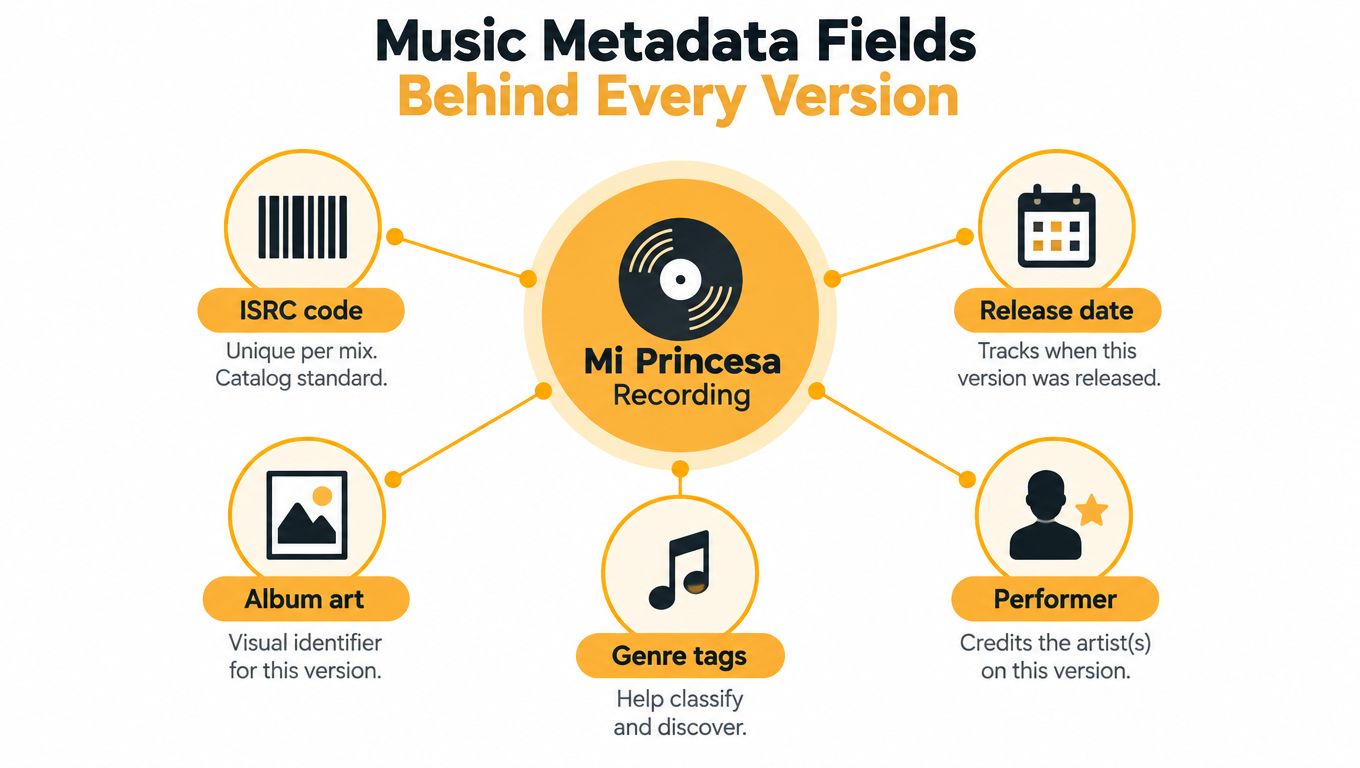
Music metadata guidance also emphasizes the separate roles of identifiers, creative credits, performers, labels, and release dates for discovery, royalty allocation, and rights administration. A practical music metadata guide explains why these fields should remain distinct rather than being compressed into one descriptive line.
For anyone checking a video entry, a platform-specific video metadata checklist can provide a useful way to review title, artist, description, and attribution fields.
Here is the kind of row a careful catalog might display:
| Recording | Performer | ISRC | ISWC | Release date | Label |
|---|---|---|---|---|---|
| Mi Princesa | Named artist | Recording identifier | Work identifier | Catalog date | Releasing label |
The row doesn't replace the audio. It gives the audio a traceable identity.
For editorial standards and the difference between a metadata page and a reviewed entry, see this explanation of editorial reviews.
Official Video Embeds and Content ID Attribution
A video can provide useful evidence, but only when its attribution is clear. YouTube explains that “Music in this video” information may be added automatically when copyright management tools such as Content ID claim a video. Metadata can then appear in the description area to identify the song and artist. YouTube's documentation on music attribution is the most direct reference for how that information can surface.
For a Mi Princesa search, begin with the channel. An artist's verified channel or an official topic channel is stronger evidence than a re-upload account. Then inspect the description for the original song and artist information, rather than relying only on text burned into the video frame.
Signals that help identify an official upload
- Channel identity: The uploader should connect clearly to the artist, label, or recognized music catalog.
- Description metadata: Look for song and artist details supplied alongside the video.
- Audio consistency: Compare the vocal performance and arrangement with the version named on the lyric page.
- Rights indicators: A Content ID-linked attribution can help establish that the platform recognizes the music asset.
A lyric video with copied text may still point toward the right song, but it isn't automatically an authoritative source. Re-uploaded videos can combine the wrong lyrics with the right title, especially when several artists share Mi Princesa.
Practical rule: Verify the audio, performer, and rights attribution together. One matching word in a video title isn't enough.
Romantic, Family, and Devotional Readings of the Lyrics
The phrase “my princess” carries different emotional meanings across recordings. In David Bisbal's documented version, the language points toward a romantic relationship. The beloved is idealized through dreams, longing, and direct appeals for love, so “princess” operates as a metaphor for a partner.
Other versions may use the title in a family setting. A singer can address a daughter or another cherished family member with language centered on protection, home, honor, or care. The same affectionate phrase then carries a different relationship, even if the title remains unchanged.
A devotional reading can appear in Christian or spiritually oriented music. In that context, “princess” may refer to a sacred figure, a spiritual ideal, or a person framed through faith. The genre and surrounding vocabulary become essential because the title itself offers no reliable answer.
Read the relationship through the wording
Look for shifts in address and imagery:
- Romantic clues: Direct appeals to a lover, references to desire, dreams, or the heart.
- Family clues: Language about home, childhood, protection, gratitude, or lifelong care.
- Devotional clues: References to heaven, prayer, grace, spiritual guidance, or sacred identity.
Pronouns can also help. Familiar tú and intimate declarations often suggest a personal romantic or family address, while more formal language may create distance or reverence. These are interpretive signals, not absolute rules.
Translation adds another layer. A literal English rendering may preserve the words but miss whether “princess” is romantic, familial, or devotional. The safest approach is to identify the performer first, then read the lyric in the context of that artist's recording.
How Artist, Album, and Song Pages Connect on House of Lyrics
A reliable lyric catalog should show how a song belongs to an artist and an album, rather than presenting an isolated block of text. The structure begins with the artist page, where a performer's releases are grouped. An album page then supplies the tracklist and release context, while the individual song page carries the lyrics, credits, identifiers, and video connection.
For a title like Mi Princesa, that relationship prevents accidental merging. David Bisbal's page should lead to the relevant Sin Mirar Atrás entry, while Remmy Valenzuela's page should lead to his separate Música Mexicana context. The song title may be identical, but the linked performer and album entities keep the recordings distinct.
A reader's path through the catalog
- Artist page: Confirm the performer and browse the surrounding discography.
- Album page: Check the release context and tracklist.
- Song page: Review the lyric text, composer, lyricist, recording identifier, and video.
- Credit links: Follow writers and rights information when the catalog exposes them.
Rights holders need a stronger route for corrections. A verified artist, manager, label, or distributor should be able to document control of the relevant recording before changing credits or lyrics. That protects the catalog from casual edits and helps preserve the difference between an official text and an unofficial transcription.
Readers can start with the artist directory when the search result identifies a performer but not the album. From there, the cross-linked catalog should make it easier to confirm whether the page represents the Bisbal recording, the Valenzuela release, or another song that shares the title.
Navigating the Catalog With Cross-References
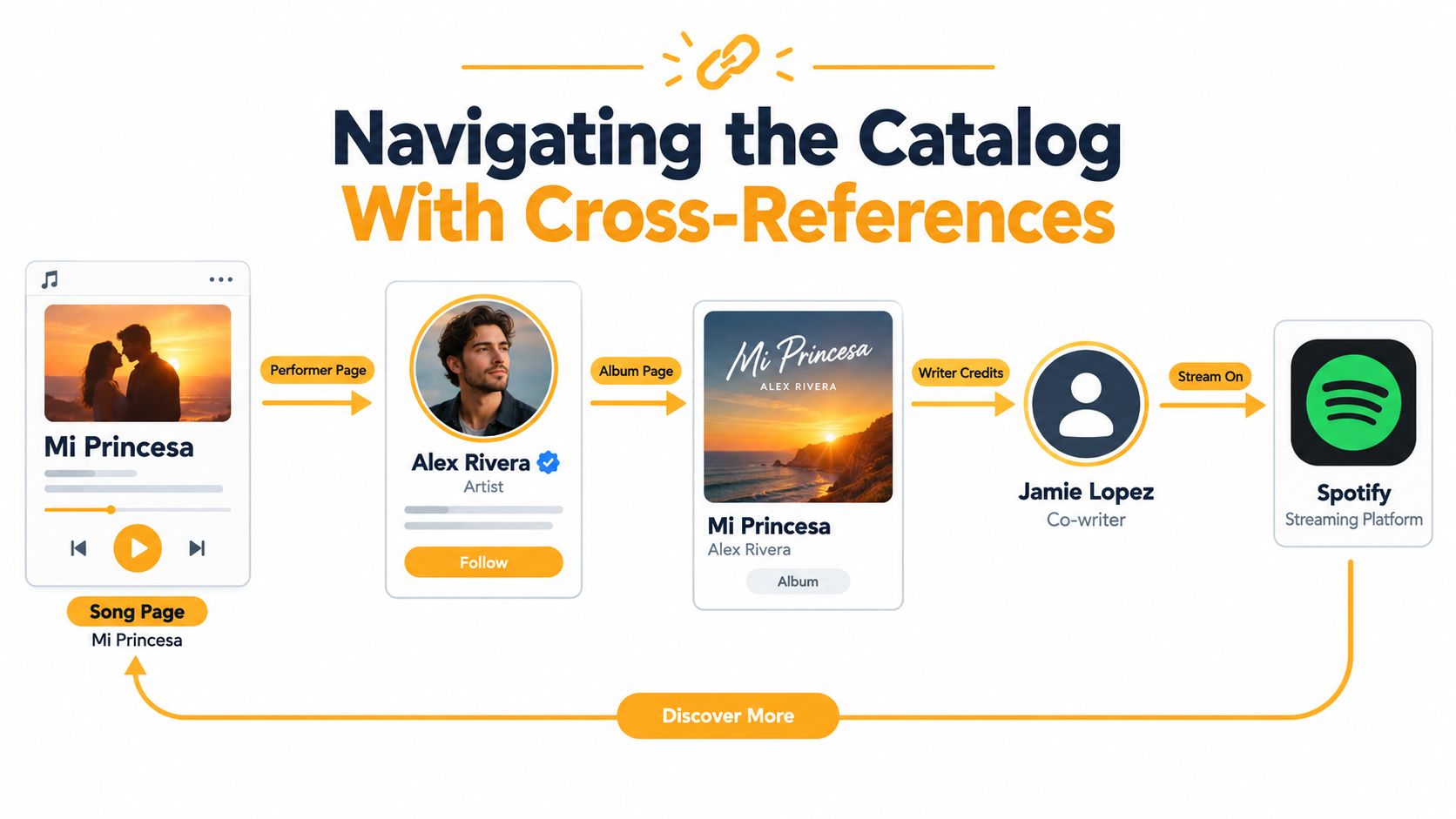
Cross-references turn a lyric search into a guided path. Start with the song page, then move to the performer, the album, and the credited writers. Each link answers a different question, and together they reduce the guesswork created by repeated titles.
Suppose you find Mi Princesa beside David Bisbal's name. Selecting the artist should open the performer's broader discography. Selecting Sin Mirar Atrás should reveal the album context and neighboring tracks. The reverse route works too. Start with an album, open its tracklist, and use the title only after the performer and release have already been established.
Use filters to preserve context
Genre, release period, label, and writer fields can help you branch from one version to another without collapsing them into a single result. A searcher moving from Bisbal's Spanish pop recording to Valenzuela's Música Mexicana entry should retain the artist and catalog context at every step.
Writer profiles can add another layer. If a songwriter appears on several tracks, that profile can reveal related compositions, but it shouldn't be used to assume that every song with the same title belongs to the same work. The ISWC and ISRC distinctions covered earlier are important here. One identifies the composition, while the other identifies the specific recording.
Navigation habit: Follow the links in this order when the title is ambiguous, song, performer, album, then credits.
Quick Reference of Documented Mi Princesa Recordings
The table below is a practical starting point, not a substitute for listening or rights confirmation. The documented data is strongest for the David Bisbal and Remmy Valenzuela entries. Information for lesser-known versions may be incomplete, especially where public listings don't expose songwriter, label, identifier, or video details.
| Artist | Year or catalog date | Genre | Label | Songwriter credit | ISRC available | Official video verified |
|---|---|---|---|---|---|---|
| David Bisbal | 2009-10-20 | Spanish-language pop | Not established in the verified data | Amaury Gutiérrez, as credited by JioSaavn | Not established in the verified data | Not established in the verified data |
| Remmy Valenzuela | 2015-10-06 | Música Mexicana | Not established in the verified data | Not established in the verified data | Not established in the verified data | Not established in the verified data |
| Carolyn Chajón | Cataloged among later or distinct entries | Not established in the verified data | Not established in the verified data | Not established in the verified data | Not established in the verified data | Not established in the verified data |
| Waleska Morales | Cataloged among later or distinct entries | Not established in the verified data | Not established in the verified data | Not established in the verified data | Not established in the verified data | Not established in the verified data |
| Josh Morales and Miel San Marcos | Cataloged among later or distinct entries | Not established in the verified data | Not established in the verified data | Not established in the verified data | Not established in the verified data | Not established in the verified data |
| Víctor Muñoz | Cataloged among later or distinct entries | Not established in the verified data | Not established in the verified data | Not established in the verified data | Not established in the verified data | Not established in the verified data |
The table deliberately leaves unsupported fields open. A blank or unconfirmed field is more useful than a fabricated label or identifier because it tells you what still needs verification from a label, distributor, rights holder, or authoritative platform listing.
Common Questions About Mi Princesa Lyrics
Which Mi Princesa lyrics should I choose? Start with the artist and album, not the title alone. David Bisbal's recording is the best-documented pop reference, while Remmy Valenzuela's entry belongs to a separate Música Mexicana catalog.
Can I trust an English translation? Treat translations as interpretive aids. Compare the Spanish text with a licensed or rights-aware source, because a literal translation may not explain whether “princess” refers to a lover, family member, or devotional subject.
Who can correct a lyric page? Rights holders, distributors, and verified artist teams are the appropriate contributors for official edits. Fans can flag suspected errors, but they shouldn't present an unverified transcription as authoritative.
Is “Mi Princessa” the same title? No. Mi Princessa is a separate spelling and should not automatically be treated as a version of Mi Princesa.
Use the quick-reference table to match the performer and catalog context before choosing a lyric page.
House of Lyrics connects artist, album, and song pages with artist-approved lyrics, credits, and official video embeds. Visit House of Lyrics to identify the correct Mi Princesa recording and explore a more reliable, rights-aware music catalog.