Amor Prohibido Lyrics: Selena's Official Reference
Explore the official Amor Prohibido lyrics, verified songwriter credits, and translation notes for Selena's iconic track on House of Lyrics.
You've opened three lyric tabs for “Amor Prohibido”, and the chorus looks slightly different in each one. One page may omit an accent, another may mishear a repeated phrase, and a third may actually be showing a translation or a Selena-and-Samo recording rather than Selena's original studio track. For a fan, that's frustrating. For a journalist, music student, label representative, or archivist, it creates a cataloging problem.
A dependable entry for Amor Prohibido lyrics must identify the exact recording, preserve the approved Spanish text, separate song metadata from album achievements, and explain where translation becomes interpretation. It should also connect the words to an authoritative audiovisual reference, because vocal phrasing and arrangement can help resolve unclear transcriptions.
Table of Contents
- Introduction to the Definitive Lyric Reference
- The Official Spanish Lyric Text
- Translation Notes and Interpretive Context
- Songwriting Origins and Cultural Resonance
- Separating Song Metrics from Album Achievements
- The Official Audiovisual Reference
- Resolving Version and Remix Confusion
- How Rights Holders Manage Catalog Accuracy
- Quick Reference Index and Cross References
Introduction to the Definitive Lyric Reference
Crowdsourced lyric pages often look authoritative because they appear in search results quickly. Their weakness is less visible: readers usually can't tell who supplied the transcription, which recording was used, or whether later edits were reviewed by a rights holder. A single misplaced word can change the rhythm of a line, while a missing accent can alter the written form of Spanish without changing how a casual reader interprets it.
For Selena's “Amor Prohibido,” those distinctions matter. The song is the Spanish-language lead single and title track from Selena's fourth studio album, released by EMI Latin in March 1994. The song entity is the recording itself. The album entity is the larger release that contains it. Treating both as one record encourages errors in credits, certification, release information, and search indexing.
A canonical lyric reference should therefore answer several questions before presenting any text:
- Which recording is this? Selena's original studio version, a remix, a cover, a live performance, or a collaboration?
- Which language is authoritative? The original Spanish lyric should remain distinct from any English rendering.
- Who approved the wording? Rights-holder review gives readers a clearer provenance trail than anonymous edits.
- What metadata belongs to the song? Songwriters, producer, label, recording location, and release date shouldn't be mixed with album-level achievements.
Readers looking for Selena's catalog can use the Selena artist page as an example of entity-based organization, where the artist, album, and song relationships can remain distinct. That structure is more useful than a bare block of text because it lets fans sing along while giving professionals a record they can cite and audit.
Practical rule: Confirm the recording identity before you judge whether a lyric transcription is correct.
The Official Spanish Lyric Text
The most important editorial principle is simple: the original Spanish wording should remain the primary reference. A translation can explain meaning, but it shouldn't replace the composition's language, cadence, or orthography. Spanish accents and punctuation also deserve attention. They may not change the sound for every listener, but they preserve the written identity of the work.
A rights-holder-approved lyric page should display the text in readable stanza breaks, retain the approved diacritics, and avoid implicitly normalizing phrasing from an unofficial transcription. It should also identify the version beside the lyric, so a reader doesn't mistake a translation page or collaboration for Selena's original recording.
Because the lyric text is copyrighted, this reference does not reproduce the full song lyric. A production-grade page should publish only wording authorized by the relevant rights holders and should maintain a version history for approved changes. Readers who need the complete text should consult the authorized lyric display connected to the original recording.
What to verify before reading
Use this short checklist when comparing a lyric page with the recording:
- Match the artist and recording. The page should name Selena and identify the original studio version rather than relying on the title alone.
- Check the language field. The primary text should be Spanish, with any English rendering clearly labeled as a translation.
- Inspect the credits. The entry should preserve the credited writers, including Selena Quintanilla, A.B. Quintanilla III, and Pete Astudillo.
- Look for version control. A trustworthy page should distinguish an approved update from an anonymous correction.
- Use the official audiovisual reference. Listening to the canonical recording helps confirm repeated phrases, vocal entrances, and arrangement-specific lines.
Minor transcription differences can affect more than spelling. They may change where a singer places a syllable, obscure a repeated response, or make a line appear longer or shorter than it sounds in the performance. For Tejano archives, preserving the original phrasing is part of preserving the music itself.
A useful lyric record should also keep composition data separate from recording data. The song title, writers, publisher information, and language describe the underlying work. The vocalist, producer, label, version, and audiovisual release describe a particular recording or presentation. That separation protects both fans and professionals from treating an unofficial text as if it were the definitive catalog source.
Translation Notes and Interpretive Context
An English translation of “Amor Prohibido” can be helpful, but it should never be presented as though it were the Spanish lyric itself. Translation involves choices about grammar, idiom, tone, rhythm, and emotional emphasis. A literal rendering may stay close to the words while sounding stiff in English. An interpretive rendering may communicate the feeling more naturally while moving farther from the sentence structure.
Literal meaning versus natural English
A literal translation asks, “What does each phrase say as directly as possible?” It preserves the basic semantic content and makes the relationship between the source and target languages visible. That approach helps students, archivists, and bilingual readers compare lines without confusing adaptation with quotation.
An interpretive translation asks a different question: “How can an English-speaking listener experience the emotional force of this phrase?” It may rearrange syntax, select a more natural idiom, or clarify an implication that Spanish communicates through context. That can make the song easier to understand, but the result should be labeled as interpretive.
The distinction becomes especially important in the chorus. The title itself combines amor, love, with prohibido, forbidden or prohibited. In English, “forbidden love” sounds natural and carries the same central idea. A word-for-word approach may preserve the adjective order of Spanish or mirror its syntax more closely, but it may not produce the most idiomatic English phrase.
Why idioms need editorial notes
Spanish lyrics often carry emotional meaning through compact phrases that don't map neatly onto English. A translation may need to decide whether to preserve a social implication, explain it, or leave it open. Each choice affects how a listener understands the relationship, the obstacle surrounding it, and the narrator's emotional position.
A responsible translation page should therefore include labels such as:
- Original Spanish: the approved lyric text for the identified recording.
- Literal English gloss: a close explanation of the wording and grammar.
- Interpretive English translation: a readable rendering that prioritizes emotional meaning.
- Translator's note: a short explanation of idioms or culturally specific implications.
A translation can clarify the lyric without becoming a replacement for the lyric.
Search results can make this harder because a translation may be attached to a different recording. The English translation reference on Musixmatch is associated with Selena and Samo, which illustrates why the artist and version fields must be checked before a reader treats an English page as a translation of Selena's original studio recording.
The strongest editorial practice keeps interpretation transparent. It doesn't pretend that one English sentence is the only possible meaning. Instead, it shows what the Spanish says, identifies where the translator has chosen natural English, and gives readers enough context to understand the emotional architecture without erasing the source language.
Songwriting Origins and Cultural Resonance
“Amor Prohibido” carries a narrative that feels intimate, but its reach comes from the way that intimate story opens into larger questions about social boundaries. The credited writing is commonly attributed to Selena Quintanilla, A.B. Quintanilla III, and Pete Astudillo. The track was recorded in San Antonio, Texas, during album sessions that ran from September 1993 into early 1994, according to the catalog background record.
From family history to shared experience
The song's narrative was based on family history and became associated with a relationship challenged by class differences. That origin gives the lyric a concrete emotional setting, but listeners have never been limited to one biographical reading. The central conflict, love constrained by social expectations, can be recognized across families, communities, and generations.
For working-class Tejano listeners, the song's power lies partly in that social tension. It treats romantic feeling as something that can collide with status, approval, and inherited rules. The story remains personal, yet the conflict feels public because other people's judgments shape what the lovers believe they're allowed to do.
That combination helps explain why the song belongs in a broader Latin music catalog, not only as a successful Selena recording but also as a cultural document within Tejano's working-class expression.
Why later listeners hear more than one story
Queer listeners have also reinterpreted “Amor Prohibido” as a song about socially prohibited love. That reading doesn't erase the family-history context. It demonstrates how a well-defined narrative can acquire additional meanings when audiences recognize their own barriers in its emotional language.
The song's endurance comes from this layered quality. One listener may focus on class conflict. Another may hear a family refusing to accept a relationship. Someone else may connect the words to a love that must remain hidden because society has defined it as unacceptable. The lyric doesn't need to name every possible circumstance to support those responses.
A careful catalog entry should distinguish documented origin from audience interpretation. The first belongs in the credits and historical notes. The second belongs in cultural context, where it can be described as a later reading rather than misrepresented as the sole intention of the writers. That distinction respects both the creators and the communities who found personal meaning in the recording.
Separating Song Metrics from Album Achievements
Music databases often create confusion by placing a song's chart record beside the parent album's achievements without labeling the entity involved. For “Amor Prohibido,” that mistake can make album-level sales or certifications appear to describe the individual track. A reliable catalog record must show exactly what belongs to the single and what belongs to the album.
The track reached No. 1 on Billboard's Hot Latin Songs chart for nine consecutive weeks and was later certified 7× Platinum by the RIAA, representing 420,000 certified digital units under the cited reporting. Those figures describe the recording's chart and certification history, and the certification should remain labeled as territory- and format-specific. See the song-level chart and certification reference) for that distinction.
The album has a separate history. It reached No. 1 on Billboard's Top Latin Albums chart, entered the all-genre Billboard 200 and peaked at No. 29, and received a Grammy nomination for Best Mexican-American Performance. It also spent 97 weeks at No. 1 on Billboard's Regional Mexican Albums chart between April 9, 1994, and May 27, 2017, according to the Grammy account of Selena's legacy.
Track versus album catalog metrics
| Entity | Metric Type | Achievement |
|---|---|---|
| “Amor Prohibido” recording | Hot Latin Songs chart | No. 1 for nine consecutive weeks |
| “Amor Prohibido” recording | RIAA certification | 7× Platinum, representing 420,000 certified digital units under the cited reporting |
| Amor Prohibido album | Top Latin Albums chart | Reached No. 1 |
| Amor Prohibido album | Billboard 200 | Peaked at No. 29 |
| Amor Prohibido album | Grammy recognition | Nominated for Best Mexican-American Performance |
| Amor Prohibido album | Regional Mexican Albums chart | Spent 97 weeks at No. 1 between April 9, 1994, and May 27, 2017 |
A catalog manager should never copy the album's certification into the track record just because the title appears in both places. The same caution applies to sales, chart duration, award recognition, and reissue performance. Each field needs an entity label, source, territory, format, and date when those details are available.
This is the practical purpose of metadata management for music catalogs. Structured records prevent a successful album from absorbing the identity of one song, and they give journalists, managers, labels, and researchers a defensible way to describe the work.
The Official Audiovisual Reference
Lyrics are inseparable from the recording a listener is trying to identify. A written line may look ambiguous on the page, but the singer's pronunciation, backing responses, repetition, and rhythmic placement can resolve what an anonymous transcription got wrong. That's why an official music video or other rights-holder-approved audiovisual source should sit beside the lyric record.
Listen for the recording identity
Start with the artist name and version label. Confirm that the audiovisual reference presents Selena's original recording, not a cover, remix, live performance, or later collaboration. Then compare the vocal arrangement with the text. Listen for:
- Cumbia-based rhythmic movement, which shapes how syllables land against the groove.
- Selena's vocal inflections, especially where a phrase is sustained or colored emotionally.
- Repeated lines and responses, which third-party transcriptions may merge or omit.
- The arrangement's sequence, which helps distinguish the studio master from alternate versions.
An official audiovisual reference also establishes provenance. A user-uploaded clip may be mislabeled, edited, pitched differently, or paired with the wrong lyrics. Even when the audio sounds familiar, the page should make clear which source anchors the catalog entry.
The best reference experience pairs three elements without collapsing them into one: the approved Spanish lyric, the recording metadata, and the official video embed. Each answers a different question. The lyric tells readers what was authorized in writing. The metadata identifies the work and recording. The video lets listeners hear the exact performance connected to the entry.
A simple verification routine
When checking a lyric page, play the official audiovisual source from the beginning and compare the first verse, chorus, and repeated phrases. If the page diverges, don't immediately assume the recording is wrong. Check whether the page has selected a different version or whether the text is a translation.
Professionals should also record the audiovisual URL and access context in their internal notes. Fans may only need a reliable sing-along reference, but music supervisors and journalists need to know why that particular recording supports the text. This small habit makes the page useful for both everyday listening and rights-aware research.
Resolving Version and Remix Confusion
The title alone doesn't identify the recording. A search for “Amor Prohibido lyrics” may return Selena's original, a later cover, a remix, or a collaboration such as the Selena-and-Samo version. Translation pages can describe a different recording while displaying the same song title, so a familiar-looking lyric isn't proof that the page matches the original.
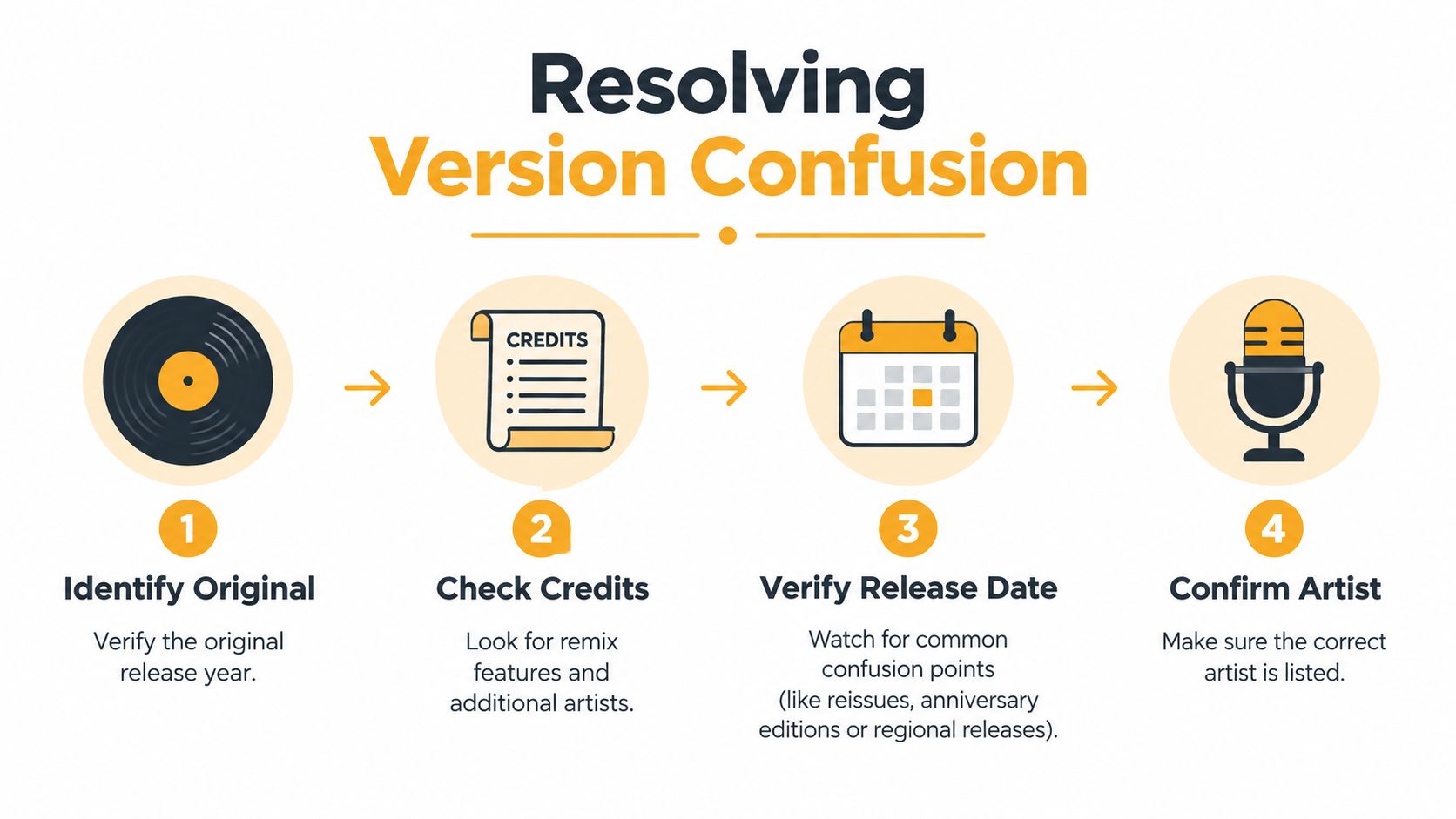
Four checks for the correct version
Identify the original. Look for Selena's Spanish-language lead single and title track from the album released by EMI Latin in March 1994. If the page presents a different artist pairing or an alternate arrangement, treat it as a separate recording entry.
Check the credits. Compare the songwriter and performer fields. A remix or collaboration may add featured artists, new production credits, or a different vocal arrangement. The underlying composition can remain related while the recording metadata changes.
Verify the release date. A page that uses the title but provides no release context leaves too much room for confusion. Album placement, single information, and later reissue data should be shown independently.
Confirm the artist. Search results often compress artist names and titles. Make sure the page clearly identifies Selena rather than a cover artist, a collaboration, or an artist using a similarly titled release.
If the artist, version, and release context aren't visible, the lyric page isn't ready for archival use.
This method also applies to other music reference pages, including a separate lyric catalog example where the recording identity should be established before the text is copied or translated. The principle is consistent: title matching is only the first step.
Version confusion isn't a minor inconvenience. It can attach the wrong vocal arrangement to a lyric, assign collaboration credits to the original, or lead a translator to describe a different performance. A version selector, explicit artist field, recording date where verified, and separate language variants solve much of the problem before a reader reaches the lyric itself.
How Rights Holders Manage Catalog Accuracy
Crowdsourcing makes it easy for a lyric page to appear quickly, but speed doesn't establish authority. Rights holders need a controlled process that confirms who can edit a page, preserves the approved wording, and keeps changes from appearing publicly before review.
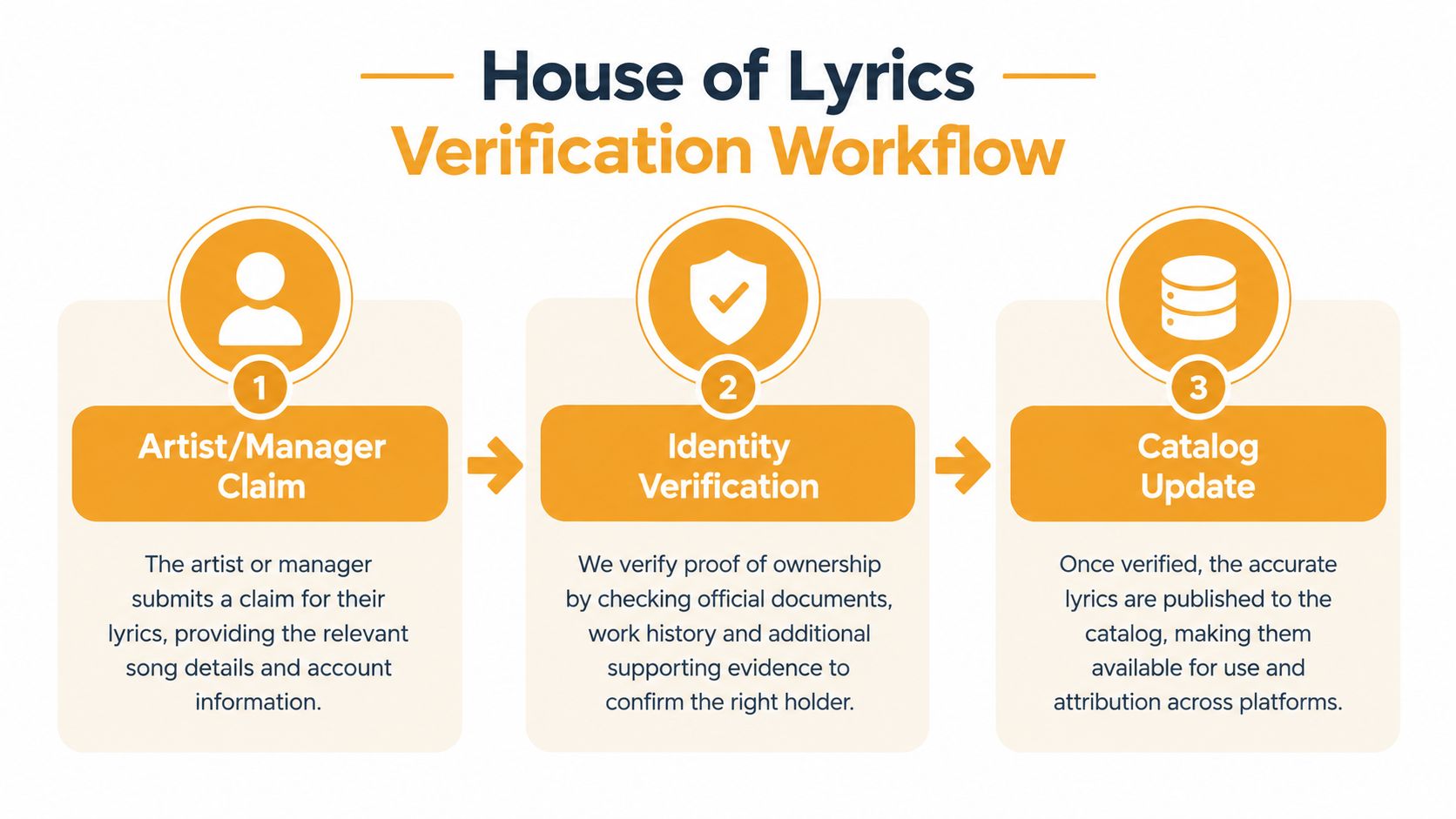
A practical verification workflow
An artist, manager, or label representative begins by claiming the relevant artist, album, or song page. Ownership verification can use a one-time code placed in an X or SoundCloud bio, giving the platform a direct signal that the claimant controls the associated profile.
The second stage confirms identity and authority. That step matters because a person who knows a song title or has access to an unofficial transcription isn't necessarily authorized to alter credits or publish lyric text. Verification should connect the account to the artist or rights-management team responsible for the catalog.
The final stage is the catalog update. A verified owner can submit lyrics, credits, and metadata through an editor, while an editorial review holds the changes before publication. This creates a record of responsibility without treating every proposed edit as equally reliable.
Why approval belongs in the workflow
A review step protects against common catalog failures:
- Unauthorized wording: A transcription may be popular but still differ from the approved text.
- Wrong recording links: A page can accidentally connect lyrics to a remix or collaboration.
- Credit drift: Co-writers or producers may disappear when users copy data between sites.
- Unclear revision history: Readers need to know whether a correction came from a rights holder or an anonymous contributor.
The editorial review process provides the governance layer that open editing often lacks. It doesn't remove the need for careful research. It gives that research a defined path from submission to public catalog entry.
For “Amor Prohibido,” the result should be a record that keeps the original Spanish wording, songwriter credits, recording details, version identity, and official audiovisual reference aligned. Artists and managers retain control, while fans receive a page whose provenance is visible rather than implied.
Quick Reference Index and Cross References
A quick-reference record should be easy to copy into a press note, research spreadsheet, rights log, or editorial brief. It should also distinguish verified core metadata from contextual interpretation and commercial history.
Core catalog record
| Field | Reference |
|---|---|
| Song | “Amor Prohibido” |
| Artist | Selena |
| Language | Spanish |
| Recording role | Lead single and title track from the album Amor Prohibido |
| Album label | EMI Latin |
| Album release | March 1994 |
| Credited writers | Selena Quintanilla, A.B. Quintanilla III, and Pete Astudillo |
| Recording location | San Antonio, Texas |
| Recording sessions | September 1993 into early 1994 |
| Primary reference text | Rights-holder-approved Spanish lyrics |
| Translation status | Keep literal glosses separate from interpretive English translations |
| Audiovisual reference | Official recording or rights-holder-approved video |
| Version control | Distinguish original, remix, cover, live version, and collaboration |
The song and album should remain linked, but not merged. The album page can carry album-level chart, award, sales, certification, and reissue information. The song page should carry the recording's own chart and certification fields, with territory and format labels that prevent readers from treating a certification as a universal global sales figure.
Useful cross-references
Researchers exploring Selena's catalog should connect “Amor Prohibido” with the other album tracks that reached No. 1 on Billboard's Hot Latin Songs chart, “Bidi Bidi Bom Bom,” “No Me Queda Más,” and “Fotos Y Recuerdos.” Those links help explain the album's internal chart impact without confusing the achievements of one recording with another.
A good index can also point readers toward:
- The parent album entry, for album-level chart and award context.
- The artist entry, for discography navigation and identity confirmation.
- The original audiovisual source, for vocal and arrangement verification.
- The songwriting and credits record, for authorship and rights research.
- The translation variants, clearly labeled by language and recording version.
- The revision history, for tracking approved catalog updates.
The enduring importance of this record isn't only its popularity. It lies in the relationship between text, performance, authorship, release history, and audience interpretation. When those layers remain separate but connected, fans can find the right words, and professionals can trust the surrounding metadata.
House of Lyrics offers artist-approved lyrics, structured artist, album, and song pages, official video embeds, and a review workflow for catalog updates. For a reliable reference to Selena's “Amor Prohibido lyrics” and other music entries, visit House of Lyrics and explore the verified library.