Paloma Blanca Lyrics: Verified History and Official Video
Paloma Blanca Lyrics. Explore the verified lyrics, history, and official video of Paloma Blanca. A complete reference for fans and creators on House of Lyrics.
You know the moment. A familiar melody comes through an old radio, a family playlist, or a cover band's set, and you recognize it before you can name it. Then you search for the Paloma Blanca lyrics, only to find different spellings, incomplete lines, or pages that offer no clear indication of where their text came from.
That uncertainty matters. A song remembered across generations deserves more than a hurried transcription. It deserves a traceable history, accurate credits, and media that connects the words to the recording listeners know. The guide below approaches “Paloma Blanca” as an archival object, not a block of searchable text. For broader pop context, you can also browse the pop music collection, while a video context extraction platform can help researchers examine how music appears within audiovisual material.

Table of Contents
- Introduction to the Paloma Blanca Phenomenon
- The Global Chart Success of the Song
- Understanding the Lyrical Theme of Freedom
- How Verified Lyrics Are Curated on House of Lyrics
- Navigating Rights, Credits, and Attribution
- The Importance of Official Video Integration
- Quick Reference - Key Song Facts and Stats
- Conclusion - Celebrating a Timeless Classic
Introduction to the Paloma Blanca Phenomenon
A listener may recognize the opening of “Paloma Blanca” before recalling its title. Searching for the Paloma Blanca lyrics then raises a harder question: which wording belongs to the recording, and which version comes from memory or an uncredited transcription?
The song, also known as “Una Paloma Blanca,” was written by Dutch musician Johannes Bouwens, who performed as George Baker, and recorded first by the George Baker Selection. Released in 1975, it served as the title track of the group's fifth album, with “Dreamboat” on the B-side (song history and chart record). Those details give the words a fixed place in a release history rather than leaving them as detached text.
Why the words need context
A trustworthy lyric page connects the transcription with the performer, writer, release year, recording, and rights-holder attribution. That information works like a label on an archival photograph: it helps readers identify what they are seeing and assess whether the text has a traceable origin. House of Lyrics brings that verification-focused approach to its pop music collection, while a video context extraction platform can help examine how the song appears in audiovisual material.
The title offers another useful clue. “Paloma Blanca” means white dove in Spanish, an image that shapes the song's emotional center. Reading the lyric beside its release history and recurring association with freedom makes its language easier to interpret, instead of treating it as poetry without a musical setting.
For music historians, this context supports catalog research. Singers can check wording before rehearsal. Long-time listeners gain a clearer record of a song that may have accompanied family life for decades.
The Global Chart Success of the Song
A listener in 1975 could encounter “Paloma Blanca” through very different radio cultures and still recognize its central melody. The single reached No. 1 in Austria, Finland, Flanders, the Netherlands, Sweden, Switzerland, West Germany, New Zealand, and South Africa, according to its documented chart history.
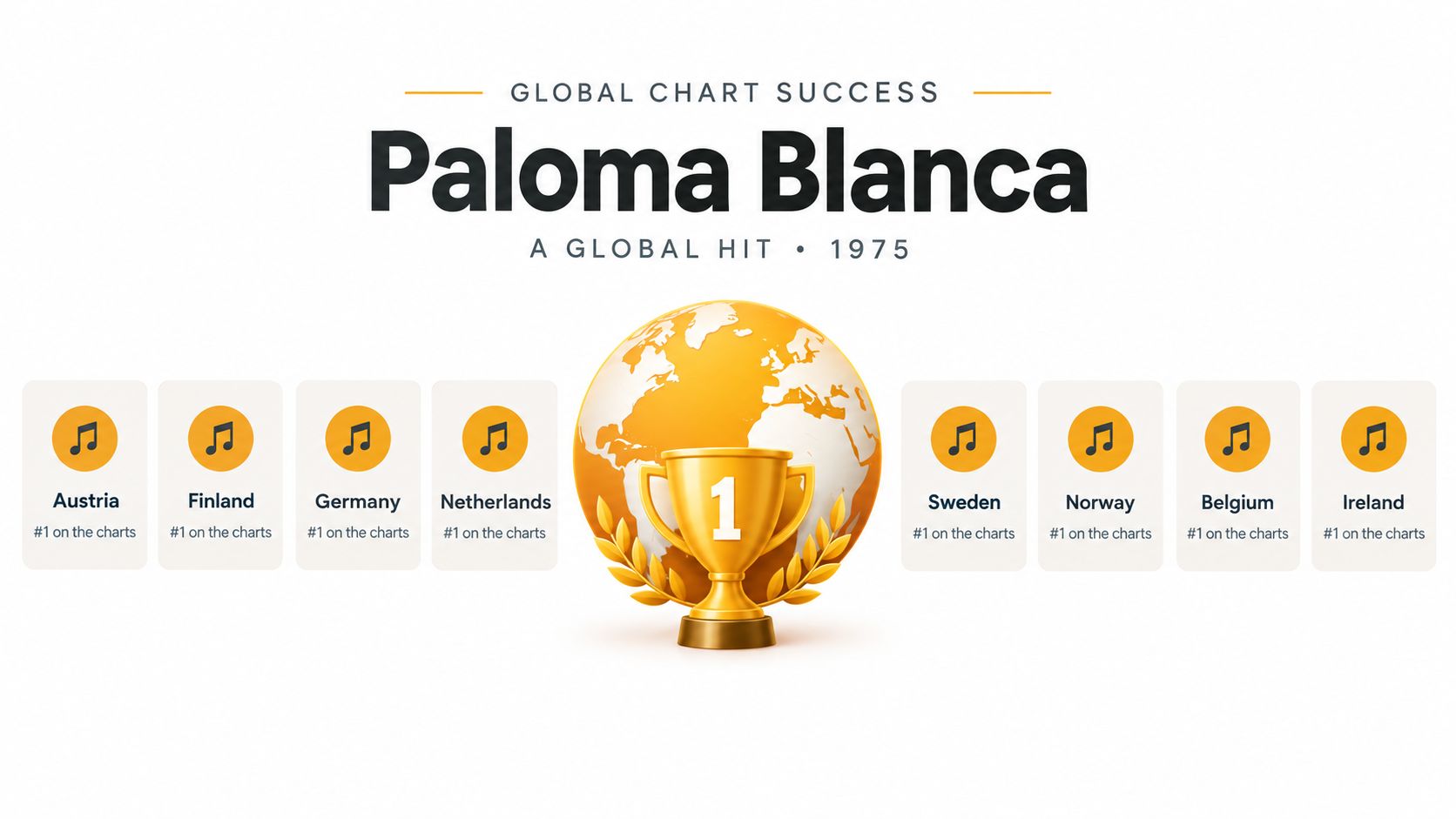
Its reach extended into major English-language markets. In the United States, the song reached No. 1 on Billboard's Easy Listening Singles chart on February 14, 1976, peaked at No. 26 on the Billboard Hot 100, and reached No. 33 on the Hot Country Singles chart. It peaked at No. 10 in Canada and the United Kingdom, and at No. 2 in Australia.
What the chart pattern tells us
These results show a song moving across language markets, radio formats, and audience expectations. Its presence on American easy-listening and country charts is especially revealing. The recording's melodic style connected with listeners outside a single pop category, much as a familiar tune can travel farther than the language of its lyrics.
Commercial accounts also report worldwide sales ranging from more than two million to more than seven million copies. That wide range reflects differences in how releases and versions are counted. It is better presented as a documented variation than reduced to one definitive total, as summarized in the sales and chart overview.
For lyric archiving, that distinction matters. A widely circulated recording may reach listeners through singles, albums, radio edits, covers, translations, and remembered performances. Each route can introduce small wording changes. A verified lyric record, presented with rights-holder attribution through House of Lyrics, gives readers a stable reference while preserving the complexity of the song's publishing and recording history.
Understanding the Lyrical Theme of Freedom
The song's central image is a white dove, and its emotional meaning is freedom. George Baker has described the song in those terms in a published interview, connecting the bird with release, movement, and the wish to escape confinement. The title makes that symbol immediate: “Paloma Blanca” names the dove itself, while the lyrics leave room for listeners to attach their own experiences to it.
The song's creation helps explain its unusually open, memorable character. Accounts describe the melody first emerging as a wordless idea, after which members of the orchestra encouraged Baker to add lyrics. The words were placed over a musical foundation that already expressed much of the feeling, so the vocal story stayed direct and accessible (historical account of the song's theme and creation).
Why the image travels so well
A symbol can cross language markets more easily than a detailed cultural reference. Listeners may hear the white dove as a personal image, a romantic emblem, or a wider sign of liberation. Like a melody that remains recognizable after translation, the image carries its emotional force without requiring every listener to share the same background.
The song's Dutch reception shows how strongly that idea connected with its home audience. It remained on the Dutch chart for 13 weeks, including four weeks at No. 1, and Dutch public-radio history places it at No. 1 in the 1975 year-end ranking, according to the Dutch chart and year-end history.
That success adds context to the lyric without closing down its meaning. A carefully curated House of Lyrics page can preserve the rights-holder attribution and verified wording while allowing the dove to remain open to interpretation. The words sound personal, yet their documented history shows how one intimate image became a shared international experience.
How Verified Lyrics Are Curated on House of Lyrics
A dependable lyric record begins with a dependable source. House of Lyrics is presented as an artist-run library that pairs artist-approved lyrics with official video embeds, allowing verified artists and rights holders to claim pages and manage the information associated with their work.
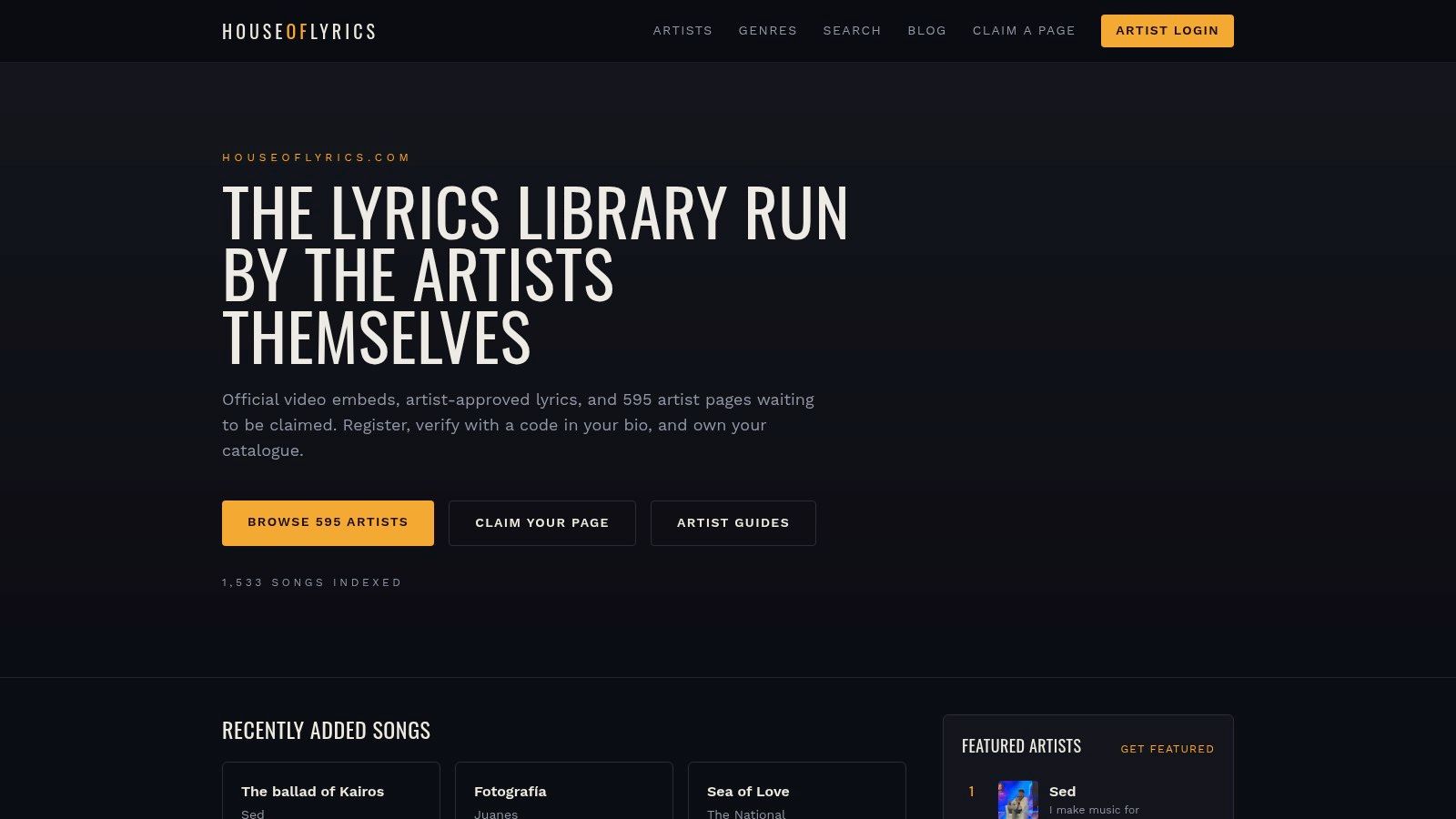
The verification process is designed to connect page control to an identifiable owner. A rights holder places a one-time code in an X or SoundCloud bio, confirming control through a public channel rather than relying only on an unverified email address. That step helps reduce the risk of impersonation and gives the page a clearer chain of responsibility.
A practical editorial workflow
The process can be understood in four stages:
- Claim the relevant page. An artist or verified rights holder identifies the artist, album, or song page connected to the catalog.
- Confirm ownership. The owner uses the verification code process to demonstrate control of the associated social profile.
- Edit the record. Lyrics, credits, and metadata can be entered or corrected through the page editor.
- Submit changes for review. Updates are held for editorial approval before they appear publicly.
That final review matters because a page can contain more than lyric text. Names, songwriter credits, album relationships, spelling, and media links all affect how future readers understand the recording. A structured editorial process treats those fields as part of the archive, not as decorative extras. The principles behind this approach are discussed in what an editorial review involves.
The official video connection adds another layer of verification. Instead of separating the words from the performance, the page can place the lyric record beside an authoritative audiovisual source.
A video reference can help listeners confirm the recording's identity and hear how phrasing, repetition, and vocal emphasis work together. For this song, that relationship is especially useful because a remembered line may sound different when heard in the original arrangement.
Navigating Rights, Credits, and Attribution
A lyric page contains at least two different kinds of information. The first is public metadata, such as the title, performer, release year, writer, and recording details. The second is the lyric text itself, which is copyrighted expression and requires appropriate authorization for display.
“Paloma Blanca” shows why a catalog should preserve source-specific credit fields rather than flattening every database into one answer. MusicBrainz identifies Hans Bouwens as lyricist and composer, while a licensed sheet-music listing identifies Sony/ATV Music Publishing as publisher and also credits Hans Bouwens for composition and lyrics (licensed sheet-music credit information).
Why one field may not tell the whole story
A contributor field and a publisher field describe different relationships. The writer created the composition or lyrics. The publisher represents rights administration for a repertoire, territory, or licensing arrangement. Database records may also reflect different source conventions, update histories, and levels of catalog detail.
A production lyric record should therefore retain:
- Contributor roles, distinguishing lyricist, composer, performer, and other participants.
- Publisher information, tied to the source that supplies it.
- Provenance notes, recording where each credit came from.
- Correction history, so later editors can understand why a field changed.
- Authorization status, showing whether the lyric text is licensed or approved for display.
Archival rule: Keep public metadata separate from protected lyric expression, and never infer ownership from an unverified transcription page.
Readers who need broader background on the legal framework can consult this overview of U.S. copyright law for musicians. The practical point is straightforward. A site may be able to identify a song without having permission to reproduce its words.
Good metadata management for music catalogs also protects against a common mistake, treating a single database presentation as universally authoritative. Source-specific fields let archivists show what is known, what is attributed, and what still requires territorial or repertoire verification. Visible attribution then gives both creators and readers a clearer account of the record's origin.
The Importance of Official Video Integration
A lyric page and a video page answer different questions. The lyric page helps a listener follow the words. The video shows the performance, arrangement, vocal delivery, and visual identity attached to the recording. Keeping them together creates a more complete reference than either one can provide alone.
Unofficial lyric sites often separate these experiences. A reader may find text on one page, a user-uploaded video on another, and a conflicting transcription somewhere else. That fragmentation makes it harder to know whether the words and recording belong to the same source.
Comparing the two approaches
| Fragmented reference | Integrated reference |
|---|---|
| Text may lack visible provenance | Lyrics carry attribution and editorial context |
| Video may come from an unofficial upload | The page can embed a recognized official source |
| Credits may be copied without explanation | Metadata fields can preserve roles and sources |
| Corrections are difficult to trace | Reviewed updates create a clearer record |
For listeners, the benefit is immediate. Hearing “Paloma Blanca” while reading an authorized lyric text helps connect syllables to melody and prevents a search result from becoming an isolated block of words. For artists and rights holders, official integration keeps the public-facing experience closer to the intended recording.
Creators studying how visual material supports music can also browse actionable music video concepts. The same principle applies to archival pages: context should clarify the work, not distract from it. A carefully maintained official lyrics video reference gives listeners a more coherent path from search result to song.
Quick Reference - Key Song Facts and Stats
A compact reference helps readers check the song's identity, recording history, and credit trail without treating “Paloma Blanca” as anonymous lyric text. The table separates documented catalog details from a reported sales range and identifies where credit wording comes from.
| Field | Documented detail |
|---|---|
| Common title | “Paloma Blanca,” also known as “Una Paloma Blanca” |
| Writer and performer identity | Johannes Bouwens, who performed as George Baker |
| Recording artist | George Baker Selection |
| Release year | 1975 |
| Album position | Title track of the group's fifth album |
| B-side | “Dreamboat” |
| Central theme | Freedom, expressed through the image of a white dove |
| Reported worldwide sales | More than two million to more than seven million copies |
| Publisher presentation | Sony/ATV Music Publishing in a licensed sheet-music listing |
| Lyric and composition credit | Hans Bouwens in that catalog presentation |
The release, album, B-side, and sales information belong to the song's documented historical record. The publisher and credit lines come from a licensed sheet-music presentation, so they should be read as catalog metadata rather than as a replacement for the lyric itself. That distinction matters when a lyric page aims to show rights-holder attribution and traceable context.
Readers can continue through the featured music pages to compare other classic recordings, where credits and catalog history support discovery.
Conclusion - Celebrating a Timeless Classic
“Paloma Blanca” remains memorable because its melody is immediate, its central image is clear, and its idea of freedom leaves room for listeners to bring their own experience. The song's history adds depth to that familiarity. It began with a melody, gained words associated with a white dove and liberation, and then traveled across a remarkably broad range of radio and chart markets.
Accurate lyrics matter because songs are not anonymous strings of lines. They belong to writers, performers, publishers, and listeners who carry them forward. A trustworthy record keeps those relationships visible, separates metadata from copyrighted text, and places the words beside media that helps identify the original performance.
The best lyric reference is therefore more than a search result. It's a small piece of music preservation, giving a classic song a stable home while respecting the people and rights behind it.
House of Lyrics offers artist-approved lyrics, visible attribution, structured song metadata, and official video embeds in one music library. Visit House of Lyrics to explore “Paloma Blanca” and discover classic recordings through a more reliable, rights-aware reference.