Next in Line Lyrics Matched to the Right Song
Find next in line lyrics by artist, year and theme, from Johnny Cash’s 1957 single to other same-title songs, plus credits and video.
Several unrelated songs share the title Next in Line; the earliest documented one here is Johnny Cash's single of April 1, 1957, written by John R. Cash, with Don't Make Me Go as the B-side. Before trusting any Next in Line lyrics, match the artist and recording, not just the title.
The familiar advice to open the first lyric result and start reading skips the most important check. A perfectly transcribed lyric can still be the wrong answer if you remember a different singer, a different scene, or an anime character rather than a country courtship.
That's what makes this title such an interesting catalog puzzle. The words on the label look alike, but the songs behind them need separate identities.
Table of Contents
- Which Next in Line You Mean
- Johnny Cash Single Credits and Story
- Songs Grouped by Theme and Era
- Other Recordings Entry by Entry
- Confirmed Meaning Versus Fan Readings
- Credits Rights and Official Video Rules
- Quick Lookup by Clue and Artist
- Title Variants Covers and Related Pages
- Claim the Page or Open the Match
Which Next in Line You Mean
Same-title songs behind Next in Line lyrics
| Artist | Documented theme | Credits status |
|---|---|---|
| Johnny Cash | Romantic succession after other suitors fail | Verified on official site |
| Conway Twitty | Separate country recording under the same title | Unverified here |
| WALK THE MOON | Flirtatious driving narrative | Unverified here |
| After Image | Aging, conformity, and generational pressure | Lyrics-derived only |
| Erik Santos | Separate artist entity, market not confirmed | Unverified here |
| Divide Music | Annotation link to Endeavor in My Hero Academia | Unreviewed biography |
| Stagecrew | Distinct same-title recording | Unverified here |
| Meese | Distinct same-title recording | Unverified here |
| Nevermore | Individual fan reading about heroin | Not band-confirmed |
Treat this as an identity table, not a declaration that every theme has equal authority. Some cells describe a recognizable lyric situation; others record only that an artist has a separate same-title entry. The credits column tells you how cautiously to use the match.
A result such as the Genius Johnny Cash lyric page identifies a particular artist's entry, not a universal lyric sheet for the title. Search placement doesn't establish which recording you heard, and a familiar chorus title doesn't establish a shared songwriter.
Match a memory before matching words
Start with the strongest thing you remember. A singer's name is usually more useful than a title; a distinctive scene can be more useful than a vague genre label. If you remember a car and flirtation, for example, don't select Cash just because his name is recognizable.
Use these checks in order:
- Voice or artist: Compare the credited performer with the voice you remember.
- Scene: Look for courtship, driving, questions about aging, or a character reference.
- Recording context: Check whether you heard a studio track, live performance, playlist item, or fan video.
- Credit gaps: Leave album, year, and songwriter fields empty when you can't verify them.
Blank metadata is better than borrowed metadata. Importing a year from another same-title page makes a tidy-looking entry less reliable.
Titles aren't recording identifiers
Next In Line and Next in Line are casing variants. Capitalization alone doesn't prove that recordings share a master, a writer, or even the same underlying song.
The same caution helps when searching a remembered phrase rather than a title. Our And I Wonder guide offers another useful starting point for phrase-led discovery: establish the song identity before treating a lyric match as settled.
Catalog rule: Choose the artist row that fits your memory, then investigate that recording. Don't make the recording fit the first lyric page you find.
For Cash, the primary-source credit block follows below. For the other artists, the open gaps stay visible rather than being filled from lookalike pages.
Johnny Cash Single Credits and Story
The shared title is the first thing to check, not the lyric. Johnny Cash's Next in Line is an early single with its own credits and story, distinct from unrelated songs that use the same title.
The official Johnny Cash track page identifies John R. Cash as the songwriter, gives April 1, 1957 as the release date, and lists “Don't Make Me Go” as the B-side. Those details anchor the recording's identity. The accompanying sleeve and sheet music offer visual context, while the track page provides the release information.
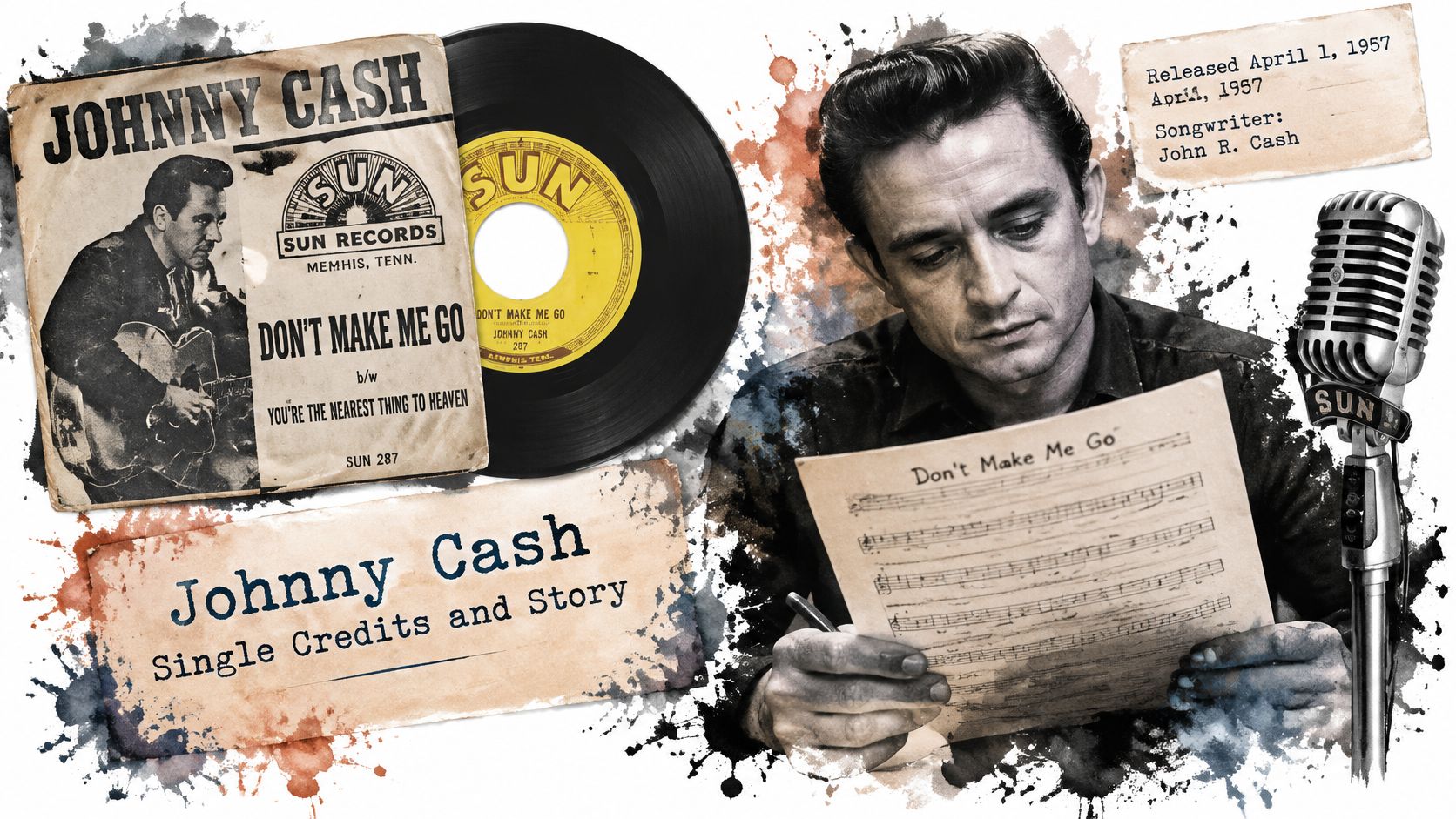
The credit block to preserve
Keep each credit attached to the specific recording. A complete-looking entry is less useful if it borrows an album or date from another song with the same title.
| Field | Entry |
|---|---|
| Artist | Johnny Cash |
| Songwriter | John R. Cash |
| Release | April 1, 1957 |
| Format | Single |
| B-side | Don't Make Me Go |
| Primary reference | Official Johnny Cash track page |
| Album | Leave blank unless independently established |
“I Walk the Line” is a separate Johnny Cash work, not an alternate title or spelling for this song. Similar wording can lead searchers to the wrong entry, so keep the two recordings' credits apart.
From waiting to stepping forward
The song's story turns on a romantic narrator who watches other suitors try and fail, then presents himself as ready to take his turn. The title first describes his place among the people pursuing the relationship; later, it expresses his own intention.
That shift gives the repeated phrase its purpose. The narrator moves from observing to acting, creating a compact arc without requiring a listener to treat the title as a literal queue.
- Character: A narrator who has watched and waited.
- Obstacle: Other suitors have tried without success.
- Turn: He says he is ready to act next.
For artist-level browsing, the Johnny Cash artist page is a separate route to his catalog. A sleeve image can help identify an era or release, but it does not establish that a video upload is official. Listeners who recall a rock-band vocal, a pop driving scene, or an anime character should look for a different artist's entry rather than fit those clues to Cash's song.
Songs Grouped by Theme and Era
A familiar title does not identify a song. Start with the clue you remember, then check the artist and recording before matching lyrics. Alphabetical lists work well when you know the name already; theme and era give you another route when you recall only a chorus's mood or where you heard it.
Listeners may remember a song's words and melody differently, so matching the recording matters more than matching lyric text alone. The diagram below offers a way to browse country songs by theme and era, while the descriptions identify the artist matches.
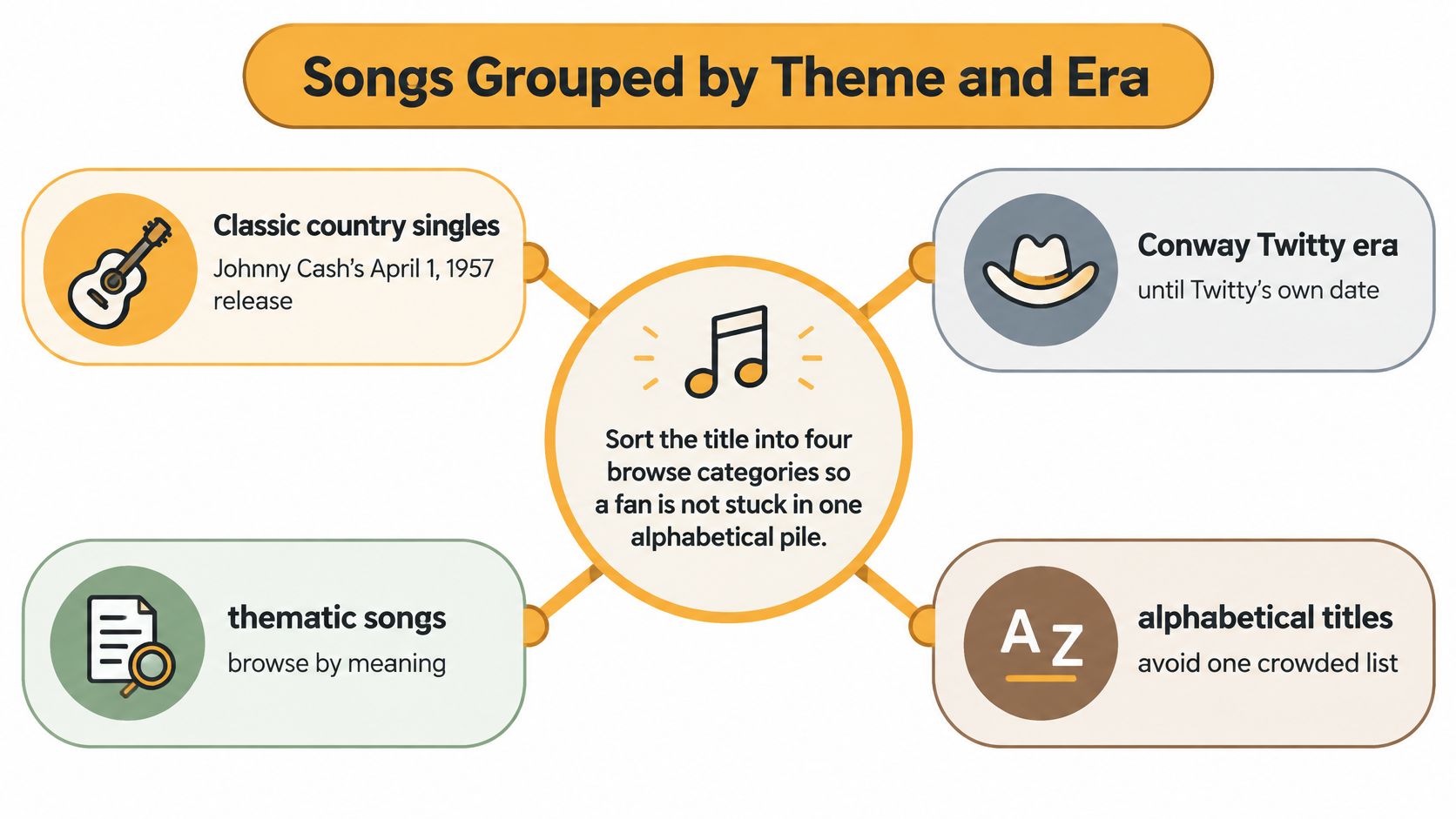
Browse by the clue you remember
Classic country singles is a useful starting point for Johnny Cash and Conway Twitty. A vintage country vocal may point you toward this group, but it does not establish that two recordings share a composition. Check the artist's individual entry, and treat Twitty's album and release details as open until verified.
For modern pop and indie, the flirtatious driving scene points toward WALK THE MOON. Keep Meese and Stagecrew as separate title matches in this browsing area. Similar title wording is not evidence that they are aliases or collaborators.
- Reflective and alternative writing: Questions about aging, purpose, and social expectations point toward After Image. Nevermore fits an alternative browsing route, but a listener's theory about drugs should not define its category.
- Soundtrack and character-linked uses: An Endeavor or My Hero Academia reference points toward Divide Music. Erik Santos belongs on a separate artist-name route when language or market helps distinguish the match. That placement alone does not establish an anime connection.
A category helps you find, not prove
A shelf can describe style, history, or context, and those labels answer different questions. Classic country singles signals a stylistic and historical route; character-linked uses describes context. Neither category identifies a songwriter.
If you remember a title from a video featuring an anime character, inspect the Divide Music entry first. That clue can help identify the artist, but it does not establish a soundtrack album. Leave the album field unfilled unless a reliable release record supports it.
A browse category points to the right question. The recording's own credits answer it.
Use the artist entries to compare what is known, which credits remain open, and which listening clues fit. Words and melody can lead to different memories; the artist and recording together help distinguish songs that share a title.
Other Recordings Entry by Entry
These entries keep the same fact-gap-clue pattern so you can compare candidates quickly. Unverified credits mean the details aren't established here, not that the artist has no credits.
Conway Twitty
Established: A separate country title match. Open gaps: Release date, album, and songwriter aren't verified here.
Listening clue: A country performance credited to Twitty rather than Cash. Category: Classic country singles. Match the performer name, then open Twitty's own song entry; a similar vocal tradition isn't evidence of the same composition.
WALK THE MOON
Established: The lyric discussion places the title in a flirtatious driving narrative. Open gaps: Album, release year, and songwriter details remain unverified here.
Listening clue: A car-and-crush scene. Category: Modern pop and indie. Open the band's own entry when that scene fits, and don't merge it with another song just because both use succession imagery.
After Image
Established: The available lyric discussion concerns growing older, conformity, purpose, and generational pressure. Open gaps: Those observations aren't a songwriter interview, and the release credits aren't established here.
Listening clue: Questions about aging and what comes next in life. Category: Reflective writing. Choose After Image's entry when those questions match your memory, then keep the interpretation label attached to any explanation.
Erik Santos
Established: Erik Santos is a distinct artist match for the title. Open gaps: Language, market, album, release date, and songwriting credits aren't confirmed here.
Listening clue: The performer's name or a performance you can identify independently. Category: Separate market or cover discovery, pending verification. Open that artist's own entry rather than assuming an English country lyric belongs to the performance.
Divide Music
Established: An annotation connects the track with Endeavor from My Hero Academia. Open gaps: The associated biography is unreviewed, so the connection isn't songwriter-confirmed intent.
Listening clue: Endeavor or the anime title. Category: Character-linked discovery. Use the clue to select the artist's entry, then distinguish the recording's documented credits from its commentary.
Stagecrew
Established: A distinct same-title recording. Open gaps: Album, year, songwriter, and a dependable narrative description remain unknown here.
Listening clue: The Stagecrew name attached to the performance. Category: Unverified same-title discovery. Open its own entry and resist importing the better-documented story of another artist's song.
Meese
Established: A separate title match under Meese. Open gaps: Album, year, and songwriting details aren't verified here.
Listening clue: The band name in a playlist or track display. Category: Modern pop and indie browsing, with identity still to confirm. Select the Meese entry before evaluating any lyric text.
Nevermore
Established: A listener has offered a heroin interpretation. Open gaps: That reading isn't band-confirmed; the discussion itself asks whether band members used drugs.
Listening clue: The Nevermore name, not the theory alone. Category: Alternative fan discussion. Open the artist's entry without converting a commenter's question into biography.
- Keep the performance attached: A screenshot of the artist and track display can help you preserve the match.
- Keep versions separate: The Wayfaring Stranger lyrics guide is a related reference for approaching a title through its particular performance rather than assuming a universal page.
Confirmed Meaning Versus Fan Readings
Use a layered rule: distinguish what the words depict, what documented context establishes, and what listeners interpret. A claim about authorial intent needs artist or songwriter evidence; an appealing explanation alone isn't enough.
This diagram separates those kinds of evidence rather than ranking listeners' enjoyment.
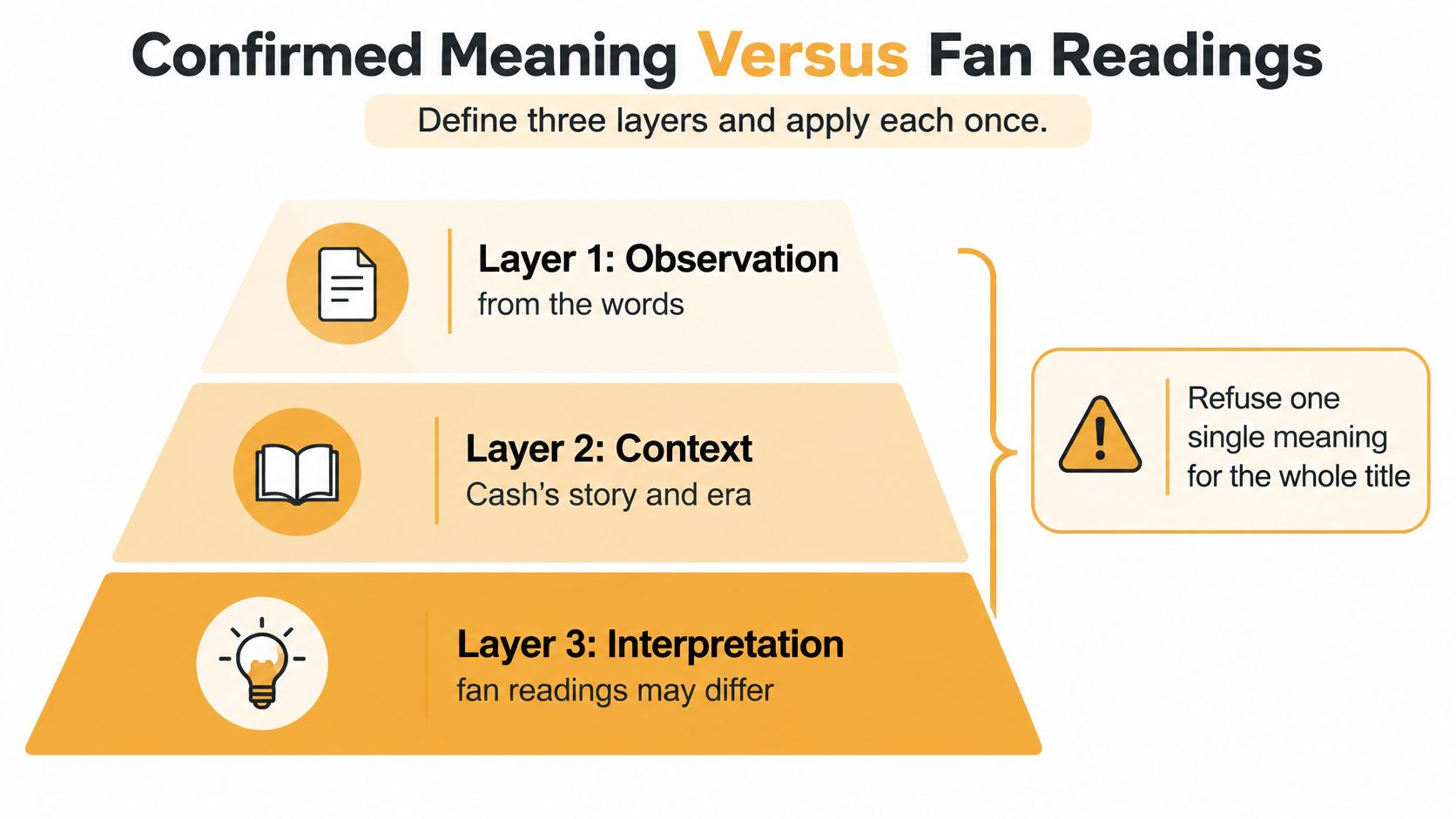
Observation and documented context
Observation describes something a reader can identify in the lyric. After Image's recurring questions about age and expectations support a reading about existential uncertainty. They don't, on their own, establish what the songwriter intended.
The Songtell discussion of After Image's Next in Line describes themes including aging, conformity, purpose, and generational pressure, but doesn't establish those themes as a statement from the songwriter or rights holder. That distinction lets you discuss the song thoughtfully without attributing your explanation to its creator.
Documented context comes from attributable evidence such as official credits or an interview. Cash's official credit record establishes authorship and release identity, but even a verified writer credit doesn't turn every interpretation of the story into that writer's stated intention.
- Observation label: The words raise questions about growing older.
- Context label: An identified official record establishes a credit or release fact.
- Interpretation label: A listener reads the questions as anxiety about purpose.
Community interpretation needs its own label
Nevermore's heroin reading belongs to community interpretation, not confirmed biography. Divide Music's character connection also needs its qualification preserved when it appears beside an unreviewed biography.
Editorial test: A firm claim about intended meaning needs documented context. Otherwise, label it interpretation, not confirmed.
That wording matters in comment discussions. Fans can disagree about a metaphor without accusing each other of getting an established fact wrong, and rights holders won't find a listener's theory presented as their official note.
A video is another item to evaluate, not automatic proof of the surrounding explanation. Before treating the supplied embed as context for a particular recording, confirm its artist, title, uploader, and description.
A useful annotation states both its insight and its limit. For After Image, that could read: the recurring questions support an existential reading, but no songwriter statement is established here. The practical label remains interpretation, not confirmed.
Credits Rights and Official Video Rules
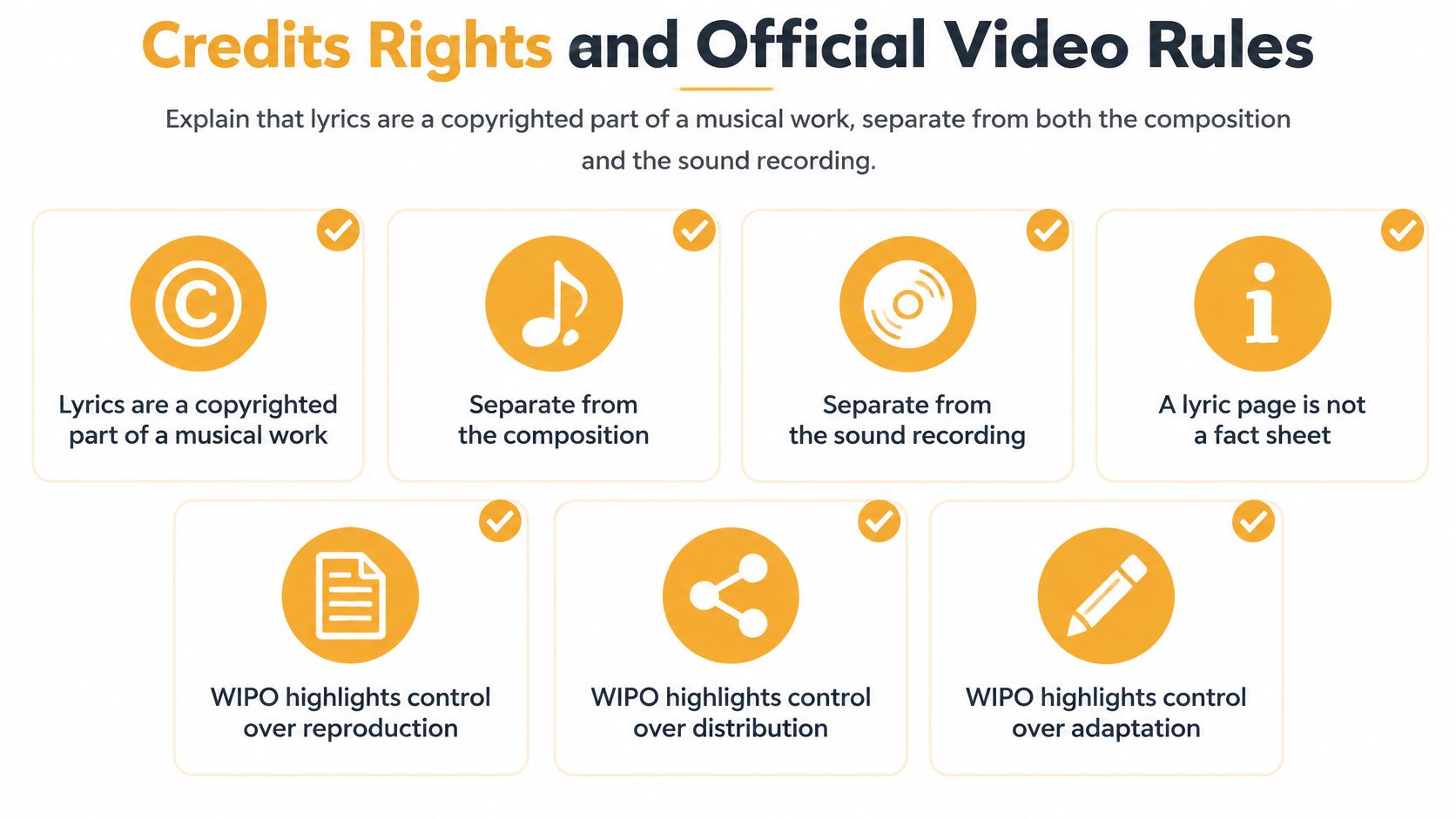
Lyrics are copyright-protected text within a musical work, not merely factual metadata, and permission to display them is distinct from permission to use a sound recording. The WIPO guide to creating value from music identifies reproduction, distribution, communication to the public, and adaptation among the rights owners may control.
The checklist below is a publishing reminder. A named songwriter helps establish attribution, but attribution by itself doesn't authorize lyric display.
Keep an auditable approval record
Before publishing a lyric, an editor should be able to establish who authorized it and what the authorization covers. A practical record includes:
- Claimant identity: The person or organization requesting control.
- Authority basis: How that claimant is entitled to approve the text.
- Writing and publishing credits: Songwriter and publisher information where known.
- Approval record: Approval time and the editor responsible.
- Display scope: The text, territory, presentation, or other limits covered by the grant.
- Version history: The approved wording and subsequent changes.
Don't treat an editor's confidence in a transcription as a substitute for permission. The editor checks the submission; the rights record establishes the basis for publishing it.
Review changes and media separately
Re-review lyric edits, translations, annotations, and synchronized timing. Some changes may introduce adaptation questions or fall outside the original permission, so retaining the previous approved version makes the review traceable.
A lyric grant doesn't automatically authorize hosting a master recording or video. Confirm the audiovisual source independently, distinguish an official upload from a fan upload, and preserve the basis for any media use.
Our music rights management guide provides related context for organizing those responsibilities. For this title, the important operational check is that an approval belongs to the correct artist and work, not merely to a page bearing the same words.
At House of Lyrics, we only host lyrics submitted by the artist or rights holder. Submitted lyrics are reviewed by the song owner or our editors before they appear on a page.
Before publication: Name the claimant, preserve the authority record, show the credits, and identify the media source. Keep takedown and dispute notes with the approval history.
A reader can inspect visible attribution and the publisher's stated policy. An editor should go further and verify the underlying record rather than inferring permission from a polished page.
Quick Lookup by Clue and Artist
Use this lookup when a playlist label or half-remembered scene is all you have. The identity table helps separate the artists; this table turns a specific memory into a candidate without claiming that every match is conclusive.
Clues that identify a Next in Line recording
| Clue | Artist | Category | Trust level |
|---|---|---|---|
| Early single with B-side Don't Make Me Go | Johnny Cash | Classic country | Credits verified |
| Other suitors fail, then the singer steps forward | Johnny Cash | Classic country | Lyric scene, not a quote |
| Country vocal and the artist is not Cash | Conway Twitty | Classic country | Title match only |
| Flirting while driving | WALK THE MOON | Modern pop and indie | Scene match only |
| Questions about growing old and expectations | After Image | Reflective writing | Lyrics-derived, not an interview |
| Endeavor or My Hero Academia | Divide Music | Soundtrack and character | Annotation, not confirmed intent |
| A heroin reading or a drug question | Nevermore | Alternative fan discussion | Explicit fan interpretation |
| The name Erik Santos | Erik Santos | Separate market or cover | Artist name only |
| The name Stagecrew or Meese | Stagecrew or Meese | Unverified same-title rows | Name only |
Use weak clues cautiously
A non-Cash country vocal doesn't uniquely identify Conway Twitty. It puts his entry on your shortlist; the performer credit must finish the job. Likewise, a drug discussion can identify a conversation around Nevermore without proving that the recording itself has that subject.
The trust column describes the evidence behind the clue. It isn't a rating of the artist, song quality, or fan community.
- Check the displayed artist: Playlist titles can describe a mood or collection rather than the track currently playing.
- Inspect the actual recording: Compare the voice and arrangement with the remembered performance.
- Keep uncertainty visible: If the name is your only clue, don't promote the match to verified credits.
Check spelling and language without merging entries
Next In Line and Next in Line may be cataloged differently without being different works. Conversely, identical spelling doesn't establish that performers recorded the same composition.
A non-English performance also deserves its own identity check. Don't attach English lyrics merely because the translated or displayed title looks familiar.
Choose the candidate row, open that artist's song entry, and confirm the performance. The rights checklist becomes relevant if you're publishing the words or media; it isn't a prerequisite for finding something to listen to.
Title Variants Covers and Related Pages
A good catalog doesn't end at the correct lyric page. It makes the relationships around that song clear without combining works that only look related.
For Cash's single, the B-side relationship belongs in the cross-references. I Walk the Line belongs on a separate song page, even when a searcher reaches it through a mistaken title.
Build relationships that explain themselves
| Relationship | Useful navigation | What it mustn't imply |
|---|---|---|
| Artist to song | Performer's catalog to each individual title | All songs share writers |
| Single to B-side | Paired release reference | Both sides are one work |
| Song to album | Album page when the release is verified | A guessed album assignment |
| Song to character context | Qualified Endeavor reference | Confirmed songwriter intent |
| Same-title alternatives | Clearly labeled other-artist choices | Covers or shared masters |
A not-this-version choice should name the destination artist. Johnny Cash, Conway Twitty, WALK THE MOON, After Image, Erik Santos, Stagecrew, Meese, and Nevermore need distinct destinations, with Divide Music available for the character-linked match.
Treat covers, live recordings, and soundtrack placements as separate recording rows with their own release and credit fields. A new performance shouldn't overwrite the identity of the recording a reader originally selected.
Keep presentation work downstream of identification
Say a playlist mixes the early country single with a later pop track under the same title. Each needs its own song identity and corresponding embed, even if the playlist display makes them look interchangeable.
If you're preparing an authorized short-form video, Clipoven's guide to sync lyrics to vocals in Shorts is a useful presentation resource after you've identified the recording and cleared the intended use. Timing words accurately can't repair a wrong-song match.
- Preserve title variants: Store alternate capitalization without treating it as proof of a separate work.
- Leave unknown relationships blank: Don't invent an album or cover relationship to complete navigation.
- Flag missing destinations: A missing cross-reference can indicate an unclaimed page or incomplete catalog work, not that the song doesn't exist.
Claim the Page or Open the Match
The right next action depends on whether you're listening or responsible for the recording. A fan needs a dependable match; an owner needs control over the public record.
If you're listening
Choose the artist whose voice and scene fit your memory, then open only that song's entry. For the early Cash single, use the official artist track record identified above as your credit reference.
Don't keep borrowing details from neighboring results once you've found the match. A different page may be accurate for its own artist and still be irrelevant to the recording you heard.
- Artist matches: Check the performer before reading a full lyric.
- Performance matches: Confirm that the audio is the version you remember.
- Context matches: Keep interpretations qualified rather than using them as identity proof.
If you control the recording
Claim the artist or song when your Next in Line is missing, mixed with another act, or lacking the right official media. Claiming a song page on House of Lyrics is free.
Begin through the page-claim process, confirm control, and prepare the approved text and credits. Our verification process uses a code in an X or SoundCloud bio to establish control rather than accepting a name alone.
A claimed artist can manage albums, songs, and official video embeds, and publish their own lyrics through a full editor before anything goes live. Rights holders can add artist-approved lyrics, credits, chords or tabs, and media, with review before public display.
We have 595 artist pages waiting to be claimed. A recognizable artist name in the index isn't proof that its owner already controls the page.
Each song still needs its own page. That's the practical safeguard that keeps Cash distinct from WALK THE MOON and every other same-title recording, while letting owners correct their own catalog without altering someone else's.
Owners should claim the right page and submit the approved text. Listeners should choose the matching recording and ignore the unrelated same-title results.
House of Lyrics brings artist-approved lyrics, clear song identities, and official video embeds together so a shared title doesn't have to mean a confused search. Visit House of Lyrics to find your Next in Line match, or claim the page for the recording you control.