10 Music Publishing Platforms for Artists in 2026
Compare 10 music publishing platforms by pricing, rights administration, distribution, metadata, and fit for independent artists and labels.
The best music publishing platform isn't the same for every artist. A songwriter chasing missing performance royalties needs a different workflow from a producer licensing beats, a label managing a large rights database, or an artist who mainly needs authoritative lyrics and credits online.
Compare platforms by the problem they solve, not by the size of their feature list. Check ownership retention, collection scope, royalty-specific fees, payment timing, contract tails, distributor dependence, metadata workflows, and service level before signing. Publishing administration, digital distribution, rights data, and public-facing catalog accuracy are connected, but they aren't interchangeable.
That distinction matters because digital collections administered by collective management organizations rose from €3.06 billion in 2021 to €4.1 billion in 2022, with digital income reaching 36% of total collections in 2022, according to the Independent Music Publishers Forum's global market review. A publishing administrator may register compositions and pursue royalties. A distributor may deliver recordings. A rights-data system may keep identifiers and ownership records consistent. A service such as House of Lyrics adds another layer, giving verified rights holders control over lyrics, credits, artist pages, album pages, song pages, and official video references.
Here are ten platforms, compared by the operational workflow they support.
Table of Contents
- 1. House of Lyrics
- 2. Songtrust
- 3. TuneCore Publishing Administration
- 4. Sentric Music Publishing
- 5. Symphonic Publishing Administration
- 6. BeatStars Publishing
- 7. ONErpm ONE Publishing
- 8. DistroKid Publishing
- 9. Kobalt Music Publishing with AMRA
- 10. Wixen Music Publishing Administration
- Top 10 Music Publishing Platforms Comparison
- Build the Workflow Around Your Catalog
1. House of Lyrics
House of Lyrics solves a public-catalog problem that royalty administrators generally don't solve. It gives artists and verified rights holders a controlled place to publish artist-approved lyrics, credits, structured catalog information, and official music video embeds. The catalog connects artist, album, and song pages, making it easier for fans, journalists, managers, labels, and collaborators to find a consistent public reference.
Claiming a page requires ownership verification through a one-time code placed in an X or SoundCloud bio. Once verified, the rights holder can use a full-page editor to update lyrics and metadata, while editorial review holds changes before publication. That combination is more operationally useful than allowing anyone to edit a lyric page, because it creates a visible distinction between approved information and unverified submissions.
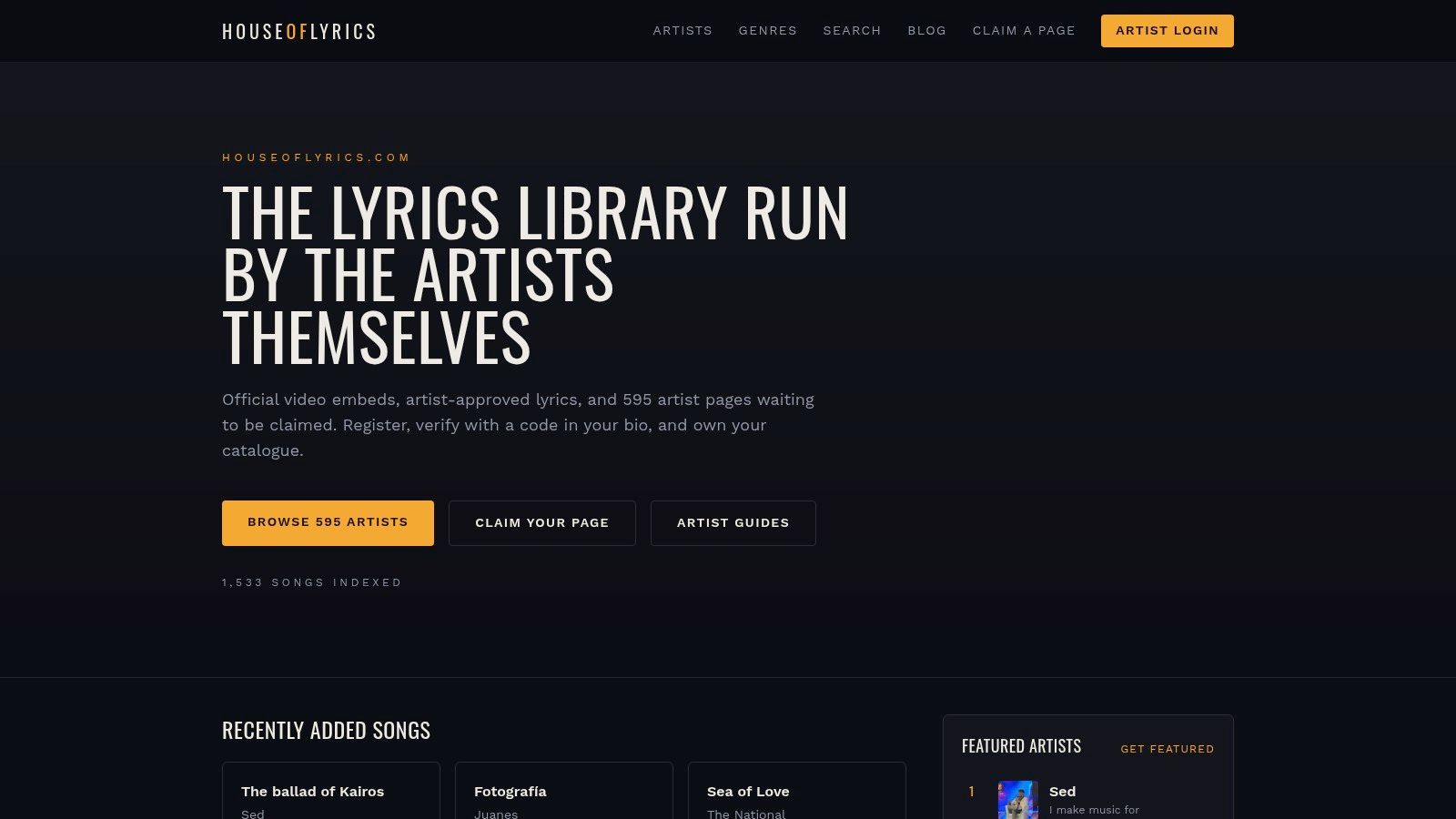
The platform already indexes about 595 artist pages and 1,533 songs, including names such as Adele, AC/DC, Rosalía, Bad Bunny, Carlos Santana, Shakira, Selena, and The National, according to the supplied House of Lyrics platform information. Its active editorial content also supports discovery and metadata education.
What House of Lyrics does not replace
House of Lyrics isn't a royalty-collection service merely because it verifies who controls a page. A lyric page can identify a songwriter, publisher, recording, or contributor, but it can't by itself register a composition for mechanical, performance, synchronization, or neighboring-rights income. The MIDiA Research survey of 776 songwriters found that 61% weren't signed up to a mechanical-rights organisation, which illustrates why public catalog control and royalty administration should be treated as separate workflows.
Practical rule: Use House of Lyrics to make the public catalog accurate and attributable. Use a publishing administrator to handle the applicable registration and collection work.
No public pricing, paid-plan, API, or integration details are listed on the site, and editorial review may mean that urgent changes aren't published immediately. Artists without an X or SoundCloud bio may also face a verification barrier. To claim and manage an eligible page, start with the House of Lyrics claim workflow, then connect the verified catalog to the administrator that fits the rights problem.
2. Songtrust
Songtrust is a strong self-serve choice for independent songwriters who want publishing administration without changing distributors. Its workflow centers on registering compositions with performance-rights organizations, collective management organizations, digital and mechanical sources, and YouTube through Content ID. The songwriter keeps copyright under an administration-only arrangement, while Songtrust handles registration and reporting through its dashboard.
The practical advantage is separation. You can use Songtrust even if your recordings are distributed through another company, so the publishing workflow doesn't have to follow the master-distribution workflow. That makes it useful for writers with a mixed catalog, several distributors, or no desire to rebuild their release setup around one ecosystem.
Songtrust presents public pricing and admin rates, but the fee can differ by royalty type, so a writer shouldn't reduce the decision to one headline percentage. Mechanical and performance income may follow different administrative economics, and society payment cycles can delay the first payment after registration.
Where metadata becomes decisive
Self-serve administration is only as reliable as the work information submitted. Writer names, publisher roles, ownership shares, identifiers, and recording relationships need to match across the relevant systems. A public lyric page won't collect money automatically, but a structured catalog can help an artist notice missing credits and conflicting versions before submitting a work.
The House of Lyrics guide to metadata management is useful alongside that process because it treats metadata as an ongoing operational responsibility rather than a one-time release form. Songtrust is best for an artist who wants broad administration and can maintain accurate records independently. It isn't the obvious choice for a catalog that requires high-touch forensic recovery or bespoke creative sync support.
3. TuneCore Publishing Administration
TuneCore Publishing Administration is built for artists who already distribute recordings through TuneCore and want publishing activity inside the same account. It supports global registrations, unlimited song submissions under one writer account, and integrated tracking and analytics. TuneCore can also act as publisher of record, so the songwriter doesn't need to create a separate publishing entity for that administrative purpose.
The consolidated workflow is the main benefit. Release information, account access, and publishing administration sit closer together, which can reduce the number of dashboards an independent artist needs to maintain. It also makes sense for a writer who wants optional sync pitching from the same provider.
Sync, however, changes the economics. The supplied terms specify a 50% commission on sync license fees when the writer opts into sync pitching, and the agreement should be assessed separately from ordinary administration. An artist who only wants registrations may not want to opt into a creative service with a different commercial structure.
The distributor trade-off
TuneCore is convenient when the artist is committed to the TuneCore ecosystem. That convenience becomes a constraint if the artist regularly changes distributors or wants publishing administration to remain completely independent from release delivery. Before opting in, check what happens to registrations, reporting access, and future administration if distribution moves elsewhere.
The House of Lyrics release guide complements this workflow by keeping the artist's public-facing release information organized. TuneCore can manage applicable rights administration. House of Lyrics can make sure the corresponding artist, album, song, lyrics, credits, and official video references present a consistent public catalog.
4. Sentric Music Publishing
Sentric Music Publishing stands out for flexibility. Its published terms describe a 28-day rolling agreement and an 80/20 split favoring the writer for publishing and neighboring-rights services. That combination suits artists who want administration and neighboring-rights support without committing to a long, rigid term.
The self-serve onboarding process lets writers add works and live-performance claims, while the neighboring-rights service extends beyond composition administration. This matters for artists who want to consider both the musical work and eligible uses of the recording, although the exact scope should be confirmed for the artist's territory and catalog.
Read the deal by income type
The writer-friendly headline split doesn't answer every commercial question. Sync income shares and other deal-specific terms can vary, so an artist should review how each revenue category is treated instead of assuming that the publishing split applies everywhere. The short rolling arrangement also doesn't guarantee immediate payments, complete registrations, or identical support across regions.
Sentric's UK base can be an advantage for writers who want a clear public FAQ and a flexible agreement. It may be less convenient for teams that need support aligned with another time zone or a more hands-on global account service. Neighboring rights also require careful separation from publishing rights, because a page that identifies a song doesn't establish every recording-rights entitlement.
For a band, manager, or rights holder, the best use of Sentric is as an administration layer with flexible exit mechanics. Pair it with a controlled catalog system so writer roles, credits, lyrics, and recording references remain clear when works are added or amended.
5. Symphonic Publishing Administration
Symphonic Publishing Administration is the natural fit for artists already using Symphonic Distribution or those who prefer a formal agreement with a clearly posted rate structure. Its published materials distinguish performance and non-performance or mechanical administration, and the supplied rate card lists 15% for performance income and 20% for non-performance income on the relevant services.
That distinction is more useful than a single blended headline rate. A songwriter can compare the administrator against the actual income categories in the catalog, then assess whether the convenience of the Symphonic ecosystem justifies the administrative fee. The platform also provides guidance for registering writers and works, including situations involving bands and multiple writers.
Contract tails deserve attention
Symphonic's agreement includes a standard post-term collection tail. That doesn't automatically make the deal unsuitable, because an administrator may continue collecting income generated during the administration period after termination. It does mean the writer should understand which rights remain covered, for how long, and whether the tail affects future registrations or only previously administered uses.
The formal documentation is helpful for a team that wants to review terms before submitting a catalog. The trade-off is that Symphonic is less strongly associated with a broad self-serve publishing community than some competitors. Artists who need extensive educational content, hands-on recovery, or bespoke sync development may need another layer of support.
Use Symphonic when rate transparency and distributor alignment matter. Before signing, build a record of every writer, share, identifier, and work version. That reduces the chance that a clear agreement is undermined by unclear metadata.
6. BeatStars Publishing
BeatStars Publishing is designed around the producer and beatmaker workflow. Publishing administration sits inside the BeatStars Studio environment, alongside beat sales, split management, and related creator tools. For a producer whose catalog already lives on BeatStars, the value comes from keeping commercial activity and publishing claims in one ecosystem.
This setup addresses a problem that general-purpose administrators may not solve as naturally: the relationship between a beat license, the producer's publishing interest, the songwriter's share, and the agreed split. Beatmakers often work across many collaborations, and the administrative risk isn't limited to missing registrations. It also includes unclear ownership, inconsistent split information, and confusion over what a license permits.
BeatStars provides a formal Publishing Services Agreement and educational resources explaining how publishing works within the platform. The supplied platform information also notes a past partnership alignment with Sony Music Publishing, but that history shouldn't be treated as a guarantee of a particular result for every account.
Review the agreement, not the ecosystem story
Admin commission rates and some commercial details aren't prominently published, so the Publishing Services Agreement should control the decision. Check the administered rights, term, termination process, collection tail, payment timing, and treatment of co-writers before opting in.
The House of Lyrics music marketing guide fits the public-discovery side of the workflow. BeatStars can support beat sales, splits, and publishing claims. House of Lyrics can give verified rights holders a controlled way to present lyrics, credits, and official video references once a finished song has entered the public catalog.
7. ONErpm ONE Publishing
ONErpm's ONE Publishing is built for artists who want distribution, publishing administration, analytics, and accounting in one account. Publishing statements appear within ONErpm's accounting and reporting tools, while the platform also connects with its distribution and creator-service ecosystem.
The main operational benefit is consolidation. An artist who already relies on ONErpm doesn't need to reconcile as many separate portals when checking release activity and publishing statements. Educational resources and reporting tutorials can also help newer writers understand how payments and account records relate to their releases.
ONErpm provides a publishing administration agreement for compositions, and the legal agreement text is available to review before opting in. That is useful because pricing and administrative commission aren't prominently posted publicly. The artist should confirm those terms during signup instead of assuming that the distribution relationship establishes the publishing economics.
Convenience can create dependency
Some features may require distribution through ONErpm, so the artist needs to distinguish between a separate publishing service and a benefit tied to continued distributor use. That matters for managers who move releases between providers, labels that use multiple delivery partners, and artists who want publishing data to remain portable.
ONErpm is a practical fit for a consolidated workflow, particularly when accounting visibility matters more than a standalone publishing dashboard. It is less suitable when the writer wants a fully distributor-neutral administrator, a boutique recovery service, or an explicitly published rate card. In every case, preserve writer splits, identifiers, and approved metadata outside the platform as well, so one account doesn't become the only source of truth.
8. DistroKid Publishing
DistroKid Publishing is aimed at artists who already distribute through DistroKid and want master and songwriting administration under one login. The service can register eligible compositions globally and collect mechanical and performance royalties while the artist retains ownership and DistroKid acts as publishing administrator.
The appeal is straightforward. A DistroKid client can manage release delivery and opt into publishing without adding an unrelated provider. The service also publishes scope rules, including eligibility limitations for cover songs and mashups, which helps artists avoid assuming that every recording in their account qualifies.
Payment timing requires planning. DistroKid's supplied publishing information states that payouts are scheduled quarterly after the initial setup period, and the first payment may arrive about six months after registration. That delay doesn't necessarily indicate a problem, because collection depends on registrations and society payment cycles, but it should be reflected in cash-flow expectations.
The service isn't available as a distributor-neutral publishing option. Eligibility is tied to releasing music through DistroKid, making it a poor fit for an artist who changes distributors frequently or has a catalog spread across other delivery services.
The House of Lyrics music-promotion resource supports a different part of the release workflow. DistroKid can administer eligible songwriting income. House of Lyrics can help verified rights holders keep the public lyric page and official video reference aligned with the release.
9. Kobalt Music Publishing with AMRA
Kobalt is a high-touch global option for established catalogs that need advanced data processing, direct digital collections, and creative support. Its technology stack includes KORE for usage processing, matching, royalty analytics, and auditability, while AMRA supports direct digital licensing and collections across more than 200 territories, according to the supplied Kobalt platform information.
That infrastructure matters when a catalog contains many writers, works, recordings, territories, and licensing relationships. A large catalog doesn't just need more registrations. It needs systems that can match usage to the right work, preserve reporting detail, expose discrepancies, and support audit trails when the account team investigates a claim.
Kobalt also offers creative A&R and sync support to selected roster members. That makes it different from a purely self-serve administrator, but it also means the service isn't an open signup tool for every independent songwriter. Onboarding is selective, pricing is bespoke, and contract terms require negotiation.
Choose Kobalt for complexity
Kobalt's advantage is not just global reach. It is the combination of rights data, direct digital licensing, reporting, and human intervention for catalogs that justify that level of service. A small catalog with uncomplicated ownership may not benefit enough to offset the loss of self-serve simplicity.
An artist considering Kobalt should ask how the company will handle work conflicts, historical data, co-writer changes, audit requests, sync approvals, and termination. Public lyric accuracy still sits outside the administrator's core function. Even an enterprise publishing relationship benefits from a separate, verified source for lyrics, credits, canonical artist pages, and official video embeds.
10. Wixen Music Publishing Administration
Wixen Music Publishing is built for established writers and catalogs that need hands-on royalty recovery rather than a simple registration dashboard. Its administration-only model lets the writer retain copyright, while the company focuses on forensic royalty tracking, audits, enforcement, and coordination with global sub-publishers.
The supplied platform information describes a typical administration commission of around 10% of net receipts, which can look attractive compared with services that charge different rates across royalty categories. The more important comparison, however, is whether the catalog has enough complexity or historical activity to justify selective, manual attention. A lower administrative rate isn't automatically better if the artist primarily needs basic registrations and self-serve reporting.
Wixen's workflow is selective. There isn't a simple open signup path, and the company expects catalogs with material earnings. That makes it unsuitable for a new songwriter who wants immediate, automated onboarding, but potentially valuable for an established writer who suspects that income has been missed, misallocated, or left unclaimed.
Recovery requires evidence
A forensic administrator needs accurate writer splits, agreements, identifiers, registrations, statements, and usage records. Public lyrics and credits can support the surrounding evidence, but they don't prove a royalty claim on their own. The artist should preserve contracts and source documents, then give the administrator a catalog that distinguishes compositions from sound recordings and identifies every contributor.
Wixen is the strongest fit in this list for high-touch recovery and enforcement. It is the weakest fit for artists seeking transparent self-serve signup, instant onboarding, or a platform with publicly listed standardized terms. Review the administration agreement carefully, including commission calculations, term, authority, audit provisions, and termination mechanics.
Top 10 Music Publishing Platforms Comparison
| Platform | Core Offering | Trust & Quality | Value / Pricing | Target Audience | Unique Selling Points |
|---|---|---|---|---|---|
| House of Lyrics 🏆 | Artist-run lyrics library + official video embeds; claimable artist→album→song pages; editorial review | ★★★★☆ Verified rights holders; editorial approval | 💰 No public pricing; registration & verification required | 👥 Artists, rights holders, fans, press, managers | ✨ Artist-approved lyrics with attribution; social-bio verification; canonical video embeds |
| Songtrust | Global publishing admin; PRO/CMO registrations + YouTube Content ID | ★★★★ Self-serve, transparent dashboard | 💰 Published pricing; admin rates vary by royalty type | 👥 Independent songwriters & small catalogs | ✨ Wide global registrations; YouTube CID claiming |
| TuneCore Publishing | Publishing admin integrated with TuneCore distribution; optional sync pitching | ★★★ Smooth if in TuneCore ecosystem | 💰 Clear setup fee & commission info published | 👥 TuneCore distributors looking for one-account workflow | ✨ Integrated tracking/analytics; optional sync pitching |
| Sentric Music Publishing | Publishing + neighboring rights; 28-day rolling agreement | ★★★★ Writer‑friendly split & flexible term | 💰 80/20 writer split; short rolling term | 👥 Writers seeking flexible terms; UK-centric users | ✨ 28-day rolling agreement; neighboring rights service |
| Symphonic Publishing | Admin with published rates by royalty type; formal terms & docs | ★★★★ Transparent rate card & documentation | 💰 15% performance / 20% non-performance (example) | 👥 Users of Symphonic distribution; bands & multi-writer groups | ✨ Clear rate breakdown; band/multi-writer guidance |
| BeatStars Publishing | Publishing admin for BeatStars creators; integrated with Studio plans | ★★★ Good for BeatStars ecosystem users | 💰 Commission details in Publishing Agreement (not prominent) | 👥 Producers/beatmakers selling on BeatStars | ✨ Seamless beats→publishing workflow; splits & catalog integration |
| ONErpm, ONE Publishing | Publishing admin integrated with ONErpm distribution & reports | ★★★ Integration + published legal agreement | 💰 Pricing/admin commission not prominently posted | 👥 ONErpm distributors and creator services users | ✨ Monthly accounting/reporting in ONErpm; unified account |
| DistroKid Publishing | Publishing admin for DistroKid members; global registrations & scheduled payouts | ★★★ Keep ownership; opt-in service | 💰 Available to DistroKid clients; quarterly payouts; initial delay (~6mo) | 👥 DistroKid distributors wanting combined masters+publishing | ✨ Single login/payment flow for masters and publishing |
| Kobalt (with AMRA) | Enterprise-grade global admin; direct collections via AMRA; advanced analytics | ★★★★★ High-end transparency (KORE) & global scale | 💰 Bespoke contracts & negotiated pricing | 👥 Established catalogs, publishers, enterprise | ✨ Direct AMRA collections; deep analytics & sync/A&R support |
| Wixen Music Publishing | Boutique admin & royalty recovery; forensic audits & enforcement | ★★★★ Strong reputation; high-touch service | 💰 ~10% admin (typical); selective intake | 👥 Established writers/catalogs needing recovery/enforcement | ✨ Forensic royalty tracking, audits, aggressive recovery |
Build the Workflow Around Your Catalog
Start with the rights problem, not the platform name. If the priority is broad global registration and administration without changing distributors, a self-serve provider such as Songtrust may be the logical starting point. If the priority is one account for distribution and publishing, TuneCore, ONErpm, or DistroKid may reduce operational friction, provided you're comfortable with the relevant ecosystem dependency and eligibility rules.
Producers and beatmakers should examine how a platform handles licenses, splits, and recurring collaborations. BeatStars Publishing is designed around that relationship between beat activity and publishing administration. Writers who also need neighboring-rights support should examine Sentric's broader service scope, while artists who want clearly separated performance and non-performance administration fees may prefer Symphonic's published structure.
Sync support needs its own evaluation. A distributor-linked publishing service may offer pitching, but the commercial terms can differ substantially from ordinary administration. TuneCore's supplied terms, for example, specify a 50% commission on sync license fees when sync pitching is selected, so an artist shouldn't compare it only with the administration fee for ordinary royalties.
High-volume or internationally complex catalogs need a different standard. DDEX defines ten standards families for automated exchange across the digital music value chain, and its RDR and RDx work addresses repertoire and rights-data exchange, as explained in the DDEX standards documentation. In practice, that means a serious catalog should keep artists, works, recordings, releases, contributors, identifiers, territories, ownership shares, approval status, and change history as separate but connected records.
The broader market also shows why administration infrastructure matters. The IMPF estimated that revenues accruing to music publishers and songwriters reached €15.8 billion globally in 2023, including collective-management collections and direct licensing, while independent music publishers generated €2.57 billion and represented 26.3% of the measured publisher market, according to its 2025 global market review. Those figures describe a rights ecosystem with multiple collection routes, not a guarantee that any individual platform will recover every royalty.
Before signing, use this sequence:
- Define the priority: Decide whether you need global collection, distributor consolidation, producer and beat administration, neighboring-rights support, sync development, or forensic royalty recovery.
- Separate rights categories: Distinguish the composition from the sound recording, then identify which service handles performance, mechanical, synchronization, neighboring, or digital uses.
- Read the agreement: Check ownership retention, administration authority, royalty-specific fees, payment cycles, term, termination, post-term collection tails, territory, and any exclusive opt-in.
- Confirm eligibility: Make sure your distributor relationship, catalog type, co-writer structure, and release history qualify for the service.
- Prepare the data: Document writer splits, publisher roles, ISWC and ISRC identifiers where available, recording relationships, credits, territories, and approved metadata before registration.
- Preserve a source of truth: Keep copies of agreements, submissions, statements, identifiers, before-and-after metadata, approval records, and editorial changes outside any single platform.
House of Lyrics belongs in that last part of the workflow, but it shouldn't be mistaken for a royalty administrator. Its value is public accuracy and rights-holder control. Verified artists and rights holders can claim artist, album, and song pages, manage lyric text, add credits and metadata, and place official video references beside the corresponding song. Editorial review keeps changes from appearing publicly without an approval step.
That makes House of Lyrics complementary to the administrator you choose. The administrator handles the applicable rights and royalty workflow. House of Lyrics helps fans, press, managers, labels, and collaborators find an authoritative public catalog, while structured pages make it easier to spot missing or inconsistent information before it creates downstream confusion.
The strongest choice for your catalog may therefore be more than one platform. Use a self-serve administrator for registration, a distributor-linked service for consolidation, a producer-focused system for beat and split workflows, or a high-touch company for recovery. Then give the public catalog the same care you give the royalty data, because accurate lyrics, credits, identifiers, and official media are operational infrastructure, not decoration.
House of Lyrics gives verified artists and rights holders control over artist, album, and song pages, with artist-approved lyrics, credits, metadata, official video embeds, and editorial review before updates go live. Visit House of Lyrics to build a more authoritative public catalog alongside the music publishing platform that manages your royalty workflow.