Lyrics I Feel Good by James Brown Full Song Guide
Find lyrics I Feel Good by James Brown plus credits, release facts, and the official video. A trusted guide to the 1965 classic and other songs
Have you ever searched for “lyrics I Feel Good” and assumed the title identified one song? It doesn't. A remembered hook can lead to James Brown, Pitbull, or another recording, and a copied lyric page may still leave you unsure whether you found the studio version, a live performance, or an unofficial transcription.
The reliable approach is to identify the recording first. Match the artist, era, musical opening, and listening context, then verify the lyrics against an authoritative recording and credited catalog information.
Table of Contents
- Which I Feel Good Did You Actually Hear
- Title and Artist Comparison at a Glance
- Inside James Brown's 1965 Crossover Hit
- Artist-Approved Lyrics and Verse Structure
- Songwriting Credits, Label, and Recording Details
- Why Artist-Approved Lyrics Pages Matter
- Influence, Samples, and Where to Go Next
- Quick Reference Box for I Feel Good
- Common Questions About I Feel Good Answered
Which I Feel Good Did You Actually Hear
Start with the memory you have, not the words you think you remember. Did the song open with a tight, punchy rhythm section and James Brown's famous shouted delivery? Was it a contemporary dance track associated with Pitbull? Or did you hear the phrase in a film, sports setting, advertisement, playlist, or short-form video without seeing the artist name?
At least two prominent recordings share the title. James Brown's “I Got You (I Feel Good)” is the mid-1960s rhythm and blues classic. Pitbull's “I Feel Good” is a 2021 track featuring Anthony Watts and DJ White Shadow, as reflected in the Genius entry for Pitbull's song. Those recordings differ in period, production, vocal style, and cultural setting, even though a search engine may place them beside each other.
Use four checks:
- Match the opening sound. A sharp vintage band entrance points toward James Brown. A polished modern dance production points toward Pitbull.
- Identify the voice. Brown's vocal is forceful, rhythmic, and highly expressive. Pitbull's performance belongs to a contemporary pop and dance setting.
- Place the era. Brown's recording belongs to the 1960s, while Pitbull's track is from the 2020s.
- Confirm the version. A studio single, live performance, cover, sample, or soundtrack use may share recognizable material without being the same recording.
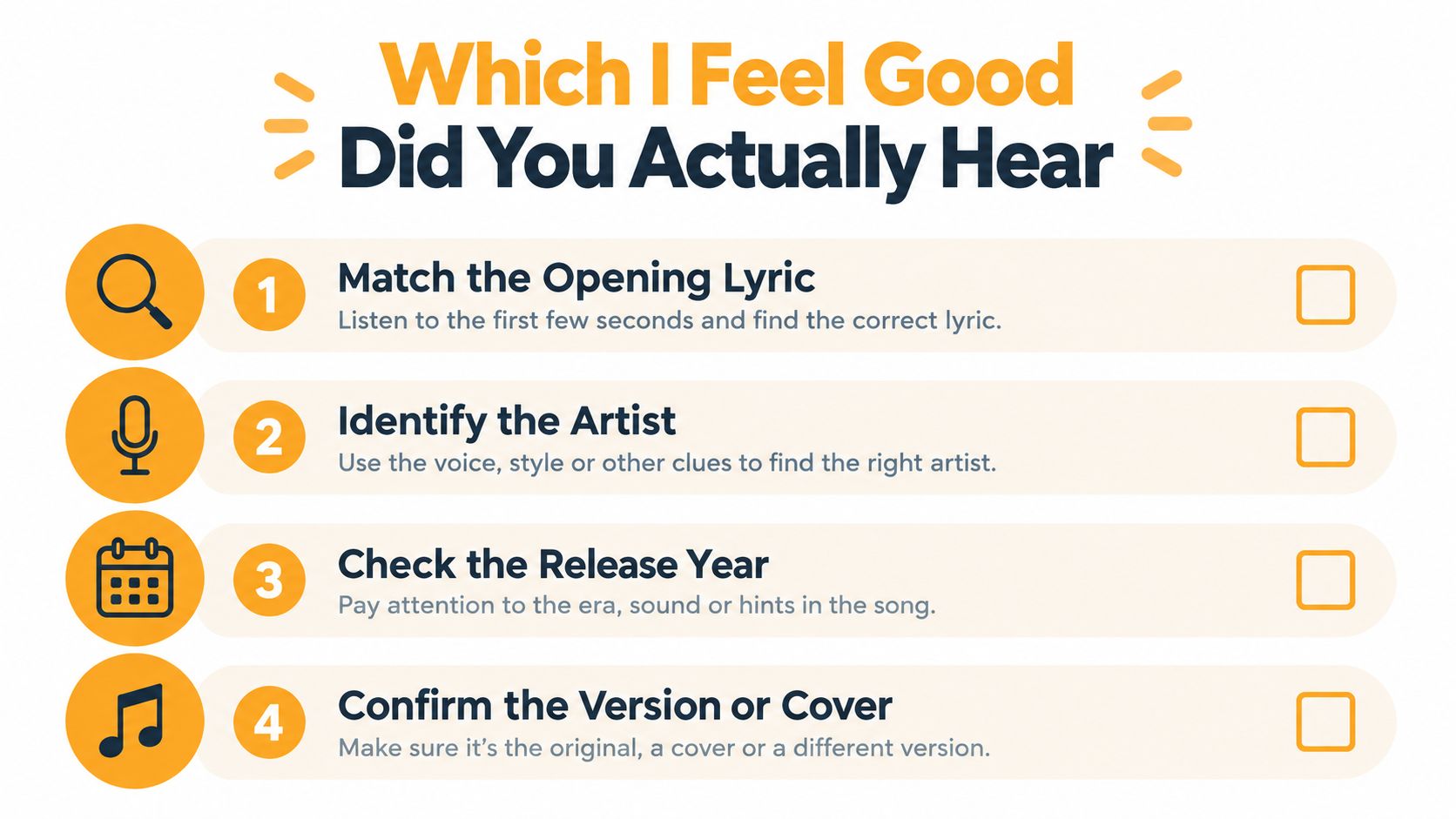
Practical rule: Don't begin with a lyric transcription. Begin with the recording identity, because the correct text depends on the correct artist and version.
This matters beyond convenience. Bain's music-discovery research found that 18 different channels ranked among the top three discovery sources for at least 5% of U.S. respondents in its analysis of music discovery. A listener may encounter a song through a recommendation, video, playlist, broadcast, or cultural reuse and remember only the title or hook. Identification is therefore the first reference task.
Title and Artist Comparison at a Glance
The table below gives you a quick way to narrow the search. Some details are intentionally described qualitatively where a verified source does not establish a specific catalog field.
I Feel Good Songs Compared
| Artist | Year | Genre | Label | Identifying Cue |
|---|---|---|---|---|
| James Brown | 1965 | Rhythm and blues with funk elements | King Records | Vintage band attack, shouted vocal, instantly recognizable repeated hook |
| Pitbull featuring Anthony Watts and DJ White Shadow | 2021 | Contemporary pop and dance | Verify the release metadata on the official artist or rights-holder page | Modern production, rap-led delivery, club-oriented presentation |
| Other covers or title matches | Varies | Varies | Varies | Check the artist, recording date, opening arrangement, and official video before using any lyric page |
James Brown is the safest match when the remembered performance feels like a classic soul or funk recording. His song is formally titled “I Got You (I Feel Good),” although listeners often search using only the phrase “I Feel Good.” That shortened search is understandable, but it also removes the artist clue that would make identification easier.
Pitbull's track creates the opposite problem. A listener may remember the title from a recent playlist or video, then land on a James Brown lyric page because the older recording has stronger cultural recognition. The title alone can't resolve that ambiguity.
Use the identifying cue as a starting point, then confirm the recording through an official video, artist page, or clearly attributed catalog entry. A generic transcription can reproduce words while still attaching them to the wrong version.
Inside James Brown's 1965 Crossover Hit
What makes James Brown's “I Got You (I Feel Good)” more than a familiar refrain? The recording's date, release, arrangement, and chart path place the lyric query in a specific musical context.
Brown recorded the song on May 6, 1965, at Criteria Studios in Miami. King Records released it in October 1965. Its identity comes through the combination of a disciplined rhythm section, sharp accents, and a vocal performance built on repetition and physical energy. The band supplies the frame, while Brown's voice makes the central phrase unmistakable.

A precise chart timeline
The single entered the Billboard Hot 100 on November 13, 1965, at No. 68. One week later, it rose 54 positions to No. 14. It reached No. 3 on December 18 and held that position for three weeks, according to the song's Billboard history summary).
Its pop success did not separate the recording from Brown's rhythm-and-blues audience. The song spent six nonconsecutive weeks at No. 1 on Billboard's R&B singles chart, showing how the same performance worked across both markets.
The release came after “Papa's Got a Brand New Bag,” which had already led the R&B chart for eight weeks. “I Feel Good” became Brown's highest-charting entry among 91 Billboard Hot 100 appearances.
The hook is memorable, but the chart movement reveals the larger achievement. Brown connected a rhythm-and-blues foundation with pop-radio accessibility.
That combination explains the continuing lyric searches. Listeners may remember the refrain first, like recognizing a book from one familiar line, but accurate identification depends on the voice, band, recording era, and full title working together.
Artist-Approved Lyrics and Verse Structure
A trustworthy lyric page should let you hear the words in their musical setting, not separate them from the performance. For “I Got You (I Feel Good),” use the artist-approved text available through the rights holder or an explicitly attributed official lyrics source. I can't reproduce the full copyrighted lyrics here, but you can verify the wording against the official recording and video presentation.
The song's structure is compact and performance-driven:
- Opening statement: Brown establishes the emotional premise immediately.
- Verse material: The singer describes the source of his happiness and affection.
- Hook: The central phrase returns as the song's main recognition point.
- Repeated vocal sections: Brown stretches and reinforces the hook through delivery, emphasis, and band interaction.
Listeners often mishear songs like this because the vocal performance is expressive rather than conversational. Brown bends syllables, pushes words against the rhythm, and uses shouted emphasis as part of the arrangement. A transcription that ignores the recording can make a vocal gesture look like an additional lyric line.
How to verify a line
Read the text while listening to the studio recording. Pay attention to whether a phrase is a lyric, a repeated exclamation, or a performance ad-lib. Those distinctions matter when you're preparing a quotation, building a playlist note, studying song form, or checking a line for karaoke.
For a useful explanation of how verses, pre-choruses, choruses, and repeated sections function, consult this guide to song structure and lyric organization. It helps explain why a short song can still contain distinct musical roles even when the chorus and vocal hook dominate the listener's memory.
An official video embed adds another layer of confirmation. You can compare the vocal phrasing, arrangement, and visual presentation in one place instead of choosing between disconnected lyric pages and user-uploaded clips.
Songwriting Credits, Label, and Recording Details
Credits are more than background decoration. They establish who created the work, which label released the master, and how a listener or journalist can distinguish the original single from later covers, edits, and performances.
The verified recording details identify May 6, 1965, at Criteria Studios in Miami, as the recording date and location. King Records released the single in October 1965. The song is commonly identified by its full title, “I Got You (I Feel Good),” rather than the shortened search phrase.
Key Credits and Release Facts
| Field | Detail |
|---|---|
| Artist | James Brown |
| Full title | “I Got You (I Feel Good)” |
| Recording date | May 6, 1965 |
| Recording location | Criteria Studios, Miami |
| Label | King Records |
| Release | October 1965 |
| Original format | Single |
| Catalog context | Brown's strongest U.S. pop-chart success |
The supplied verified information establishes the artist, recording session, label, and release timing, but it doesn't provide a complete songwriter or producer credit block. A careful reference page should leave those fields unfilled until a reliable rights-holder or catalog source confirms them.
That restraint protects readers from a common metadata error. Search results often blend credits from a studio recording, a reissue, a compilation, and a live version. Start with the original artist page, such as the James Brown catalog reference, then check whether the specific song entry identifies the same version you're researching.
Why Artist-Approved Lyrics Pages Matter
A fan transcription can be useful, but it doesn't automatically establish accuracy or rights provenance. Different pages may preserve different spellings, omit repeated vocal phrases, or combine studio lyrics with words heard in a live performance.
An artist-approved page follows a clearer chain of control. A verified artist or rights holder claims the relevant artist, album, or song page, confirms ownership through a one-time code placed in an X or SoundCloud bio, and submits text or metadata for editorial review. The change is held before publication rather than appearing instantly.
What verification changes for the reader
- Attribution is visible: Readers can see who supplied or approved the text.
- Edits have a review stage: A correction doesn't become public without editorial handling.
- Catalog entities stay separate: Artist, album, and song pages can connect without collapsing different recordings into one entry.
- The official video sits beside the text: Listeners can check words against a canonical audiovisual source.
- Rights holders retain control: Verified contributors can manage credits and metadata for their catalog.
This structure is especially helpful for a title as ambiguous as “I Feel Good.” The page needs to identify the artist before displaying words, then place those words beside the correct recording. A title-only transcription does neither reliably.
The difference between transcription and provenance is explained in this guide to official lyrics and video pages. For listeners, the practical result is simple: fewer conflicting versions and a clearer route from remembered hook to verified song.
Influence, Samples, and Where to Go Next
James Brown's recording continues to surface because it works in several settings at once. The rhythm is immediate, the vocal hook is easy to recognize, and the performance communicates excitement before a listener has processed every word. That makes the song useful in cultural moments that need a fast signal of energy or celebration.
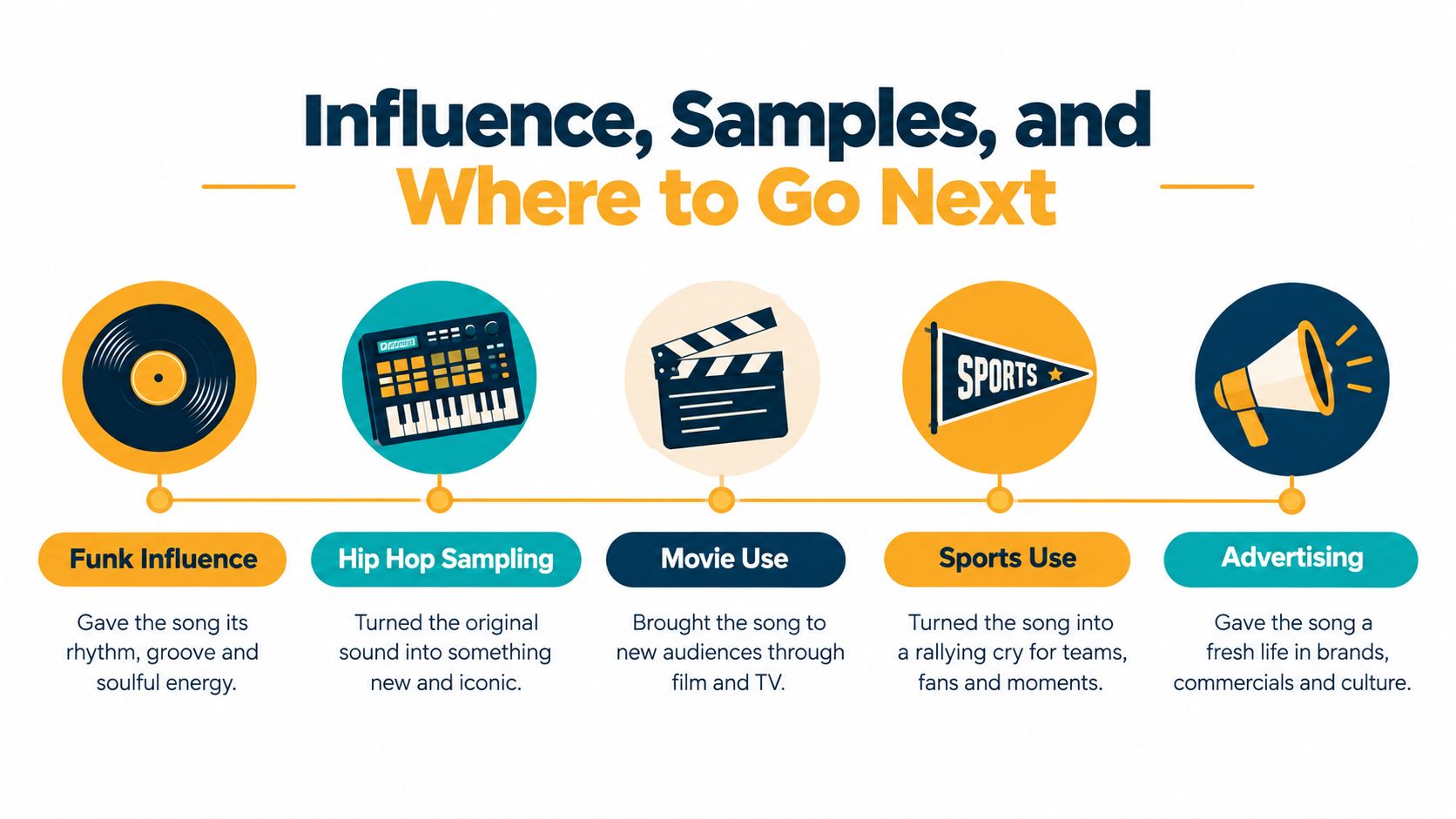
Its afterlife can be understood through five routes:
- Funk influence: The tight rhythmic interplay and shouted vocal approach demonstrate how a band can make repetition feel dynamic.
- Sampling and reinterpretation: Producers and performers can draw on its vocal identity, rhythmic feel, or recognizable hook when creating new work.
- Film and television use: A familiar recording can establish mood quickly, especially when a scene needs optimism or comic momentum.
- Sports settings: The refrain translates easily to crowd energy and celebratory moments.
- Advertising: A recognizable phrase can communicate positive feeling without a long explanation.
The important distinction is between influence and proof. A listener may recognize a hook in a new context, but that doesn't establish whether the newer work sampled the master, replayed a composition, used a cover, or borrowed a phrase. Credits and rights records are needed for that conclusion.
Once you've confirmed the James Brown recording, explore the surrounding catalog rather than stopping at the search result. Compare it with “Papa's Got a Brand New Bag,” listen for the relationship between vocal exclamation and rhythm section, and check the artist's verified song and album pages for connected recordings. That path turns a one-line lyric search into genuine artist discovery.
Quick Reference Box for I Feel Good
Use this box to identify the recording before citing it in a playlist note or catalog. The familiar search phrase points to the full title “I Got You (I Feel Good)” by James Brown.
At-a-Glance Reference
| Field | Value |
|---|---|
| Artist | James Brown |
| Full title | “I Got You (I Feel Good)” |
| Recording date | May 6, 1965 |
| Recording studio | Criteria Studios, Miami |
| Label | King Records |
| Release month | October 1965 |
| Hot 100 debut | November 13, 1965, at No. 68 |
| Hot 100 peak | No. 3 |
| Time at peak | Three weeks |
| R&B chart result | Six nonconsecutive weeks at No. 1 |
| Hot 100 catalog standing | Highest-charting entry among 91 appearances |
The chart and release details come from the documented Billboard history summarized above. The available reference does not establish songwriter, producer, or original single-length details, so those fields should remain unfilled rather than guessed.
For a larger music catalog, consistent fields make descriptions easier to compare and maintain. A structured approach to music metadata management keeps artist, recording, release, and rights information aligned. Treat the table like a library catalog card: it identifies the item quickly, while credits and rights records require separate confirmation.
Common Questions About I Feel Good Answered
Why do lyric pages show different words?
Some pages rely on fan transcriptions, while others may reflect a live performance, a remaster, or a different recording. Brown's expressive delivery can also make repeated vocalizations sound like separate lyric lines. Compare the text with the original studio recording and prefer a page with visible attribution and editorial control.
Which “I Feel Good” is the James Brown song?
The full title is “I Got You (I Feel Good).” It's the 1965 King Records single recorded at Criteria Studios in Miami. If the remembered track has a modern dance or rap production, check the Pitbull recording instead.
How can I tell a live performance from the studio original?
Listen for changes in pacing, crowd response, extended vocal sections, or a different band arrangement. The studio single has a fixed presentation, while live versions may stretch the hook or add audience interaction.
Who owns the publishing rights?
The supplied reference information doesn't establish a complete publishing-rights chain. Don't infer ownership from a lyric page alone. Check the official catalog, rights-holder information, or a recognized performance-rights database for a rights-specific answer.
Does another artist use the same title?
Yes. Pitbull released a 2021 track titled “I Feel Good” featuring Anthony Watts and DJ White Shadow, so the title isn't unique. Identify the artist before copying lyrics, citing credits, or sharing a video.
Where should I find the official video?
Use an artist, label, or rights-holder page that embeds or links to the official audiovisual release. The editorial principles described in this guide to review workflows help explain why approval and attribution matter.
House of Lyrics brings artist-approved lyrics, verified credits, and official video embeds together so you can confirm a song instead of relying on an uncertain transcription. Visit House of Lyrics to identify “I Feel Good” accurately and explore the connected artist and song catalog.