I Believe I Can Fly Lyrics and Official Song Reference
Read the definitive I Believe I Can Fly lyrics, watch the official video, and explore complete song credits, release history, and version metadata.

You search for “I Believe I Can Fly lyrics” and find several pages that look almost identical. One has a line missing, another follows a karaoke edit, and a video upload pairs the words with a cover rather than the original recording. The result is more than a minor inconvenience. Fans may learn the wrong text, while journalists, educators, editors, and rights holders may attach accurate words to the wrong version.
A reliable lyric reference has to answer several questions at once: Which recording is this? Who wrote it? What release does it belong to? Are the lyrics authorized, and does the accompanying video represent the same work? Treating those details as separate pieces creates the confusion that users are trying to escape.
The strongest catalog entry connects the lyric text, artist attribution, release history, credits, and official audiovisual source. It also makes uncertainty visible instead of presenting a transcription as definitive. For anyone building or checking a music archive, that editorial discipline matters as much as the words themselves.
Table of Contents
- "Introduction to the Definitive Lyric Reference"
- "The Complete Artist-Approved Lyric Text"
- "Official Music Video and Audiovisual Context"
- "Songwriting Credits and Production Metadata"
- "Release History and Version Identification"
- "Chart Performance and Commercial Milestones"
- "Claiming and Managing Pages on House of Lyrics"
- "Quick Reference and Catalog Cross-References"
"Introduction to the Definitive Lyric Reference"
Why lyric search results can disagree
A listener might begin with the soundtrack recording, then open a page built from a later album listing. Another reader may follow a karaoke version whose structure has been shortened for performance. Cover recordings create another layer of ambiguity, especially when a page title identifies only the song and not the performer.
These pages can look authoritative while offering no clear provenance. A user shouldn't have to compare several videos, inspect scattered credits, and guess whether a spelling difference reflects a genuine alternate version or a transcription error.
The phrase “official lyrics” also needs careful handling. It can mean a text supplied by the songwriter, publisher, label, or verified rights holder. It shouldn't be used casually for a crowd-sourced transcription that has no visible attribution or editorial history.
Practical rule: Treat every lyric page as a catalog record, not just a block of text. The recording, writer, version, rights source, and supporting media should agree.
What a dependable reference should show
A trustworthy entry identifies the artist and songwriter before displaying the lyric text. It separates the original recording from covers, radio edits, live performances, and remastered releases, then places the official video beside the words where an authorized embed is available.
An editorial workflow adds another safeguard. Contributions can be checked for wording, formatting, credits, and version identity before publication, rather than appearing immediately after an anonymous edit. The principles behind that process are outlined in House of Lyrics' editorial review guide, which describes why review and attribution belong inside a modern music library.
For “I Believe I Can Fly,” the catalog trail is unusually important because the song moved from a film soundtrack into a later album context. The reference record should therefore preserve the relationship between the song, the film, the original performer, and subsequent versions without collapsing them into one undifferentiated page.
Why this approach helps different readers
A fan wants to sing the right words. A music journalist needs an accurate writer credit and release context. An educator may need to discuss the song without reproducing an unverified transcription, while a rights holder needs to know whether a page represents the correct recording.
The same metadata answers all four needs. Clear attribution reduces accidental mislabeling, version fields prevent cover recordings from inheriting the original artist's identity, and official media gives readers a direct way to confirm what they're hearing.
The result isn't merely a cleaner search experience. It's a more responsible record of a song's authorship and circulation.
"The Complete Artist-Approved Lyric Text"
Why the canonical text matters
Readers searching for I Believe I Can Fly lyrics usually want the complete words, but completeness alone doesn't establish accuracy. A page can contain every section and still mishear a phrase, omit a repeated passage, or arrange the verses according to a different edit.
The correct editorial order is simple:
- Confirm the recording. Identify R. Kelly's original performance rather than a cover, karaoke track, or live version.
- Confirm the rights source. Use text supplied or approved by the relevant artist, publisher, label, or verified rights holder.
- Preserve the recording's structure. Keep verse, pre-chorus, chorus, bridge, and repeated sections aligned with the canonical release.
- Label alternatives. If a radio edit or performance changes the structure, give it a separate version record instead of blending it into the main text without note.
That process protects meaning. A misplaced line can change the movement from uncertainty to confidence, while an omitted repetition can make the lyric appear shorter than the recording the listener knows.
Reading the song as a progression
The song's emotional architecture moves from limitation toward possibility. Its opening perspective acknowledges doubt and vulnerability, then gradually builds toward a chorus that expresses confidence, aspiration, and self-belief.
That progression is why formatting deserves attention. Verse labels help readers understand the song's development, while chorus markers make repeated language easier to follow without implying that every release uses identical sequencing. A canonical lyric page should be readable enough for a fan and precise enough for an editor checking a quotation.
The text should also carry visible attribution. Readers need to know who wrote the song and which recording the page represents before they treat the words as a source.
Avoiding transcription drift
Unverified lyric pages often accumulate small changes over time. One contributor guesses at a difficult phrase, a second copies that guess, and a third reformats the result as though it were confirmed. The error then appears across multiple pages, creating the illusion of agreement.
A catalog editor should compare the text with the designated recording and rights-approved material, then preserve the approved wording rather than “correcting” it based on personal expectation. The same principle applies to other entries, including the editorial handling discussed in House of Lyrics' reference to “All This Time” lyrics.
Because the full copyrighted lyric text isn't reproduced here, the reliable way to read it is through an artist-approved lyric page that identifies the recording and rights provenance. Avoid copying a transcription merely because it ranks well or matches another unverified page. The useful reference is the one that tells you whose words you're reading and which version they belong to.
"Official Music Video and Audiovisual Context"

Lyrics become easier to verify when the page places them beside authoritative audiovisual material. A reader can hear the phrasing, observe the structure, and confirm that the words correspond to the intended recording instead of relying on a detached text file.
What the video adds
The official video gives the song a visual setting that reinforces its central ideas of flight, aspiration, and crossing personal boundaries. Those motifs don't replace the lyric text, but they help explain why the song has remained associated with uplift and ambition beyond its original film context.
A video embed also reduces a common source of error. Search results may surface fan uploads, covers, lyric videos, edits, or clips with altered audio. A recognized official source gives the reader a clearer audiovisual reference point and makes version checking more direct.
Pairing the lyric text with the authorized video lets readers verify words and recording identity in the same visit.
How to check text against media
Start with the performer shown in the catalog record, then compare the opening vocal, arrangement, and song structure with the embedded video. If the page contains a different singer, a shortened arrangement, or a performance recording, it should be labeled separately.
Editors should watch for three forms of mismatch:
- Performer mismatch: The page names R. Kelly, but the audio belongs to a cover artist.
- Edit mismatch: The lyrics follow a full studio arrangement while the video uses a shortened broadcast version.
- Media mismatch: The text identifies the soundtrack recording, but the embed points to an unofficial upload or unrelated performance.
These checks are especially valuable for songs that circulate in karaoke libraries and social video clips. A clean page doesn't merely provide an attractive player. It establishes a relationship between lyrics, recording, performer, and source.
Why official embeds improve access
Readers shouldn't need to leave a lyric page, search a second platform, and compare thumbnails to locate the correct video. Keeping the media with the catalog entry shortens that path and gives journalists, teachers, and fans one consistent point of reference.
The same editorial principle applies across a music library. A related entry such as House of Lyrics' “Body Electric” reference is more useful when its text and audiovisual context identify the same work rather than presenting disconnected media.
For archival quality, the video should be treated as supporting evidence, not decoration. The lyric remains a textual record, while the official embed helps readers validate performance identity, arrangement, and presentation.
"Songwriting Credits and Production Metadata"
A serious song record begins with attribution. For “I Believe I Can Fly,” multiple music metadata references credit R. Kelly as the songwriter. Apple Music lists him as songwriter and arranger, while DBpedia describes the song as written and composed by Robert Kelly and originally recorded and released in 1996. (Apple Music's catalog entry provides one metadata reference.)
Reading the roles correctly
Song credits use related but distinct terms:
- Songwriter or composer: The person credited with creating the song's words, melody, or composition.
- Producer: The person responsible for shaping the recorded production, which can include arrangement decisions, sound, performances, and recording direction.
- Arranger: The person who adapts the composition for a particular instrumentation, vocal layout, or recorded presentation.
- Recording artist: The performer associated with the released recording.
The same person may hold several roles, but those roles shouldn't be collapsed into one generic “artist” field. A catalog that records each function separately gives users a clearer view of authorship and production.
Provenance protects the catalog
Accurate metadata helps rights holders identify which page represents their work and helps editors distinguish the original from a cover. It also gives licensing and editorial teams a traceable record when they need to confirm who wrote, arranged, produced, or performed a track.
The distinction becomes practical when versions circulate. A cover may preserve the composition while changing the recording artist, producer, arrangement, and rights pathway. A radio edit may retain the same writer credit but require a separate recording or version entry.
The Spotify track API from Captapi can be useful for teams checking structured track fields across digital catalog workflows. It shouldn't replace rights-holder confirmation, but structured data can help editors compare title, artist, album, and identifier fields before publishing a record.
A practical metadata model
A dependable entry should keep these fields distinct:
| Field | What it establishes |
|---|---|
| Song title | The composition's public name |
| Primary artist | The performer attached to the referenced recording |
| Writer | The credited author or composer |
| Producer and arranger | The recording and presentation roles |
| Release context | Soundtrack, album, single, or reissue |
| Version label | Original, edit, live recording, or cover |
| Media source | The authoritative audiovisual reference |
That structure makes the page easier to audit. It also supports accurate links between the song, artist, album, soundtrack, and alternate recordings, much like the catalog logic used in House of Lyrics' “It's Impossible” reference.
"Release History and Version Identification"
The original release context
High-confidence catalog data places the song's original release in late 1996 and connects it to the soundtrack for the film Space Jam. One catalog reference lists the release date as November 26, 1996, while also identifying the song's appearance in the 1996 film soundtrack. (DBpedia's catalog record documents that release context.)
That information gives listeners a starting point, but it doesn't prove that every page labeled with the title represents the same audio. The song later appeared on R. Kelly's 1998 album R., creating another major catalog relationship and another opportunity for pages to merge distinct release contexts.
Comparing the main versions
| Reference point | What to verify | Why it matters |
|---|---|---|
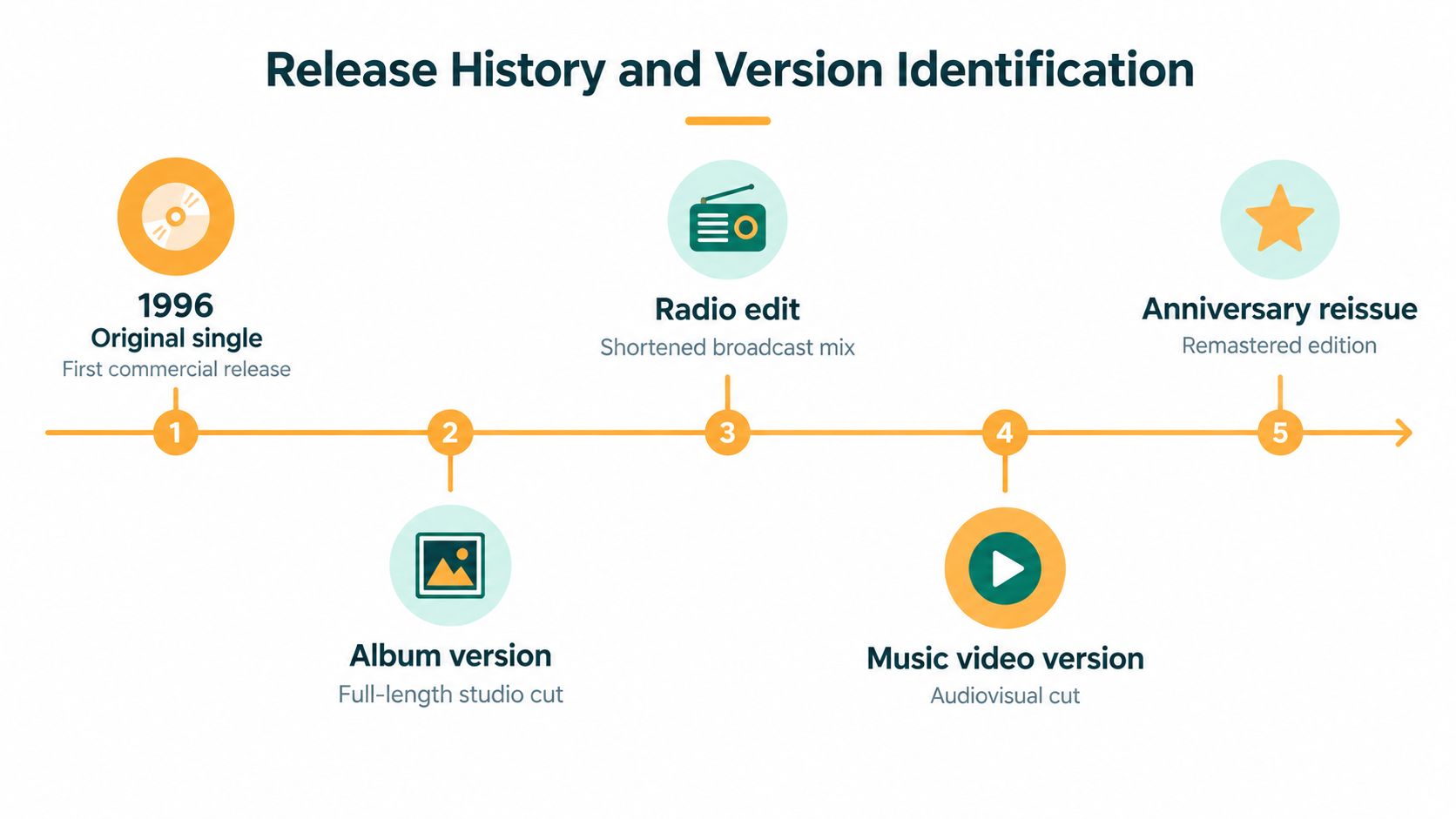
| Soundtrack release | Connection to Space Jam and the original late-1996 release | Establishes the first commercial context |
| Album appearance | Placement on the 1998 album R. | Shows a later album relationship |
| Radio edit | Shortened or broadcast-oriented structure | May change the sequence or length |
| Music video cut | Audio used with the official video | Confirms which presentation the viewer hears |
| Cover recording | Different performer and recording credits | Preserves the original writer while identifying a new recording |
A page should never treat these labels as interchangeable. The soundtrack and album versions may share the same composition, but the catalog record must state which recording the lyric text and video describe.
The supplied release timeline visual is useful as a reminder that version names need evidence. In a real archive, every node should point to a release or recording record rather than functioning as an assumption.
A simple identification routine
When you encounter an unfamiliar page, check the artist field first. Then compare the release context, album association, video source, and audio length. If any field conflicts with the others, record the discrepancy instead of choosing the most familiar version.
Covers deserve their own entry. They can use the same composition and title, but they don't inherit R. Kelly's recording identity or production metadata. Karaoke versions and fan videos should be labeled as derivative or unofficial media when their rights status isn't established.
The embedded video should be treated as a reference for the particular audiovisual presentation shown on the page. If a different upload is used elsewhere, readers should be able to see that it represents a separate source or version.
"Chart Performance and Commercial Milestones"
A catalog record becomes more useful when it separates a song's chart results from its broader commercial story. For “I Believe I Can Fly,” the record spans pop and R&B audiences, a soundtrack release, a later album appearance, and international circulation.
The principal chart results
The single peaked at No. 2 on the Billboard Hot 100 in early 1997. It also reached No. 1 on the Billboard R&B Singles chart for six non-consecutive weeks, showing strength in both mainstream pop and R&B markets. The Genius' song reference provides the cited chart details.
A catalog note should preserve the chart name, peak position, and duration separately. “A major hit” may summarize the result, but it cannot replace those fields. Keeping them distinct works like labeling shelves in an archive: each result remains attached to the chart that produced it.
International reach and certification
The song topped charts in at least eight other countries. It earned platinum certification in the United States and the United Kingdom, as well as gold certifications in seven countries, including France and Germany. Together, these milestones document reach beyond the film's original market.
Certification language needs the same precision as chart language. Platinum or gold is a formal award within a specific market and certification system. It should not be rewritten as a universal sales total when the evidence identifies certification outcomes rather than one worldwide unit figure.
What the pattern tells us
The record combines crossover visibility with sustained recognition in R&B. Its international chart and certification history adds geographic breadth, while the soundtrack-to-album path gives the song a longer commercial narrative than a single film tie-in.
For rights holders and archivists, three claims should remain separate:
- Chart performance describes ranking on a named chart.
- Certification records a recognized milestone in a particular market.
- Cultural interpretation explains the significance of those results without creating another statistic.
That separation supports a dependable House of Lyrics entry. The song may be described as a global pop anthem because its documented chart and certification footprint supports that interpretation. The record should still avoid unsupported estimates about sales, streams, or audience size, especially when distinguishing the soundtrack recording from later album presentations.
"Claiming and Managing Pages on House of Lyrics"
Artists, managers, labels, and other verified rights holders need more than a correction form. They need control over the public record, including the lyric text, credits, artist identity, album relationship, and version labels.
Verification before editing
House of Lyrics uses a one-time verification code placed in an X or SoundCloud bio. The claimant places the code where the platform can confirm control, then submits the claim for the relevant artist, album, or song page.
That method connects the page claim to a public account controlled by the claimant. It offers a stronger ownership signal than an email-only process, especially when several people may share similar names or when an unofficial page already ranks for the song title.
The process is designed to establish identity before edit access is granted. A rights holder shouldn't be asked to correct a public catalog record without a clear way to demonstrate authority over the page.
Editing the record responsibly
Once verified, the owner can use the full-page editor to manage lyrics, credits, and metadata. The useful workflow is deliberate rather than instant:
- Claim the correct entity. Check whether the page represents the artist, album, composition, or recording.
- Review existing fields. Look for wrong performers, incomplete credits, duplicate versions, or missing release context.
- Submit the corrected record. Include the approved lyric text and the appropriate source media.
- Wait for editorial approval. Changes are reviewed before they become public.
- Maintain version clarity. Add distinct records when a cover, edit, live performance, or reissue deserves separate treatment.
The approval stage creates a checkpoint between private editing and public publication. It helps prevent a rushed change from replacing a correct record or introducing a new attribution error.
Why page ownership matters
A musician may find that third-party pages use an outdated biography, an incomplete writer credit, or lyrics copied from a different recording. A label may discover that several releases point to one generic title page. Claiming the catalog creates a place where authorized information can be standardized.
The platform's claim process is available through House of Lyrics' page claiming portal. Rights holders should prepare the correct artist name, release relationships, lyric text, credits, and official video before submitting changes, because accurate inputs make editorial review more efficient.
"Quick Reference and Catalog Cross-References"
A useful song page should work at two speeds. A fan may need a quick confirmation of the performer and release, while a journalist or rights manager may need to trace the song to its soundtrack, album, writer, and official video.
Song Metadata Quick Reference
| Attribute | Detail |
|---|---|
| Song | “I Believe I Can Fly” |
| Primary artist | R. Kelly |
| Writer | R. Kelly, also identified as Robert Kelly in catalog metadata |
| Original release | November 26, 1996 |
| First release context | Space Jam soundtrack |
| Later album context | R. |
| Billboard Hot 100 peak | No. 2 |
| Billboard R&B Singles peak | No. 1 for six non-consecutive weeks |
| Official audiovisual reference | Use the authorized video embed attached to the catalog entry |
The date, soundtrack relationship, writer credit, and chart fields should remain tied to their supporting catalog records. A summary table is helpful, but it shouldn't become a substitute for version-level detail.
How to cross-reference the record
Begin with the artist page, then follow the album and soundtrack relationships. From there, check whether the song has separate records for the original single, album appearance, radio edit, music video presentation, or cover recordings.
That navigation matters because title-only searches flatten relationships. A song title can point to a composition, a specific master recording, a video, a karaoke file, or a cover. Structured links keep those entities distinct while still allowing readers to move between them.
Rights and version confusion remains a central problem for lyric search. Songfacts' reference entry notes the need to distinguish the original R. Kelly recording from covers and edits, and cites Musixmatch's report that 81% of listeners search for lyrics online. That figure makes accurate indexing important, but it doesn't make every high-ranking transcription reliable.
Supporting audiovisual references
If you're preparing a lyric video, educational presentation, or catalog asset, verify the song identity before creating visuals. Resources covering professional video creation tips can help with production planning, but the creative workflow should begin with the correct lyric text and rights information.
A final audit should ask:
- Does the artist match the recording?
- Does the release context identify the soundtrack or album?
- Are writer, producer, and arranger fields separated?
- Is the lyric text approved or clearly attributed?
- Does the video represent the same version?
- Are covers and edits listed separately?
That checklist turns a search result into a usable catalog reference. It also gives fans, editors, and rights holders a common standard for deciding whether a lyric page deserves trust.
House of Lyrics brings artist-approved lyrics, official video embeds, structured credits, and claimable catalog pages together in one music reference system. If you want to verify or manage the record for “I Believe I Can Fly” or another song, visit House of Lyrics and explore the platform's artist and rights-holder tools.