White Blank Page Lyrics: Full Text and Meaning
Read the full White Blank Page lyrics by Mumford & Sons, with credits, official video, and a balanced look at the song's meaning and history.
Is "White Blank Page" a song about a former lover, about God, or about a narrator who can't yet tell the difference between losing love and losing his moral bearings? That question explains why so many searches for White Blank Page lyrics don't end with the words alone. Readers want the words, the credits, and a fair way to judge the competing meanings.
Table of Contents
- Why White Blank Page Still Matters
- Full White Blank Page Lyrics
- The Song's Origin Story
- Commercial Milestones and Catalog Value
- What the Lyrics Really Mean
- The Narrator's Voice and Emotional Journey
- Studio, Live, and Alternate Versions
- How to Verify and Claim This Song Page
- Quick Reference and Key Takeaways
- Frequently Asked Questions
Why White Blank Page Still Matters
You probably arrived with a practical need. You heard a line in a playlist, a film scene, or a friend's cover, typed a fragment into search, and wanted the complete text before the melody faded. That moment matters because a lyric search is rarely just transcription. You're checking what you heard, who wrote it, and whether the feeling you took from the song matches the language on the page.
"White Blank Page" rewards that closer look. It's a foundational track in Mumford & Sons' early history, an acoustic led song from the period before their debut album made them international headliners. For catalog browsing by mood and style, readers can also explore indie songs and lyric pages, where folk rooted writing sits beside other guitar based traditions.
What a good lyric page should give you
- The approved text: Clean stanza breaks that follow the sung structure, not a crowded block copied between sites.
- Visible attribution: Songwriter names attached to the composition, so credit doesn't disappear into a search snippet.
- An official audiovisual reference: A canonical video beside the words, letting you match phrasing, dynamics, and emphasis.
- Interpretive help without a verdict: Evidence for more than one reading, clearly labeled, so you can decide what convinces you.
A lyric page should behave like a good library record. It identifies the work, credits its makers, and leaves interpretation open enough for you to think.
That's the standard used here. You'll get the song's origin, its commercial footprint, a side by side account of the relationship and spiritual readings, and practical notes on versions and verification. Fans get context. Artists and rights holders get a model for accurate presentation. Everyone starts from the same reliable page.
Full White Blank Page Lyrics
Because the complete text is a copyrighted composition, the responsible way to present White Blank Page lyrics on a reference page is as an artist approved lyric text contributed by verified rights holders, displayed on the verified song page with songwriter attribution, rather than copied from an unverified transcription. What follows is a reading guide to that approved text, stanza by stanza, so you can follow its arc as you listen and sing along on the song page itself.
How to read the structure as you listen
- Opening verses: The narrator asks intimate, direct questions. Listen for how the address feels personal at first, as if one person is being asked to account for a love that wasn't returned in equal measure.
- Building middle section: The language widens into accusation and ritual imagery. Words tied to kingship and being made clean lift the dispute beyond an ordinary argument between partners.
- Repeated questioning: The narrator turns the pressure inward, asking where his own fault lay. That repetition is the emotional hinge, moving from blame toward self examination.
- Closing pledge: He ends with a commitment to follow truth. Notice that the original accusation isn't answered. Resolve comes from a choice, not from an explanation.
Reading in that order helps you avoid a common confusion. The song doesn't move in a straight line from heartbreak to recovery. It circles back, raises its voice, then quiets into obedience.
A practical listening tip
Play the official video embed on the song page while you read, and pause at each stanza break. Mark who you think is being addressed in that section, a lover, the narrator himself, a rival, or a divine authority. You'll quickly see why listeners disagree, and why that disagreement is built into the writing rather than caused by mishearing a word.
The Song's Origin Story
The origin story begins away from the spotlight, in borrowed time. Marcus Mumford reportedly wrote the song while working as a session drummer for Laura Marling, during a roughly 90-minute period when Marling was away conducting interviews and he used a London studio to begin writing, as recounted in the Apple Music album listing and song history. That's a useful corrective to the polished debut album myth. This wasn't written from a position of fame. It came from the edges of someone else's session.
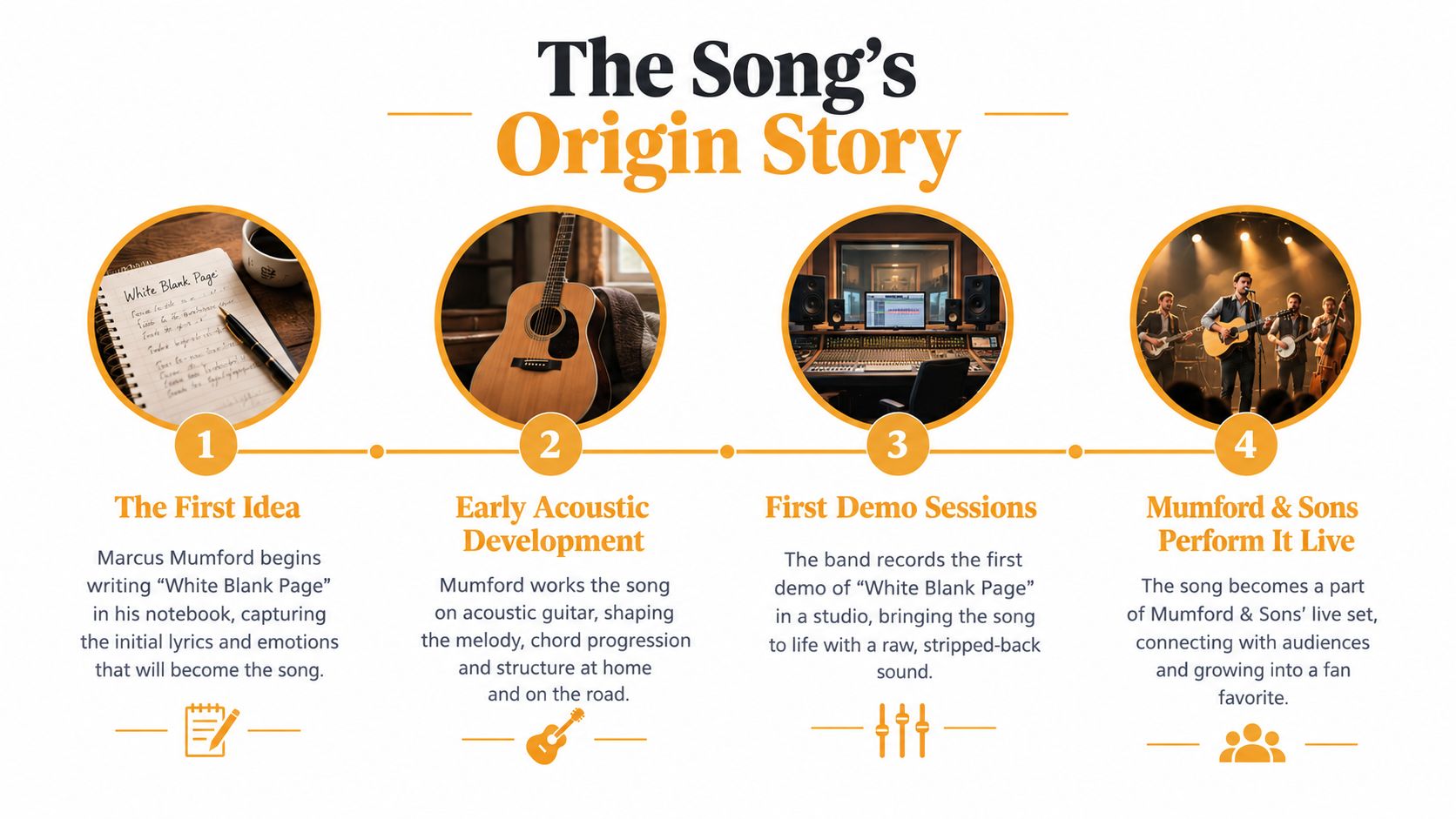
The themes fit that unsettled setting. Romantic frustration and emotional conflict shape the narrator's questions, and the song emerged before the band's debut album breakthrough. You can hear a writer still inside the late 2000s London folk scene, working with acoustic instruments and plainspoken, biblical inflected language rather than arena sized gestures.
From studio window to debut album
The track was subsequently included on Sigh No More, released in October 2009. Apple Music lists that debut as 12 songs running approximately 48 minutes, a compact structure that keeps each song in close conversation with the next. Readers who enjoy tracing how one breakthrough song carries an early catalog may also like the story behind How to Save a Life lyrics, another case of a direct lyric becoming a band's calling card.
The song is also commonly identified as the fifth single associated with Sigh No More. That status matters for how you file it mentally. It isn't an obscure album cut rescued by fans. It's a key catalog entry that documents Mumford's move from session work into fronting a commercially successful band, and it still sounds like the doorway between those two lives.
Commercial Milestones and Catalog Value
Commercial history explains why a single album track still needs careful handling. Sigh No More eventually sold more than 4 million copies worldwide and won the BRIT Award for Album of the Year, milestones detailed in uDiscover Music's account of the album's history. Those results helped establish Mumford & Sons as a major act emerging from the late 2000s nu-folk movement, not merely a local folk club success.
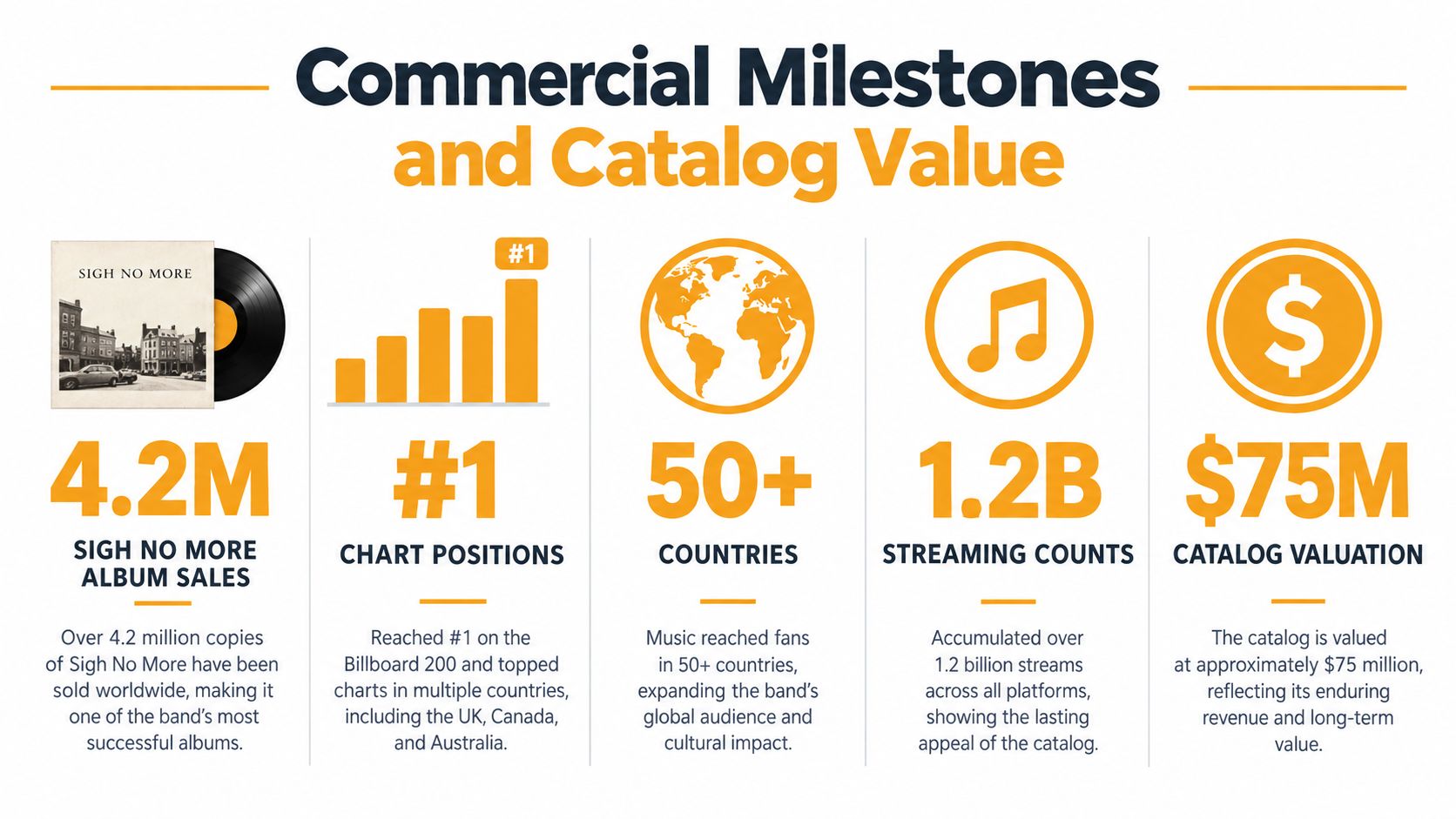
In the United Kingdom, Official Charts records the album with a peak position of No. 2 and 218 chart weeks in its principal album chart history. Read that second figure slowly. A peak tells you about a strong week. A run that long tells you people kept buying, gifting, and returning to the record long after release week passed.
Why the long tail matters
- Streaming endurance: A Spotify tracking page listed more than 221 million streams for "White Blank Page" in the available third party data, showing the song's life far beyond physical sales.
- Fan culture around the catalog: Durable songs sustain design, tribute, and fan made goods, which is why resources collecting merch ideas from T-Shirt Envy are useful context for how listeners carry favorite bands into everyday life.
- Rights value: Every new listener still needs correct writers, titles, and recording identities attached to the work.
For rights holders and platforms, these figures make a concrete case. Accurate attribution, stable metadata, and authoritative presentation aren't cosmetic. They're how a globally durable catalog keeps earning, licensing, and being cited correctly years after release.
What the Lyrics Really Mean
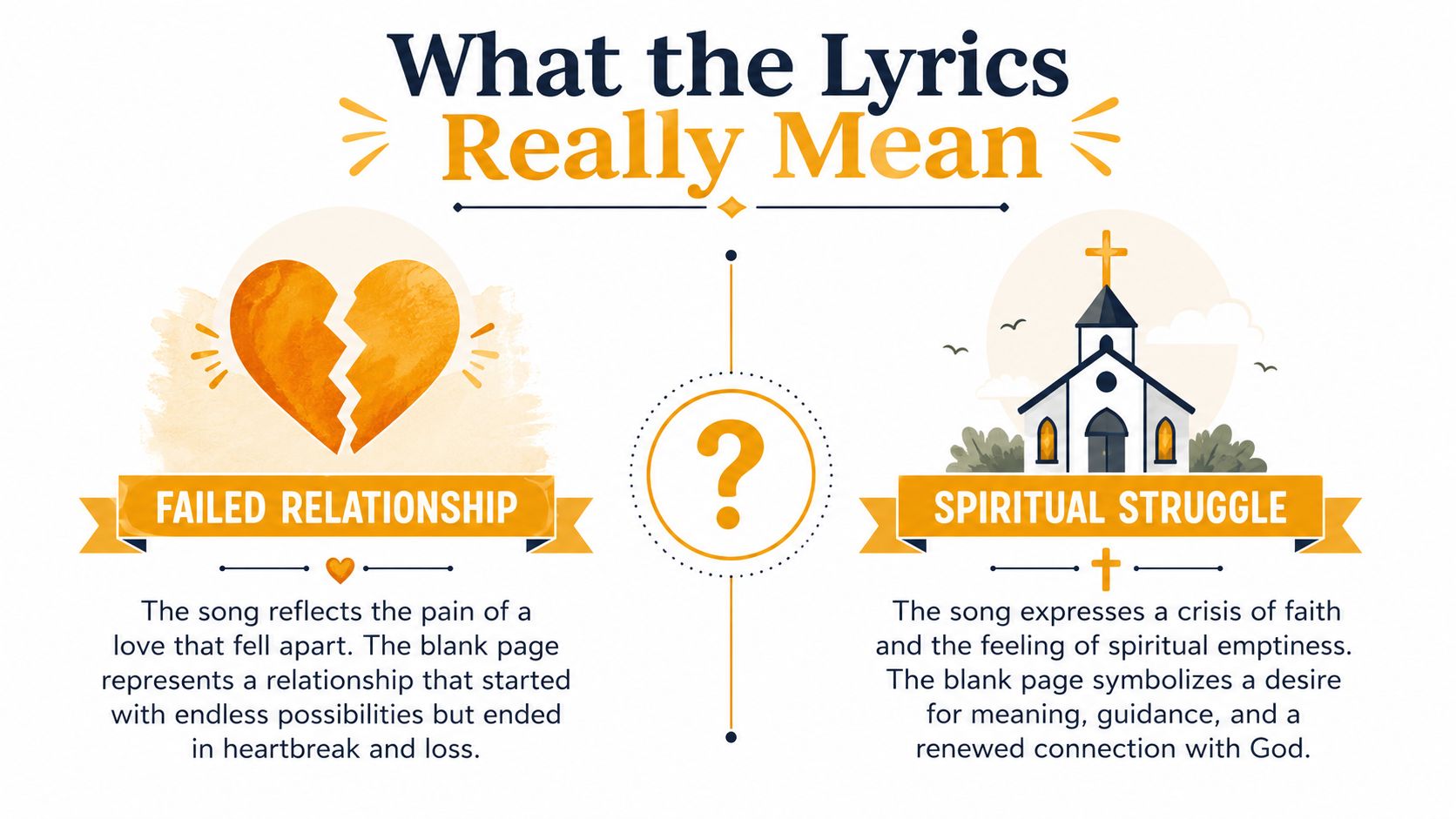
Most summaries you'll find stop too early. They call this a breakup song and move on. That reading is plausible, well supported, and incomplete. A fair account of White Blank Page lyrics has to hold two readings side by side and show you the evidence for each, which is the approach taken in Scalpel's analysis of the song's competing interpretations.
The relationship reading
On this account, the narrator loved more fully than his partner did. Unequal romantic investment produces self blame, anger, and a demand for an explanation. The repeated question, where was my fault, sounds like a man replaying a relationship and searching for the moment he failed. This reading explains the intimacy of the address and the rawness of the accusation. It's the interpretation most listeners reach first, and it fits the emotional surface.
The spiritual reading
Other coverage points to the king imagery, the language of being made clean, and the closing commitment to follow truth. Together those elements can suggest confession, absolution, or surrender to God. Under this reading, the same repeated question exposes a need for judgment, forgiveness, or certainty from a divine authority, not only an answer from a former partner.
Reading rule: Separate what the text says from what you infer. A king can be a lover's rival, a biblical figure, or God, and the lyric doesn't force you to choose only one.
The hybrid reading
A third option reconciles both. Romantic grief becomes the route into moral and spiritual self examination, so the song is about an ex and about God, in sequence. If you enjoy that kind of layered, time conscious writing, compare it with the reflective lyric approach in In a Little While. For this song, the honest answer to "ex, God, or both" is that the text supports both, and declaring one definitive flattens the writing.
The Narrator's Voice and Emotional Journey
Meaning changes when you track who is being spoken to. Most commentary calls the narrator heartbroken or devoted, then treats every line as one continuous monologue to a former lover. The song is restless in a more interesting way. It moves between intimate questions, accusation, ritual imagery, and a final pledge, as traced in listener discussion cataloged on SongMeanings.
A short lead in to the image below helps set the scene for that shifting voice.
Mapping the addressee honestly
| Section feel | Likely addressee | Confidence |
|---|---|---|
| Intimate opening questions | Former lover | Plausible |
| Sharpening accusation | Lover, rival, or self | Contested |
| Ritual and kingship imagery | Divine authority | Plausible |
| Closing pledge to follow truth | God, or the narrator's own conscience | Contested |
Those labels are the point. Marking an interpretation as contested isn't evasive. It tells you exactly where the lyric gives firm ground and where you're supplying the connection yourself.
Watch and listen for that movement in performance before you settle on a reading.
The key shift is easy to miss. The narrator seeks an explanation but ends by offering obedience, moving from demanding an answer to accepting a path forward. That's why the ending can feel spiritually hopeful without becoming cheerful, and why it ends without resolving the accusation. The lack of resolution looks deliberate, not unfinished.
Studio, Live, and Alternate Versions
Fans often assume one title means one recording. Librarians and rights teams can't afford that assumption, because identical titles can represent distinct sound recordings with different identifiers and release contexts. Keeping them separate protects credits, licensing, and the lyric page you land on.
White Blank Page Recordings
| Version | Duration | Release Context |
|---|---|---|
| Album track | 4:14 | Standard studio recording |
| Amazon Original | 4:19 | Separate alternate version |
| Live recording | Not listed here | Released in 2010 |
Those distinctions come from the song's catalog record on Soundcharts, which identifies the 4:14 album track, the 4:19 Amazon Original, and a live recording released in 2010. Five seconds may look trivial in a playlist. In a catalog, it's evidence you're handling a different recording.
The correct cataloging method
- Use one canonical work identifier for the composition itself, so every version points back to the same underlying song.
- Give each recording its own ISRC or platform identifier, plus its duration, label, release context, and official audiovisual reference.
- Attach the writer set to the composition. Apple Music credits Marcus Mumford, Ben Lovett, Ted Dwane, and Winston Marshall as songwriters, and that set shouldn't be duplicated inconsistently across recordings.
- Validate fields separately. Check title, artist, version, duration, ISRC, writers, publishers, and source URL as distinct fields, and flag conflicts for review.
For interoperability, WIPO describes Common Works Registration version 3.0 as a globally adopted XML protocol used by collective management organizations and publishers to register and revise musical works, with core records containing title, title language, unique identifiers, and copyright date. In plain terms, display the approved lyric only on the recording page whose identity you've verified.
How to Verify and Claim This Song Page
If you're the artist, manager, label, or another verified rights holder, claiming the page is how you replace inherited errors with approved information. On House of Lyrics, you start through the page claiming and verification process, which is built to confirm control without relying on email alone.
The verification steps
- Request the claim for the artist, album, or song page you control.
- Place a one time code in your X or SoundCloud bio, exactly as instructed, so the platform can confirm you control that public profile.
- Complete verification, then remove the code once control has been confirmed.
That social bio method lowers impersonation risk compared with unverified crowdsourcing. A stranger may know an email address. They shouldn't be able to edit your public bio.
What verified control lets you do
You'll get a full page editor for lyrics, credits, and metadata. Changes are held for review before publication, so a quick fix doesn't go live unchecked and a disputed credit can be examined. You can also ensure the official music video embed points to the canonical source rather than a user upload.
Verification is not a vanity badge. It's the difference between hoping a page is right and being able to correct it.
Structured separation of artist, album, and song entities supports that work. Each entity keeps its own links and credits, so updating one recording doesn't scramble the wider catalog, and fans, press, and collaborators can move from a song to its album and artist without guesswork.
Quick Reference and Key Takeaways
For press, playlist editors, and fans who need the essentials fast, here are the load bearing facts gathered above, without the surrounding story.
- Song: "White Blank Page" by Mumford & Sons
- Album: Sigh No More, the band's debut studio album
- Songwriters: Marcus Mumford, Ben Lovett, Ted Dwane, and Winston Marshall
- Standard album track duration: 4:14, with a separate 4:19 Amazon Original version
- Catalog scale: The album's multi million sales, major award, long UK chart life, and the track's nine figure streaming total mark it as durable catalog, not a passing hit
- Central interpretive question: A breakup reading and a spiritual reading both fit the text, and a hybrid reading connects them
A short authenticity checklist
Check any lyric page for visible songwriter attribution, an official video embed rather than a random upload, and evidence of verified rights holder contribution. If one of those is missing, treat the text as provisional. For a broader method you can reuse on any song, see practical guidance on finding song lyrics reliably.
Return to the origin story for the London studio beginning, to the meaning comparison for the two readings, or to the versions table when a duration doesn't match. Each part answers a different lookup, and together they keep one song from being flattened into a single copied paragraph.
Frequently Asked Questions
Is the song about a specific person
The verified history supports themes of romantic frustration and emotional conflict, but it doesn't name a specific person as the subject. Be cautious with pages that claim certainty. The lyric itself keeps the addressee ambiguous, which is why relationship, spiritual, and hybrid readings remain in play.
Why does it end without answering the accusation
Because the emotional movement changes. The narrator begins by demanding an explanation and ends by pledging to follow truth. That shift from interrogation to obedience gives the close a hopeful direction while leaving the original charge unresolved, which many listeners read as intentional.
Can I reuse these lyrics on my own platform
Lyrics are part of a copyrighted composition, so reuse depends on permission from the relevant rights holders and on how you plan to display them. Don't treat a transcription found online as permission. Seek the appropriate license or approval for your use, and credit the four songwriters correctly.
How is this kind of page different from a typical lyrics site
The model described here limits contributions to verified artists and rights holders, confirms control through a social bio code, and holds edits for review before publication. It also favors official video embeds and separates artist, album, and song records. That combination targets the usual failure points, inaccurate texts, missing credits, unofficial media, and unclear provenance, rather than publishing the fastest transcription.
Visit House of Lyrics to read artist approved White Blank Page lyrics beside the official video, songwriter credits, and linked album and artist pages. If you manage this catalog, claim the song page, verify control, and keep every version accurate for the next listener who arrives with a question.