How to Write Lyrics for a Song: Practical Guide
Learn how to write lyrics for a song with this step-by-step guide. From hooks to structure, rhymes to revision, get actionable tips from industry pros.

You've got a verse that looks strong in your notebook, a chorus you can hum, and a melody that refuses to carry the words naturally. The problem usually isn't a lack of imagination. It's that a good lyric on the page and a melody-ready lyric are different objects.
Learning how to write lyrics for a song means managing both sides at once. You need a clear emotional idea, memorable language, a hook people can sing, and lines that respect the melody's stress, spacing, and breath. You also need a practical way to revise, collaborate, document credits, and make sure the final lyric appears publicly in the version you approved.
Table of Contents
- Starting the Lyric Workflow Without Waiting for Inspiration
- Building Your Song from a Core Concept and Chorus First
- Avoiding Abstract Writing and Weak Rhyme Patterns
- Fitting Lyrics to Melody for Better Singability
- Collaborating Effectively in Co-Writing Sessions
- Claiming and Verifying Artist-Approved Lyrics Online
- Final Checklist Before Publishing Your Lyrics
Starting the Lyric Workflow Without Waiting for Inspiration
The track is looping, the room is quiet, and the session has started, but the blank document keeps producing vague phrases. “Sad song” and “late-night feeling” describe a mood, not a writing brief. A usable lyric begins with a situation that can change.
Write one sentence containing a situation and a change. “I'm leaving the apartment, but I still want you to stop me” gives you a speaker, conflict, and possible chorus. “This song feels lonely” gives the later lines no clear direction. The sentence does not need poetic polish. It needs to give the lyric a specific event, want, and consequence.

A lyric is emotional expression and a commercial text that listeners process quickly and revisit. A 2023 survey of people ages 8 to 18 found that 73.6% read song lyrics at least once a month, while 31.8% wrote song lyrics at least once a month (ERIC survey PDF). The practical lesson is straightforward: listeners already meet lyrics as readable, repeatable language. Clear phrasing and memory value therefore matter alongside unusual imagery.
Turn the idea into a working brief
Write a short note with these fields:
- Speaker: Who is saying this?
- Situation: What just happened or is about to happen?
- Desire: What does the speaker want?
- Obstacle: Why is it difficult to get?
- Hook: Which sentence captures the emotional contradiction?
Then record a rough voice memo. Explain the concept to a friend and mark the words that receive natural emphasis. Those spoken stresses can reveal which words deserve strong notes, which phrases may need shortening, and where the melody will require room to breathe. A line that reads beautifully may still fail if its key word lands on a weak beat or arrives too late for the hook.
Use the first draft as a working file, not a finished lyric. Keep the original wording, date each revision, and label the version used in the session. Record collaborators and agreed splits while the details are fresh. Original wording, attribution, and co-writing splits affect lyric ownership and its legal and commercial use. A history of lyric ownership in copyright notes that England recognized authors' exclusive rights in a “musical composition” in 1831, initially for 28 years (Oxford Academic chapter).
If the song uses a confrontational voice, the DissTrack AI guide to writing diss tracks offers a useful structural reference for direct address, escalation, and memorable insults. Use the techniques without copying its language. For a broader creative routine, this guide to becoming a musician places lyric writing within an artist's wider practice.
Building Your Song from a Core Concept and Chorus First
A chorus can sound impressive in a notebook and still fail in the room. The deciding test comes earlier: can the core idea become a phrase the listener remembers and the singer can repeat without fighting the melody?
Berklee's songwriting handbook recommends reducing an idea to its verb, adjective, and noun skeleton, then building from the title or chorus while checking phrase length, note length, and spacing against the melody. Use that pass before adding decorative lines. It keeps the lyric's purpose visible while you test what sings.
Reduce the idea before decorating it
Start with a plain concept: “I keep pretending I'm over someone because admitting I miss them would make me vulnerable.”
Its skeleton could be:
- Verb: pretending
- Adjective: over
- Noun: missing you
Turn those words into possible titles or chorus anchors:
- “I'm Not Over You”
- “Pretending I'm Over You”
- “Missing You in Public”
Choose the phrase with the strongest emotional charge and cleanest melodic shape, not automatically the most literary one. Open vowels, manageable stress, and fewer hard consonant clusters often make a hook easier to sing. A clever phrase can lose its value if the vocalist has to force it onto the notes.
Write the chorus first when the central idea is already clear. It should state, sharpen, or transform that idea emotionally. Keep its key wording stable, since repetition gives the listener an anchor. The verses must earn each return by supplying evidence, movement, detail, or a new angle. If a verse restates the chorus, cut or redirect it.
For additional chorus-specific structure, use this practical guide to how to write a chorus, then sing the draft immediately. Do not wait until the lyric looks finished. A rough vocal exposes crowded syllables, weak stresses, and a title that cannot carry the melody.
Give every section a job
Sketch the song's movement before writing full lines:
| Section | Main job |
|---|---|
| Verse one | Establish the specific situation |
| Pre-chorus | Increase pressure or anticipation |
| Chorus | State the emotional hook |
| Verse two | Add a consequence, memory, or complication |
| Bridge | Reveal a new truth or change the perspective |
The structure can change. Its value is diagnostic. If both verses say “I miss you,” there is no progression. Put the broad feeling in the chorus, then show what it does to the speaker's day, choices, body, or relationships.
Edit in passes. First mark the lines the audience must remember. Next remove lines that repeat the same job. Then sing the remaining sections over the melody and shorten anything that crowds the breath or buries the hook. Save the original draft, date each revision, and label the version used in the session. Record collaborators and agreed splits while the details are fresh, so the approved lyric and its ownership history do not become unclear.
Practical rule: Write the line the audience must remember before writing the lines that lead to it.
Avoiding Abstract Writing and Weak Rhyme Patterns
The first draft often contains the right emotion in the least useful language. “I feel broken, lost, and empty” may be honest, but it gives the singer and listener little to see. Concrete details create an emotional route into the feeling.
Replace the label with an observable action. Instead of “I'm lonely,” try the scene: the untouched second mug, the phone lighting up without your name, or a jacket still hanging behind the door. The specific image carries the emotion without announcing it.
Professional lyric-writing guidance identifies abstract writing, forced rhymes, overlong phrases, and inconsistent tense as recurring problems. It also recommends showing rather than telling, cutting filler, reading aloud, and avoiding clichés or metaphors that don't add fresh meaning (lyric-writing revision guidance).
Use the four-line filter
Read each line aloud and ask:
- Could a person say this? If the grammar exists only to reach a rhyme, rewrite it.
- Can I see or hear it? Trade broad emotional labels for physical details.
- Does the stress sound natural? Spoken emphasis should not fight the musical emphasis.
- Does this line serve the section? A verse line should develop the situation, while a chorus line should reinforce the hook.
Forced rhyme is especially damaging because listeners hear the compromise. If the only available rhyme turns the sentence into something nobody would say, abandon the perfect rhyme. A near rhyme, internal rhyme, repeated consonant, or unrhymed ending may preserve the voice better.
Cut words that don't earn their space
Watch for padding such as “really,” “just,” “that,” “very,” and repeated setup phrases. Don't delete every small word automatically. Some create conversational timing or emotional hesitation. Keep them when the melody needs the space or the speaker sounds more natural with them.
Clichés need a similar test. A familiar phrase can work if the surrounding detail gives it a new context, but a familiar metaphor placed beside other familiar metaphors creates a lyric that feels assembled rather than lived. Read the entire draft aloud over the track, not just line by line on the screen. Your mouth will expose crowded syllables, awkward consonants, and tense changes your eyes may forgive.
Use rhyme as a structural tool, not as proof that the writing is finished. The listener remembers the emotional destination first. A technically impressive rhyme that weakens meaning has cost more than it contributes. More targeted editing examples are available in these lyric-writing tips.
Fitting Lyrics to Melody for Better Singability
A lyric may read perfectly in silence and collapse once a singer has to deliver it. Melody controls duration, pitch, stress, and breathing, so the words need testing against the notes early, not after the lyric feels finished.
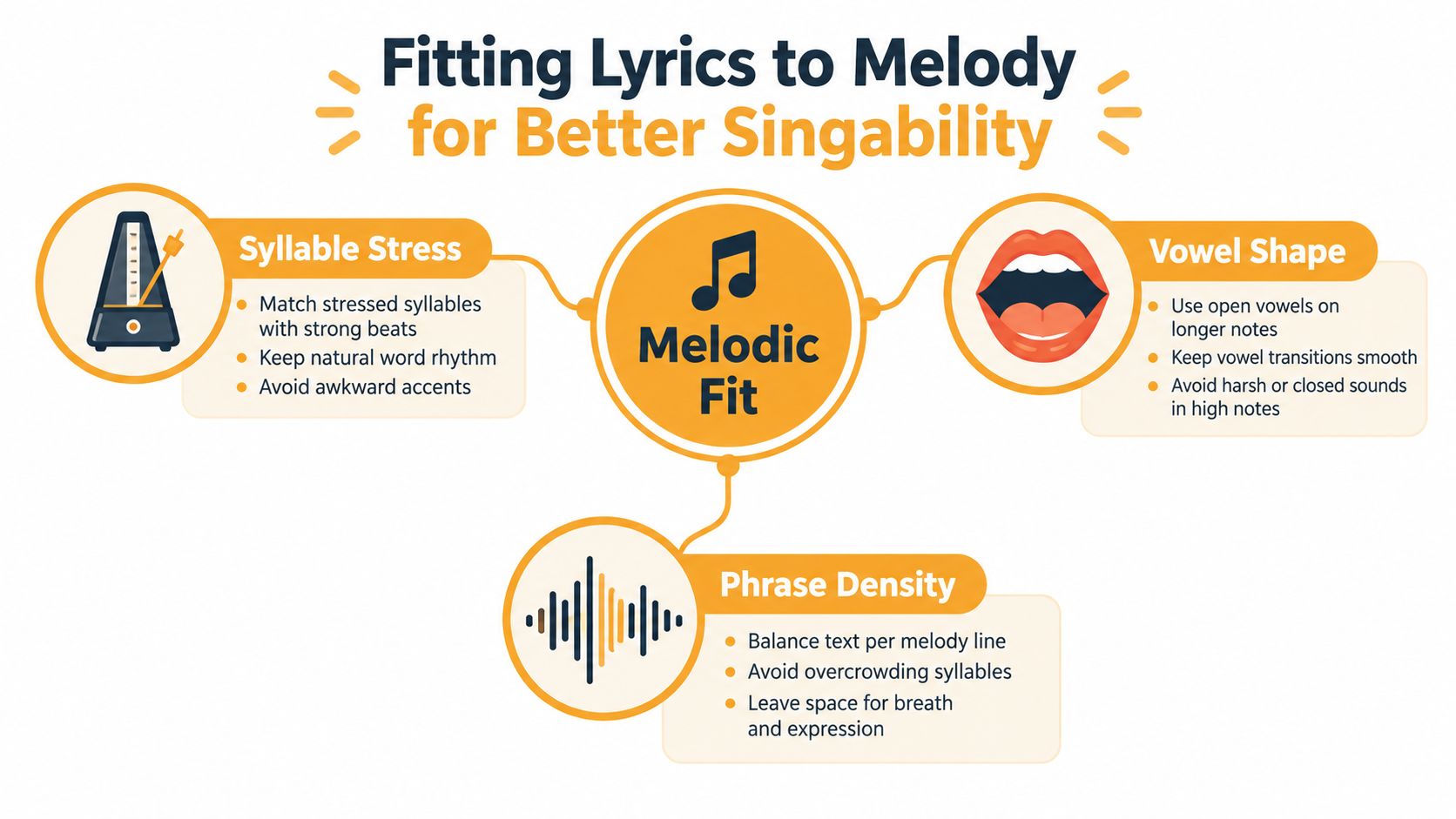
Begin by marking the melody's strongest beats. Tap the pulse, write down the syllables you naturally emphasize, and compare those stresses with the draft. Check note length, phrase length, and spacing as both parts develop. Those details determine whether a line feels intentional or crammed.
Match stress before counting syllables
Syllable count matters, but stress comes first. If the melody accents a weak syllable, a familiar word can sound unnatural or become harder to understand. Speak the line normally, then sing it. When the phrase forces an awkward pronunciation, change the word instead of making the singer fight the melody.
Vowel shape matters on sustained notes. Open vowels usually give a singer more room to hold pitch, while dense consonant clusters can interrupt the line. Place difficult vowels and consonant-heavy words carefully, especially at the song's emotional peak.
Phrase density creates a practical trade-off. More words carry more story; fewer words leave room for tone, breath, and audience participation. Draft the idea in prose, then compress it without removing the emotional turn. Keep the image that makes the line personal and cut explanation around it.
Test alternate hooks in short-form format
Short-form clips add a production constraint for many writers. The Berklee lyric-writing guide discusses testing chorus versions, considering BPM and short-video formats, and refining hooks around replay behavior. Use that advice to test delivery, not to flatten the writing.
Record several chorus options over the same backing track. Compare where the title lands, whether the first listen reveals the central idea, and whether the final word gives the singer a satisfying vowel or rhythmic release. If cutting syllables removes meaning, replace the whole phrase instead of shaving words randomly from its middle.
Keep an edit log for each version. Label the lyric that matches the approved melody, save the final wording separately from abandoned alternatives, and confirm the singer or artist has approved the exact text before distributing it. That record prevents a strong demo line from being replaced by an earlier draft during publishing or lyric management.
The song's structure should support the fit. This overview of song structure can help you decide whether the hook needs a pre-chorus lift, a repeated post-chorus, or a bridge that changes the lyric's emotional temperature.
Collaborating Effectively in Co-Writing Sessions
Solo writing gives you uninterrupted control over voice, subject, and revision. Co-writing gives you immediate counterarguments, alternate melodies, and language you may not have found alone. Neither method is automatically stronger. The right choice depends on whether the song needs privacy and concentration or friction and expansion.
A solo session works well when the material is highly personal or when the narrator's voice must remain consistent. A co-writing room helps when you've found the subject but not the hook, or when the track demands a rhythmic approach outside your usual habits. Set the song's brief before debating individual lines. Agree on the speaker, emotional destination, genre, and section that needs attention.

Protect the voice while sharing the draft
Bring your core concept into the room, but don't defend every first-choice word. Ask what the line is supposed to accomplish before deciding whether a suggestion works. A collaborator may replace an image you love because the syllables are crowded, or preserve a phrase you consider plain because it lands perfectly on the melody.
Cross-cultural collaboration needs extra care. Specific details can make a lyric credible, but unexplained local references may lose emotional clarity for listeners elsewhere. Don't erase every regional detail to make a song broadly legible. Instead, keep the detail that reveals character and support it with enough surrounding context that the feeling remains clear.
Recent songwriting commentary describes increasingly hybrid tracks built through regional rhythms, unexpected instruments, and rapid collaboration (SongCage songwriting guide). The useful lesson isn't to chase novelty. It's to ask whether the language belongs to the speaker and whether another performer could deliver it without turning it into a costume.
After the creative work, discuss credits while everyone still remembers who contributed what. Lyrics, melody, topline changes, title ideas, and production can overlap, so write down the agreed split and version date. Don't rely on a casual message several months later.
Watch this short session-focused video before your next room, then return to the draft with a clearer sense of how collaboration affects the finished performance.
Claiming and Verifying Artist-Approved Lyrics Online
Finishing the lyric file doesn't finish the public version. Fans, journalists, collaborators, and performers may encounter a lyric through search results or unofficial uploads, so the displayed words and credits need an accountable source.
House of Lyrics is an artist-run music and lyrics library that connects artist-approved lyrics with official video embeds. Its claim workflow lets artists and verified rights holders manage artist, album, and song pages through a verification process, rather than relying on open, unverified submissions.
Complete the ownership check
Use the House of Lyrics claim page to begin the process. The platform's stated workflow uses a one-time code placed in an X or SoundCloud bio to confirm that you control the relevant artist page. Once ownership is verified, you can work inside the page editor for lyrics, credits, and metadata.
The bio-code step is important because it ties the claim to a public account you control. It also creates a clearer record than an anonymous submission, especially when multiple people upload conflicting versions of a song. If you manage an artist's catalog, keep the account and page information consistent before starting the claim.
Review the canonical text before publication
The editor supports updates to lyrics and related metadata, with changes held for editorial review before they appear publicly. That pause gives you a chance to check spelling, line breaks, featured artists, songwriting credits, album placement, and the exact lyric version you intend to approve.
Official video embeds also give the song page a reliable audiovisual reference. Structured artist, album, and song pages help visitors move through the catalog without confusing a demo lyric, an alternate edit, or an outdated fan transcription with the approved text.
Think of public lyric management as version control. Keep your local master draft, record approved collaborators, and compare the page display against the final vocal before requesting an update. If the lyric changes after release, document why and submit the corrected version through the review flow rather than creating another competing copy elsewhere.
Final Checklist Before Publishing Your Lyrics
A lyric can sound strong in the room and still fail as a public record. Before sending it to a collaborator, distributor, publisher, or fan platform, check both the sung result and the catalog information.
Start with the listener's first encounter. Does the chorus reveal the central idea without explanation? Does the title arrive clearly? Can the singer reach the important words without rushing, swallowing consonants, or stressing the wrong syllable?
Run the performance check
Sing the full song at its intended tempo, then speak the lyric without music. Mark every breath problem, awkward consonant, changed word, or line that feels easier to sing differently. Those marks show where a lyrically good line may not yet be melody-ready.
- Hook clarity: Circle the phrase you want remembered. Confirm that each chorus supports it instead of competing with it.
- Narrative movement: State what each verse adds. Cut verses that only restate the chorus.
- Natural stress: Check that the melody emphasizes the syllables you would stress in speech.
- Vowel and breath fit: Hold sustained notes and test whether the vowel shapes remain comfortable.
- Language quality: Replace abstract labels, stale metaphors, filler, and forced rhymes that weaken the speaker's voice.
- Version control: Name the final file clearly. Keep the date, collaborators, and agreed credits with it.
Listen once without looking at the words. If the chorus feels vague, revise the hook before adding more poetic language. If the meaning disappears only in performance, reduce phrase density, adjust stress, or change vowel placement.
Verify the public record
Compare the approved lyric with the final vocal recording before publication. Check names, featured performers, writers, producers, album information, punctuation, and line breaks. The lyric is read as text and heard as performance, so small differences can affect comprehension and attribution.
Copyright history also explains why authorship records matter. Later reforms in the UK and U.S. extended protection for many works to the life of the author plus 70 years, as described in the Oxford Academic history cited earlier. Preserve writing records and agree on splits before conflicting versions appear.
Use an explicit finalization sequence: save the approved master, record the collaborators and credits, compare every line with the vocal, then submit the same version to the relevant artist page or platform. After publication, inspect the displayed lyric rather than assuming the upload preserved your line breaks.
Finally, claim the relevant artist page through its verification process, review the displayed lyric, and request corrections through the editorial workflow. House of Lyrics gives artists and verified rights holders a way to manage artist, album, and song pages, edit lyrics and metadata, and pair approved text with official video embeds. Visit House of Lyrics to claim your page and place the final lyric where fans and collaborators can find it.