Hand of God Lyrics: The Complete Song-by-Song Guide
Hand of God lyrics explained across every major recording. Find the right version, read verified text, and learn what each artist actually meant.

Type Hand of God lyrics into a search bar and a basic question turns messy fast. Which song do you mean. The grunge track, the pop-rap outro, the indie confessional, the worship song, or something else entirely?
That confusion isn't a minor indexing glitch. It's the story. “Hand of God” isn't one canonical composition with one agreed lyric sheet. It's a recurring song title that keeps reappearing across styles, eras, and audiences, which means any single page that treats one set of words as the answer is already flattening the record.
Table of Contents
- Why There Is No Single 'Hand of God' Song
- The 'Hand of God' Song Title Cluster Across Decades
- Comparing the Major 'Hand of God' Recordings
- Soundgarden 'Hand of God' Lyrics and Credits
- Jon Bellion 'Hand of God (Outro)' Lyrics and Meaning
- Emma Ruth Rundle 'Hand of God' Lyrics and Context
- Faith, Grief, and Metaphor Across the Lyrics
- Why Different Lyric Sites Disagree
- How House of Lyrics Fixes the Disambiguation Problem
- Quick Lookup for the Right 'Hand of God'
- Related Songs and Where to Go Next
Why There Is No Single 'Hand of God' Song
The first thing to get straight is simple. There is no universal “Hand of God” lyric. Search results for the phrase surface multiple unrelated songs, including versions associated with Soundgarden, Nick Cave, Jon Bellion, Gang of Youths, New Order, and others, according to a discussion of the title-cluster problem at SongMeanings' “Hand of God” entry.
That matters because title overlap invites false certainty. A reader searches for one song, lands on a page built for another, and comes away thinking the web can't agree on the words. In many cases, the web is answering different questions.
What readers are usually asking
Most “Hand of God lyrics” searches fall into one of these buckets:
- They know the artist already. They want the text for Soundgarden, Jon Bellion, Emma Ruth Rundle, or another specific recording.
- They know only the phrase. They remember “Hand of God” from a chorus, title card, playlist, or recommendation and need help identifying the artist.
- They want meaning, not transcription. They've seen several songs with the same title and want to know whether the phrase signals faith, irony, grief, or metaphor.
Practical rule: If a lyric page doesn't identify the artist and release clearly, treat it as provisional, not definitive.
Why the title keeps causing mix-ups
“Hand of God” is a phrase loaded with cultural weight. It can suggest providence, punishment, rescue, destiny, myth, guilt, or surrender. Songwriters in very different traditions keep returning to it because the title arrives with built-in tension.
The result is a song cluster, not a single song lineage. Shared wording doesn't mean shared melody, authorship, or message. It means separate artists found the same phrase useful for very different reasons.
The 'Hand of God' Song Title Cluster Across Decades
How many different songs can hide behind one search phrase?
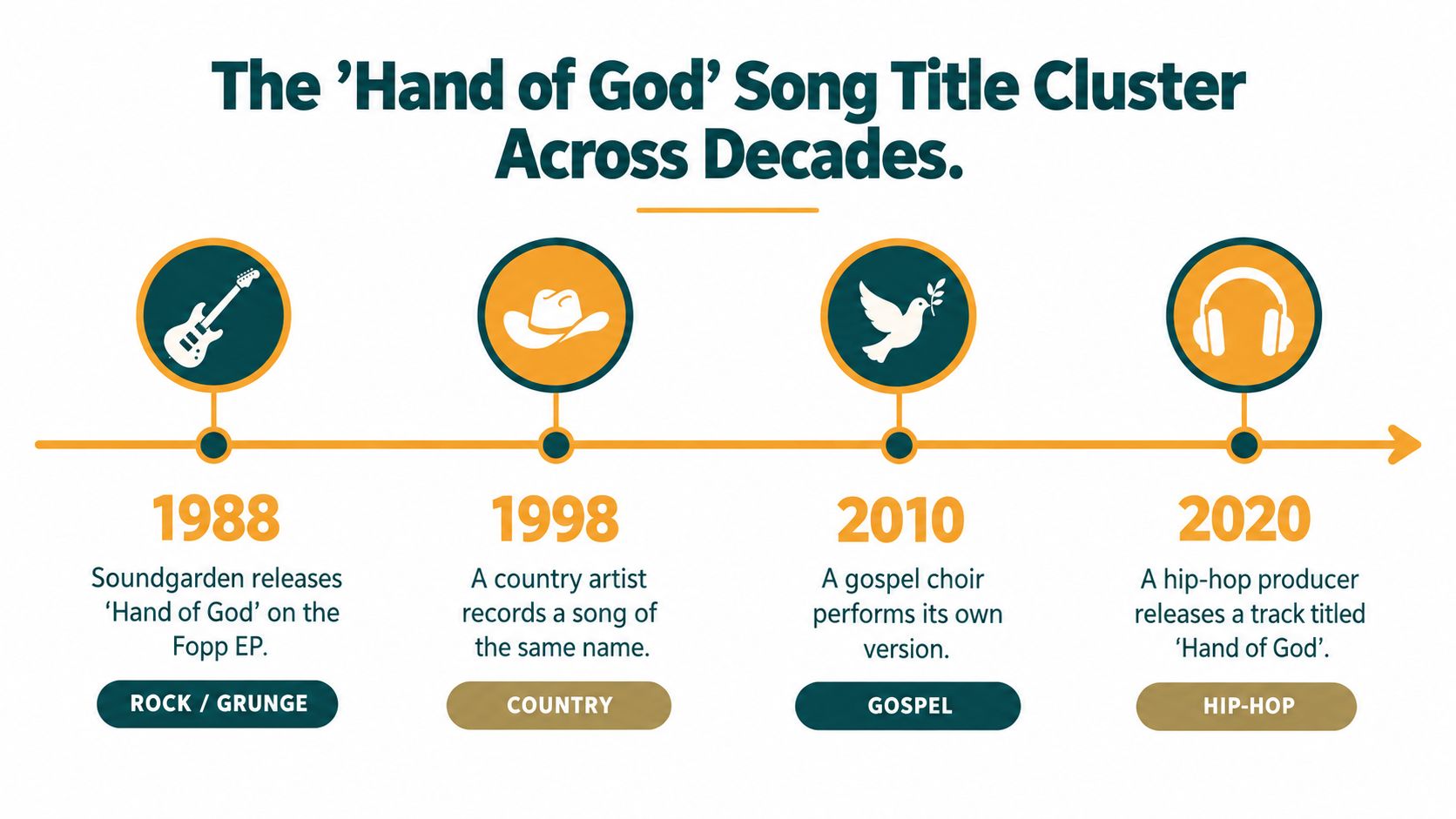
Quite a few, and the release trail matters. Soundgarden's "Hand of God" belongs to the band's late-1980s early catalog, documented on Genius' lyric page for the recording. Jon Bellion's "Hand of God (Outro)" appears on The Human Condition, while Emma Ruth Rundle's "Hand of God" appears on Marked for Death. A much later worship recording by Todd Galberth and Chandler Moore uses the same title again. Put those entries side by side and the phrase starts to look less like a single song and more like a recurring title that keeps resurfacing in different scenes.
One phrase, many scenes
The overlap is easy to see once genre enters the picture. Soundgarden sits in a guitar-driven lineage, so readers starting from that angle often need a rock lyrics archive and related rock catalog browsing. Bellion's version travels through pop and rap audiences. Rundle's reaches indie and gothic-folk listeners. Todd Galberth and Chandler Moore's title points toward contemporary worship.
Those are different audiences, different release contexts, and different lyrical expectations.
The 2016 collision
The title became especially crowded in 2016 because two widely indexed recordings arrived within the same year. Jon Bellion released "Hand of God (Outro)" as part of The Human Condition in June 2016, as listed in major album metadata for that release. Emma Ruth Rundle's "Hand of God" followed on Marked for Death in September 2016, according to Shazam's listing for Emma Ruth Rundle's "Hand of God". That proximity helps explain why lyric pages, search snippets, and user memory often blur the two, even though the songs come from separate albums and reach for different meanings.
A title can repeat across decades without carrying a shared message. That is the pattern here.
Comparing the Major 'Hand of God' Recordings
If you're trying to identify the right song quickly, the fastest method is to compare artist, release context, genre, and theme side by side. That's usually enough to separate a grunge-era recording from a modern outro or a worship track.
Major 'Hand of God' Recordings Compared
| Artist | Track | Album / Release | Year | Label | Genre | Theme |
|---|---|---|---|---|---|---|
| Soundgarden | Hand of God | standalone recording associated with the band's early catalog | 1987 | not reliably established here | rock / grunge | force, pressure, dark intensity |
| Jon Bellion | Hand of God (Outro) | The Human Condition | 2016 | not reliably established here | pop-rap / singer-songwriter | mortality, guilt, family, survival |
| Emma Ruth Rundle | Hand of God | Marked for Death | 2016 | Sargent House | indie / gothic-folk | grief, surrender, intimacy |
| Todd Galberth and Chandler Moore | Hand of God | later worship release | 2025 | not reliably established here | gospel / worship | literal praise, divine encounter |
| Various screen composers | Hand of God | cue or soundtrack usage under similar phrasing | varies | varies | soundtrack / score | dramatic or symbolic cueing |
How to separate them fast
A few tells usually solve the mystery:
- If the title includes “Outro,” you're almost certainly in Jon Bellion territory.
- If the release is tied to Marked for Death, it's Emma Ruth Rundle.
- If the mood is congregational or praise-centered, the search may be pulling a gospel or worship recording.
- If the texture is abrasive, loud, and early-alt oriented, Soundgarden is the likely match.
The phrase is shared. The recordings aren't.
Soundgarden 'Hand of God' Lyrics and Credits
For many rock listeners, Soundgarden is the earliest major stop in this title cluster.
The verified data places Soundgarden's “Hand of God” at October 1, 1987 in modern indexing, and that early date gives the song a special place in the cluster. It sits close to the period when the band's sound was becoming one of the defining voices of heavy Seattle rock.
Why this version still dominates rock searches
Soundgarden's title has longevity because it sounds foundational even before a listener checks the date. The phrase “Hand of God” in this setting doesn't arrive as soft reassurance. It lands with tension and threat. That's why so many later lyric searches still circle back to this recording first.
One lyric fragment often associated with this song is:
“See it coming down on me / It's never ending.”
Those lines fit the broader Soundgarden mode. Pressure, repetition, weight, and atmosphere matter as much as any doctrinal reading.
What to watch for in indexing
This is also the version most likely to be mistaken for a generic “classic rock” answer when a search engine can't tell which artist a user intended. That's useful if you were looking for Soundgarden. It's misleading if you were searching for Bellion or Rundle.
For listeners who want to hear the recording in context, the official upload route matters more than a stray lyric scrape.
Jon Bellion 'Hand of God (Outro)' Lyrics and Meaning
Jon Bellion's version is the one that pushed the phrase back into mainstream online lyric culture in the streaming era. Unlike the blunt finality of the Soundgarden title, “Hand of God (Outro)” arrives as a closing statement, reflective and exposed.
A title that sounds devotional but plays differently
The key mistake with Bellion is assuming the title guarantees a straightforward worship reading. It doesn't. The interpretive gap noted in a comparative meanings discussion at LyricsMeanings' Nick Cave “Hand of God” page helps here. The phrase can point to spiritual surrender in one song and to addiction, guilt, mortality, or parental reassurance in another.
Bellion's recording belongs in that second category. The divine wording functions less like a doctrinal claim and more like a frame for fear, survival, and responsibility.
Why listeners latch onto this one
Bellion's song carries the emotional mechanics of an outro. It gathers the album's tension and turns inward. Even readers who don't know the full lyric often remember the song as a confession addressed toward family and the future.
A commonly cited line from this track is:
“God help me, I'm living.”
That phrase explains a lot of the song's pull. It's not triumphant. It's exhausted, grateful, frightened, and still moving.
Another reason Bellion's version keeps surfacing is chronology. It appeared in the same year as Emma Ruth Rundle's unrelated song, so many searchers remember only the title and the year, not the artist. Once that context slips, the results page becomes a guessing game.
Emma Ruth Rundle 'Hand of God' Lyrics and Context
What are readers looking for when they search “Hand of God” in 2016: Jon Bellion's outro, or Emma Ruth Rundle's far more private song from the same year?
Rundle's recording sits in a different lane from the better-known rock and pop entries that share the title. According to the release information for Marked for Death at Discogs, “Hand of God” appears on the 2016 album released through Sargent House. That basic catalog detail matters because title-only searches often send listeners to the wrong lyric page.
A first-person use of the phrase
With Rundle, the title does not arrive as spectacle. It arrives as voice. The song's language is often read as inward, close-miked, and emotionally compressed, which fits the larger mood of Marked for Death.
A lyric fragment commonly associated with this recording is:
“I am the hand of God / Reaching out to you”
That line changes the phrase's function. In Soundgarden, the title can read as accusation or force. In Rundle's version, the speaker appears to inhabit the image directly. Depending on the listener, that can sound protective, burdened, devotional, or destabilized. The wording supports more than one reading, and the arrangement does not force a single answer.
Why this version is easy to confuse with others
Rundle's song gets misfiled for practical reasons as much as interpretive ones. The title matches Soundgarden's exactly, and its 2016 release date places it beside Bellion's unrelated “Hand of God (Outro)” in search results and database listings. Readers who remember only the phrase, not the artist or album, can easily land on the wrong lyrics.
That is the larger pattern with this title cluster. Rundle's “Hand of God” is not a hidden alternate take on someone else's song. It is a separate composition with its own credits, mood, and lyrical frame.
Faith, Grief, and Metaphor Across the Lyrics
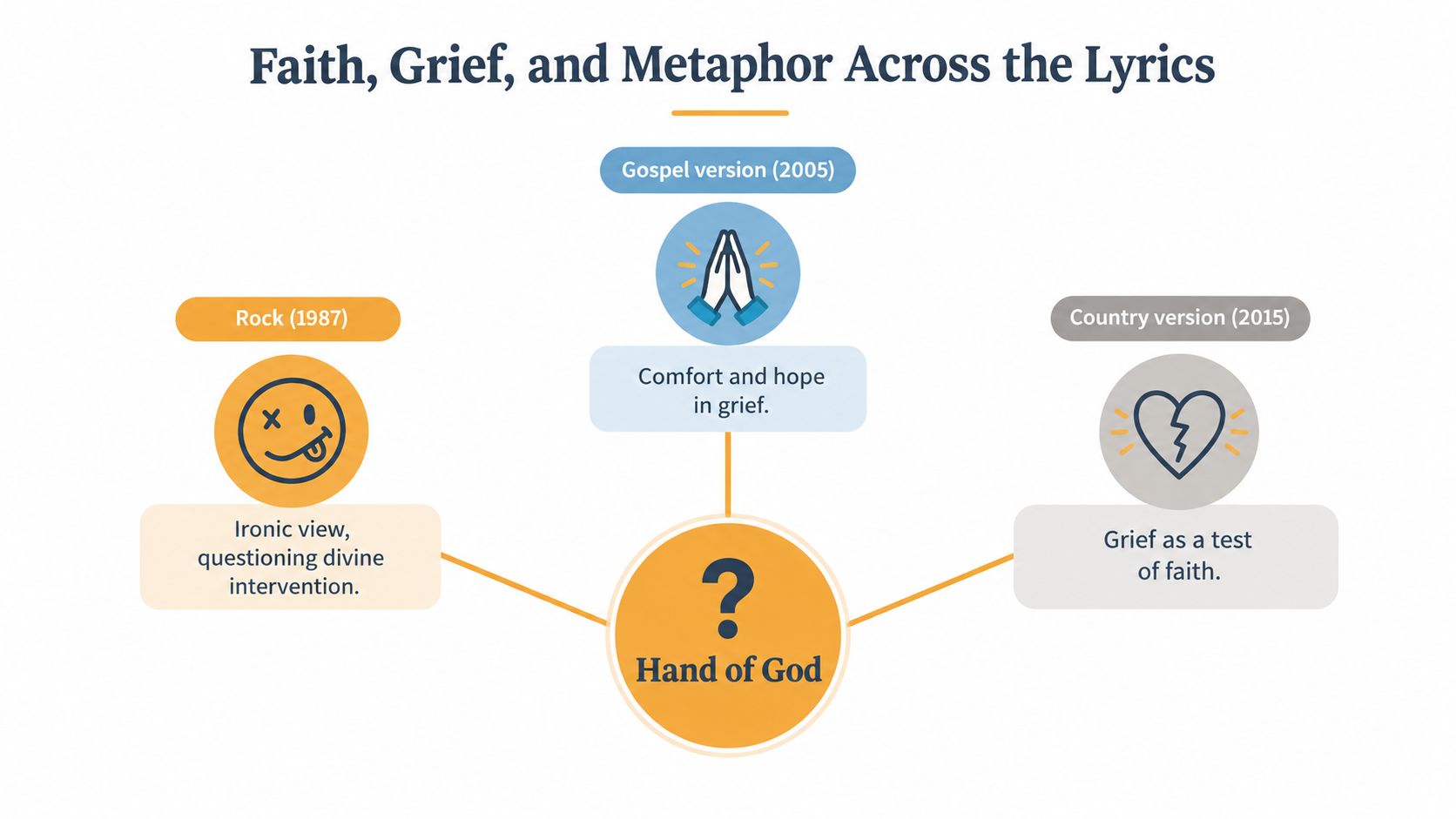
The most interesting thing about Hand of God lyrics isn't that artists reuse the phrase. It's that they don't mean the same thing by it.
Four recurring readings
Across the title cluster, the phrase tends to fall into a few broad interpretive lanes:
- Literal devotion. In worship settings, “Hand of God” often names divine comfort or intervention directly.
- Ironic self-mythologizing. In heavier rock contexts, the phrase can sound accusatory, theatrical, or destabilizing rather than reverent.
- Grief language. Some versions use the title to describe loss, pressure, or the force of events a speaker can't resist.
- Human metaphor. In other readings, the “hand” may stand in for a parent, rescuer, lover, or companion rather than a supernatural actor.
Why flattening the phrase misses the music
That spread is the major interpretive mistake in a lot of lyric explainers. They hear religious vocabulary and collapse everything into one spiritual message. But the title does different work depending on who sings it and how the lyric voice is framed.
A reader moving from Soundgarden to a worship version isn't tracking the same symbolic system. A reader moving from Bellion to Rundle isn't either. The shared phrase creates a bridge, but not a shared doctrine.
For a good example of how adjacent songs can send readers into interpretive overreach, compare this with another title-driven lyric reading in this take on “16 Shots” lyrics. The same lesson applies. A title can attract one assumption while the lyric underneath argues for another.
Some “Hand of God” songs pray. Some accuse. Some mourn. Some reach for another person and borrow sacred language to do it.
Why Different Lyric Sites Disagree
Most lyric-site disagreement starts with metadata, not with interpretation.
The strongest metadata model in music publishing separates works, recordings, and people through standard identifiers. ISWC identifies the musical work, ISRC identifies the sound recording, and contributor identifiers help distinguish rights holders across systems. Government guidance on music-streaming metadata also notes that authors' rights organizations and record labels are authoritative sources with limits, which is why a single source-of-truth metadata sheet is best practice before publication or licensing, according to the UK report's executive summary on music-streaming metadata.
Why Lyric Sites Disagree on 'Hand of God'
| Cause | Effect on Search Results |
|---|---|
| Shared title across unrelated artists | One page may rank for several songs at once |
| Missing version labels | “Outro,” live edits, and alternate versions get collapsed |
| Weak recording identifiers | A site may attach the wrong lyric to the right title |
| Community edits without rights review | Popular submissions can override accurate but less visible entries |
| Scraped pages built from fragments | Readers see incomplete or blended text |
The editorial layer matters
Metadata also needs structure. A music-video metadata checklist from Versus Media's guide to normalized music metadata argues for a normalized core record containing the official artist name, official title, version label, language, and release date, with rights contacts stored separately in a dedicated rights block. That sounds technical, but the user-facing consequence is plain. Without that separation, lyric pages become easier to mislabel and harder to correct.
Readers who want to understand why review standards matter on music pages will recognize the same issue in this explanation of editorial review. Titles collide. Records need gates.
How House of Lyrics Fixes the Disambiguation Problem
What should a lyric page do when "Hand of God" points to several unrelated songs instead of one answer?
House of Lyrics addresses that problem by treating a shared title as a cluster, then splitting the results by artist, release, and version label before a reader reaches the lyric text. That editorial choice matters here because Soundgarden's song, Jon Bellion's "Hand of God (Outro)," and Emma Ruth Rundle's "Hand of God" do not share a meaning, a sound, or a catalog context. They only share a title.
The page design follows that distinction. Artist name appears first. Release context stays attached to the song. Version labels are visible, not buried. Credits and related pages connect the lyric to the correct recording rather than to a loose search phrase. For a query this ambiguous, those details are the difference between identification and guesswork.
What a better lyric page needs
A useful title-cluster page usually includes:
- Clear artist labeling. Readers should know whose song they are viewing before the lyric begins.
- Release information. Album or project title, year, and version label help separate similarly named tracks.
- Editorial review tied to credits. Corrections need to attach to the right recording, not to every song with the same title.
- Cross-links between close matches. If a reader searched the wrong version, the page should present the other likely candidates.
That last point is easy to miss. Good lyric editing is not only about accurate transcription. It is also about directing the reader to the right song fast, especially when a recurring title keeps resurfacing across decades. The same cataloging logic appears on other ambiguous-title guides on the site, including the explainer on "All This Time" lyrics identification and version matching.
House of Lyrics does not treat "Hand of God" as one song with competing interpretations. It treats the phrase as a recurring title, then sorts the recordings so readers can decide which lyric they came for.
Quick Lookup for the Right 'Hand of God'
If you only need the right artist match, this grid is the fastest route.
Quick Lookup Match Your Search to the Right Hand of God
| If You Searched… | Artist | Song Title | Album / Release | Year | Genre |
|---|---|---|---|---|---|
| the grunge one | Soundgarden | Hand of God | early Soundgarden catalog | 1987 | rock / grunge |
| the outro from The Human Condition | Jon Bellion | Hand of God (Outro) | The Human Condition | 2016 | pop-rap |
| the Sargent House version | Emma Ruth Rundle | Hand of God | Marked for Death | 2016 | indie / gothic-folk |
| the worship version | Todd Galberth and Chandler Moore | Hand of God | later worship release | 2025 | gospel / worship |
| the post-hardcore one | Tiny Moving Parts | Hand of God Is Coming Soon | separate title variation | not established here | post-hardcore |
| the Kanye-related search result | Kanye West | Hand of God related interlude phrasing | separate usage context | not established here | hip-hop |
If you want to browse artist and song pages directly instead of gambling on a generic search result, start from the House of Lyrics home page.
Related Songs and Where to Go Next
The most rewarding way out of a title-cluster search isn't a recap. It's a listening path.
If Soundgarden is your entry point, stay with songs that carry the same charged intensity and lyrical abrasion. If Bellion is the version you meant, the rest of The Human Condition gives that outro its emotional frame. If Emma Ruth Rundle is the one you were chasing, her surrounding catalog deepens the same atmosphere of vulnerability, weight, and controlled distortion.
The side roads matter too. Nick Cave belongs in this conversation because his writing pushes the phrase toward spiritual and narrative ambiguity. Worship listeners may want the more literal devotional lane. Heavy and indie listeners usually want the opposite. The phrase holds because all of those paths remain open at once.
If you're tired of landing on the wrong “Hand of God,” House of Lyrics gives you a cleaner way to search by artist, album, and song page instead of a title alone. It pairs lyrics with official video embeds and supports verified artist-managed updates, which is exactly what recurring titles like this need.