A Mis Enemigos Letra: Valentín Elizalde Song Guide
A mis enemigos letra - Explore the lyrics and meaning of A Mis Enemigos by Valentín Elizalde. Find the full letra and understand the story behind this iconic
You're probably here because you searched for A Mis Enemigos letra, found the same lines copied across several websites, and still didn't get the answer you wanted. Is this really Valentín Elizalde's song? What do the place names mean? Why do so many pages give rough English translations but almost no cultural explanation?
That gap matters more than people think. A corrido isn't just a lyric sheet. It carries local identity, performance style, social tension, and authorship questions that can get flattened when the song is reduced to copy-pasted text. For a song as famous and as debated as “A Mis Enemigos,” context is part of the meaning.
Table of Contents
- Why This Reference Exists
- Valentin Elizalde and A Mis Enemigos
- Complete Lyrics with Cultural Annotations
- Album Placement and Official Credits
- Understanding Narcocorrido Context
- Why Verified Lyrics Matter
- How to Access Official Videos and Claim Pages
- What Makes This Reference Different
Why This Reference Exists
A lot of lyric searching follows the same frustrating pattern. You type in a title, click the first result, and get a wall of text with no songwriter credit, no release context, and no clue whether the words are official, fan-submitted, or machine-copied from somewhere else.
That problem gets worse with regional Mexican music. Songs circulate through live performance, compilation albums, re-uploads, and translation pages. By the time an international listener searches for A Mis Enemigos letra, they often land on a page that shows the words but strips away the song's history.
What usually goes wrong
Three problems show up again and again:
- Duplicated lyric text without attribution, so readers can't tell who supplied it.
- Weak translations that preserve line order but miss tone, slang, and regional references.
- No credit layer for the songwriter, recording context, or official catalog placement.
For this song, those missing pieces matter. The named places, the confrontational closing lines, and the singer's public image all shape how listeners understand the track.
Practical rule: A trustworthy lyrics page should tell you who wrote the song, how it's cataloged, and whether the text comes from a verified rights holder.
What a better reference looks like
A strong song reference doesn't stop at transcription. It brings together the lyric text, credits, release identity, and cultural annotation in one place. That's especially important when a song sits inside a genre that many outsiders misunderstand.
Readers searching this song usually want more than one thing at once:
- The Spanish lyric text.
- A plain-English explanation of key phrases.
- Context for names like Navojoa and Guasave.
- Clarity on whether the song is discussed as a corrido or narcocorrido.
- Reliable credits and ownership information.
When those elements live together, the song becomes legible to both longtime fans and first-time listeners.
Why verification matters
Artist-approved and rights-holder-reviewed pages help solve a basic trust problem. If the web is full of unattributed lyric copies, the safest path is a page where text, credits, and media are connected to verified ownership rather than anonymous upload habits.
That's purpose of a reference like this one. It doesn't just help you sing along. It helps you understand what you're singing, who created it, and why the song still carries weight.
Valentin Elizalde and A Mis Enemigos
Valentín Elizalde remains one of the most recognizable voices in regional Mexican music from the 2000s. Part of his staying power comes from how fully he inhabited the corrido tradition. His performances projected confidence, local pride, and public defiance, all qualities that made certain songs feel larger than radio singles.
“A Mis Enemigos” became one of the clearest examples of that image.

Apple Music lists the song in Elizalde's catalog, with one version appearing on Vencedor De Colección, and another listing showing an August 19, 2003 release date for a Banda Carnaval and Valentín Elizalde collaboration entry. The track is credited to Francisco Lira. That catalog trail matters because it places the song within Elizalde's final era of commercial visibility and confirms that the title belongs to a documented release history, not just oral circulation across fan pages and uploads, as shown in Apple Music's song listing for “A Mis Enemigos”.
Why this song lasted
Many corridos are remembered by specialists or loyal genre fans. This one traveled further. Its language is direct, its posture is unmistakable, and its final address “to all my enemies” gave listeners a phrase they could instantly remember and quote.
That memorable quality comes from a few overlapping traits:
- Public bravado: the speaker doesn't sound private or reflective. He sounds performative, almost ceremonial.
- Regional grounding: references tied to Sonora and Sinaloa help the song feel rooted rather than generic.
- Confrontational framing: the song doesn't hint at rivalry. It names it.
These features helped attach the track to Elizalde's larger persona. The song didn't exist in his catalog. It reinforced the character audiences associated with him.
More than a diss track
International readers sometimes approach songs like this expecting a straightforward enemy anthem. That's too narrow. In regional Mexican music, especially corrido traditions, boasting often serves several functions at once. It can assert dignity, answer gossip, defend reputation, and mark belonging to a place or community.
The emotional force of the song comes from its mixture of warning and pride, not from threats alone.
That distinction helps explain why the track still circulates in lyric archives and music services long after its initial release cycle. Listeners aren't only searching it to decode conflict. They're also returning to a performance of identity.
Complete Lyrics with Cultural Annotations
Most pages that rank for A Mis Enemigos letra give you one of two things. Either they paste the Spanish text with no explanation, or they offer a stiff translation that drains the song of tone. Neither option helps much if you want to understand why the lyrics stuck in people's memory.
Before the annotations, one caution matters. Because lyric copies vary widely across the web, readers should treat unattributed text carefully and compare it against artist-approved or rights-holder-controlled sources whenever possible. A contextual guide is most useful when it stays close to verified text and clearly separates literal meaning from interpretation.
How to read the lyric language
This song works through repeated gestures of self-definition. The singer presents himself as someone shaped by work, loyalty, place, and confrontation. That means even a short phrase can carry more cultural meaning than a literal translation suggests.
Here are the lines and ideas that usually confuse non-native listeners the most.
| Spanish Phrase | Literal Meaning | Cultural Context |
|---|---|---|
| A mis enemigos | To my enemies | A direct dedication. It frames the whole song as a public address to rivals. |
| Que sigan ladrando los perros | Let the dogs keep barking | A dismissive image. In everyday interpretation, barking suggests noisy critics who can complain but can't alter the speaker's course. |
| Navojoa | Navojoa | A city reference that anchors the song in Sonoran identity and signals local belonging rather than abstract pride. |
| Guasave | Guasave | A Sinaloan place name that extends the song's regional map and ties it to a northern Mexican social world listeners recognize immediately. |
| Envidia | Envy | Not just jealousy in a casual sense. In many songs, it points to social resentment aimed at visible success, reputation, or toughness. |
| Familia | Family | A core honor term. It signals loyalty, origin, and moral grounding even inside a confrontational narrative. |
Why place names matter
When the song references Navojoa and Guasave, it isn't decorating the lyric with random geography. Those names make the singer sound local, situated, and known. In corridos, that's powerful. A named place can function almost like testimony. It says the speaker belongs somewhere real.
That's one reason generic English translations often fail. They can carry over the place name, but they rarely explain what the place does inside the song.
For readers who like close lyric interpretation in other genres too, the editorial approach used in guides such as this annotated lyric article on “16 Shots” shows how much context can change your reading of familiar lines.
The barking dogs image
The line about dogs barking became memorable because it compresses a whole attitude into one image. Critics make noise. The singer remains standing. The phrase isn't subtle, and it isn't supposed to be. Its force lies in how quickly listeners understand the hierarchy it creates.
A good annotation doesn't replace the lyric. It restores the social meaning the lyric already carries.
Literal meaning and performed meaning
A beginner often asks, “Is the singer describing his life exactly, or is he performing a role?” In corridos, that question doesn't always have a neat answer. The voice can feel autobiographical and theatrical at the same time.
That's why the song resonates beyond a word-for-word reading. The speaker's defiance matters, but so does the ritual of saying it aloud in public. The lyric becomes a statement of endurance, pride, and refusal to be shamed by enemies or envy.
Album Placement and Official Credits
When people discuss a song online, they often mix together three separate things: the composition, the recording, and the release where they encountered it. For casual listening, that confusion may not seem serious. For rights, royalties, and accurate cataloging, it matters a lot.
Work versus recording
The cleanest way to organize a song professionally is to separate the musical work from any specific recording of it. Industry metadata practice treats ISWC as the identifier for the composition, including lyrics and melody, while ISRC identifies a specific sound or video recording. That distinction is essential because one song can exist in multiple recordings, edits, or remixes while still remaining one underlying work, as explained in this overview of metadata hygiene for global royalties.
For “A Mis Enemigos,” that separation helps explain why you may see different listings attached to the same song title.
Official metadata for A Mis Enemigos
| Field | Value | Source |
|---|---|---|
| Song title | A Mis Enemigos | Apple Music listing |
| Performing artist | Valentín Elizalde | Apple Music listing |
| Songwriter credit | Francisco Lira | Apple Music listing |
| Catalog appearance | Vencedor De Colección | Apple Music listing |
| Another documented listing | Banda Carnaval and Valentín Elizalde collaboration entry | Apple Music listing |
| Documented release date on that listing | August 19, 2003 | Apple Music listing |
Why credits need consistency
Songwriter data isn't just a courtesy line. It's part of the infrastructure that keeps a catalog legible. When legal-name credits, publisher ownership fields, and composition splits are inconsistent, downstream systems can struggle to match works correctly.
For musicians, managers, and label staff, the lesson is simple:
- Keep writer names consistent across releases and lyric pages.
- Separate the work from the recording in your records.
- Preserve source attribution when publishing lyrics or credits publicly.
If you read music metadata closely, you'll notice that lyric interpretation pages and technical credit pages serve different needs. A page like this song analysis entry on “Body Electric” works as a useful contrast because it shows how editorial writing and catalog reference can complement each other without becoming the same thing.
Understanding Narcocorrido Context
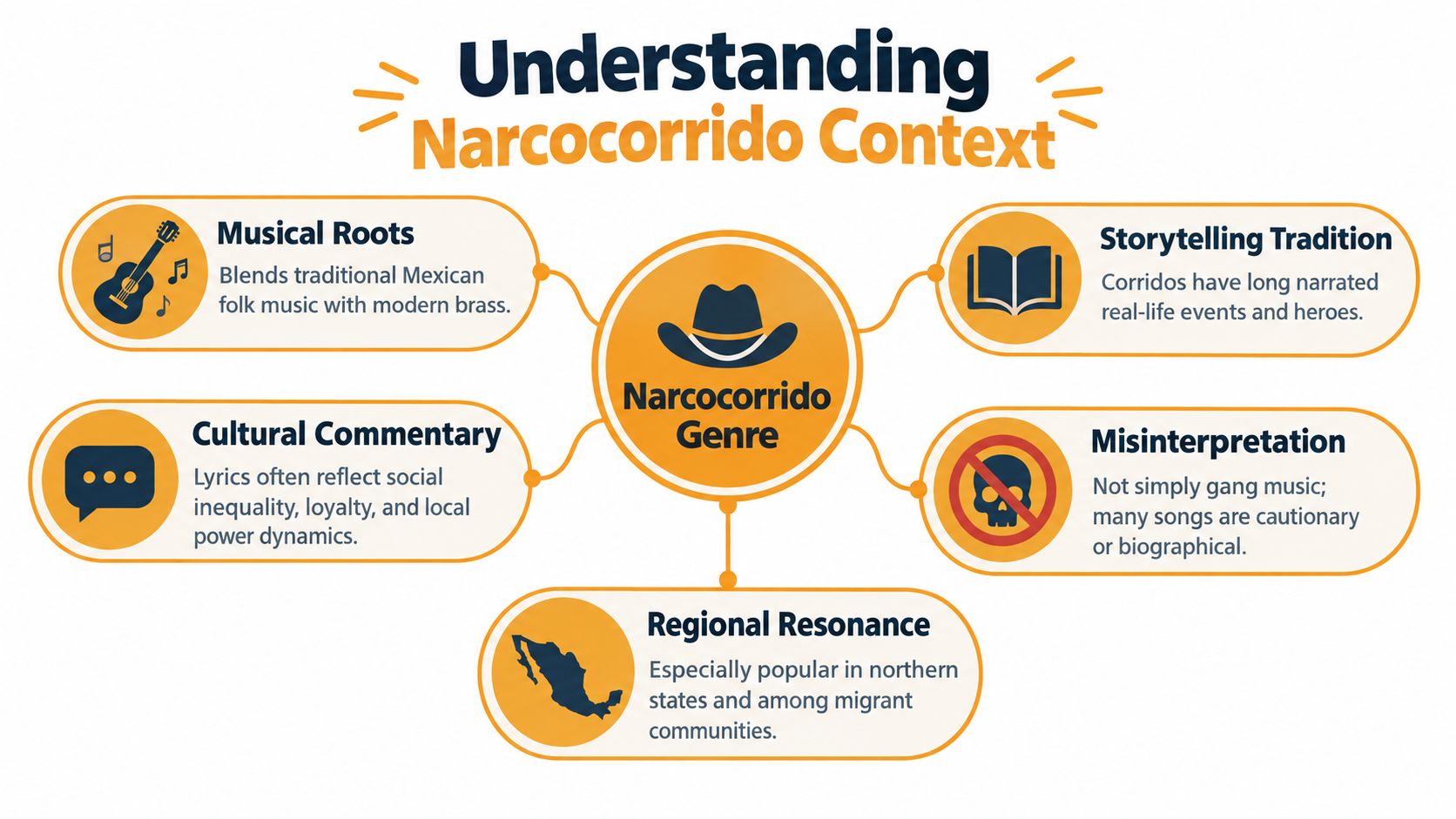
Outside Mexico, narcocorrido often gets flattened into a crude label. People hear the term and assume every song in that orbit exists only to glorify criminal life. That reading misses how corridos function as storytelling forms, local memory, social commentary, and identity performance.
The genre is descriptive as well as performative
Corridos have long narrated events, reputations, rivalries, and regional heroes. In the narcocorrido context, that narrative habit moved into the era of organized crime. The result is a body of songs that can sound celebratory, cautionary, autobiographical, mythic, or strategic depending on who performs them and how audiences hear them.
That doesn't erase the danger surrounding the genre. It just means the music can't be understood by one moral shortcut.
Many listeners need two kinds of literacy at once. Musical literacy for the corrido tradition, and historical literacy for the violence surrounding some of its subjects.
Why this song became so controversial
A 2022 Infobae report says “A Mis Enemigos” was allegedly dedicated to Joaquín “El Chapo” Guzmán, founder of the Sinaloa Cartel, and links the song to the violent context surrounding Elizalde's career in later public memory. The same report matters because it places the track inside broader debates about narcocorridos as real-time commentary on organized crime rather than treating it as an isolated curiosity. You can read that account in Infobae's article on the controversy around “A Mis Enemigos”.
Many readers get stuck. They want a yes-or-no answer. Is it autobiography? Is it propaganda? Is it performance persona? In practice, songs like this often live in the tension between those categories.
Regional identity still matters
The song's references to work, family, and named northern places are important because they keep the lyric grounded in community language, not just notoriety. That grounding is part of why the track resonated with listeners who may not have approached it primarily through cartel discourse.
If you're exploring how this fits inside a wider musical context, the broader category page for Latin music genres and styles offers a useful map for situating corridos alongside other traditions.
A narcocorrido can be controversial and culturally significant at the same time. That's the only honest way to read a song like this.
Why Verified Lyrics Matter
A lyric page becomes unreliable fast when nobody can tell who supplied the text. That problem isn't minor. It affects fans, journalists, translators, and rights holders differently, but they all run into the same underlying issue: unattributed words travel farther than verified ones.
Accuracy starts with ownership
Rights-safe lyric publishing depends on authoritative metadata handoff rather than open, unverified crowd input. In the standards world, DDEX MEAD is used to send enrichment data such as lyrics, bios, images, and focus-track information alongside release metadata, while MWDR standardizes rights communication for musical works in licensing contexts. That framework is explained in this breakdown of DDEX metadata standards and enrichment workflows.
For readers, the takeaway is simple. The closer a lyrics page is to verified ownership and structured metadata, the lower the risk of mistranscription, mismatched credits, or later disputes.
What verification changes in practice
When a platform limits page control to verified artists or rights holders, a few useful things happen:
- Impersonation risk drops because random users can't overwrite public lyrics.
- Credit fields stay cleaner because the editor works from ownership-backed information.
- Takedown conflicts become less frequent when provenance is clear from the start.
House of Lyrics follows that model by allowing artists and verified rights holders to claim and manage artist, album, and song pages through a controlled review workflow instead of anonymous crowdsourcing.
Verified lyrics aren't only about legal caution. They preserve artistic meaning.
That matters for a song like “A Mis Enemigos,” where one mistranslated phrase can turn regional bravado into nonsense, or strip a place reference of the identity it carries.
Why this matters beyond lyrics pages
The same readers who care about official lyrics often need adjacent rights information. For creators searching for legal-use audio options for video, podcasts, or background scoring, a practical companion resource is this guide on how to find copyright-free music with LesFM.
If you want to understand how review and approval workflows support lyric accuracy before edits go live, this explainer on editorial review for music pages gives the operational side of that process.
Verified text doesn't remove interpretation. It gives interpretation a stable foundation.
How to Access Official Videos and Claim Pages
Sometimes the fastest way to verify a song page is to see whether it connects lyrics, credits, and official audiovisual material instead of leaving each element scattered across the web. A clean song reference should let listeners move from text to trusted media without guessing which upload is canonical.
For listeners
If you're browsing song pages, look for these signals:
- Official video embeds tied directly to the song page, not random user-uploaded clips.
- Linked artist and album pages so the song sits inside a visible catalog structure.
- Visible credits and lyric attribution instead of an anonymous text dump.
That setup helps when a song exists in more than one release context or circulates under similar titles.
For artists and rights holders
The claim workflow is meant to prove page control without relying only on email. A rights holder places a one-time verification code in an X or SoundCloud bio, confirms ownership, and then gets access to page editing tools. From there, they can update lyrics, credits, metadata, and connected pages, with changes held for review before public publication.
The practical sequence usually looks like this:
- Find the relevant artist, album, or song page in the public index.
- Start the claim process.
- Complete the ownership check using the one-time bio code.
- Open the page editor and submit updates.
- Wait for review before the revisions appear live.
If you want to compare how a song-specific article can connect readers back into a broader page ecosystem, this example guide on “All This Time” lyrics shows that kind of navigation in action.
Why official video access matters
Lyrics don't live alone. Performance, arrangement, pacing, and visual framing all change how a song lands. An official embed helps listeners hear the song in its intended presentation rather than through a low-quality repost that may strip away context or alter audience perception.
For a track with as much cultural and historical weight as “A Mis Enemigos,” that connection between text and official media is part of responsible documentation.
What Makes This Reference Different
Most lyric pages answer the smallest possible question. They tell you what words appear in what order. That's useful, but it isn't enough for a song like “A Mis Enemigos.”
What readers usually need is a layered reference. They want the lyric, the cultural framing, the official credits, and a way to separate speculation from documented catalog facts. Without that mix, the song gets flattened into either a mystery or a stereotype.
The missing middle
The web is full of extremes. One page gives bare text. Another gives sensational backstory with little care for authorship or meaning. The missing middle is a page that can do both of these jobs:
- Preserve the lyric accurately
- Explain the song responsibly
That second task is where cultural annotation matters most. A place name isn't just a place name. A barking-dogs line isn't just an insult. A dedication to enemies isn't just aggression. In corrido language, each of those carries social weight.
One song, several audiences
A strong reference serves more than one kind of reader at once:
| Reader | What they need |
|---|---|
| Fan | Accurate lyrics and a clear sense of what the memorable lines mean |
| New listener | Cultural orientation without needing prior knowledge of regional Mexican music |
| Journalist | Attributed credits and careful handling of contested narratives |
| Rights holder | Clean metadata, ownership clarity, and control over public presentation |
That combination is what generic lyric databases often miss. They assume everyone wants the same thing. In reality, one person is trying to sing along, another is writing about genre history, and another is checking whether the songwriter credit has been preserved.
Why this song deserves that treatment
“A Mis Enemigos” remains compelling because it sits at the crossroads of performance, place, controversy, and memory. It's part of regional Mexican music history, but it's also part of a larger conversation about how songs survive online after their original release moment passes.
When a page combines verified text, contextual notes, official credits, and rights-aware presentation, it does more than organize information. It protects meaning from distortion.
If you care about songs like “A Mis Enemigos” in their full context, House of Lyrics offers artist-approved lyrics, official video connections, and catalog pages that keep credits and meaning tied together. Visit it to explore verified song pages, compare versions, and read lyrics with the context they deserve.